

Variegated Cactus Plants
Written with AI assistance, edited and checked against horticultural sources.
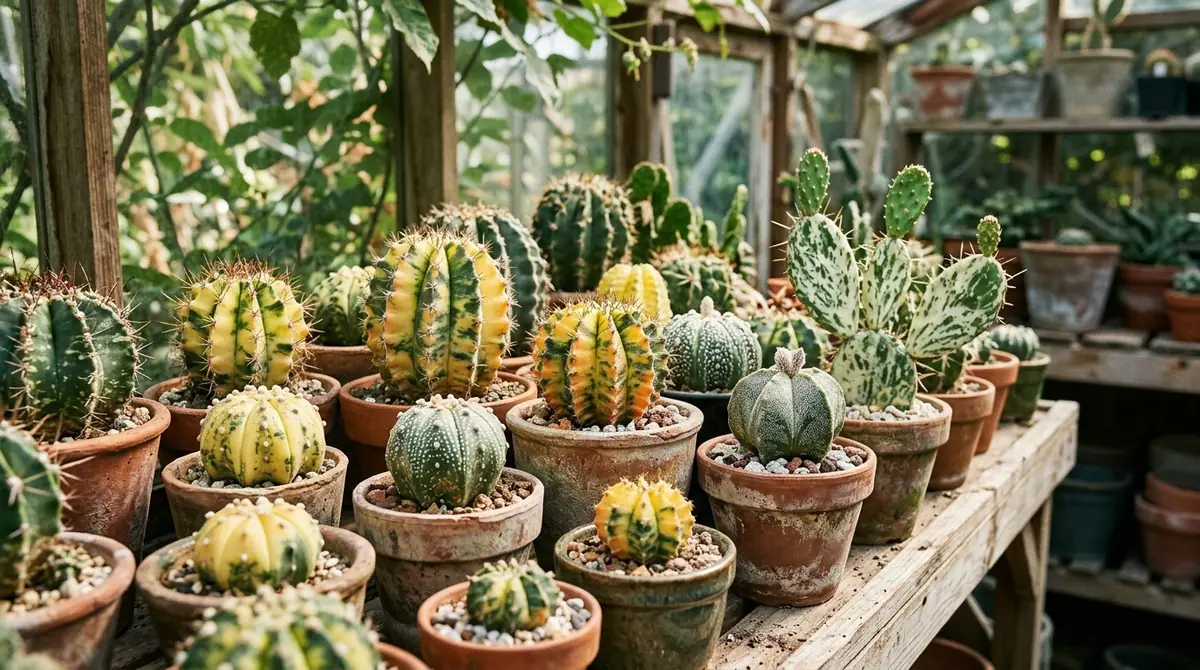
A mutant Gymnocalycium mihanovichii pup that emerges stark, neon yellow from its green parent stem lacks chlorophyll entirely as a genetic ghost. Severing it too early causes starvation in days, while leaving it too long allows the parent to crush its vascular ring, making the delicate balance between cellular survival and striking aesthetic mutation in growing variegated cactus plants the ultimate test for any modern interior or arid landscape designer.

1. Botanical Overview & Natural Habitat
Variegation in cacti occurs through a few distinct biological mechanisms. Most commonly, it is a genetic mutation that affects chloroplast development, resulting in chimeras where mutant, non-green tissue grows alongside normal, green photosynthetic tissue. In other instances, it is caused by stable genetic shifts or transient viral infections. Because these striking creams, yellows, and pinks lack the chlorophyll necessary to convert light into energy via photosynthesis, variegated cactus plants rely entirely on the remaining green portions of their bodies to feed the whole organism.
In their native habitats—ranging from the high-altitude deserts of South America to the arid scrublands of Mexico—completely all-white or all-yellow cacti rarely survive. Intense, unfiltered desert sun scorches unpigmented tissue instantly, and slower growth rates leave wild mutants vulnerable to predation and competition. Consequently, the variegated specimens we cultivate in greenhouses and homes are the product of selective human propagation. Cultivars like Astrophytum ornatum 'Variegata', Mammillaria bocasana 'Multiceps Variegata', and the famous Gymnocalycium mihanovichii var. friedrichii (often grafted onto a green rootstock like Hylocereus) represent pinnacle achievements in horticultural selection.
For landscape designers operating in milder climates, factoring in regional hardiness is essential. For instance, if you are designing an outdoor arid installation wondering What Zone is San Diego for Plants, you will find that many variegated cacti can thrive outdoors year-round, provided they receive afternoon shade. Conversely, if your project sits on the East Coast and you are evaluating What Zone is Virginia for Plants, these sensitive mutations must be kept in containers and brought indoors before freezing autumn temperatures arrive.
2. Essential Environmental & Care Requirements
Growing variegated cactus plants successfully requires replicating an environment that offers high light intensity without the destructive thermal extremes that scorch vulnerable tissues. Because they possess less chlorophyll, they burn much faster than their all-green counterparts.
| Parameter | Optimal Condition | Common Mistake | Why It Matters |
|---|---|---|---|
| Light | 4 to 6 hours of bright, indirect to filtered morning sun (2,000 to 4,000 foot-candles) | Placing directly in harsh, unshaded midday summer sun | Lack of chlorophyll causes unpigmented cells to scald, forming permanent necrotic black patches. |
| Temperature | 70°F to 85°F (21°C to 29°C) active growing season; 50°F to 55°F (10°C to 13°C) winter dormancy | Exposing to sudden drafts or temperatures below 45°F (7°C) | Sudden thermal shock disrupts delicate vascular transport in chimeric tissues, leading to rot. |
| Soil Mix | 50% inorganic grit (pumice, perlite, coarse turface) and 50% low-organic cactus loam | Using dense, moisture-retaining potting soil with high peat content | Retained moisture suffocates roots, inviting opportunistic fungal pathogens like Phytophthora. |
| Watering | Soak-and-dry method: water deeply only when the soil is 100% dry down to 3 inches (7.6 cm) | Giving small, frequent sips of water | Encourages shallow root development and leaves lower soil zones permanently damp. |
Beyond light and water, airflow is a critical component often overlooked by indoor growers. Stagnant air combined with damp soil creates a breeding ground for mealybugs and fungal spores, which target the stressed, slow-growing cells of variegated specimens. Ensure your indoor setup utilizes a small oscillating fan on low speed for a few hours daily to mimic natural desert breezes.
💡 Pro-Tip: When assessing your variegated cactus for light levels, look at the color intensity. If the yellow or pink streaks start turning a bleached, translucent white, your plant is receiving too much ultraviolet radiation and is beginning to burn. Move it a few feet back or introduce a 30% shade cloth immediately.
3. Step-by-Step Cultivation, Feeding & Propagation
Cultivating variegated cacti demands a methodical approach, particularly when you move past basic care into propagation. Because many stunningly bright mutations lack enough chlorophyll to support their own root systems independently, mastering specialized techniques like grafting is vital.
| Parameter | Optimal Target |
|---|---|
| Fertilizer Ratio | Low-nitrogen, high-potassium formula (e.g., 5-10-10 or specialized cactus fertilizer) |
| Feeding Frequency | Once every 30 days during active spring and summer growth |
| Propagation Cut Depth | Minimum 0.5 inches (1.3 cm) above vascular ring for offsets; exact alignment for flat grafts |
| Callus Formation Time | 7 to 14 days in a dry, shaded area |
Step-by-Step Propagation via Flat Grafting
- Sterilize Your Instruments: Wipe a sharp scalpel or razor blade with 70% isopropyl alcohol to prevent transmitting pathogens to the exposed plant tissues.
- Select Rootstock and Scion: Choose a vigorous, well-rooted green rootstock—such as Hylocereus undatus or Eriocereus jusbertii—and a healthy variegated offset (scion) that is at least 0.75 inches (1.9 cm) wide.
- Make the Cuts: Slice the top off the rootstock at a clean horizontal angle, then trim the edges of the rootstock cylinder at a 45-degree angle to prevent the skin from shrinking away from the center as it dries. Make a matching horizontal cut across the base of your variegated scion.
- Align the Vascular Rings: Locate the dark green circular vascular bundles (the ring of nutrient-carrying tubes) on both the rootstock and the scion. Press them together so that their rings intersect at least at one point. Perfect concentric alignment is not mandatory, but intersection is critical for vascular fusion.
- Secure the Union: Place rubber bands or specialized grafting twine over the scion, running it down under the pot rim to apply gentle, constant downward pressure for 7 to 10 days.
- Post-Grafting Recovery: Keep the newly grafted plant in a warm, humid-controlled, shaded area at 75°F to 80°F (24°C to 27°C) for 14 days until the vascular tissues permanently knit together. Remove the rubber bands carefully after 14 days.
For home gardeners expanding their collections to outdoor beds, matching companion plants is just as important as the propagation technique. If you are designing a mixed-climate container or bed, you might look at companion strategies similar to those used when evaluating Zucchini Companion Plants Good Bad, ensuring that aggressive growers do not crowd out your slow-growing, sensitive variegated specimens. Similarly, if you are planning an edible garden layout alongside your ornamental succulents, understanding regional timing—such as knowing When to Plant Tomato Plants in California—helps you establish a well-rounded, seasonally responsive garden design.
4. Common Problems, Pests & Troubleshooting
Even experienced growers encounter setbacks with variegated cacti because their genetic mutations make them inherently more delicate than standard green species.
- Stem Rot and Mushy Bases: Caused by overwatering or poorly draining soil. If the base turns translucent yellow-brown and soft to the touch, immediately slice away all infected tissue above the rot line using a sterilized blade. Dust the remaining healthy top with sulfur powder, allow it to callous for 14 days, and reroot it.
- Sunscald and Necrosis: Appears as dry, papery, dark brown or black patches on the sun-facing side of the plant. While this damage is permanent, moving the plant to a spot with filtered light prevents further spreading.
- Reversion: Sometimes a variegated cactus will suddenly produce a completely green branch or pup. Because green tissue produces vastly more energy than variegated tissue, it will quickly dominate the plant's resources. Use a sterile razor blade to excise the green growth entirely at its point of origin to preserve the mutation.
- Mealybugs and Scale: These sap-sucking pests love the tender, nutrient-rich new growth of variegated cacti. Treat infestations immediately by dabbing pests with a cotton swab soaked in 70% isopropyl alcohol, or apply a systemic insecticidal soap designed for succulents according to the manufacturer's instructions.
⚠️ Important Caution: Never use standard heavy-duty horticultural oils or systemic chemical treatments containing high concentrations of petroleum distillates on variegated cacti. Their weakened epidermal layers cannot process these harsh chemicals, which often results in catastrophic chemical burns and total plant collapse.

5. Frequently Asked Questions
Why is my variegated cactus turning completely green?
This phenomenon is known as reversion. The fast-growing, chlorophyll-dense green cells are outcompeting the slow-growing variegated cells for resources. To save the mutation, you must use a sterilized blade to cut away any solid green stems or pups right where they emerge from the main body.
Can variegated cactus plants grow in total shade?
No. While variegated plants burn easily in intense sun, they still require significant light to survive. Because their white, yellow, or pink sections lack chlorophyll, the remaining green patches must work twice as hard. Place them in bright, indirect light or filtered morning sun—roughly 2,000 to 4,000 foot-candles—to maintain a healthy energy balance.
Do variegated cacti need special fertilizer?
They benefit from a low-nitrogen, high-potassium fertilizer diluted to half strength, applied once a month during their active growing season (spring through summer). Avoid high-nitrogen fertilizers; excess nitrogen forces rapid, weak growth that is exceptionally vulnerable to rot and pest infestations in chimeric tissues.
How do I know if my variegated cactus is rotting from the root up?
Check the lower stem for discoloration, softness, or a translucent, water-soaked appearance. If the plant wobbles easily in its soil mix or fails to take up water after a deep soaking, unpot it immediately. Trim away black, mushy roots back to firm, white or light-tan tissue, allow the plant to dry for 10 days, and replant it in fresh, dry grit mix.
Related Guides
📋 Table of Contents ▼ Click to expand
Tags:
Keep reading
🌿 Related Plants You Might Like


PlantSavvyWorld
Editorial team
PlantSavvyWorld is an independent botanical education project. Articles are drafted with AI assistance, then edited and checked against university extension services, botanical garden collections and other published horticultural sources.