

Variegated Gymnocalycium
Written with AI assistance, edited and checked against horticultural sources.
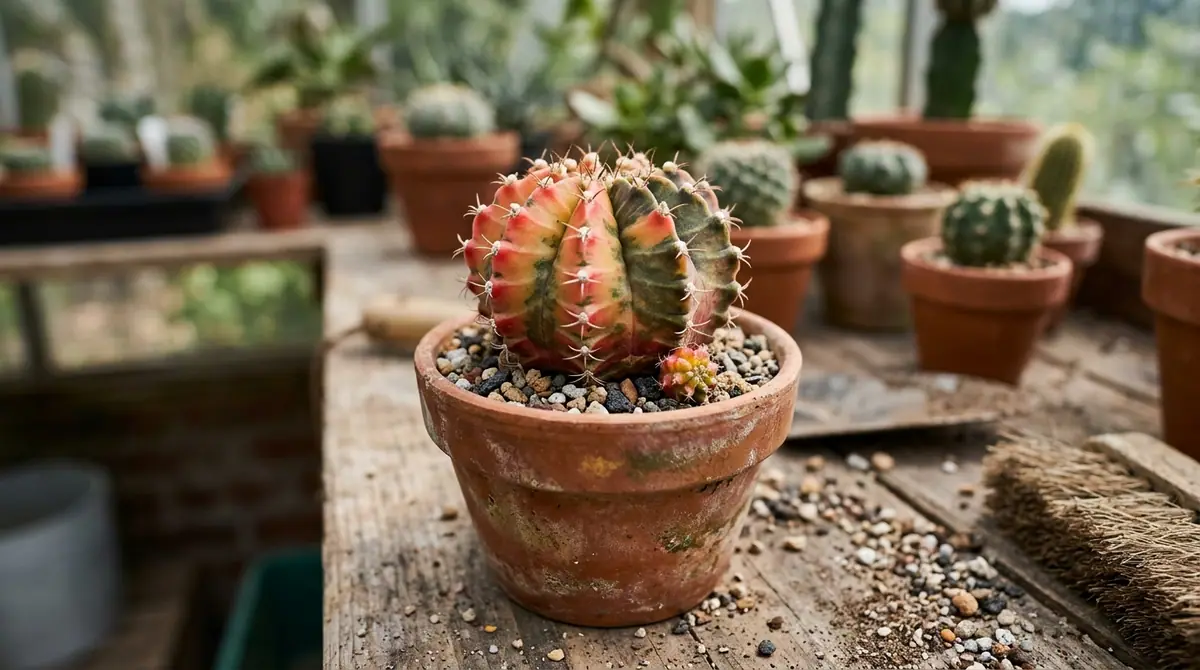
A Gymnocalycium mihanovichii var. friedrichii 'Nishiki' can throw a terrifying, neon-magenta offset during winter dormancy when the mercury drops to 45°F (7.2°C). Although the lack of chlorophyll in bright pink sectors threatens the scion, mastering this delicate physiological balance turns these marbled anomalies into the absolute crown jewels of any indoor collection.
1. Botanical Overview & Natural Habitat

Variegated specimens, particularly mutations like Gymnocalycium mihanovichii var. friedrichii (often called the Moon Cactus), are characterized by genetic somatic mutations that block chlorophyll synthesis in specific cellular layers. This genetic disruption results in stunning splashes, sectors, or complete takeovers of yellow, red, orange, and hot pink pigments driven by carotenoids and betalains.
Because these mutant tissues lack chlorophyll entirely, true full-variegation (all-pink or all-yellow seedlings) cannot photosynthesize independently and will perish within 14 to 21 days of exhausting their endosperm if grown on their own roots. Consequently, viable variegated Gymnocalycium plants either retain enough green chloroplastic tissue to survive on their own roots (root-grown or "own-root" variegates) or must be grafted onto a vigorous, fully green rootstock—most commonly Hylocereus undatus or Eriocereus jusbertii—which acts as an organic life support system, pumping water and sugars up to the scion.
| Parameter | Optimal Condition | Common Mistake | Why It Matters |
|---|---|---|---|
| Light Exposure | Bright, indirect light (2,500–4,000 foot-candles) | Direct, unshielded afternoon sun | Lacks chlorophyll; fragile tissues scorch and burn rapidly. |
| Temperature Range | 70°F–85°F (21°C–29°C) active; 50°F–55°F (10°C–13°C) dormant | Exposure to freezing temps below 35°F (1.6°C) | High water content in grafted stocks causes immediate cell rupture when frozen. |
| Soil pH | Slightly acidic to neutral (6.0–6.8) | Highly alkaline, heavy limestone soils | Locks out iron and micronutrients, causing chlorosis in remaining green sectors. |
| Watering Frequency | Completely dry soil between waterings (every 10–14 days in summer) | Keeping soil constantly moist | Triggers rapid, fatal root and vascular rot at the graft union. |
2. Essential Environmental & Care Requirements
Creating a thriving microclimate for variegated Gymnocalycium requires balancing their natural subtropical needs with their altered physiological vulnerabilities.
Light Requirements
In their natural habitat, standard Gymnocalycium species appreciate light shade. Variegated cultivars demand even more protection. Provide them with 4 to 6 hours of bright, indirect sunlight daily, or place them under commercial LED grow lights emitting roughly 2,500 to 4,000 foot-candles. East-facing windowsills or filtered southern exposures behind a 30% shade cloth are ideal. If the red or yellow pigments begin to wash out and turn pale, the plant is receiving too little light; if you notice brown, papery, sunken patches, move the plant away from the light source immediately.
Temperature and Air Circulation
Maintain daytime temperatures between 70°F and 85°F (21°C and 29°C). During the winter rest period—lasting roughly 90 days from November through February—drop temperatures to between 50°F and 55°F (10°C and 13°C) to induce dormancy. Good air circulation is non-negotiable; stagnant, humid air invites fungal spores to settle on the vulnerable, juicy tissues of the plant. A small oscillating fan running on low speed for a few hours daily in your indoor growing space will dramatically reduce fungal outbreaks.
💡 Pro-Tip: When using artificial grow lights, keep your variegated Gymnocalycium at least 12 to 18 inches (30 to 45 cm) away from high-intensity diode panels. The concentrated thermal radiation can easily cook the delicate pigments on the south-facing side of the cactus before you notice visual signs of burning.
Substrate and Potting Mix
Standard cactus soil mixes from big-box stores are usually too organic and retain moisture far too long. Formulate a custom inorganic-heavy substrate containing 70% to 80% mineral components and no more than 20% organic matter. Combine coarse horticultural pumice, expanded shale, and decomposed granite (sized 1/8 inch to 1/4 inch) with a small amount of sifted organic compost or coco coir. This ensures rapid drainage and mimics the rocky, porous soils documented in botanical surveys by institutions like the Royal Botanic Gardens, Kew.
3. Step-by-Step Cultivation, Feeding & Propagation
Growing variegated Gymnocalycium successfully—especially grafted specimens—requires meticulous attention to root health and hydration timing.
Watering Protocol
Water your plants deeply until liquid runs out of the drainage holes, but only when the potting medium is 100% dry to a depth of 2 inches (5 cm). In the peak of summer, this usually translates to every 10 to 14 days. In winter, reduce watering to once every 4 to 6 weeks just to keep the rootstock from shriveling entirely. Never let water pool in the apex of the cactus or around the graft union, as this is the primary entry point for basal rot.
Fertilization
Because variegated plants grow slower than their all-green counterparts, they require minimal feeding. Apply a balanced, low-nitrogen, high-potassium liquid cactus fertilizer (such as a 5-10-10 or 2-7-7 formulation) diluted to one-quarter strength. Feed only once every 4 weeks during the active growing season (April through August). Cease all fertilization completely during the fall and winter dormancy periods.
Step-by-Step Propagation Sequence
Propagating variegated Gymnocalycium depends heavily on whether your plant is an own-root specimen producing offsets or a grafted plant. For grafted varieties, offsets (pups) that possess some green coloration can sometimes be rooted on their own, while fully colorful or all-pink pups must be grafted onto a new rootstock. Here is the professional protocol for flat-grafting a variegated pup onto a Hylocereus rootstock:
- Select and Sterilize: Sterilize a sharp, thin grafting knife or razor blade using 70% isopropyl alcohol. Choose a healthy, plump variegated offset at least 0.5 inches (1.3 cm) in diameter and a vigorous, freshly rooted Hylocereus or Eriocereus rootstock measuring 4 to 6 inches (10 to 15 cm) tall.
- Make the Cuts: Slice horizontally across the top third of the rootstock, removing the growing tip. Immediately slice a 45-degree bevel around the top rim of the rootstock to prevent the skin from shrinking away from the center as it dries. Make a clean, single-stroke horizontal cut across the base of your variegated scion.
- Align the Vascular Rings: Locate the vascular ring—the small, dark circle or dotted ring of transport tissue in the center of both the scion and the rootstock. Carefully place the scion onto the rootstock so that their vascular rings intersect at least at one point. This intersection is critical; without vascular contact, the scion cannot receive nutrients.
- Secure the Graft: Apply downward and slightly twisting pressure to press out any trapped air bubbles. Secure the scion in place using clean rubber bands or floral tape stretched gently down over the apex of the scion and anchored beneath the base of the rootstock pot.
- Cure and Heal: Place the newly grafted plant in a warm (75°F–80°F / 24°C–26°C), humid, shaded environment out of direct airflow for 7 to 10 days. Do not water during this curing window. Remove the rubber bands gently after 14 days, and resume normal, cautious watering once the union is completely calloused and fused.
⚠️ Important Caution: Never use dull blades when grafting cacti. A crushing, jagged cut destroys the delicate vascular bundles in both the scion and the rootstock, preventing cellular fusion and resulting in immediate rot and failure of the graft.
4. Common Problems, Pests & Troubleshooting
Even with careful management, variegated cacti can run into physiological and pathological issues. Early intervention is critical to saving the plant.
Root and Stem Rot
Root rot usually presents as a sudden yellowing, softening, or translucent mushiness at the base of the rootstock or right at the graft union. If rot originates in the rootstock, you can often decapitate the rotting roots, carve away the infected tissue until you hit clean, white-green flesh, let the remaining healthy stem callous for 7 days, and re-root it. However, if rot has migrated upward into the variegated scion, the plant is rarely salvageable. Adjust your soil mix to include more inorganic grit if you encounter root rot more than once.
Pests
Variegated Gymnocalycium are frequently targeted by sap-sucking insects, particularly mealybugs and red spider mites. Mealybugs hide in the dense, woolly areoles between the ribs, leaving white, cottony secretions. Spider mites thrive in dry, warm indoor environments, leaving a fine, dusty webbing across the plant and causing the colorful skin to turn a dull, rusty brown. Treat mealybugs by dabbing them directly with a cotton swab soaked in 70% isopropyl alcohol. For spider mites, wash the plant thoroughly with a gentle stream of water, followed by an application of horticultural insecticidal soap or neem oil, ensuring you test the oil on a small area first to verify it does not burn the sensitive variegated skin.
Reversion

5. Frequently Asked Questions
Can you grow a variegated gymnocalycium on its own roots?
Yes, but only if the plant or offset contains enough green chlorophyll to sustain its own metabolic processes. Fully pink, red, or yellow own-root specimens lack chlorophyll entirely and cannot survive independently. They must be grafted onto a green rootstock or they will starve to death within weeks.
Why is my variegated gymnocalycium turning white or translucent?
This is a classic sign of severe sunburn or photo-oxidation. Because variegated tissues lack protective pigments and sufficient chlorophyll, direct, intense sunlight destroys their cellular structure, turning the flesh bleached-white, soft, and translucent. Move the plant immediately to a location with bright, indirect light or filtered shade.
How often should I repot a grafted variegated gymnocalycium?
Repot every 2 to 3 years, preferably in the early spring just as new growth begins. Grafted plants rely heavily on the rootstock's vigor, and the root system of a standard Hylocereus or Eriocereus fills a pot quickly. Use a slightly larger pot—only 1 inch (2.5 cm) wider than the previous container—and refresh the mineral-heavy potting mix.
Why is the rootstock of my grafted moon cactus turning yellow and shriveling?
The rootstock (Hylocereus, often dragon fruit cactus) has a shorter lifespan than the Gymnocalycium scion and naturally degrades or becomes woody over time. It can also fail due to overwatering, underwatering, or natural aging. If the rootstock collapses, you will need to perform an emergency re-grafting procedure by cutting away the dead rootstock and grafting the healthy scion onto a fresh, vigorous rootstock.
Related Guides
📋 Table of Contents ▼ Click to expand
Tags:
Keep reading
🌿 Related Plants You Might Like

PlantSavvyWorld
Editorial team
PlantSavvyWorld is an independent botanical education project. Articles are drafted with AI assistance, then edited and checked against university extension services, botanical garden collections and other published horticultural sources.