
Variegated Plumeria
Written with AI assistance, edited and checked against horticultural sources.
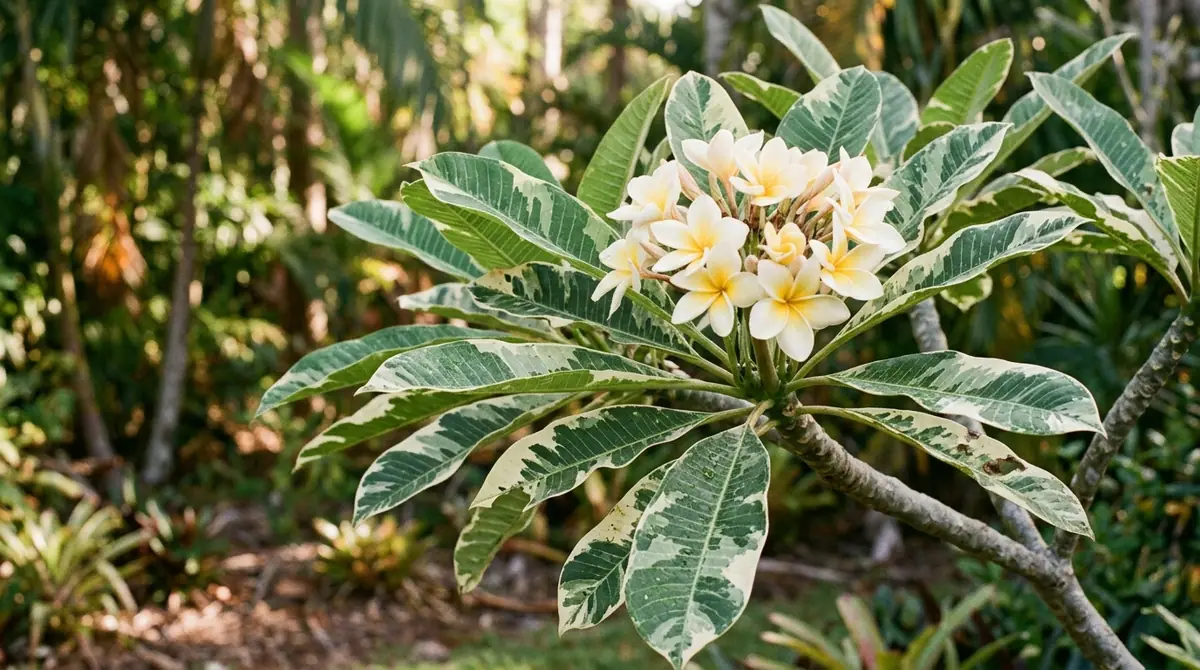
Stepping into a greenhouse in early June three summers ago, the morning light hit a newly imported ‘Celadine Variegata’ cutting at an exact forty-five-degree angle, making its cream-margined foliage look like stained glass. I had waited eighteen months for that flush, watching a sluggish root system struggle under the lower photosynthetic capacity inherent to chimeric variegation. That moment captured everything I love and caution people about when growing variegated plumeria: they are breathtaking botanical sculptures that demand an entirely different level of horticultural discipline than their solid-green cousins.

1. Botanical Overview & Natural Habitat
Variegated plumerias belong to the genus Plumeria (most commonly derived from Plumeria rubra or Plumeria obtusa), falling within the family Apocynaceae. Native to Central America, Mexico, the Caribbean, and South America, wild plumerias thrive in tropical, deciduous forests where they experience distinct wet and monsoon-like dry seasons.
The variegation you see on specialty cultivars—such as 'Lemon Swirl', 'Variegated Singapore', or 'Strawberries and Cream'—is a genetic mutation affecting chlorophyll production. Unlike standard green-leaved plumerias, variegated specimens exhibit sectorial or periclinal chimeras. This means certain cell layers lack the genetic instructions to produce normal chloroplasts, resulting in white, cream, or yellow margins, stripes, or speckles.
Because chlorophyll is the primary pigment responsible for harvesting light energy via photosynthesis, variegated cultivars inherently possess less photosynthetic machinery per square inch of leaf surface than all-green varieties. Consequently, their cellular metabolic rate is slower, growth is typically more compact, and tissue is exceptionally sensitive to environmental stressors like photo-oxidation (sunburn) and root hypoxia.
2. Essential Environmental & Care Requirements
Growing variegated plumeria successfully requires balancing their tropical heritage with their compromised energy-production capabilities.
Light exposure is your primary balancing act. While standard plumerias demand baking in unshaded, glaring sunlight, variegated forms require 6 to 8 hours of bright, filtered light or morning sun paired with afternoon protection. If exposed to intense, direct overhead sun when temperatures exceed 90°F (32°C), the lack of protective chlorophyll in the white or yellow leaf zones leaves those cells vulnerable to severe scorching and necrosis.
Temperature management is equally critical. Plumerias are strictly tropical to sub-tropical plants. They thrive when ambient temperatures range between 75°F and 90°F (24°C to 32°C). Growth stalls entirely below 60°F (15°C), and permanent cell damage occurs if exposed to frost or freezing temperatures below 32°F (0°C).
Soil structure dictates root health. In their native habitats, they anchor into porous, rocky, volcanic soils where water drains away almost instantly. You must replicate this aerated profile. For further reading on soil physics and container media structure, consult the University of Florida IFAS Extension.
| Parameter | Optimal Condition | Common Mistake | Why It Matters |
|---|---|---|---|
| Light | 6–8 hours bright filtered or morning sun | Full blazing midday desert sun | White/cream leaf tissue lacks chlorophyll and burns instantly under high UV/heat. |
| Temperature | 75°F–90°F (24°C–32°C) | Exposing to drafts or below 50°F (10°C) | Triggers premature dormancy and root shock in sensitive chimeric tissue. |
| Soil pH | 6.5 to 7.0 (Slightly acidic to neutral) | Heavy, dense clay or native garden dirt | Induces root rot (Phytophthora) and suffocates delicate root hairs. |
| Watering | Soak-and-dry method; dry to 3 inches (7 cm) | Keeping soil constantly damp | Variegated roots have lower metabolic demand; excess water breeds fungal pathogens. |
💡 Pro-Tip: When designing a landscape or patio layout, place your variegated plumeria where it receives gentle eastern morning light and is shielded by taller canopy plants or shade cloth during the brutal 1:00 PM to 4:00 PM solar window. This single placement adjustment eliminates 80% of leaf scorch issues.
3. Step-by-Step Cultivation, Feeding & Propagation
Propagation of variegated plumeria must be done vegetatively via stem cuttings or air layering. Planting seeds from a variegated parent will almost never yield a variegated offspring due to the unstable nature of chimeric mutations passing through sexual reproduction.
Step-by-Step Propagation Protocol
- Select Scion Material: In mid-spring when the plant is actively waking up, select a healthy, semi-hardwood stem tip measuring 10 to 14 inches (25 to 35 cm) long that clearly exhibits strong variegation patterns.
- Make the Cut: Using a sterilized razor blade or pruning shears cleaned with 70% isopropyl alcohol, make a clean, 45-degree angle cut to maximize the surface area for rooting hormone absorption.
- Calus Formation: Dip the freshly cut end in powdered rooting hormone containing indole-3-butyric acid (IBA). Place the cutting in a shaded, well-ventilated area for 7 to 14 days to allow the milky white latex sap to dry and form a thick, protective callus. This prevents bacterial rot upon planting.
- Potting Up: Plant the callused cutting 3 inches (7 cm) deep into a pre-moistened, sterile rooting mix consisting of equal parts perlite and coarse horticultural sand. Avoid organic compost at this stage.
- Bottom Heat and Moisture: Place the container on a horticultural heating mat calibrated to maintain a soil temperature of 78°F to 82°F (25°C to 28°C). Water sparingly—only mist the surrounding medium—until root initials form, which typically takes 30 to 45 days.
When fertilizing established plants, use a balanced, low-nitrogen, high-phosphorus water-soluble fertilizer (such as a 10-30-10 or 11-35-15 formula) applied at half-strength every 14 days during the active growing season (May through August). High nitrogen forces lush, all-green vegetative growth that can outpace and eventually revert the variegated chimeric tissue back to solid green.
⚠️ Important Caution: Never use standard garden soil or topsoil in containers for plumerias. Standard garden dirt compacts rapidly, eliminates air pore space, and retains perched water tables that will rot the succulent root system within 72 hours. For official horticultural guidelines on container media management, visit the Royal Horticultural Society.
4. Common Problems, Pests & Troubleshooting
Growing chimeric plants means managing unique physiological reactions alongside standard pest pressures.
Leaf Reversion: If you notice a branch suddenly pushing out completely solid green leaves, you are experiencing cellular reversion. The all-green mutation out-competes the slower-growing variegated cells. You must prune this branch back immediately to the main trunk or to a node showing active variegation to save the cultivar's pattern.
Tip Dieback and Stem Rot: Soft, squishy stems usually indicate overwatering or fungal pathogens like Botryosphaeria or Phytophthora. Cut away the rotting tissue using a sterilized blade until you hit pristine white wood with no brown discoloration, then apply a copper-based fungicide to the wound.

5. Frequently Asked Questions
Why are the white edges of my variegated plumeria turning brown and crispy?
Brown, crispy margins are almost always caused by a combination of high light intensity, low humidity, or erratic watering. Because the white areas lack chlorophyll, they cannot process intense heat and light the way green tissue does. Move the plant to a location with bright, filtered light and ensure your watering schedule keeps the root zone consistently moist without becoming waterlogged.
Can I grow variegated plumeria indoors year-round?
Yes, but it is challenging. Variegated plumerias require massive amounts of light. Indoors, they must be placed directly in a south-facing window or under high-output LED grow lights for 12 to 14 hours daily. Without intense light indoors, they will drop their leaves, weaken, and become highly susceptible to root rot during their winter rest period.
How do I stop my variegated plumeria from turning completely green?
Reversion happens when environmental stress or excess nitrogen triggers the dominant green cells to take over the plant's growth points. To halt reversion, prune out any solid green branches immediately down to their origin point on the main trunk, reduce your nitrogen fertilizer applications, and ensure the plant is receiving optimal light levels.
When should I bring my potted variegated plumeria indoors for the winter?
You must bring your plumeria indoors or into a frost-free greenhouse before nighttime temperatures drop consistently below 50°F (10°C). Once temperatures fall into the 40s (°F), plumerias naturally drop their leaves and enter dormancy. Reduce watering to near zero once dormancy sets in, as the plant requires almost no moisture when leafless.
Related Guides
- Variegated Gymnocalycium
- Variegated Cactus Plants
- Variegated Cactus
- Variegated Hosta
- Rooting Plumeria Cuttings
📋 Table of Contents ▼ Click to expand
Tags:
Keep reading
🌿 Related Plants You Might Like

PlantSavvyWorld
Editorial team
PlantSavvyWorld is an independent botanical education project. Articles are drafted with AI assistance, then edited and checked against university extension services, botanical garden collections and other published horticultural sources.