

Plumeria Potting Mix
Written with AI assistance, edited and checked against horticultural sources.
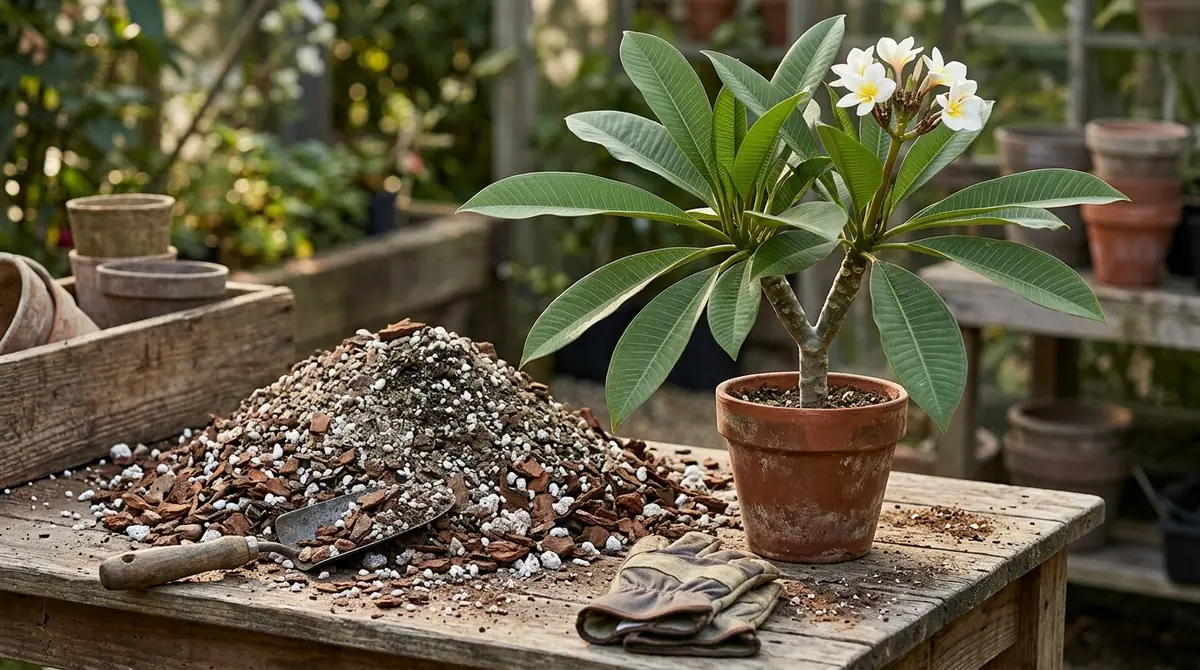
I still vividly remember the morning I lost my favorite Plumeria rubra 'Celadine' to root rot. It was the summer of 2014, and heavy, relentless rains had turned my carefully curated patio pots into soggy death traps. When I tugged on the trunk to check for stability, the entire plant slid effortlessly out of the soil, revealing a mass of blackened, decaying roots that sloughed off in my hands. That painful botanical failure taught me a lesson I have never forgotten: with plumerias, success or sudden death lives entirely beneath the soil line. Today, I view the plumeria potting mix not merely as a medium for anchorage, but as a complex life-support system that must precisely mimic the volcanic, sharply drained slopes of Central America. Let us engineer that ideal subterranean environment together.
1. Botanical Overview & Natural Habitat

Understanding this evolutionary background is the key to mastering their cultivation in containers. Plumerias are xerophytic-leaning tropicals; their thick, succulent stems and branches are specifically designed to store water during prolonged dry spells, while their root systems are structurally intolerant of prolonged saturation. When you cage a plumeria in a standard peat-heavy potting soil, you create a microscopic swamp that completely suffocates the root hairs, triggering anaerobic conditions and fatal fungal pathogens like Phytophthora and Pythium.
Botanically, plumeria roots lack root hairs in the traditional sense of many herbaceous plants; instead, they rely on mycorrhizal associations and large, fleshy roots that demand continuous oxygen exchange. A proper plumeria potting mix must possess macro-porosity—large air spaces between soil particles—that allows atmospheric oxygen to penetrate deep into the container while allowing excess water to rush out the drainage holes within seconds of irrigation.
| Parameter | Optimal Condition | Common Mistake | Why It Matters |
|---|---|---|---|
| pH Range | 6.5 to 7.0 (Slightly acidic to neutral) | Using heavily alkaline or acidic peat-only soils | Locks out essential micronutrients like iron and phosphorus |
| Drainage Rate | Water exits container within 15 seconds | Using dense garden soil or heavy compost | Prevents the standing water that causes fatal root rot |
| Organic Matter | 20% to 30% maximum | Planting in 100% rich garden compost | Organic matter breaks down over time, compacting air spaces |
| Particle Size | 0.25 inches to 0.5 inches (6 mm to 12 mm) | Using fine, powdery potting soils | Large particles ensure permanent air pockets for root respiration |
2. Essential Environmental & Care Requirements
Replicating a Central American hillside on your back deck or patio requires strict adherence to precise environmental thresholds. Plumerias are notoriously unforgiving of cold, wet conditions, making temperature management the cornerstone of their seasonal care.
During the active growing season, from late spring through early autumn, plumerias demand intense, unsparing sunlight. They require a minimum of 6 to 8 hours of direct, unfiltered sun daily. If grown in partial shade, branches will stretch out weakly, internodes will elongate, and flower production will plummet or cease entirely. Ambient temperatures should consistently range between 75°F and 90°F (24°C to 32°C). When nighttime temperatures consistently drop below 50°F (10°C) in the autumn, cellular metabolism slows down, signaling the plant to enter dormancy.
⚠️ Important Caution: Never leave potted plumerias exposed to freezing temperatures or prolonged cold rains in autumn. When internal plant tissues drop below 32°F (0°C), water inside the succulent stems expands, ruptures cell walls, and causes irreversible mushy collapse that cannot be cured.
Watering technique is entirely dictated by your custom potting mix. Because the soil drains so rapidly, you must water deeply until it runs freely from the base of the pot, but you must allow the top 2 to 3 inches (5 cm to 7.5 cm) of the mix to dry out completely before irrigating again. During the winter dormancy period—when the plant drops all its leaves—water must be restricted to a bare minimum, just enough every 30 to 45 days to prevent the woody stems from shriveling entirely.
For further scientific reading on container-grown tropical plant physiology and media selection, consult the University of Florida IFAS Extension.
3. Step-by-Step Cultivation, Feeding & Propagation
Creating and utilizing the ultimate plumeria potting mix requires a methodical approach. Do not rely on off-the-shelf potting soil straight from the bag; retail mixes are almost universally formulated for moisture retention, which will suffocate your plumeria.
Here is my tried-and-true custom blending and potting protocol:
- Source Your Components: Gather coarse perlite or pumice (for macro-drainage), high-quality aged pine bark fines (0.25-inch to 0.5-inch particle size), and a low-nutrient, professional peat- or coir-based potting soil.
- Blend the Matrix: In a large mixing tub or wheelbarrow, combine 40% coarse perlite or pumice, 40% aged pine bark fines, and 20% standard potting soil. This ratio guarantees elite aeration and structure that will not break down for at least 3 years.
- Select the Container: Choose a container with multiple large drainage holes at the base. Terracotta or unglazed clay pots are superior because their porous walls allow moisture to evaporate laterally, protecting against overwatering.
- Prepare the Base Layer: Cover the drainage holes inside the pot with a single layer of porous landscape fabric or broken terracotta shards to prevent soil from washing out while maintaining maximum water egress.
- Establish Planting Depth: Fill the bottom of the pot with your custom mix until the top of the root ball sits exactly 1 inch (2.5 cm) below the rim of the container. The trunk flare—where the roots meet the stem—must remain level with or slightly above the soil surface; burying the stem deeper invites collar rot.
- Backfill and Settle: Gently cascade the remaining mix around the root ball, tapping the sides of the container firmly every few inches to eliminate large air pockets around the roots without compacting the medium.
- Initial Irrigation: Water the newly potted plumeria thoroughly until water streams out the bottom. If the soil level drops around the trunk, top it off with a thin layer of mix, ensuring the base of the trunk remains completely exposed and dry.
Feeding your plumeria is equally dependent on the soil chemistry. Because our custom, high-drainage potting mix leaches nutrients quickly during watering, regular supplementation is mandatory during the active growing season (May through August). Apply a water-soluble, high-phosphorus fertilizer (such as a 10-50-10 or specialized plumeria blend containing micronutrients like iron, magnesium, and zinc) every 14 days. Phosphorus is the primary chemical driver behind robust floral inflorescences.
Propagation is remarkably straightforward via stem cuttings. Take a 12-inch to 18-inch (30 cm to 46 cm) tip cutting in late spring from a healthy, mature branch using a sterilized pruning saw. Allow the cut end to callous over completely in a shaded, dry area for 7 to 14 days until a hard, protective leather-like skin forms over the wound. Plant the calloused cutting 3 inches (7.5 cm) deep directly into a container filled with pure, damp perlite or coarse sand—completely omitting organic matter to prevent basal rot while roots form. Keep the medium barely moist, and place the pot in a warm, bright location (80°F / 27°C) until roots emerge within 35 to 50 days.
💡 Pro-Tip: When potting up a bare-root plumeria or fresh cutting, mix a handful of mycorrhizal fungi inoculant directly into the root zone soil. These beneficial fungi form a symbiotic network with the plant's roots, dramatically increasing nutrient absorption efficiency and defending the root system against soil-borne pathogens like Fusarium.
4. Common Problems, Pests & Troubleshooting
Even with an impeccably engineered potting mix, plumerias can occasionally encounter environmental stress or opportunistic pests. Swift diagnosis prevents minor setbacks from becoming fatal catastrophes.
Root Rot (Phytophthora spp.)
- Symptoms: Sudden wilting of leaves despite moist soil, yellowing lower foliage, and a soft, spongy, or black trunk base at the soil line.
- Correction: Unpot the plant immediately. Use a sterile blade to carve away all black, mushy root tissue down to firm, white wood. Dip the remaining healthy roots in a 10% household bleach solution or a copper-based fungicide, let dry for 24 hours, and repot into fresh, completely sterile custom mix. Reduce watering drastically.
Spider Mites (Tetranychus urticae)
- Symptoms: Fine stippling or yellow speckling on the upper surface of leaves, accompanied by delicate, dusty webbing on the undersides and leaf axils, typically occurring during hot, dry weather.
- Correction: Blast the foliage thoroughly with a harsh stream of water from a garden hose to physically disrupt their colonies. Follow up by spraying all leaf surfaces—especially the undersides—with horticultural oil or insecticidal soap every 7 days for a 3-week cycle to eradicate newly hatched nymphs.
Iron Chlorosis
- Symptoms: Bright yellow leaves with prominent, dark green veins, typically appearing on new growth first. This is rarely caused by a lack of iron in the soil, but rather by a high pH (above 7.5) that locks the nutrient out.
- Correction: Test your irrigation water and soil pH. Acidify the soil by drenching with a balanced iron chelate solution or incorporating elemental sulfur into the top layer of the potting mix to bring the pH back down to the optimal 6.5 range.

5. Frequently Asked Questions
Can I use regular potting soil for plumeria?
No. Standard retail potting soils are formulated for moisture retention and generally contain high percentages of peat moss, forest humus, and moisture crystals. These dense components hold onto water far too long, excluding oxygen from the root zone and rapidly inducing fatal root rot in plumerias.
How often should I repot a potted plumeria?
Potted plumerias should generally be repotted every 2 to 3 years in the spring just as new growth begins. Over time, organic components like pine bark break down and compact, destroying the essential air spaces in the mix. Move the plant up to a container that is only 2 inches to 4 inches (5 cm to 10 cm) wider in diameter than the previous pot.
Why are my plumeria leaves turning yellow and dropping off?
Leaf yellowing and dropping is most frequently caused by overwatering and saturated soil conditions that damage root hairs. However, it can also be a natural seasonal response when older lower leaves are shed as the plant funnels energy into new terminal growth, or when temperatures drop below 50°F (10°C) in autumn signaling dormancy.
What is the best soil pH for growing plumeria in pots?
Plumerias perform best in a slightly acidic to neutral soil pH ranging between 6.5 and 7.0. Within this narrow window, macro- and micronutrients—particularly phosphorus, iron, and manganese—remain fully soluble and readily available for uptake by the root system.
Related Guides
- Plumeria Potting Soil
- Hoya Potting Mix
- Rooting Plumeria Cuttings
- Plumeria Rooting Hormone
- Plumeria Dormant
📋 Table of Contents ▼ Click to expand
Tags:
Keep reading
🌿 Related Plants You Might Like

PlantSavvyWorld
Editorial team
PlantSavvyWorld is an independent botanical education project. Articles are drafted with AI assistance, then edited and checked against university extension services, botanical garden collections and other published horticultural sources.