
Plumeria Rooting Hormone
Written with AI assistance, edited and checked against horticultural sources.
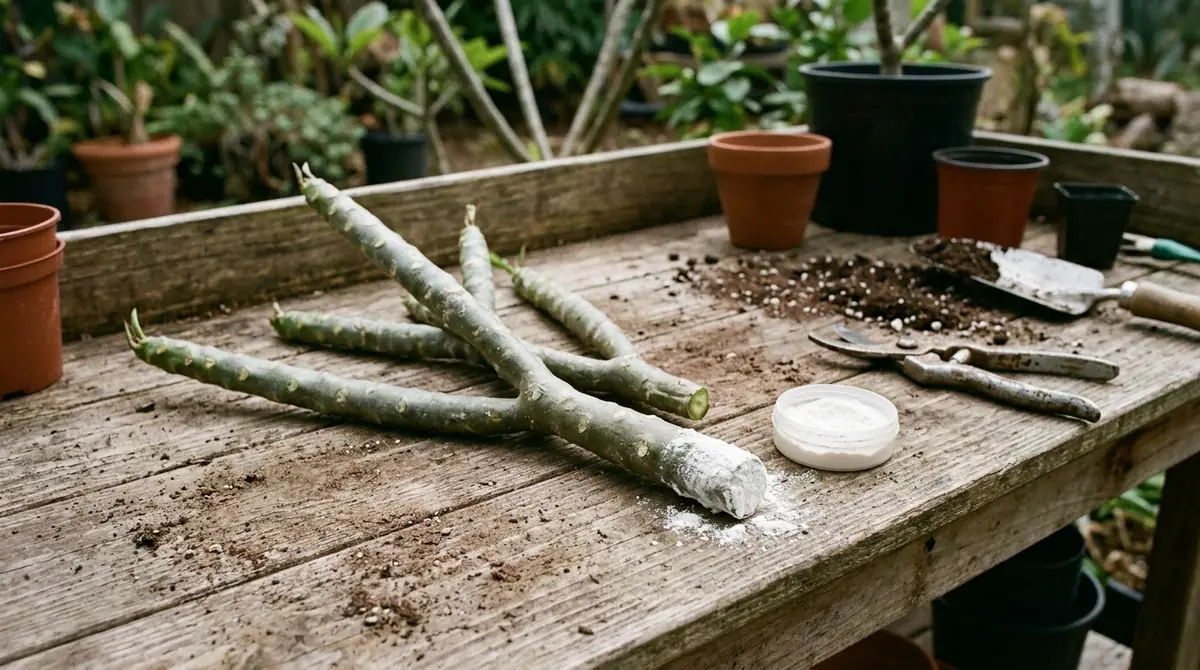
Plumerias (Plumeria spp.), with their succulent stems and latex-rich vascular systems, require a completely different hormonal and environmental approach than standard woody ornamentals. Newly severed plumeria cuttings that are dipped straight into bargain-bin powder rooting hormones and shoved into soggy peat will turn to mush within ten days, as they require proper callousing and specific propagation conditions.

1. Botanical Overview & Natural Habitat
Plumerias belong to the Apocynaceae family, sharing lineage with oleander, periwinkle, and desert rose (Adenium obesum). Native to Central America, Mexico, the Caribbean, and parts of South America, these deciduous to semi-evergreen trees thrive in tropical and subtropical dry forests. In their native habitat, they experience distinct wet and dry seasons. During the dry season, they drop their leaves, conserve moisture in their thick, succulent stems, and rely on stored energy reserves to survive until the rains return.
Botanically, plumeria stems are packed with a milky white latex sap containing toxic alkaloids, such as plumieride, which serves as a natural defense mechanism against herbivores. When you cut a plumeria branch, this sap rushes to the wound and coagulates to seal it. While protective in nature, this latex can act as a physical barrier that impedes root initiation if the cutting is not handled correctly.
Plumerias naturally propagate when branches snap off during tropical storms or dry-season winds. The broken branch drops to the ground, forms a protective callus over several weeks, and eventually roots in the sandy, well-draining soil when seasonal moisture arrives. When we use a plumeria rooting hormone, we are artificially supercharging this natural survival mechanism. We stimulate cell division in the vascular cambium, forcing undifferentiated plant cells to transform into root meristems rather than continuing down their default vegetative or defensive pathways.
2. Essential Environmental & Care Requirements
Rooting a plumeria cutting is entirely dependent on temperature, moisture control, and substrate selection. Without leaves to transpire water, a plumeria cutting cannot absorb moisture through foliage; it must rely strictly on ambient heat to drive metabolic processes while preventing the stem from drying out entirely.
| Parameter | Optimal Condition | Common Mistake | Why It Matters |
|---|---|---|---|
| Bottom Heat | 75°F – 85°F (24°C – 29°C) | Relying on cool ambient indoor air (under 68°F / 20°C) | Warmth at the basal end triggers rapid cellular division and callus formation; cold conditions cause basal rot before roots can form. |
| Substrate Moisture | Barely damp; spray-dried surface | Saturated, wet potting soil | Excess moisture promotes fungal pathogens (Phytophthora and Pythium); dry cuttings need only minimal ambient humidity to trigger rooting. |
| Light Level | Bright, indirect light (3,000–5,000 foot-candles) | Direct, scorching midday sun or deep shade | Direct sun overheats and dehydrates the unrooted stem; deep shade stalls photosynthesis and delays root initiation. |
| Cutting Depth | 2 to 3 inches (5 to 7.5 cm) | Burying too deep (over 4 inches / 10 cm) or too shallow (under 1 inch / 2.5 cm) | Proper depth provides physical stabilization without burying the primary stem nodes too deep in moisture. |
For precise horticultural guidelines on managing propagation substrates and sanitation, consult the University of Florida IFAS Extension.
3. Step-by-Step Cultivation, Feeding & Propagation
Applying rooting hormone to a plumeria cutting requires strict sanitation and precise timing. Follow this step-by-step sequence to ensure high rooting success rates:
- Select and Harvest the Cutting: Choose a healthy, disease-free branch measuring 12 to 18 inches (30 to 45 cm) in length. Using a sterile pruning saw or sharp utility knife cleaned with 70% isopropyl alcohol, make a clean, straight cut at a 90-degree angle.
- Strip Foliage and Cure: Remove all leaves from the cutting to prevent moisture loss through transpiration. Hang the cutting vertically or lay it in a shaded, dry area for 7 to 14 days until the cut end forms a hard, leathery, gray-white callus. Do not skip this step; planting a fresh cutting invites immediate bacterial and fungal entry.
- Select the Hormone Type: Choose an indole-3-butyric acid (IBA) rooting hormone powder rated between 0.3% and 0.8% active ingredient. Gels can trap moisture against the freshly callused tissue and introduce rot, so powder formulations are generally superior for succulent stems.
- Prepare the Hormone Application: Pour a small amount of the rooting powder into a separate small container or bottle cap. Never dip your cutting directly into the original commercial container, as this contaminates the entire supply with any pathogens present on the stem.
- Apply the Hormone: Lightly mist the dry, callused end of the plumeria stem with clean water or dip it briefly into sterile water so the powder adheres. Tap the stem gently into the hormone powder to coat the bottom 1 inch (2.5 cm). Shake off any excess powder to prevent localized chemical burn or clumping.
- Plant in the Rooting Medium: Insert the hormone-treated cutting 2 to 3 inches (5 to 7.5 cm) deep into a pre-made hole within a fast-draining propagation mix (such as a 50/50 blend of coarse perlite and cactus potting soil). Firm the medium gently around the base to stabilize the heavy stem.
- Provide Bottom Heat and Light: Place the container on a horticultural heating mat calibrated to maintain a soil temperature of 78°F to 82°F (25°C to 28°C). Position the setup in bright, indirect light. Water the medium lightly only when it is completely dry to the touch, which typically occurs every 10 to 14 days during the 30- to 60-day rooting window.
💡 Pro-Tip: If your plumeria cutting is particularly heavy or top-heavy, do not rely solely on the potting soil to keep it upright. Insert three bamboo stakes around the perimeter of the container and secure the stem to them with soft plant ties. If a newly forming callus shifts or rocks back and forth inside the soil, the delicate embryonic root hairs will shear off instantly, resetting your rooting timeline back to day zero.
4. Common Problems, Pests & Troubleshooting
Even with optimal use of rooting hormone, plumeria propagation can encounter setbacks. Recognizing the early warning signs saves plants before damage becomes irreversible.
- Stem Tip Wrinkling and Dehydration: If the top of your cutting begins to pucker, wrinkle, or feel slightly soft, the cutting is losing more water than it can take in. While unrooted cuttings do not have roots, they can absorb minor amounts of ambient humidity. Mist the bare stem daily with water, ensure ambient temperatures do not exceed 90°F (32°C), and move the container away from harsh reflective surfaces.
- Black Tip Fungus (Coleosporium or environmental dieback): If the tip of the stem turns black and mushy, cut back the stem 2 inches (5 cm) below the black tissue using a sterile blade. Treat the fresh cut with a copper-fungicide paste, let it re-callus for 7 days, and reapply rooting hormone before resetting it in fresh, sterile perlite.
- Spider Mites on Stems: Though rare on leafless cuttings, two-spotted spider mites can colonize the dry crevices of plumeria bark in hot, dry propagation environments. Wipe the stem down with horticultural soap or neem oil if you notice fine webbing or stippling.
⚠️ Important Caution: Never use high-concentration rooting gels containing high levels of synthetic auxins (such as NAA above 1.0%) on plumeria cuttings. Because plumeria stems store substantial internal moisture and latex, harsh chemical gels can burn the delicate cambium layer, causing the base of the stem to turn black and disintegrate within 72 hours. Always stick to professional-grade horticultural powders formulated for semi-hardwood or succulent species.

5. Frequently Asked Questions
Do you need rooting hormone for plumeria cuttings?
No, plumeria cuttings can root without hormone if environmental conditions—specifically bottom heat and warmth—are ideal. However, using a rooting hormone significantly accelerates root initiation, increases the total volume of roots produced, and drastically reduces the overall time the vulnerable unrooted cutting spends exposed to potential soil pathogens.
Should I use rooting powder or gel for plumerias?
Rooting powder is strongly preferred over gel for plumeria cuttings. Because plumerias are succulent plants with thick, latex-producing stems, gels can trap excess moisture against the wound site and promote fungal or bacterial rot. Powders adhere cleanly to a callused surface while allowing the wound to breathe.
How long does it take for a plumeria cutting to root with hormone?
When provided with optimal bottom heat between 75°F and 85°F (24°C and 29°C), a plumeria cutting typically develops viable roots within 30 to 60 days. You will know rooting has occurred when the cutting pushes out its first set of new terminal leaves and displays firm resistance when gently tugged upward.
Can you put rooting hormone on a fresh plumeria cut?
No. Applying rooting hormone to a fresh plumeria cut is counterproductive because the rushing latex sap will wash the hormone away. Furthermore, fresh cuts lack the cellular differentiation needed to absorb the hormone effectively. Always allow the cutting to dry and form a callous for 7 to 14 days before applying hormone and planting.
Related Guides
- Rooting Hormone for Fiddle Leaf Fig
- Rooting Plumeria Cuttings
- How to Cut Plumeria for Rooting
- Rooting Plumeria
- Plumeria Dormant
- How to Grow Plumeria from Seed
📋 Table of Contents ▼ Click to expand
Tags:
Keep reading
🌿 Related Plants You Might Like
PlantSavvyWorld
Editorial team
PlantSavvyWorld is an independent botanical education project. Articles are drafted with AI assistance, then edited and checked against university extension services, botanical garden collections and other published horticultural sources.