

Rooting Hormone for Fiddle Leaf Fig
Written with AI assistance, edited and checked against horticultural sources.
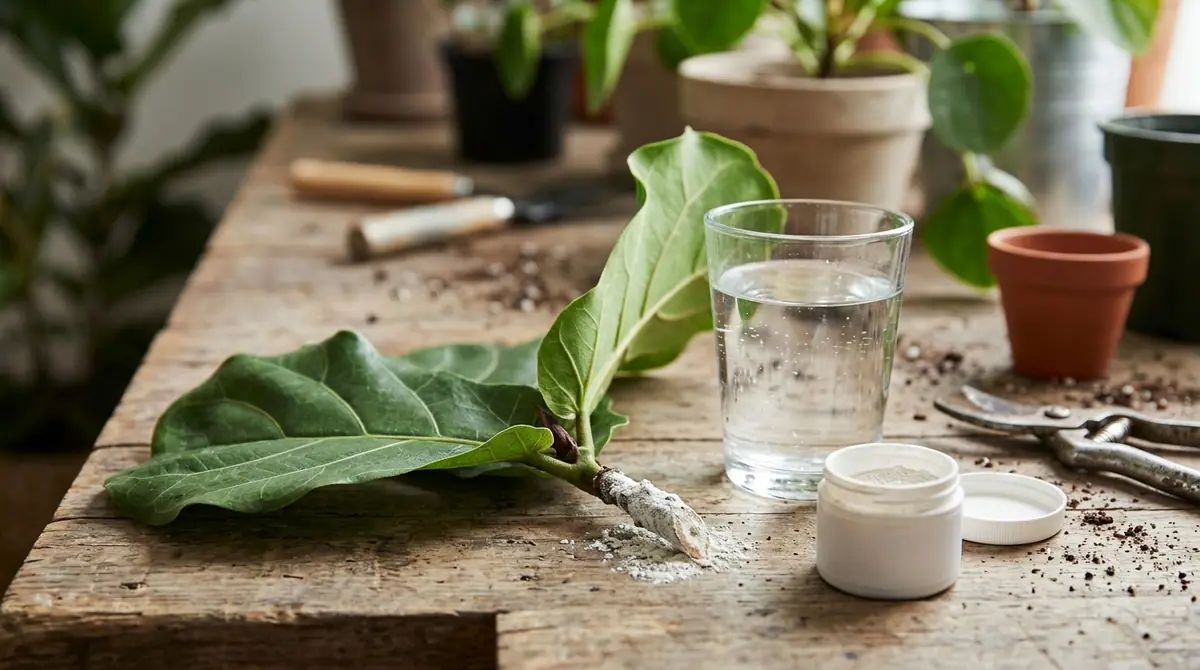
I stood in a greenhouse last October, staring at a failing Ficus lyrata top-cutting that had been sitting in a glass of tap water for six weeks without a single white nub to show for it. The lower leaves were dropping, the stem base was starting to take on a concerning translucent brown mushiness, and my patience was wearing thin. Fiddle leaf figs are notoriously temperamental when severed from their root systems; without the right chemical and environmental signals, they would rather die than throw out adventitious roots. It was only after I sliced away the rotting basal end, dusted the cambium layer with a 0.3 percent indole-3-butyric acid rooting hormone powder, and transferred the cutting into a humidized perlite-peat bench set to a bottom-heat of 78°F (25.5°C) that the transformation happened. Within 28 days, thick, vigorous roots burst through the stem tissue.

1. Botanical Overview & Natural Habitat
The Ficus lyrata, commonly known as the fiddle leaf fig, belongs to the Moraceae family and is native to the lowland tropical rainforests of western Africa, stretching from Cameroon down to Sierra Leone. In its natural understory and canopy-edge habitat, this plant experiences high ambient humidity, consistent tropical warmth, and well-draining, nutrient-rich organic soils enriched by decomposing forest litter.
Botanically, Ficus lyrata is an epiphyte-adjacent semi-woody tree that frequently begins its life as a seed deposited high in the fork of a host tree, eventually sending aerial roots down to the forest floor. This evolutionary history explains why its stems possess a high degree of phenotypic plasticity—they are biologically primed to produce adventitious roots when physical damage or environmental stress brings a branch into contact with soil moisture and organic debris.
Understanding this native biology is critical when propagating via stem cuttings. Unlike herbaceous annuals that root effortlessly in plain water, woody tropical trees like the fiddle leaf fig require specific biochemical triggers to differentiate unspecialized parenchyma cells in the vascular cambium into root meristems. When you apply a commercial rooting hormone containing auxins such as Indole-3-Butyric Acid (IBA) or 1-Naphthaleneacetic Acid (NAA), you are essentially mimicking the concentrated chemical signals that auxin transport proteins naturally deliver in the wild, forcing the plant to prioritize root regeneration over vegetative maintenance. For a deeper scientific dive into plant growth regulators and their mechanisms, you can consult the University of Florida IFAS Extension.
2. Essential Environmental & Care Requirements
Propagating a fiddle leaf fig cutting with rooting hormone requires strict environmental controls. Without roots to take up water, your cutting relies entirely on atmospheric humidity and basal temperature to stay alive while it builds its new root system.
| Parameter | Optimal Condition | Common Mistake | Why It Matters |
|---|---|---|---|
| Ambient Temperature | 75°F to 82°F (23.8°C to 27.8°C) | Letting temperatures drop below 68°F (20°C) | Low temperatures stall metabolic activity and cellular differentiation, causing the stem base to rot before roots can form. |
| Bottom Heat | 78°F to 80°F (25.5°C to 26.6°C) | Using no bottom heat or placing on cold tile | Bottom heat stimulates rapid division of cambial cells while keeping ambient air slightly cooler to reduce foliar transpiration. |
| Relative Humidity | 80% to 95% | Exposing unrooted cuttings to dry indoor air (below 40%) | Without roots, high ambient humidity prevents the large fiddle-shaped leaves from desiccating beyond repair. |
| Light Quality | Bright, indirect light (1,500 to 2,500 foot-candles) | Placing in direct, scorching sun or dark corners | Direct sun cooks and dehydrates the cutting; too little light halts the photosynthesis needed to fuel root generation. |
| Substrate pH | 5.5 to 6.5 | Using heavy, compacted garden soil | Slightly acidic, highly aerated media prevents anaerobic bacterial growth while optimizing nutrient availability for new root tips. |
💡 Pro-Tip: Never rely on ambient room temperature for propagating Ficus lyrata cuttings. Invest in a horticultural propagation heat mat with a digital thermostat probe. Keeping the rooting zone precisely at 78°F (25.5°C) cuts rooting times nearly in half compared to unheated benches.
3. Step-by-Step Cultivation, Feeding & Propagation
When preparing to take and treat a fiddle leaf fig cutting with rooting hormone, precision is everything. A sloppy cut or contaminated tool will introduce pathogens that turn your expensive cutting into a compost pile. Follow this exact protocol for a high success rate.
- Select and Sanitize Mother Material: Choose a healthy, actively growing stem on a mature fiddle leaf fig. Sterilize your pruning shears or a razor blade with 70% isopropyl alcohol to eliminate fungal spores and bacteria.
- Execute the Cut: Make a clean, 45-degree angle cut exactly 0.25 inches (0.6 cm) below a node. The cutting should be between 6.0 and 12.0 inches (15.0 and 30.5 cm) long and contain at least two to three mature leaves.
- Manage Leaf Surface Area: Immediately prune off the lowest leaf to expose the lower node. For the remaining one or two leaves, use clean scissors to snip away 50% of each leaf blade. This reduces moisture loss through transpiration while retaining enough surface area for essential photosynthesis.
- Halt the Latex Exudation: Allow the cut end to sit upright in a dry container for 30 to 45 minutes until the milky white latex sap stops oozing and forms a dry seal.
- Apply the Rooting Hormone: Pour a small amount of rooting hormone powder (0.3% IBA is ideal for semi-hardwood cuttings) into a separate dish—never dip your cutting directly into the original container to avoid cross-contamination. Moisten the bottom 1.0 inch (2.5 cm) of the stem with clean water, shake off the excess, and roll the damp stem in the hormone powder. Gently tap the stem to remove any thick clumps; excess powder can burn the delicate emerging tissue.
- Plant in Sterile Substrate: Insert the treated cutting 2.0 inches (5.1 cm) deep into a pre-moistened, sterile propagation mix consisting of a 1:1 ratio of perlite and coco coir. Firm the medium gently around the stem to ensure good contact.
- Create a Microclimate: Encase the entire pot in a clear plastic bag or clear propagation dome to lock in humidity, ensuring the plastic does not touch the remaining leaves. Place the setup in bright, indirect light over your horticultural heat mat.
- Monitor and Ventilate: Open the humidity tent for 15 minutes every 3 days to allow fresh air exchange and prevent fungal mold growth. Check the moisture of the medium weekly; it should feel like a wrung-out sponge—damp, never soggy.
- Assess Root Development: In approximately 21 to 35 days, gently tug on the base of the stem. If you feel firm resistance, adventitious roots have successfully formed. Once roots reach 1.0 to 2.0 inches (2.5 to 5.0 cm) in length, pot the cutting up into a standard 4.0-inch (10.2 cm) container with well-draining potting soil.
⚠️ Important Caution: Never use liquid rooting concentrates at full strength on Ficus lyrata unless specifically formulated for semi-hardwood cuttings and diluted according to strict laboratory guidelines. Over-concentrated synthetic auxins act as herbicides, killing the cambium layer and causing immediate stem necrosis.
For further reading on optimal plant propagation techniques and tissue management, reference the guidelines provided by the Royal Horticultural Society (RHS).
4. Common Problems, Pests & Troubleshooting
Even with rooting hormone, things can occasionally go awry during the propagation window. Here is how to diagnose and correct the most common issues:
- Stem Rot (Basal Mushiness): If the lower portion of the stem turns soft, dark brown, and smells foul, you are dealing with a fungal or bacterial rot (typically Pythium or Rhizoctonia species). This is almost always caused by media that is too wet combined with inadequate airflow. Correction: Pull the cutting immediately, use a sterilized razor blade to slice away all decayed tissue 0.5 inches (1.3 cm) above the rot line, wash the remaining healthy stem in a 10% hydrogen peroxide solution, reapply fresh rooting hormone, and plant in entirely new, sterilized perlite.
- Leaf Drop During Rooting: It is normal for a cutting to drop its oldest, lowest leaf as it diverts energy into root production. However, if all leaves drop or turn yellow and crisp, your humidity is too low or your light level is too intense. Correction: Mist the interior of your humidity dome daily, ensure indirect lighting parameters are met, and check that your bottom heat is not baking the root zone.
- Stalled Growth (No Roots After 45 Days): If the cutting looks green and healthy but refuses to push out roots after six weeks, the ambient temperature is likely too low, or the rooting hormone expired. Correction: Check your heat mat temperature. If it is functioning correctly, lift the cutting to inspect the base; if callus tissue has formed a hard, impenetrable barrier over the cut, make a fresh 45-degree cut slightly higher up, re-hormone, and reset.
- Edema and Blistering: Small, water-soaked bumps or corky brown spots appearing on the undersides of the leaves indicate inconsistent watering of the propagation medium combined with trapped, stagnant air. Correction: Increase ventilation frequency and let the top 0.5 inches (1.3 cm) of the propagation medium dry slightly between misting.

5. Frequently Asked Questions
Can I propagate a fiddle leaf fig in plain water after using rooting hormone?
While you can technically place a hormone-treated cutting into water, it is strongly discouraged. Water dilutes and washes away the active auxin powder almost instantly, rendering the rooting hormone ineffective. Furthermore, water-grown roots develop a different cellular structure than soil-grown roots, making them prone to shock when eventually transplanted into potting mix. Always use a sterile, well-aerated medium like perlite and peat when utilizing rooting hormone.
Which type of rooting hormone is best for fiddle leaf figs—powder, gel, or liquid?
Powdered rooting hormones containing 0.3% Indole-3-Butyric Acid (IBA) are generally the safest and most effective choice for woody and semi-hardwood Ficus species. Powders have a longer shelf life and carry a lower risk of localized chemical burns compared to concentrated liquids. Gels can work well, but some formulations trap bacteria against the cut site if the gel is contaminated during dipping.
How long does it take for a fiddle leaf fig cutting to root with hormone?
When provided with optimal conditions—including a consistent bottom heat of 78°F (25.5°C), high humidity, and a quality rooting hormone—you can typically expect to see active root development within 21 to 35 days. Without rooting hormone or bottom heat, that same timeline can easily stretch out to 60 or 90 days, significantly increasing the window for stem rot to take hold.
Why is my fiddle leaf fig cutting oozing white sap after I applied the rooting hormone?
The white latex sap is a natural defense mechanism containing defensive compounds like triterpenoids and rubber particles. If the sap is oozing after you applied the powder, it means you did not let the cut dry and seal properly before application. The active sap pushes the hormone powder away from the cambium layer. Always allow the cut to dry for 30 to 45 minutes until the latex stops flowing before dipping the stem into your rooting hormone.
Related Guides
- Plumeria Rooting Hormone
- Moisture Meter for Fiddle Leaf Fig
- How to Repot Fiddle Leaf Fig
- How to Prune Fiddle Leaf Fig Plant
- Rooting Plumeria Cuttings
📋 Table of Contents ▼ Click to expand
Tags:
Keep reading
🌿 Related Plants You Might Like






PlantSavvyWorld
Editorial team
PlantSavvyWorld is an independent botanical education project. Articles are drafted with AI assistance, then edited and checked against university extension services, botanical garden collections and other published horticultural sources.