

Moisture Meter for Fiddle Leaf Fig
Written with AI assistance, edited and checked against horticultural sources.
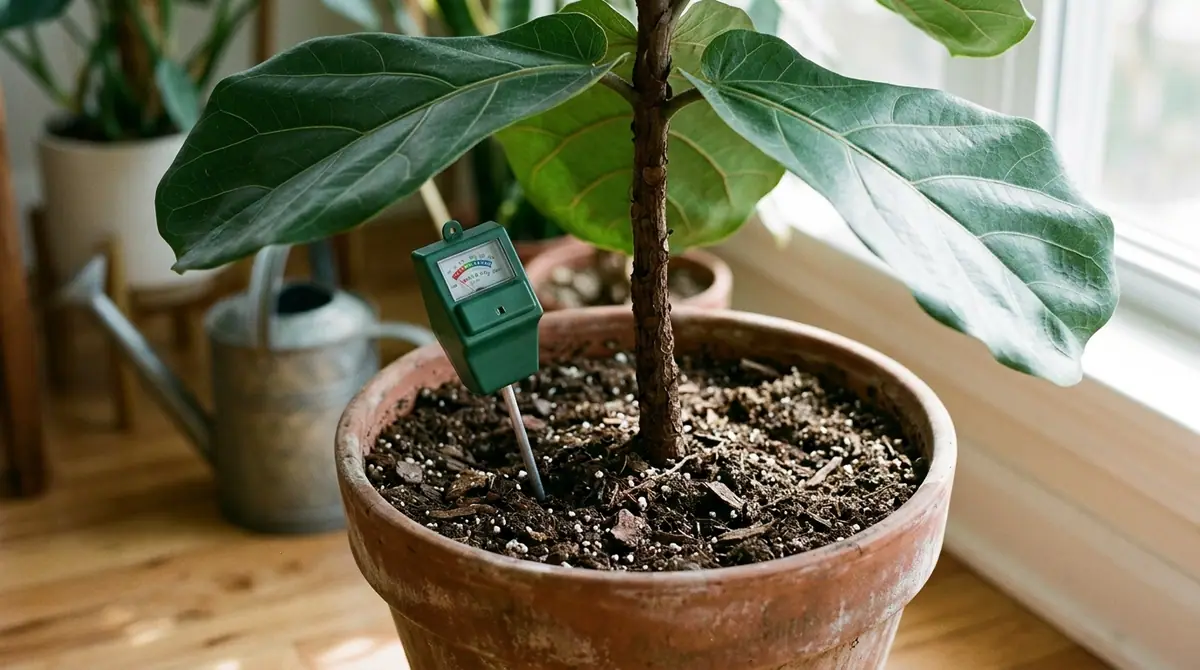
I stood in a gardener's sunlit penthouse living room last November, staring at a six-foot Ficus lyrata that was dropping three massive, leathery leaves every single week. The soil surface looked bone dry, crusty, and pale. Convinced the plant was dying of thirst, the owner had been giving it a light sip of water every Tuesday. When I pushed my 12-inch stainless steel soil probe deep into the container, the bottom four inches came out coated in a slick, anaerobic sludge. The topsoil was a desert; the root zone was a swamp. That afternoon, we didn't buy a new watering can or a bottle of fertilizer. We bought a reliable soil moisture meter, and it saved that tree.
1. Botanical Overview & Natural Habitat

Taxonomically belonging to the Moraceae (mulberry) family, Ficus lyrata earns its common descriptive name from the distinctively violin- or lyre-shaped leaves, which can easily reach 15 inches (38 cm) in length and 10 inches (25 cm) in width. These broad, glossy surfaces are evolutionary adaptations designed to capture dappled, high-intensity equatorial sunlight filtering through a dense rainforest canopy.
In indoor cultivation, mastering soil moisture management is the single greatest hurdle to keeping this plant alive. Because indoor environments lack the natural wind currents, ambient humidity, and expansive root-run of a West African rainforest, container-grown fiddle leaf figs are exceptionally vulnerable to root rot caused by stagnant water. This is precisely why understanding how to read and use a moisture meter for fiddle leaf fig care is non-negotiable for serious plant parents.
| Parameter | Optimal Condition | Common Mistake | Why It Matters |
|---|---|---|---|
| Soil Moisture (Meter Reading) | 3 to 4 (Dry to Moist) on a 1-10 scale | Keeping the meter pegged at 8–10 constantly | Saturated soil starves roots of oxygen, leading to rapid root rot. |
| Ambient Temperature | 65°F to 85°F (18°C to 29°C) | Exposing plant to drafts below 50°F (10°C) | Cold shock causes immediate leaf drop and metabolic stall. |
| Relative Humidity | 40% to 60% relative humidity | Placing near forced-air heating vents (<20% humidity) | Low humidity triggers crisp brown edges on new foliage. |
| Light Exposure | Bright, indirect light with 2–4 hours direct morning sun | Shoving the plant into a dark northern corner | Insufficient light halts photosynthesis and slows water uptake. |
2. Essential Environmental & Care Requirements
Replicating a West African lowland climate inside a modern home or office requires strict attention to environmental thresholds. Let’s break down the physical metrics your fiddle leaf fig demands to thrive.
Temperature consistency dictates metabolic activity. Fiddle leaf figs thrive when ambient temperatures remain steady between 65°F and 85°F (18°C to 29°C). Temperatures dropping below 50°F (10°C)—or sudden drafts from air conditioning units and winter entryways—will shock the plant, causing the characteristic dark brown lesions on the newest leaves.
Light is the engine of your plant. Aim for a minimum of six hours of bright, filtered light daily. An east-facing window is often ideal, providing gentle morning sun. South- and west-facing windows work well if protected by a sheer curtain during peak afternoon hours. When a plant receives insufficient light, its rate of transpiration plummets. If the leaves aren't transpiring water efficiently, the potting mix stays wet longer, rendering manual watering schedules obsolete and making a moisture meter essential to check if the roots are actually thirsty.
Soil composition must balance moisture retention with exceptional drainage. A dense, peat-heavy potting soil will hold water like a sponge and suffocate the root system. Instead, utilize a chunky, well-aerating mix composed of 50% high-quality potting soil, 25% orchid bark (ranging from 0.25 to 0.5 inches / 0.6 to 1.2 cm), and 25% perlite or horticultural pumice. This coarse matrix ensures that even when the soil is thoroughly watered, large air pockets remain trapped throughout the root zone.
💡 Pro-Tip: When inserting your moisture meter into a large 12-inch (30 cm) or 14-inch (35 cm) nursery pot, take readings in at least three distinct locations—one near the root ball's edge and two midway between the stem and the container wall. Because fiddle leaf fig roots grow dense and unevenly, moisture pockets can hide on one side of the pot while the other is bone dry.
3. Step-by-Step Cultivation, Feeding & Propagation
Growing a majestic, branching specimen requires a disciplined routine. Follow this step-by-step cultivation protocol to ensure long-term structural integrity and vibrant foliage.
- Select and Test Your Container: Choose a pot with a minimum diameter of 12 inches (30 cm) featuring at least three functional drainage holes. Never plant a fiddle leaf fig in a decorative cachepot without interior drainage.
- Mix the Substrate: Combine equal parts coarse potting soil, orchid bark, and perlite in a trug or bucket. Ensure the mixture is slightly damp before filling your container.
- Planting Depth: Unpot your fiddle leaf fig, gently tease apart circling roots at the base, and plant it at the exact same soil line it experienced in its nursery container. Burying the stem too deeply invites stem rot.
- Initial Watering & Settling: Water the potting mix thoroughly until it streams freely from the drainage holes. Allow it to drain completely for 30 minutes, then empty the saucers.
- Deploy the Moisture Meter: Insert your soil moisture meter probe vertically into the root zone, pushing it down to a depth of 4 to 6 inches (10 to 15 cm), avoiding the immediate woody trunk.
- Establish the Watering Threshold: Wait until the meter registers a reading of 3 or lower (on a standard 1-to-10 scale) before administering your next deep watering. In summer, this cycle typically repeats every 10 to 14 days; in winter, it may stretch to 21 to 28 days.
- Nutritional Management: During the active growing season (April through September), apply a balanced, water-soluble liquid fertilizer (such as a 3-1-2 or 10-10-10 formulation) diluted to half-strength once every 4 weeks. Cease all fertilization completely between October and March when natural light levels drop and the plant enters semi-dormancy.
- Propagation (Air Layering): To propagate mature specimens, utilize air layering in spring. Make an upward-sloping cut halfway through a healthy, pencil-thick stem, wedge a toothpick inside to keep it open, pack moist long-fiber sphagnum moss around the wound, and wrap it tightly in black plastic secured with twine. Roots will emerge inside the moss within 6 to 8 weeks, at which point you can sever the stem below the roots and pot it independently.
⚠️ Important Caution: Never rely on cheap, analog moisture meters that require no batteries without occasionally testing them. You can test your meter's calibration by sticking the probe into a glass of plain water (it should register a 10) and then into completely dry, air-exposed air (it should read a 1). A malfunctioning meter reading a false "dry" can lead you to overwater your fig, resulting in fatal root rot. For broader guidance on maintaining indoor tropical plant health, consult resources provided by the Royal Horticultural Society.
4. Common Problems, Pests & Troubleshooting
Even with meticulous care, indoor environments present challenges. Recognizing early warning signs saves months of rehabilitation.
Edema (Red Spots on New Leaves): If you notice tiny, rust-colored freckles or raised bumps on emerging leaves, your plant is experiencing edema. This occurs when roots take up water faster than the leaves can transpire it, causing individual plant cells to burst.
- The Fix: Adjust your watering cadence using your moisture meter, ensuring you let the soil dry out slightly more between waterings, and increase air circulation around the plant with a small oscillating fan.
Lower Leaf Yellowing and Drop: When mature, lower leaves turn a uniform, pale yellow and drop off, the culprit is almost always chronic overwatering that has damaged the fine root hairs.
- The Fix: Stop watering immediately. Allow the meter reading to drop to the lowest level. If the soil remains soggy after three weeks, unpot the plant, trim away black, mushy, foul-smelling roots with sterilized shears, and repot in fresh, dry, chunky media. You can also cross-reference plant pathology guidelines through the University of Florida Extension Service for localized fungal management strategies.
Spider Mites and Scale: Dry indoor air during winter months invites pests. Spider mites spin fine webbing on the undersides of leaves, causing a stippled, dusty appearance, while brown scale insects appear as immobile bumps along the veins and stems.
- The Fix: Wash the entire plant thoroughly in a warm shower to physically dislodge pests. Follow up by spraying every surface—including leaf undersides and stem joints—with horticultural insecticidal soap or neem oil every 7 days for a 3-week lifecycle interruption.

5. Frequently Asked Questions
How deep should I push a moisture meter into the soil for a fiddle leaf fig?
Push the metal probe to a depth of 4 to 6 inches (10 to 15 cm) into the pot. Surface readings are completely useless because the top two inches of soil dry out rapidly while the core remains saturated. Avoid jamming the probe directly against the woody trunk, as this can puncture major structural roots; instead, insert it midway between the main stem and the inner rim of the container.
What number on a moisture meter means it is time to water a fiddle leaf fig?
On a standard 1-to-10 analog moisture meter scale, you should wait until the needle drops to 3 or 2 before watering. A reading of 10 indicates waterlogged, muddy conditions; 7 to 5 indicates moist soil; and 3 to 1 indicates that the root zone is drying out and ready for a deep, thorough drenching.
Can I leave a soil moisture meter permanently in the pot?
No. Leaving a metal-probe moisture meter permanently embedded in damp potting soil accelerates electrochemical corrosion and oxidation of the probe tip. This mineral buildup ruins the meter's calibration within a few weeks. Insert the probe into the soil only when checking moisture levels, wipe it clean with a soft cloth immediately after use, and store it in a dry location.
Why does my moisture meter say the soil is dry, but the leaves are dropping?
This is a classic symptom of root shock or previous overwatering. If a plant's root system has already rotted away due to historical overwatering, the roots are dead and incapable of absorbing water. Even if you add fresh water and the meter reads dry, a rotted root system cannot drink, leaving the plant dehydrated and dropping leaves. Unpot the root ball to inspect the roots: healthy roots are firm and light-colored, while rotted roots are dark, mushy, and slip easily off their core threads.
Related Guides
- How to Repot Fiddle Leaf Fig
- How to Prune Fiddle Leaf Fig Plant
- Rooting Hormone for Fiddle Leaf Fig
- Split Leaf Philodendron Plant
- Leaf Shine Definition
📋 Table of Contents ▼ Click to expand
Tags:
Keep reading
🌿 Related Plants You Might Like



PlantSavvyWorld
Editorial team
PlantSavvyWorld is an independent botanical education project. Articles are drafted with AI assistance, then edited and checked against university extension services, botanical garden collections and other published horticultural sources.