

Dog Tail Cactus Aerial Roots
Written with AI assistance, edited and checked against horticultural sources.
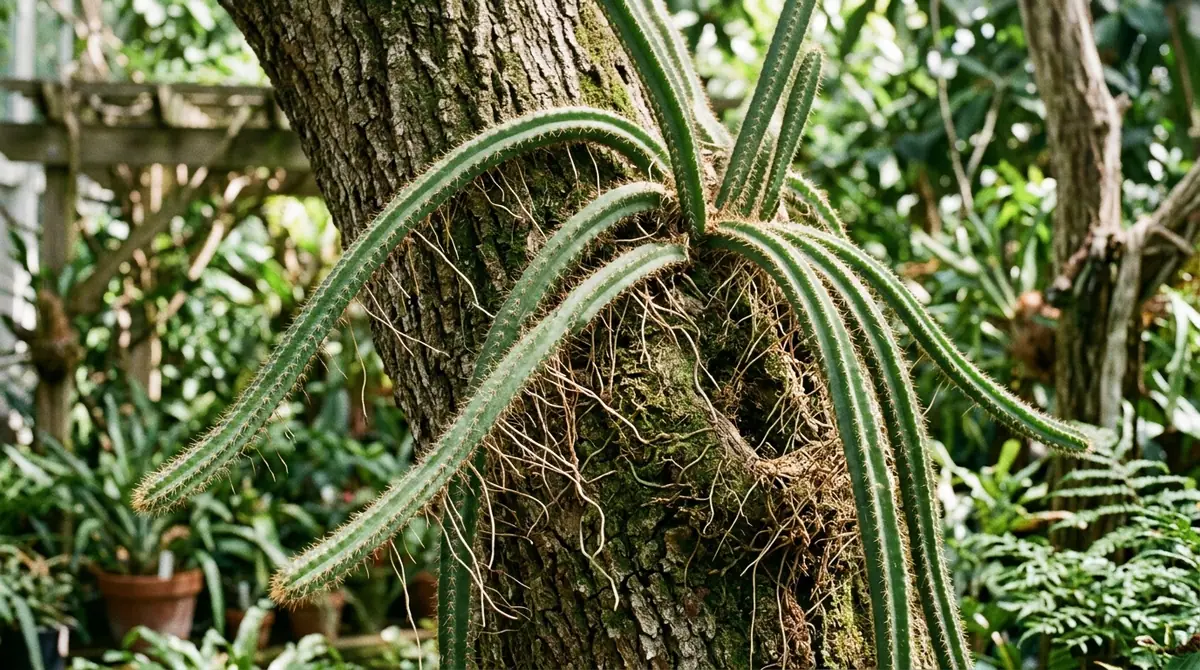
When a massive Hildewintera colademonis—better known as the dog tail cactus—draped off its shelf like a furry white waterfall develops dozens of tiny, reddish-brown nubs emerging from the stem joints four feet down the vine, panic about a massive scale insect infestation is unwarranted. Those fuzzy protrusions are simply healthy aerial roots, searching the humid air of a conservatory for moisture they instinctively know is scarce.
1. Botanical Overview & Natural Habitat
The dog tail cactus (Hildewintera colademonis, formerly classified under Disocactus and Borzicactus) is native to the sheer, vertical sandstone cliffs of Santa Cruz, Bolivia. At elevations ranging from 3,280 to 4,920 feet (1,000 to 1,500 meters), these plants grow strictly as epilithons—organisms that grow on rocks—anchored in minuscule pockets of organic debris and mineral detritus.
In their native habitat, stems cascade downward, reaching lengths of up to 8 feet (2.4 meters). The aerial roots you observe on cultivated specimens are not accidental mutations; they are an evolutionary survival strategy. In the wild, as the heavy stems lengthen and pull away from the vertical rock face, aerial roots serve a dual purpose. First, they provide mechanical bracing, latching onto rock fissures to prevent the heavy, columnar stems from snapping under their own weight during torrential Andean downpours. Second, they scavenge ambient moisture and atmospheric nitrogen from passing cloud banks and morning mountain mists.
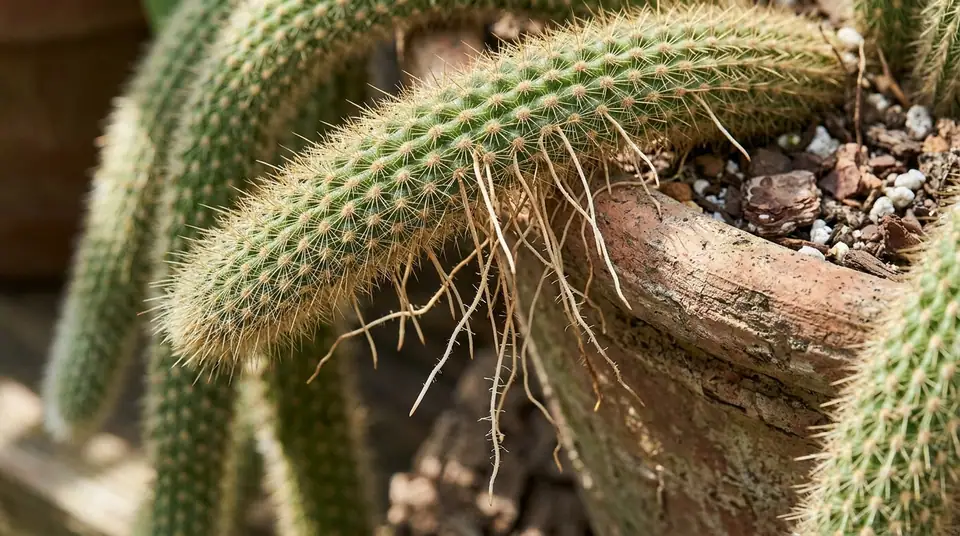
Botanically, these roots emerge from the areoles—the specialized, pár-like cushion structures unique to the cactus family where spines, flowers, and branches are produced. When the local relative humidity spikes above 75%, or when the main root system in the tiny rock crevice experiences drought stress, hormonal signals trigger meristematic cells within the areole to shift from producing spine clusters to producing adventitious root initials.
2. Essential Environmental & Care Requirements
Recreating a Bolivian canyon microclimate in a modern home or greenhouse requires precise environmental control. When your dog tail cactus starts pushing out an abundance of aerial roots, it is often a silent indicator that one or more of your environmental parameters is slightly out of balance.
| Parameter | Optimal Condition | Common Mistake | Why It Matters |
|---|---|---|---|
| Light Exposure | 6 hours of bright, direct morning sun; bright indirect light afternoon. | Keeping the plant in a dark corner or scorching it in harsh midday summer sun. | Insufficient light weakens stem structural integrity, causing etiolated growth that forces the plant to rely heavily on aerial roots for stability. |
| Substrate Temperature | 65°F to 80°F (18°C to 27°C) during active growth. | Placing pots on cold concrete floors or uninsulated windowsills in winter. | Cold roots cannot absorb water efficiently, triggering compensatory aerial root growth in search of ambient moisture. |
| Ambient Humidity | 40% to 60% relative humidity; tolerates brief spikes to 80%. | Excessively dry indoor heating or stagnant, overly humid terrarium conditions. | Extreme dryness forces aerial roots to desiccate and die back, while hyper-humidity without airflow invites fungal pathogens. |
| Watering Cadence | Soak-and-dry method; allow top 3 inches (7.6 cm) to dry completely. | Frequent, shallow sips of water that wet only the surface substrate. | Deep watering ensures the primary subterranean root system stays hydrated, reducing the plant's metabolic reliance on aerial roots. |
To master the nuances of plant root health across different species, you can study structural adaptations found in How Deep Do Pepper Plant Roots Go? Pot Size & Substrate Depth Guide, which outlines how root architecture responds directly to container constraints and moisture gradients. Similarly, managing moisture without a traditional root zone is a challenge faced by multiple genera; reviewing How to Plant Aloe Vera Without Roots offers valuable comparative insights into how succulent species mobilize adventitious tissues for survival.
💡 Pro-Tip: Do not mist your dog tail cactus aerial roots to keep them alive indoors. While it seems logical given their rainforest-adjacent habitat, indoor stagnant air combined with water sitting on dense white hairs inevitably leads to fungal rot. Instead, rely on a well-watered substrate to maintain healthy ambient humidity around the cascading stems.
3. Step-by-Step Cultivation, Feeding & Propagation
When you notice prolific aerial root production, it is often the ideal window to leverage those roots for propagation. Because dog tail cactus stems can grow unwieldy, pruning and propagating via stem cuttings with pre-formed aerial roots dramatically accelerates the establishment timeline.
Here is my exact professional protocol for propagating a dog tail cactus using its natural aerial roots:
- Select and Inspect: Identify a healthy, mature stem branch at least 6 inches (15 cm) long that features multiple plump, viable aerial roots along its lower nodes. Sterilize your pruning shears with 70% isopropyl alcohol.
- Make the Cut: Cut cleanly just below an areole cluster, ensuring you leave at least 0.5 inches (1.3 cm) of clean stem tissue beneath the lowest set of aerial roots.
- Calus the Wound: Place the cutting horizontally on a clean paper towel in a warm, dry, shaded area for exactly 7 days to allow the vascular ring and cut tissue to form a hard, protective callus.
- Prepare the Substrate: Mix a specialized epilithic cactus soil comprising 40% coarse pumice (1/4 inch / 0.6 cm grade), 30% horticultural perlite, 20% organic compost or leaf mold, and 10% expanded clay pebbles. Fill a 4-inch (10 cm) terracotta pot to within 1 inch (2.5 cm) of the rim.
- Position the Cutting: Plant the cutting vertically, burying the callused base and directing the pre-formed aerial roots downward into the top 1 inch (2.5 cm) of the substrate mix. Secure the stem with small landscape pins or bamboo stakes if it wobbles.
- Initial Dry Period: Keep the newly potted cutting completely dry for the first 14 days to encourage the aerial roots to transition into subterranean nutrient-absorbing roots without risking basal rot.
- Initiate Watering: On day 15, administer a deep, thorough watering until liquid runs freely out of the drainage holes. Resume a standard soak-and-dry watering schedule every 14 to 21 days depending on ambient temperatures.
For those interested in integrating cascading succulents into broader landscape projects where root management is paramount, you can review principles of root-friendly layout techniques detailed in Creative Landscaping Ideas Around Tree Roots, which provides fantastic conceptual frameworks for handling unusual root behaviors in architectural plantings.
⚠️ Important Caution: Never force dry, rigid aerial roots into damp soil during propagation or repotting. If an aerial root is stiff and brown, it has typically lost its meristematic tip and will snap or rot if buried too deeply. Only bury flexible, actively growing root tips, or trim away dead aerial roots entirely before potting.
4. Common Problems, Pests & Troubleshooting
While aerial roots are a normal part of Hildewintera colademonis morphology, their sudden explosion or sudden decline can signal underlying cultural stress. Here is how to diagnose what your plant is telling you.
Excessive Aerial Roots Caused by Root Rot
If your dog tail cactus suddenly pushes out hundreds of thick, fuzzy roots all along the upper and lower stems, your primary subterranean root system has likely failed. When root rot destroys the roots in the pot due to overwatering or compacted soil, the plant panics and triggers widespread adventitious root formation in a desperate bid to find water.
- The Fix: Unpot the plant immediately. Inspect the root ball. Trim away all black, mushy, or foul-smelling roots using sterile shears. Dust the remaining healthy root stock with sulfur powder or cinnamon as a natural fungicide. Repot in fresh, fast-draining substrate and withhold water for 21 days.
Dry, Brittle, and Dying Aerial Roots
If aerial roots appear desiccated, brown, and snap off easily, your indoor environment is likely suffering from relative humidity levels dropping below 25%, paired with drafty HVAC vents.
- The Fix: While you do not need to mist the plant, grouping it with other houseplants or running a nearby ultrasonic humidifier to maintain a baseline of 40% humidity will preserve the integrity of the stem tissues.
Pests Hiding in Aerial Root Clusters
The dense matrix of white hairs and tangled aerial roots on a dog tail cactus provides an ideal sanctuary for mealybugs and scale insects. These pests feed on phloem sap, weakening the plant.
- The Fix: Inspect the root nodes under a magnifying glass. If you spot white, cottony masses (mealybugs), spray the affected areas with a targeted solution of 70% isopropyl alcohol mixed with a drop of liquid dish soap. For persistent infestations, consult guidelines from a trusted agricultural authority like the University of California Statewide Integrated Pest Management Program for safe, non-toxic horticultural oil applications. To understand the broader environmental conditions that favor healthy plant defenses against such pests, refer to resources provided by the Royal Horticultural Society for expert plant care standards.
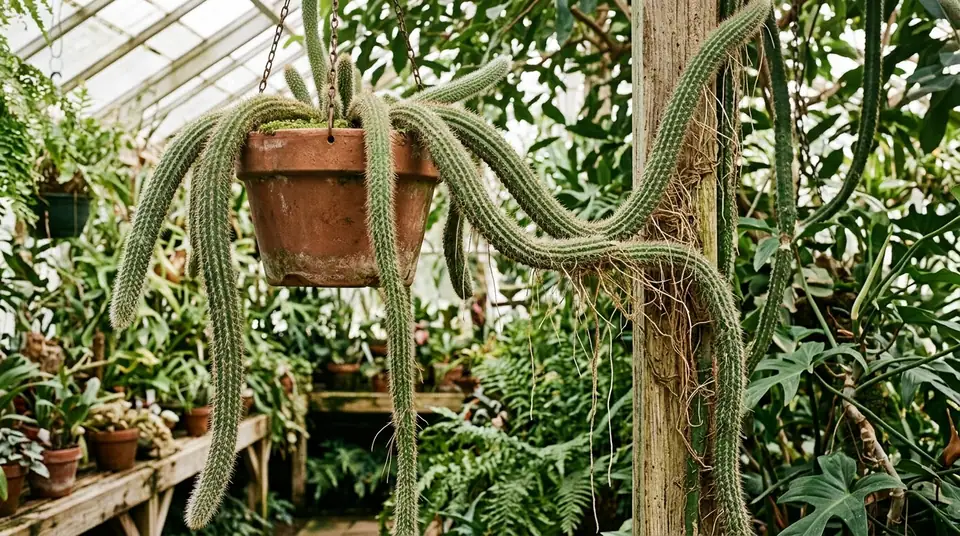
Long stems of a hanging dog tail cactus showing aerial roots in a greenhouse
5. Frequently Asked Questions
Should I cut off the aerial roots on my dog tail cactus?
You can safely cut off aerial roots without harming the plant, but doing so does not solve the root cause of why they appeared. If the roots are unsightly, sterilize a pair of fine snips and clip them flush to the areole. However, leaving them intact is generally better for the plant's natural respiration and environmental sensing.
Why is my dog tail cactus growing roots along the stem?
Stems grow roots when they sense high humidity, or conversely, when the main root system below the soil line is compromised and unable to transport enough water to the upper parts of the trailing vine. Check your soil moisture and watering habits to determine whether the plant is thriving or struggling.
Can I propagate a dog tail cactus without aerial roots?
Yes, absolutely. While stems with pre-formed aerial roots establish faster, any healthy cutting taken from a mature dog tail cactus will readily produce new roots from its severed areoles if given a proper 7-day callusing period and a dry, porous propagation medium.
Are dog tail cactus aerial roots a sign of overwatering or underwatering?
They can be a sign of either extreme. Underwatering triggers the plant to hunt for moisture in the air via aerial roots. Overwatering destroys the underground root system, forcing the plant to generate aerial roots as a backup survival mechanism to replace lost root capacity. Check your soil moisture levels to pinpoint which extreme is occurring.
Related Guides
- Dying Cactus
- Variegated Cactus Plants
- Variegated Cactus
- How Do You Plant Peony Roots
- How to Plant Aloe Vera Without Roots
📋 Table of Contents ▼ Click to expand
Tags:
Keep reading
🌿 Related Plants You Might Like


PlantSavvyWorld
Editorial team
PlantSavvyWorld is an independent botanical education project. Articles are drafted with AI assistance, then edited and checked against university extension services, botanical garden collections and other published horticultural sources.