

When to Start Seeds Indoors in Michigan
Written with AI assistance, edited and checked against horticultural sources.
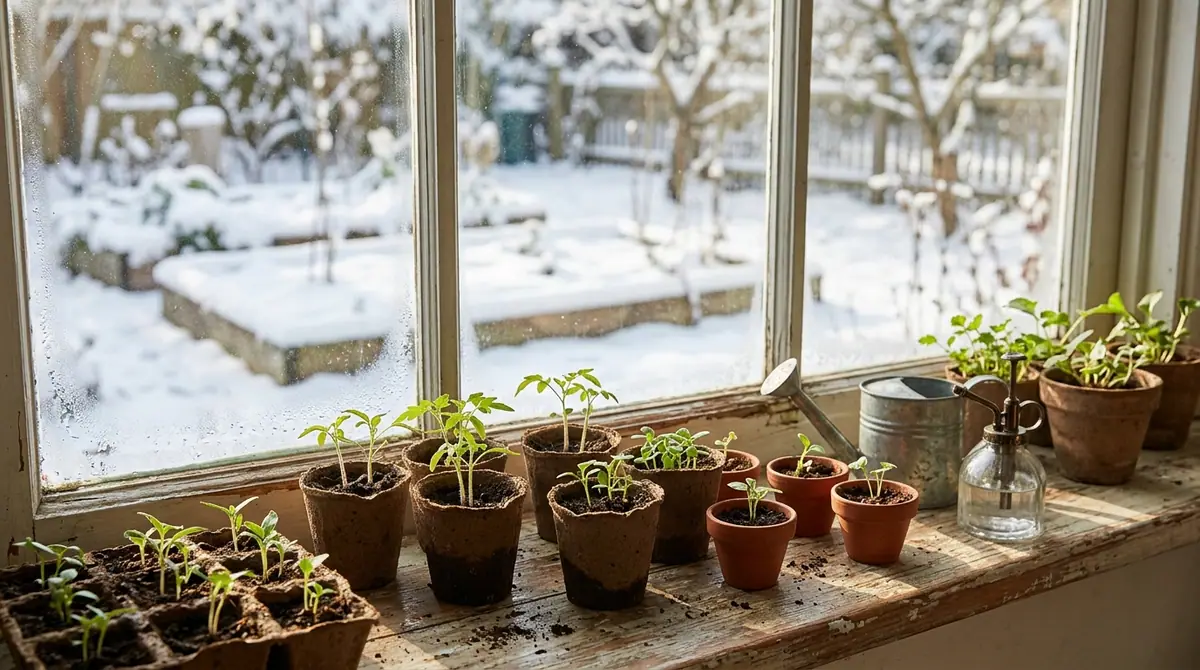
Last April, standing in a greenhouse in Ann Arbor while a wet, heavy snow squall coated the cold frames in slush, I pulled a tray of leggy tomato seedlings toward me and sighed. I had rushed the calendar by three weeks, driven by spring fever, and now I was nursing pale, collapsing stems that had outgrown their 1-inch cells long before the soil outside had thawed past 38°F (3.3°C). Michigan gardening humbles even seasoned botanists. Success here is not about beating winter; it is about synchronizing our indoor grow lights with the stubborn, shifting rhythms of Great Lakes weather.
1. Botanical Overview & Natural Habitat

Understanding the evolutionary adaptations of your crops helps explain why exact timing matters. Warm-season annuals like tomatoes, peppers, and eggplants originate from tropical and subtropical climates where soil temperatures consistently exceed 70°F (21.1°C). When we start these seeds indoors in February or March, we are artificially mimicking a long, frost-free growing season that Michigan’s natural climate simply does not provide. Conversely, cool-season crops like brassicas and How to Germinate Parsley Seeds Fast: Hot Water Soak & 7-Day Trick tolerate crisp air and can be started earlier, but pushing them too early indoors results in weak, heat-stressed plants before they ever hit the garden bed.
2. Essential Environmental & Care Requirements
Indoor seed starting in Michigan requires managing four critical environmental vectors: light, temperature, moisture, and media. Without precision in these areas, seedlings stretch, damp off, or stall entirely.
Light is the single most common failure point for Michigan indoor growers. Ambient window light—even a south-facing sill—is universally inadequate in March due to low sun angles and frequent overcast lake-effect days. Seedlings require full-spectrum LED grow lights positioned 2 to 3 inches (5 to 7.6 cm) above the foliage, running for 14 to 16 hours daily.
Temperature requirements are divided into two phases: germination and grow-out. Seeds need elevated soil temperatures to trigger metabolic activation, while post-germination seedlings thrive in cooler ambient conditions to prevent leggy growth.
Moisture management dictates root health. Over-saturation suffocates microscopic root hairs, while drought causes irreversible wilting. Water from the bottom by setting cell trays in a shallow bath for 20 minutes, allowing the sterile, peat-based soilless mix to wick moisture upward.
| Parameter | Optimal Condition | Common Mistake | Why It Matters |
|---|---|---|---|
| Soil Temperature (Germination) | 75°F to 85°F (23.9°C to 29.4°C) | Relying on cold room air | Cold media delays germination, inviting fungal pathogens like Pythium. |
| Light Intensity | Full-spectrum LED, 14–16 hrs/day | Placing trays on dim windowsills | Low light triggers etiolation, producing weak, spindly stems. |
| Ambient Air Temperature | 60°F to 65°F (15.6°C to 18.3°C) | Keeping seedlings near heating vents | High heat combined with low light accelerates unnatural top-heavy growth. |
| Media pH | 5.8 to 6.2 | Using heavy garden topsoil | Compacted native soil impedes fragile root development and lacks sterility. |
💡 Pro-Tip: Always invest in a digital waterproof soil thermometer during seed-starting season. Guessing your germination mat's temperature is a recipe for uneven sprouting; peppers, for instance, flatline below 70°F (21.1°C).
3. Step-by-Step Cultivation, Feeding & Propagation
Mastering the timeline for Michigan means mapping your frost dates precisely against crop-specific countdowns. For instance, slow-starting nightshades require an 8-to-10-week head start, while fast-growing cucurbits need only 3 weeks. If you push cucurbits too early, you will face the exact dilemma outlined in When to Transplant Cucumber Seedlings: Stop Root Shock & Boost Growth.
- Calculate Your Schedule: Subtract your target outdoor planting date from the crop's recommended indoor weeks. For a Zone 6b garden with a May 15 planting date, start slow peppers in mid-March and tomatoes in late March.
- Prepare the Media: Moisten a sterile peat-perlite-vermiculite seed-starting mix until it holds the consistency of a wrung-out sponge. Fill clean cell trays to 0.25 inches (0.6 cm) below the rim.
- Sow at Correct Depths: Plant seeds at a depth equal to two to three times their width. Tiny seeds like lettuce require surface sowing with light pressing; larger seeds like squash go 0.5 inches (1.3 cm) deep.
- Deploy Heat and Humidity: Cover trays with clear plastic domes to trap moisture and place them on a thermostatically controlled seedling heat mat set to 78°F (25.6°C).
- Transition to Light: The moment green loops break the soil surface, remove the humidity dome immediately and position your LED grow lights 2 inches (5 cm) above the leaves.
- Initiate Feeding: Once the first true leaves emerge—distinguishable from the rounded cotyledons—begin fertilizing weekly with a balanced organic liquid fertilizer diluted to one-quarter strength.
- Harden Off: Two weeks prior to your Michigan frost-free date, introduce seedlings to outdoor conditions incrementally over 10 to 14 days, sheltering them from heavy spring winds and intense direct midday sun.
For gardeners expanding their culinary repertoire beyond traditional Michigan staples, specialized resources like this Michigan State University Extension guide on starting seeds offer localized frost-date maps and regional climate nuances.
4. Common Problems, Pests & Troubleshooting
Even with careful timing, indoor environments can harbor challenges. Damping-off disease is the silent killer of Michigan seed racks. This fungal complex attacks seedlings at the soil line, causing them to pinch inward, topple, and die overnight. It thrives in stagnant, overly wet air. Prevent it by running a small oscillating fan across your seedling racks 24 hours a day to strengthen stem tissue and keep humidity levels manageable.
Leggy seedlings—tall, pale, and weak-stemmed—are another frequent hurdle caused by inadequate light or crowding. If your tomatoes or peppers begin leaning wildly toward a light source, immediately lower your fixtures and thin out overcrowded cells by snipping weaker plants at the base with sterile scissors rather than pulling them, which damages adjacent root systems.
Fungus gnats often appear when organic matter remains constantly damp. Let the top 0.5 inches (1.3 cm) of your growing medium dry out completely between waterings, and apply Bti (Bacillus thuringiensis israelensis) via watering to eradicate larvae naturally without harming young plants.
⚠️ Important Caution: Never use unsterilized garden soil or compost from your outdoor beds for indoor seed starting. Native soil contains heavy fungal spores, weed seeds, and pest larvae that will devastate indoor trays stripped of natural ecosystem controls.

5. Frequently Asked Questions
When is the absolute best time to start tomato seeds indoors in Michigan?
For most of Michigan's Lower Peninsula (Zones 5b to 6b), start tomato seeds indoors 6 to 8 weeks before your average last frost date—typically falling between mid-March and early April. Starting them in February leads to overgrown plants that become root-bound and stressed before the soil warms up enough outdoors.
Can I start all my vegetable seeds at the same time in March?
No. Different vegetables have drastically different growth rates and temperature thresholds. Cool-season crops like kale and broccoli can be started in early March, while warm-season lovers like peppers and eggplant require an earlier start in late February. Fast-growing squash and cucumbers should wait until mid-April so they do not outgrow their indoor containers.
How do I know if my seedlings are getting enough light?
If your seedlings develop long, spindly, pale stems and lean dramatically, they are starving for light. Healthy indoor seedlings should have compact, sturdy stems, deep green color, and close internodal spacing. Upgrade to high-output full-spectrum LED fixtures and keep them positioned just inches above the canopy.
What should I do if my indoor seedlings get too tall before Michigan's frost passes?
If your plants outgrow their containers too early, step them up into larger 4-inch pots using a light potting mix, burying slightly deeper if they are tomatoes (which can sprout roots along their buried stems). For more insights on managing transitioning crops effectively, consult the Royal Horticultural Society guidelines on container cultivation and plant propagation.
Related Guides
- When to Start Tomatoes Indoors Zone 6
- When to Start Tomato Seeds Indoors Zone 6
- When to Start Strawberries Indoors
- When to Start Stock Seeds Indoors
- When to Start Squash Seeds Indoors
📋 Table of Contents ▼ Click to expand
Tags:
Keep reading
🌿 Related Plants You Might Like






PlantSavvyWorld
Editorial team
PlantSavvyWorld is an independent botanical education project. Articles are drafted with AI assistance, then edited and checked against university extension services, botanical garden collections and other published horticultural sources.