

Maggots in Compost
Written with AI assistance, edited and checked against horticultural sources.
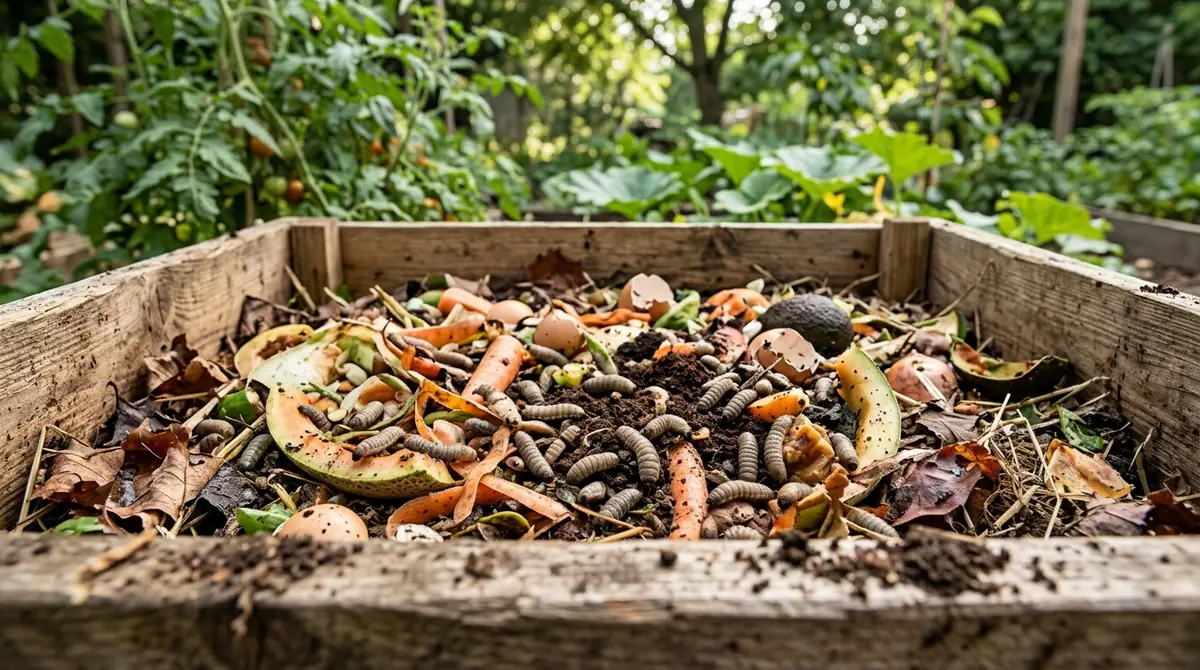
In a three-bin cedar setup in Zone 6b, the internal bin temperature can dip to 78°F (25.5°C) following a torrential three-day downpour, throwing off the carbon-to-nitrogen ratio. When this happens, a writhing, cream-colored carpet of black soldier fly larvae may appear, which can be managed by grabbing a pitchfork and adding a wheelbarrow of shredded autumn leaves.

1. Botanical Overview & Natural Habitat
To manage organisms in your compost system, you must understand their ecological role. Compost "maggots" are almost exclusively the larval stage of either the Black Soldier Fly (Hermetia illucens) or common houseflies (Musca domestica). From a soil-science perspective, these detritivores act as primary macro-decomposers, accelerating the breakdown of complex organic matter long before microscopic bacteria and fungi finish the humification process.
In their natural habitat—decaying forest floors, rotting logs, and rich topsoil layers—these larvae thrive in environments rich in decaying plant and animal tissues. Their morphology is entirely optimized for this niche: legless, cylindrical bodies with specialized mouthparts designed for rasping semi-liquid organic matter. A single black soldier fly larva can consume up to 0.08 ounces (2.3 grams) of organic waste per day during its peak feeding window.
| Parameter | Optimal Condition | Common Mistake | Why It Matters |
|---|---|---|---|
| C:N Ratio | 30:1 (Carbon to Nitrogen) | Dumping pure kitchen scraps | High nitrogen attracts egg-laying flies and creates anaerobic rot. |
| Moisture Content | 45% to 60% | Leaving the pile uncovered in rain | Excess water fills pore spaces, suffocating aerobic microbes and driving larvae to the surface. |
| Internal Temperature | 135°F to 160°F (57°C to 71°C) | Allowing the pile to drop below 110°F (43°C) | High thermal mass kills fly eggs and pathogens while accelerating decomposition. |
| Particle Size | 0.5 to 2 inches (1.25 to 5 cm) | Leaving whole vegetables or large carcasses intact | Smaller surface area slows microbial colonization, prolonging the maggot attraction phase. |
2. Essential Environmental & Care Requirements
Controlling maggots in a managed landscape system requires manipulating the core environmental parameters of your compost heap. Flies lay eggs when they detect volatile fatty acids and ammonia released by decomposing nitrogen-rich materials. To deter them, your system must maintain strict parameters regarding aeration, temperature, and carbon stratification.
Oxygen is your primary tool. Aerobic bacteria require free-air space within the pile's pore structure. When compaction or water saturation reduces oxygen levels below 10%, the pile turns anaerobic. This environment stops standard decomposition, creates foul odors, and attracts high volumes of housefly and blowfly larvae.
Temperature management is equally critical. A healthy, active compost pile should naturally heat up to between 130°F and 155°F (54.4°C to 68.3°C) within the central core (the "hot zone"). At these thermal thresholds, fly eggs and early-stage larvae cannot survive. If your pile is cool (under 90°F / 32°C), it functions merely as an open-air garbage dump rather than a bio-digester, inviting continuous colonization by insects.
Moisture must be balanced to mimic a wrung-out sponge. If you squeeze a handful of compost and more than two drops of water escape, your moisture content exceeds 60%, signaling an environment prone to pest proliferation.
💡 Pro-Tip: If you identify your visitors as Black Soldier Fly larvae (distinguished by their segmented, flat, brownish-gray bodies and active writhing), do not try to eradicate them. They are beneficial competitors that physically outcompete housefly larvae, eliminate harmful bacteria like Salmonella, and break down organic matter up to five times faster than standard earthworms.
3. Step-by-Step Cultivation, Feeding & Propagation
When dealing with an infestation of unwanted housefly maggots, or when optimizing your system to harness beneficial black soldier fly larvae, you must execute a strict corrective protocol. Follow these steps to restore balance to your composting vessel:
- Assess and Measure Moisture Depth: Insert a soil moisture meter or your bare arm 12 inches (30.4 cm) into the center of the pile. If the material is soggy, cool, and emitting a sour or sulfurous odor, you have an anaerobic pocket.
- Apply the Brown-to-Green Carbon Buffer: Add a 4-to-1 volumetric layer of dry carbon sources—such as shredded corrugated cardboard, fall deciduous leaves, or untreated sawdust—over the top of the affected area to absorb excess moisture and mask nitrogen odors.
- Turn the Pile Thoroughly: Using a compost aerator or a heavy-duty fork, turn the entire pile inside out. Move the outer, cooler edges into the center core, ensuring that all surface materials containing visible larvae are buried at a depth of at least 18 inches (45.7 cm).
- Elevate Core Temperatures: Rebuild the pile into a dense cube measuring at least 3 feet by 3 feet by 3 feet (0.9 meters cubed) to retain metabolic heat generated by microbial activity. Cover the top with a breathable canvas tarp to shed excess rainwater while allowing carbon dioxide to escape.
- Adjust Kitchen Scrap Input Protocols: Cease adding raw meat, dairy, oil, and excessive citrus peels for 21 days. Chop all remaining vegetable scraps to pieces smaller than 1 inch (2.5 cm) before burial deep within the carbon matrix.
⚠️ Important Caution: Never apply uncomposted, maggot-ridden kitchen waste directly to the root zones of edible garden crops. Raw animal proteins and untreated waste can harbor human pathogens like E. Coli and plant-parasitic nematodes that survive in low-heat soil environments.
For further reading on maintaining balanced organic systems, consult the guidelines provided by the Cornell Waste Management Institute.
4. Common Problems, Pests & Troubleshooting
Even experienced gardeners encounter persistent pest pressures within organic systems. Here is how to diagnose and resolve the most frequent complications associated with compost larvae:
- The Ammonia Odor and Larvae Outbreak: If your bin smells strongly of cat urine or ammonia, your C:N ratio is severely skewed toward nitrogen (too many green grass clippings or food scraps). The resulting high pH triggers rapid fly egg-hatching. Solution: Immediately incorporate 2 gallons (7.5 liters) of agricultural lime or wood ash per cubic yard, followed by a heavy layer of dry carbon.
- Surface Migration and Escape: If you notice thousands of larvae crawling up the sides of your plastic bin or tumbling onto the surrounding patio, they are likely searching for a dry pupation site. Solution: This is a natural life-cycle transition for black soldier fly larvae. Dig a shallow pit 6 inches (15 cm) deep adjacent to the bin, fill it with dry wood chips, and sweep the migrating larvae into it; they make exceptional, protein-rich feed if you keep chickens.
- Persistent Fruit Flies and Fungus Gnats: Small, gnat-like larvae clinging to the upper 2 inches (5 cm) of your pile indicate exposed, rotting fruit surfaces. Solution: Implement the "brown blanket" rule. Every time you add kitchen waste, immediately cap it with a 3-inch (7.6 cm) layer of finished compost, shredded paper, or finished garden soil to block oviposition (egg-laying).

5. Frequently Asked Questions
Are maggots in a compost pile bad?
Not necessarily. If they are black soldier fly larvae, they are beneficial organisms that rapidly break down waste and deter houseflies. However, if they are housefly or blowfly larvae resulting from an anaerobic, foul-smelling pile, they indicate that your system requires immediate carbon balancing and aeration.
How do I get rid of maggots in my compost without chemicals?
You can eliminate unwanted maggots naturally by altering their environment rather than using pesticides. Turn the pile to expose them to high core heat (above 130°F / 54.4°C), add dry carbon materials like shredded leaves or cardboard to lower moisture levels, and bury all food scraps at least 12 inches (30.4 cm) deep beneath the surface.
Can I still use compost that had maggots in it?
Yes, absolutely. Once the composting process reaches completion—signified by a dark, crumbly texture, an earthy forest-floor aroma, and ambient temperatures matching the surrounding air—all pathogenic risks are eliminated. Any remaining insect larvae will have completed their life cycle and departed or broken down entirely into rich organic matter.
What causes maggots to suddenly appear in outdoor compost?
Adult flies are attracted to volatile organic compounds released by decomposing proteins, simple sugars, and high-moisture green waste. If a pile is left uncovered, has too much moisture, or lacks a proper carbon cap, female flies can detect the scent from miles away and lay hundreds of eggs within hours.
Related Guides
- Topsoil and Compost Mix
- Compost As Topsoil
- Can You Compost Pistachio Shells
- Compost for Topsoil
- The Best Compost Bin Only Costs About 40
📋 Table of Contents ▼ Click to expand
Tags:
Keep reading
🌿 Related Plants You Might Like






PlantSavvyWorld
Editorial team
PlantSavvyWorld is an independent botanical education project. Articles are drafted with AI assistance, then edited and checked against university extension services, botanical garden collections and other published horticultural sources.