Written with AI assistance, edited and checked against horticultural sources.
Compacted urban clay that has zero structural pore space for roots to breathe often causes plants to wilt not from drought, but from suffocation. Instead of reaching for a bag of chemical fertilizer or a rotary tiller, bringing in two cubic yards of fully finished, dark-brown compost and layering a precise 3-inch (7.6 cm) blanket across the entire surface solves this. Within one season, soil microbiologists testing these plots will find organic matter jumps from 1.8% to 6.4%, earthworms colonize the upper 6 inches (15 cm), and struggling coneflowers double in root mass. Using compost for topsoil transformation is not just a garden hack; it is a fundamental biological restoration project that mimics the richest forest floors on earth.
1. Botanical Overview & Natural Habitat
To understand why applying compost for topsoil works so brilliantly, we have to look to natural ecosystems. In an undisturbed deciduous woodland or native prairie, plants never experience bare mineral dirt. Instead, they grow in a dynamic, living layer known scientifically as the O-horizon and A-horizon. Fallen leaves, decaying wood, and animal waste form a continuous mulch on the surface, which soil-dwelling organisms continuously process into humus.
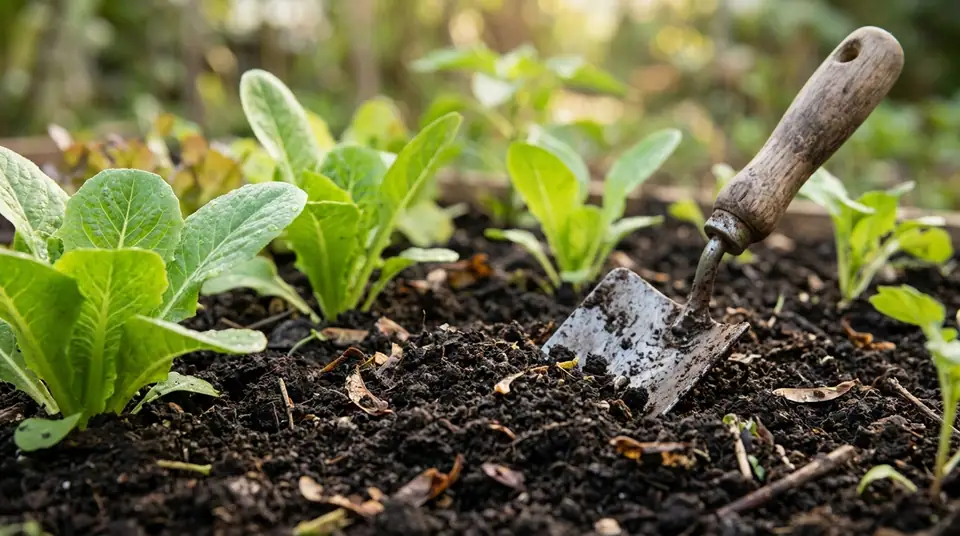
Garden trowel stuck in dark compost soil beside young leafy greens
Humus is the ultimate end-product of decomposition—a stable, colloidal substance with a massive cation exchange capacity (CEC). In natural habitats, this rich topsoil layer maintains a sponge-like architecture. It holds roughly 20 times its weight in water while simultaneously draining excess moisture to prevent root rot. When we use compost to enrich or rebuild topsoil in our home landscapes, we are artificially accelerating this natural successional process.
From a botanical perspective, topsoil enhanced with high-grade compost provides a physical matrix where plant roots can optimize resource acquisition. Fine root hairs, which are responsible for the uptake of water and immobile nutrients like phosphorus, cannot penetrate dense, compacted clay or coarse, sterile sand. Compost introduces microscopic pore networks—both capillary pores that hold water and macropores that channel oxygen down to a depth of 12 inches (30 cm) and beyond. Furthermore, matured compost teems with beneficial mycorrhizal fungi and plant growth-promoting rhizobacteria (PGPR). These microscopic allies form symbiotic relationships with plant root tips, effectively increasing the root surface area by up to 1000% and shielding plants against soil-borne pathogens like Pythium and Fusarium. If you are looking to generate your own high-grade material for this process, you can learn more by exploring How to Make Organic Compost for Vegetable Gardens at Home, or by investing in equipment outlined in guides like The Best Compost Bin Only Costs About 40 and the Best Compost Shredder. If your DIY efforts attract unwelcome visitors along the way, consult our troubleshooting guide on Maggots in Compost.
2. Essential Environmental & Care Requirements
Applying compost for topsoil is not a "set-it-and-forget-it" operation. To maximize its biological activity, you must manage specific environmental parameters. Soil microbes require warmth, moisture, and oxygen to thrive and integrate the organic matter into the existing mineral subsoil.
The microbial digestion of compost peaks when soil temperatures range between 70°F and 85°F (21°C to 29°C). Below 45°F (7°C), biological activity drops into dormancy, meaning winter applications sit inert until spring warming occurs. Moisture is equally critical: soil moisture levels should hover around 50% to 60% of field capacity—feel it by squeezing a handful; it should form a moist ball that breaks apart lightly under pressure without dripping water.
Parameter
Optimal Condition
Common Mistake
Why It Matters
Compost Maturity
Dark, crumbly, earthy smell; C:N ratio < 20:1
Using raw, uncomposted manure or woody mulch
Unfinished material ties up soil nitrogen, starving plants
Application Depth
1 to 3 inches (2.5 cm to 7.6 cm) per layer
Dumping piles > 6 inches (15 cm) thick
Deep smothering cuts off oxygen, suffocating soil fauna and roots
Soil pH Range
6.2 to 6.8
Applying overly acidic or alkaline compost blindly
Extreme pH locks out essential micronutrients regardless of organic richness
💡 Pro-Tip: Always check the carbon-to-nitrogen (C:N) ratio of your compost before topdressing lawns or beds. If the material still contains recognizable wood chips or smells faintly of ammonia, it is not ready. Applying immature compost to topsoil will trigger a temporary nitrogen lockout as soil microbes consume available nitrogen to break down excess carbon.
Transforming degraded earth into a thriving growing medium using compost requires a methodical approach. Do not simply dump compost on top of soil and walk away; proper integration ensures the organic matter bonds with the underlying mineral layers to prevent erosion and nutrient leaching.
Clear and Assess: Clear the target area of persistent perennial weeds, rocks larger than 1 inch (2.5 cm), and construction debris. Test your native soil texture by rolling a moistened sample in your palm; this tells you whether you are dealing with sand, silt, or clay.
Calculate Volume: Measure your square footage. To apply a standard 2-inch (5 cm) topdressing layer, you will need roughly 6.2 cubic yards of compost per 1,000 square feet (93 square meters).
Surface Scarification: For hard-packed clay or heavily trafficked garden beds, lightly scarify the top 0.5 inches (1.3 cm) of the native soil using a garden rake or cultivator. This creates a rough interface that prevents the new compost layer from sliding off or forming a distinct boundary layer that impedes root penetration.
Broadcast and Level: Distribute the compost evenly across the area using a wheelbarrow and a flat-backed landscape rake. Spread it to a consistent depth of 1 to 2 inches (2.5 cm to 5 cm) for established plantings, or up to 4 inches (10 cm) if you are building an entirely new bed from scratch.
Microbial Integration: Lightly work the bottom half of the compost layer into the top 1 inch (2.5 cm) of native soil using a leaf rake or cultivator tines. Leave the upper half undisturbed to act as a protective surface mulch.
Initial Watering: Apply 0.5 inches (1.3 cm) of water using a gentle, droplet-style sprinkler setting. This settles the compost particles into the soil micro-pores, establishes capillary action, and wakes up dormant soil microbes. For deeper scientific insights into soil organic amendments, consult the USDA Natural Resources Conservation Service Soil Health guides.
4. Common Problems, Pests & Troubleshooting
Even experienced gardeners encounter hurdles when integrating compost for topsoil enhancement. Identifying issues early prevents plant stress and soil degradation.
Issue: Surface Crusting and Water Repellency
Symptom: Water beads up on top of the compost layer rather than soaking in, often happening when fine-textured compost dries out completely.
Correction: Break the surface tension by gently aerating the topsoil with a garden fork. Water slowly using a oscillating sprinkler or soaker hose over a 2-hour period to rehydrate the colloidal humic acids.
Issue: Weed Seed Germination Outbreak
Symptom: A sudden explosion of annual weed seedlings across the newly topdressed beds.
Correction: This occurs when municipal compost piles fail to reach the pathogen- and weed-seed-killing temperature threshold of 131°F to 160°F (55°C to 71°C) for a sustained period. Hand-pull weeds immediately while small, or apply a light 0.5-inch (1.3 cm) layer of shredded leaf mulch over the compost to block light penetration to weed seeds.
Issue: Nutrient Imbalances and Chlorosis
Symptom: Yellowing leaves with green veins (interveinal chlorosis) on plants growing in newly amended topsoil.
Correction: Often caused by high pH levels in mushroom compost or manure-heavy blends that lock up iron and manganese. Test the soil pH and apply elemental sulfur if the pH exceeds 7.2, or foliar feed with a chelated micronutrient spray. For regional gardening protocols tailored to your specific climate zone, check out resources provided by the Royal Horticultural Society Soil Management guidelines.
⚠️ Important Caution: Never use compost sourced from municipal green waste facilities if you cannot verify their feedstock for persistent herbicides such as aminopyralid or clopyralid. These broadleaf herbicides survive the high-temperature composting process and will severely deform or kill tomatoes, peppers, beans, and other sensitive garden crops for multiple seasons. Always perform a simple bean bioassay test by sprouting a few green beans in a small pot of your compost before spreading it across your entire garden.
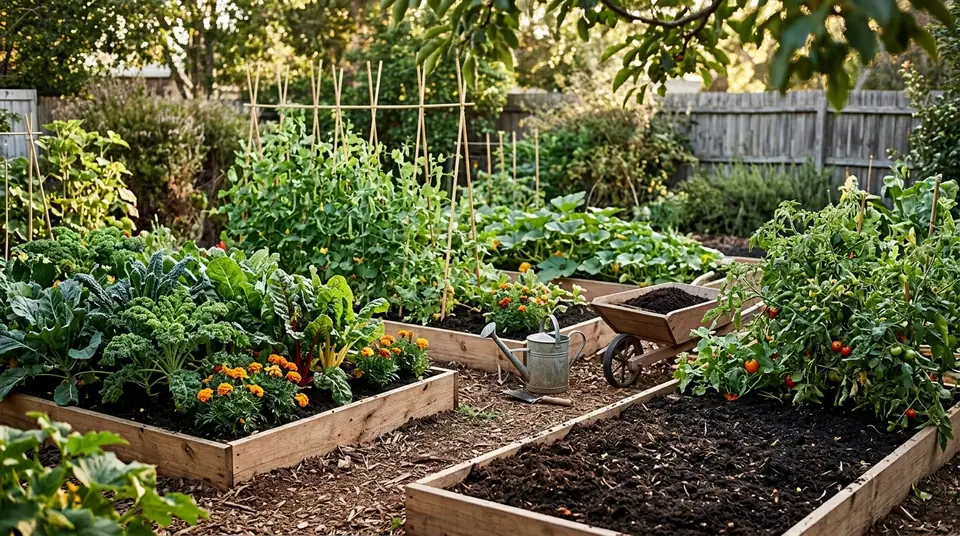
Raised garden beds filled with dark compost and lush green vegetables
5. Frequently Asked Questions
Can I put compost directly on top of my lawn as topsoil?
Yes, this is known as topdressing lawns. Apply a finely screened compost no deeper than 0.25 to 0.5 inches (0.6 cm to 1.3 cm) over the grass blades in early spring or fall. Drag it flat with a leveling rake or push broom so the grass blades remain visible, then water thoroughly. This introduces beneficial microbes, smooths out minor bumps, and feeds turf roots naturally without chemical burn.
How often should I add compost to my garden topsoil?
For established perennial beds and vegetable gardens, apply a fresh 0.5 to 1-inch (1.3 cm to 2.5 cm) layer of compost once a year, preferably in early spring before active growth begins or in late autumn after harvest. Soil biology continuously consumes organic matter, meaning carbon and humus levels drop by roughly 1% to 2% annually through natural respiration and plant uptake.
Is bagged compost from the garden center better than bulk compost?
Neither is inherently better; it depends entirely on the source and processing quality. Bagged compost is sterilized or pasteurized, offering consistent texture and freedom from weed seeds, but it is significantly more expensive per cubic yard and creates plastic waste. Bulk compost is far more economical for large projects, but you must inspect it personally for moisture content, odor, and debris before purchasing.
Will adding compost change my soil pH?
Most fully finished composts have a neutral pH ranging between 6.5 and 7.2, meaning they act as a natural pH buffer rather than a dramatic corrector. However, specialized inputs like mushroom compost can be alkaline (pH 7.5 to 8.0) due to chalk or lime additives, while composts heavy in pine needles or oak leaves may lean slightly acidic. Always match your compost type to your target plant species' pH preferences.
PlantSavvyWorld is an independent botanical education project. Articles are drafted with AI assistance, then edited and checked against university extension services, botanical garden collections and other published horticultural sources.