

How to Water and Maintain Carnivorous Plants at Home
Written with AI assistance, edited and checked against horticultural sources.
Years ago, I stood knee-deep in a North Carolina coastal pocosin, watching water slip past my waders as the Carolina sky burned a humid 92°F (33°C). I was staring directly into a dense colony of Dionaea muscipula—the Venus flytrap—anchored not in rich, loamy garden soil, but in a starved, acidic slurry of damp sphagnum peat and white sand. The water table sat a mere 0.5 inches (1.3 cm) below the surface, keeping the substrate permanently saturated. When I tried to cultivate my first indoor specimen back home by mimicking standard houseplant routines—watering it with tap water from the kitchen sink and letting it dry out between drinks—it turned black and died within three weeks. That failure launched a two-decade career studying carnivorous flora. These plants do not play by standard botanical rules, and mastering how to water and maintain them at home requires completely unlearning conventional gardening instincts.
1. Botanical Overview & Natural Habitat

Understanding this evolutionary pedigree dictates every choice you make indoors. Because their native soils feature total mineral starvation, these plants possess hyper-sensitive root systems. Standard potting soils, chemical fertilizers, and even trace minerals found in municipal tap water will quickly burn and kill them through osmotic shock—a phenomenon I often compare to giving a starving person a heavy, salt-laden meal.
For more background on matching plants to specialized habitats and companion planting strategies, you can explore our guide on Sweet Potato Companion Plants: 8 Best Garden Friends & 3 Foes to Avoid, which highlights how unique root zones and soil interactions dictate overall vigor. While you won't be planting these beside root vegetables, the principle of respecting native soil chemistry remains identical.
2. Essential Environmental & Care Requirements
To keep your carnivorous collection thriving on a windowsill, sunroom, or under lights, you must replicate four primary environmental pillars: water purity, intense light, specialized substrate, and dormant rest periods.
| Parameter | Optimal Condition | Common Mistake | Why It Matters |
|---|---|---|---|
| Water Purity | Total Dissolved Solids (TDS) < 50 ppm | Using tap, mineral, or softened water | High mineral content builds up in roots, causing irreversible chemical burn and death. |
| Light Exposure | 6 to 12 hours of direct sunlight or intense LED | Keeping them in dim, indirect indoor corners | Insufficient light halts photosynthesis and prevents trap coloration and structural integrity. |
| Substrate Mix | 50:50 unfertilized peat moss and perlite/silica sand | Using standard potting soil or miracle-gro mixes | Rich organic matter and added fertilizers introduce lethal levels of nutrients and salts. |
| Temperature | Summer: 75°F–90°F (24°C–32°C); Winter: 35°F–50°F (2°C–10°C) | Keeping tropicals in freezing cold or temperate species in constant indoor heat | Temperate species require winter cold cues to trigger hormonal dormancy cycles. |
Water quality is the single most common failure point. You must exclusively use distilled water, reverse osmosis (RO) water, or harvested rainwater with a reading under 50 parts per million (ppm) on a digital TDS meter. Never use municipal tap water, bottled drinking water with added minerals, or water softened by a household salt-exchange system.
⚠️ Important Caution: Never let your carnivorous plants sit in standard garden soil or use fertilizers of any kind. A single application of a balanced liquid houseplant fertilizer will scorch and destroy the root hairs within 48 hours.
For comprehensive botanical data on soil acidity and bog plant ecologies, consult the International Carnivorous Plant Society.
3. Step-by-Step Cultivation, Feeding & Propagation
Maintaining these specimens involves precise, disciplined routines. Follow this step-by-step protocol for daily and seasonal care:
- Select the Proper Container: Choose a pot made of UV-stabilized plastic, glazed ceramic, or unglazed terra cotta (though terra cotta wicks moisture rapidly and requires more frequent refilling). Ensure the pot features at least one dependable drainage hole at the base.
- Prepare the Substrate: Mix equal parts (50:50) of pure, unfertilized Canadian sphagnum peat moss and horticultural-grade perlite or coarse silica sand. Avoid any mix containing added wetting agents, fertilizers, or compost.
- Hydrate the Medium: Thoroughly moisten the peat-perlite mixture with distilled water in a bucket before potting until it attains the consistency of a damp, wrung-out sponge.
- Plant the Specimen: Gently nestle the plant into the substrate, ensuring the crown (where the roots meet the leaves) sits precisely at or just above the soil line. Burying the crown too deeply leads to fungal rot.
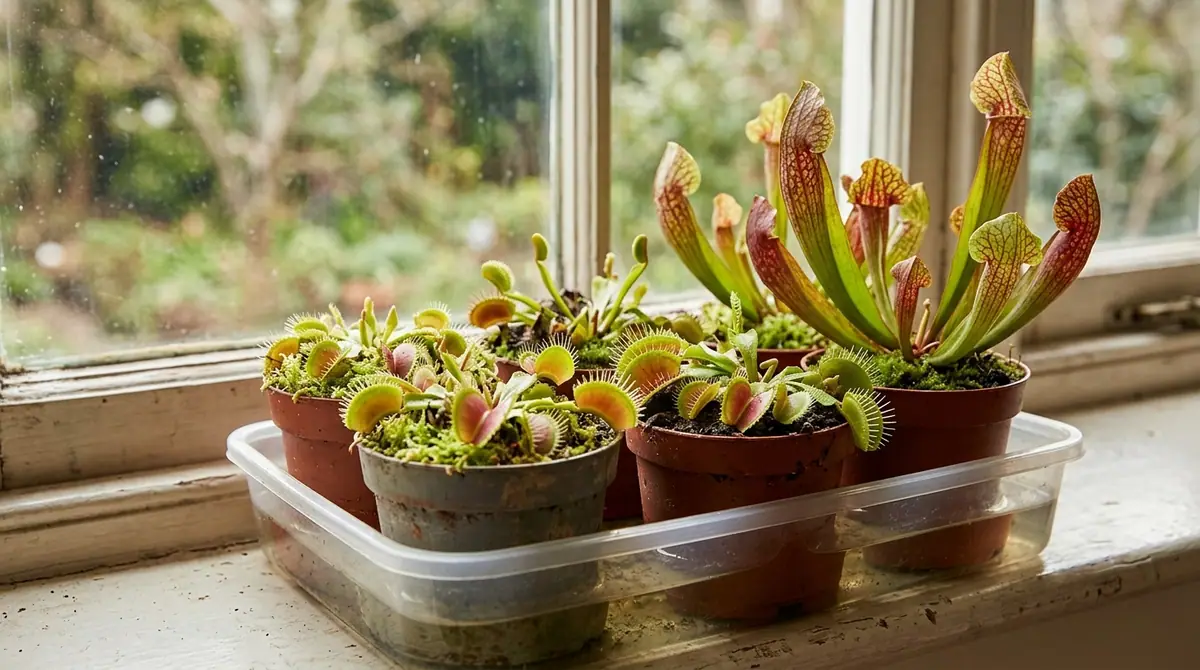
- Establish the Tray Method (Watering): Set the potted plant inside a saucers or cachepot filled with 0.5 to 1 inch (1.3 to 2.5 cm) of distilled water. Allow the medium to wick moisture upward continuously. For temperate species like Sarracenia and Dionaea, keep this water level consistent throughout the active growing season.
- Provide Optimal Lighting: Position the container in a south-facing window that receives a minimum of 6 hours of direct sunlight, or suspend a full-spectrum LED grow light 12 to 18 inches (30 to 45 cm) above the canopy for 12 to 14 hours daily.
- Manage Feeding Naturally: Allow outdoor plants to catch their own prey. If grown indoors behind glass, you may occasionally feed an active trap a single live, flightless fruit fly or a very small cricket once every 3 to 4 weeks. Never force a trap to close on non-organic objects or dead matter.
If you enjoy managing specialized plant life cycles and environmental forcing techniques—such as orchestrating dormancy or handling specialized growth stages—you may also appreciate our guide on Holiday Plants Care Guide: How to Force Poinsettias to Rebloom & Holiday Cacti ID, which explores the mechanics of environmental triggers in residential spaces.
💡 Pro-Tip: When dealing with temperate bog plants like Venus flytraps during winter, do not panic when they drop their leaves and look nearly dead. Move them to a cool, protected garage or unheated basement where temperatures stay between 35°F and 50°F (2°C and 10°C) for 3 to 4 months to satisfy their mandatory dormancy requirement.
4. Common Problems, Pests & Troubleshooting
Even experienced growers encounter environmental hurdles. Spotting issues early makes all the difference:
- Black, Dying Traps: If individual traps turn black and die off, check the age of the leaf. Older traps naturally blacken and wither. However, if all new growth turns black simultaneously, you are dealing with mineral burn from tap water or severe root rot caused by stagnant, foul-smelling anaerobic conditions. Flush the pot immediately with gallons of pure distilled water, or repot into fresh substrate.
- Etiolation (Weak, Stretched Growth): When leaves grow long, pale, and weak without structural rigidity, your plant is starving for photons. Immediately relocate it to a brighter southern exposure or increase your artificial lighting intensity and duration.
- Aphids and Fungus Gnats: Indoor collections can occasionally attract sap-sucking pests. Avoid harsh chemical sprays, which damage carnivorous foliage. Instead, gently wipe pests away with a cotton swab dipped in isopropyl alcohol, or introduce beneficial nematodes if growing in a greenhouse setting.

5. Frequently Asked Questions
Can I water my carnivorous plants with melted snow or air conditioner condensate?
Yes, both melted snow and AC condensate are generally acceptable sources of pure water, provided they meet purity standards. AC condensate is essentially distilled water produced by ambient humidity cooling over evaporator coils, though you should ensure your unit's coils are clean and free of heavy copper or chemical residues. Always test the output with a TDS meter to confirm readings remain below 50 ppm before using it on sensitive root systems.
Do Venus flytraps need to eat bugs to survive?
No, insects are not strictly required for survival. Carnivorous plants derive their energy and structural mass primarily through standard photosynthesis—converting light, carbon dioxide, and water into sugars. Insects act purely as a supplementary fertilizer source providing vital nitrogen and phosphorus. A plant grown in optimal light without ever catching a bug will survive, though it may grow slightly slower than a well-fed specimen.
Why are the traps on my pitcher plant turning brown at the tips?
Tip dieback on pitcher plants (Nepenthes or Sarracenia) is most frequently caused by low ambient humidity or erratic soil moisture levels. Tropical pitcher plants require relative humidity levels between 50% and 80%. If the surrounding air is too dry, the delicate digestive fluids inside the pitcher evaporate too quickly, scorching the delicate cellular tissue at the rim and tip of the trap.
How often should I repot my carnivorous plants?
You should refresh the substrate and repot temperate carnivorous plants every 1 to 2 years, typically in late winter or early spring just before new growth emerges. Over time, sphagnum peat moss breaks down, compacts, and accumulates trace minerals, restricting oxygen flow to the root zone. Repotting into a fresh 50:50 peat and perlite mix revitalizes root aeration and prevents mineral toxicity.
Related Guides
- How to Dechlorinate Tap Water for Free at Home
- How to Start a Hydroponic Gardening System at Home
- How to Sharpen Garden Tools Properly at Home
- How to Make Organic Compost for Vegetable Gardens at Home
- Can Cannas Grow in Water
📋 Table of Contents ▼ Click to expand
Tags:
Keep reading
🌿 Related Plants You Might Like






PlantSavvyWorld
Editorial team
PlantSavvyWorld is an independent botanical education project. Articles are drafted with AI assistance, then edited and checked against university extension services, botanical garden collections and other published horticultural sources.