

How to Make a Bubbling Rock Fountain
Written with AI assistance, edited and checked against horticultural sources.
1. Botanical Overview & Natural Habitat
Newly planted Japanese forest grass (Hakonechloa macra) can look stressed despite adequate soil moisture if the microclimate lacks humidity and acoustic tranquility. Plants do best near trickling seeps, moss-draped limestone drips, and bubbling springheads where water oxygenates the air and draws beneficial pollinators.

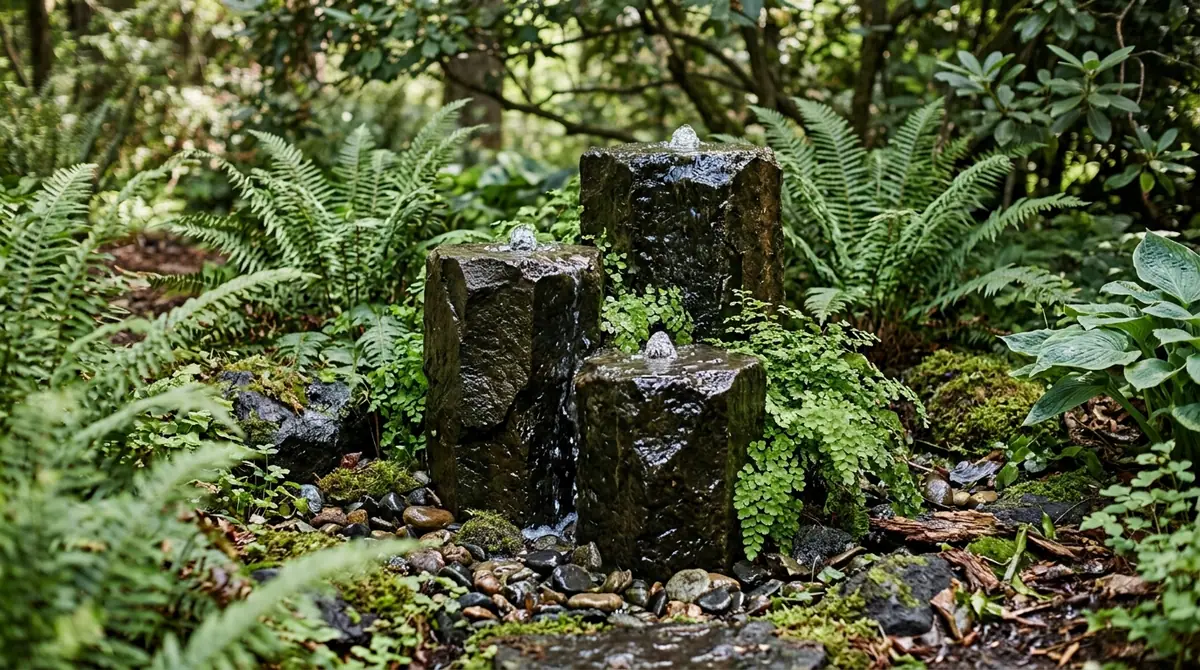
The centerpiece of this ecosystem is the bubbling rock itself. Geologically, you want a dense, non-porous stone—such as basalt, granite, or dense fieldstone—that will not fracture under the freeze-thaw cycles of winter, which routinely dip below 32°F (0°C). Unlike porous sandstone or limestone that leaches minerals and alters your soil chemistry over time, hard igneous and metamorphic rocks act as inert, sculptural anchors. They mimic the glacial erratic boulders found in native riparian zones, creating a hyper-local habitat where mosses naturally colonize the damp margins and birds gather to drink in absolute safety.
2. Essential Environmental & Care Requirements
Building a bubbling rock fountain requires precise adherence to physical, mechanical, and horticultural parameters. If you place your fountain directly under a deciduous tree, falling leaves and organic tannins will clog your pump intake within 14 days of autumn drop. You must balance aesthetic placement with mechanical accessibility.
Below is a breakdown of the critical parameters required for a healthy, low-maintenance bubbling rock installation:
| Parameter | Optimal Condition | Common Mistake | Why It Matters |
|---|---|---|---|
| Water Depth & Volume | 30 to 50 gallons (113 to 189 liters); minimum basin depth of 12 inches (30 cm) | Using an undersized 10-gallon basin | Small volumes evaporate within 48 to 72 hours in summer, causing pump burnout. |
| Sunlight Exposure | Partial shade (3 to 5 hours of morning sun) | Full, unfiltered southern exposure (8+ hours) | Excessive UV light accelerates string algae blooms and raises water temperatures above 85°F (29°C), starving fish and plants of oxygen. |
| Electrical Supply | GFCI-protected, weather-rated outdoor outlet within 15 feet (4.6 meters) | Using indoor extension cords or non-GFCI circuits | Ground Fault Circuit Interrupters prevent fatal electrical shorts when handling wet stone and submerged equipment. |
| Sub-Base Compaction | 4 inches (10 cm) of compacted crushed limestone aggregate (grade #57) | Placing the heavy basin directly onto loose, uncompacted topsoil | Settling over the first winter will tilt the basin, causing water to spill over one side instead of recycling evenly. |
💡 Pro-Tip: When selecting your core rock, run a simple vinegar test on a chip of the stone. If the vinegar fizzes, the rock contains calcium carbonate, which will continuously leach into your water, spiking pH levels and shocking any surrounding acid-loving plants like azaleas or rhododendrons when you top off or splash the fountain.
3. Step-by-Step Cultivation, Feeding & Propagation
Integrating a bubbling rock fountain into your planting beds requires treating the stone and basin as a structural extension of your garden design. You are not just placing a piece of art; you are establishing a hydrological node.
Follow this numbered protocol to construct a professional-grade bubbling rock fountain from scratch:
- Excavate the Reservoir Site: Mark a circle 6 inches (15 cm) wider than your underground basin (typically a 35 to 45-inch diameter polyethylene basin). Dig out the earth to a depth of 16 to 18 inches (41 to 46 cm), ensuring the bottom of the excavation is level.
- Lay and Compact the Base: Pour 4 inches (10 cm) of crushed #57 stone into the excavated hole. Tamp it down thoroughly using a hand tamper until the base is completely rigid and level across all axes using a 2-foot spirit level.
- Position the Basin: Lower the structural basin into the center of the pit. Check for levelness in four directions. Backfill the outer perimeter gaps with clean sand or native soil, packing it down firmly every 4 inches (10 cm) to prevent future shifting.
- Install the Submersible Pump and Tubing: Place a magnetically driven submersible pump—rated between 300 and 500 gallons per hour (GPH)—inside the basin vault. Attach reinforced, kink-free vinyl tubing to the pump outlet, running it up through the center conduit of the basin lid.
- Core and Mount the Boulder: Select a basalt or granite column that has been pre-drilled with a 1-inch (2.5 cm) core hole. Thread the vinyl tubing up through the bottom of the rock as you lower it onto the reinforced basin grate. Secure the boulder using stainless steel shims if it wobbles.
- Conceal the Basin Lid: Cover the structural plastic basin lid with a layer of heavy-duty underlayment fabric to keep debris out, then arrange washed river rock, Mexican beach pebbles, or larger fieldstones (ranging from 2 to 5 inches / 5 to 13 cm in size) across the top to hide all plastic elements.
- Fill and Test the System: Fill the reservoir with clean tap water until it reaches 2 inches (5 cm) below the rim. Plug the pump into your GFCI outlet and adjust the inline flow valve until the water wells up smoothly over the top of the rock without splashing wildly onto the surrounding soil.
For comprehensive guidance on selecting aquatic plants to frame your new water feature, consult the Missouri Botanical Garden Plant Finder.
⚠️ Important Caution: Never let your fountain run dry. Running a submersible pump without water for even 15 minutes can melt the internal housing, burn out the motor, and create an extreme electrical hazard. Always top off the reservoir weekly during peak summer months when evaporation rates peak at 1 to 2 inches (2.5 to 5 cm) per week.
4. Common Problems, Pests & Troubleshooting
Even the most carefully constructed water features encounter environmental imbalances. Here is how to diagnose and correct the most common issues:
- Green Water and String Algae: Caused by excess nitrates from surrounding lawn fertilizers and direct sunlight. Do not use chemical copper algaecides if frogs or birds visit the fountain. Instead, add floating marginal plants like water lettuce or shade the basin by planting structural perennials like Darmera peltata nearby to block direct sun.
- Rapid Water Loss: If you are losing more than 2 inches (5 cm) of water per week outside of dry weather, you likely have a water diversion issue rather than a leak. Check the splash zone around the basin perimeter; if surrounding mulch or soil is higher than the basin edge, capillary action will wick water out of the reservoir into the surrounding garden beds.
- Low Flow or Spitting: Usually caused by particulate debris clogging the pump's intake pre-filter, or a kink in the vinyl tubing hidden beneath the boulder. Unplug the system, remove the decorative top rocks, lift the pump, and rinse the intake sponge in a bucket of dechlorinated water.
- Winter Freezing Damage: In zones where winter temperatures drop below 20°F (-6°C) for extended periods, ice expansion will crack your basin and freeze your pump. By November 1st, disconnect the pump, drain the reservoir entirely, and invert the basin or store the pump indoors submerged in a bucket of water to keep its internal seals from drying out.

5. Frequently Asked Questions
Can I leave my bubbling rock fountain running all winter?
In USDA Hardiness Zones 8 through 10, yes. In zones 7 and colder, continuous winter operation can cause severe ice dams to form around the boulder, splashing water out of the basin and draining the reservoir until the pump burns out. It is always safest to shut down, drain, and store the mechanical components when freezing weather arrives.
How much does it cost to run a bubbling rock pump continuously?
Most standard fountain pumps consume between 30 and 70 watts of electricity. Running a 50-watt pump 24 hours a day consumes about 36 kilowatt-hours per month. At average utility rates, this adds roughly $4 to $7 per month to your electric bill.
Do bubbling rock fountains attract mosquitoes?
No, as long as the water is kept in motion. Mosquitoes (Culex species) require completely stagnant water to lay their eggs and complete their larval cycle. The continuous upward bubbling and circulation of a fountain disrupts the water surface tension, making it impossible for mosquito larvae to survive or breed.
What kind of rock works best for a bubbling fountain?
Dense igneous and metamorphic stones—specifically basalt columns, granite boulders, and dense quartzites—are ideal. Avoid sedimentary rocks like sandstone, limestone, or shale, as they absorb water, become brittle over time, and crack when exposed to freezing winter temperatures.
Related Guides
- Putting Rock Border Around House Foundations
- How to Stop a Dog from Digging Up Plants
- Do Deer Eat Mint
📋 Table of Contents ▼ Click to expand
Tags:
Keep reading
🌿 Related Plants You Might Like






PlantSavvyWorld
Editorial team
PlantSavvyWorld is an independent botanical education project. Articles are drafted with AI assistance, then edited and checked against university extension services, botanical garden collections and other published horticultural sources.