

Care for Moses in the Cradle Plant
Written with AI assistance, edited and checked against horticultural sources.
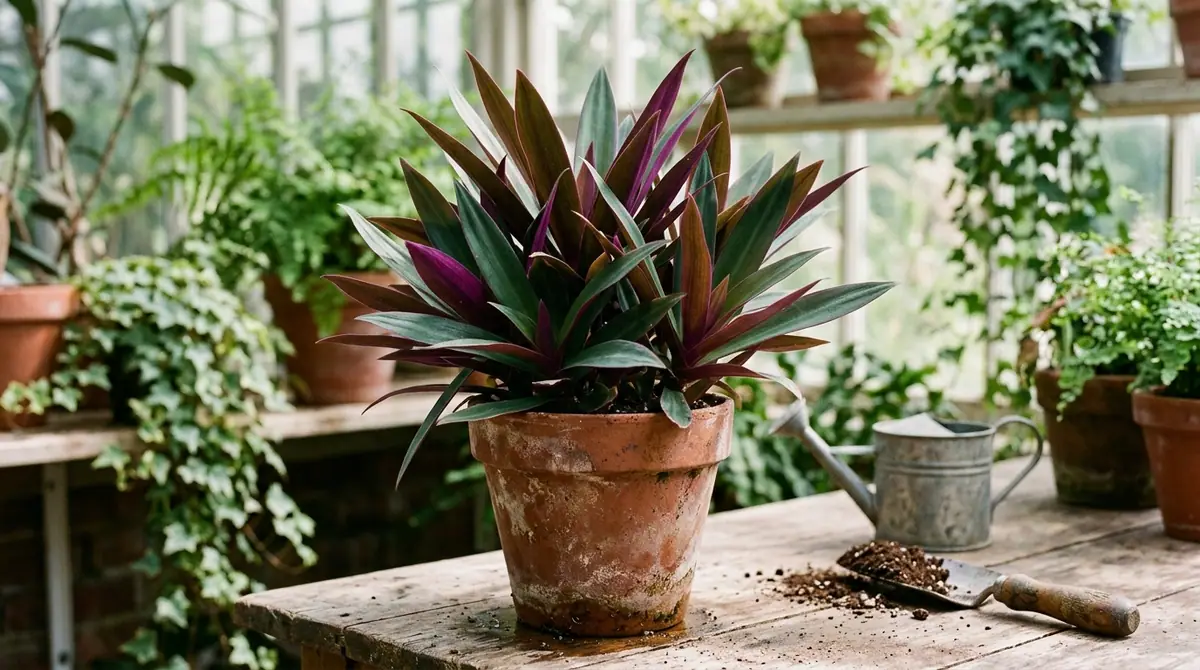
A leggy, washed-out Tradescantia spathacea with faded purple undersides and compacted soil will rebound into a dense, multi-stemmed mound of metallic foliage within 60 days when shifted to an east-facing windowsill, potted in a perlite-heavy substrate, and allowed to dry out entirely in the top 2 inches (5 cm) between waterings.
1. Botanical Overview & Natural Habitat
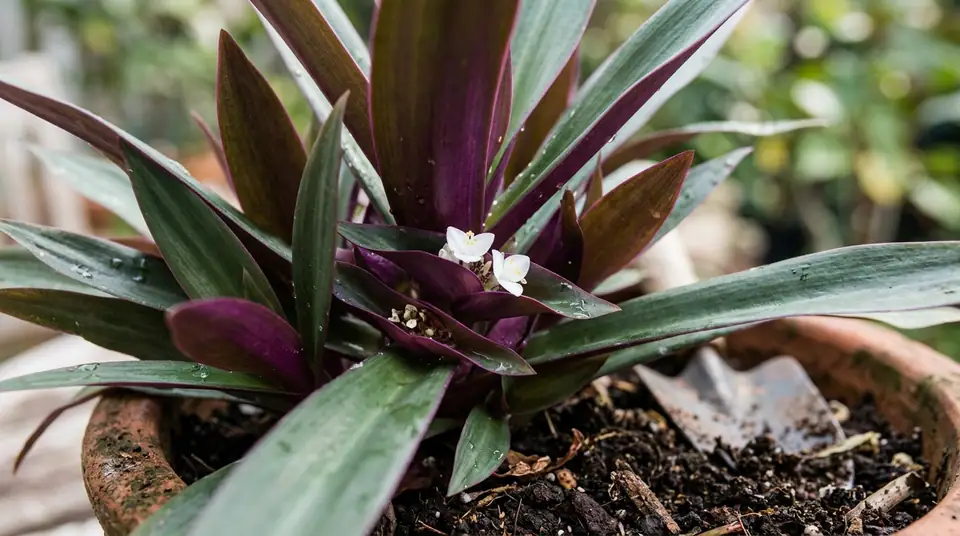
Morphologically, the plant features stiff, lanceolate leaves that emerge in a dense, upright rosette pattern. The upper leaf surfaces display a deep, glossy olive-green or dark metallic green, while the undersides reveal a striking, vibrant purple-magenta. This bicolored foliage is an evolutionary adaptation; the anthocyanin pigments on the lower leaf surface absorb and convert green light wavelengths that pass through the upper canopy, maximizing photosynthetic efficiency in low-light forest floors.
The common name "Moses in the Cradle" originates from the plant's unique inflorescence. Tiny, three-petaled white flowers nestle deep inside rigid, boat-shaped purple bracts (spathaceous bracts) that emerge at the base of the leaves, visually resembling a baby resting in a basket. While it can tolerate mild outdoor conditions, it is most frequently grown as a vibrant houseplant or as a dense, low-growing ground cover in USDA Hardiness Zones 9 through 11, where temperatures rarely dip below 30°F (-1°C). For those expanding their indoor or outdoor tropical collections, understanding microclimates is just as vital as managing vegetable rotations—much like timing your When to Plant Carrots in Zone 8a schedule or planning a cold-hardy brassica bed like When to Plant Brussel Sprouts in Zone 7.
2. Essential Environmental & Care Requirements
To successfully cultivate Tradescantia spathacea, you must replicate the warm, filtered light and well-drained soil conditions of its native Mesoamerican habitat. Neglecting these fundamental environmental parameters leads quickly to etiolation, root rot, or leaf scorch.
| Parameter | Optimal Condition | Common Mistake | Why It Matters |
|---|---|---|---|
| Light | Bright, indirect light (4–6 hours daily) | Direct, scorching midday sun or deep shade | Too much sun bleaches and burns leaves; too little shade turns purple undersides dull green. |
| Watering | Allow top 2 inches (5 cm) to dry | Keeping soil constantly saturated | Soggy media suffocates roots, triggering fungal pathogens and basal stem rot. |
| Temperature | 65°F to 85°F (18°C to 29°C) | Exposure to drafts below 50°F (10°C) | Cold stress causes cell collapse, turning foliage mushy and translucent. |
| Humidity | 40% to 60% relative humidity | Extremely dry air from forced-air heating | Low humidity curls leaf tips and attracts microscopic sap-sucking pests. |
| Soil pH | Slightly acidic to neutral (6.0 to 7.0) | Heavy, clay-dense garden dirt | Compacted soils lack the macro-pore space required for healthy root respiration. |
Light exposure dictates the intensity of the plant's coloration. Position your Moses in the Cradle within 3 feet (1 meter) of an east- or west-facing window. Southern exposures can work during winter months, but summer rays require sheer curtain filtration to prevent leaf burn.
Water management is the single most frequent point of failure. Because the fleshy stems and succulent leaves store moisture, the plant handles short periods of drought far better than waterlogged substrate. Always test the soil moisture with your finger to a depth of 2 inches (5 cm) before watering thoroughly until liquid drains freely from the pot's bottom drainage holes.
Temperature stability is equally crucial. Keep ambient temperatures between 65°F and 85°F (18°C to 29°C). If you are orchestrating an extensive indoor-outdoor plant rotation, keep in mind that moving tropicals outside prematurely can shock them, much like timing your When to Plant Beets in Utah or figuring out an optimal planting window for When to Plant Bok Choy Zone 7.
For authoritative botanical descriptions and taxonomic classifications of tropical perennials, consult the Missouri Botanical Garden Plant Finder.
💡 Pro-Tip: If your Moses in the Cradle begins losing its deep purple hue on the underside of the leaves, do not reach for fertilizer. That fading color is a direct botanical distress signal screaming for more light intensity. Move the plant one foot closer to a brighter window, and watch the magenta pigmentation intensify within three new leaf cycles.
3. Step-by-Step Cultivation, Feeding & Propagation
Propagating and repotting Tradescantia spathacea is remarkably straightforward due to the plant's natural tendency to produce dense clusters of offsets, or "pups," around the base of the mother rosette. Follow this exact propagation and repotting protocol to expand your collection safely.
- Select and Prepare the Mother Plant: Choose a mature, healthy specimen that has produced at least three distinct basal offsets measuring a minimum of 4 inches (10 cm) in height.
- Sanitize Your Tools: Sterilize a sharp pruning knife or shears using isopropyl alcohol (70% concentration or higher) to prevent introducing bacterial or fungal pathogens into the cut surfaces.
- Unpot and Inspect the Root System: Gently ease the plant out of its nursery container. Brush away excess old potting medium to expose the root crown and the underground connections between the main stem and the offsets.
- Sever the Offsets: Carefully cut each offset away from the primary stem, ensuring that each individual pup retains at least 2 to 3 healthy, intact roots of its own.
- Dust and Callus: Allow the cut portions of the stems to air-dry and callus over in a warm, shaded area for 24 to 48 hours. This crucial step prevents rot when the cutting is introduced to wet media.
- Mix the Substrate: Prepare a specialized, fast-draining potting medium consisting of 60% high-quality peat- or coir-based potting soil, 20% horticultural perlite, and 20% coarse builder's sand or orchid bark.
- Plant the Pups: Fill a 4-inch (10 cm) nursery pot with the prepared substrate. Plant the offset at the exact same soil depth it grew at previously—never bury the crown too deep, or stem rot will occur.
- Establish Initial Hydration: Water the newly potted offset thoroughly to settle the soil around the roots. Drain completely, then withhold subsequent waterings for 7 days to encourage aggressive downward root foraging.
When it comes to fertilization, feed your plant sparingly. During the active growing season (spring through summer), apply a balanced, water-soluble houseplant fertilizer diluted to half-strength once every 4 weeks. Cease fertilization entirely from late autumn through winter when plant metabolism slows down. For gardeners balancing indoor tropicals with edible crop planning, keeping track of seasonal inputs is standard practice, whether you are calculating fertilizer rates for houseplants or planning out crops like When to Plant Beets in Kansas and late-season When to Plant Pumpkins in Southern California.
⚠️ Important Caution: The sap of Tradescantia spathacea contains calcium oxalate crystals and irritating plant juices. Direct contact with skin can cause dermatitis, redness, and itching in sensitive individuals, while ingestion can lead to intense burning of the mouth and digestive tract. Always wear gardening gloves when pruning, dividing, or repotting this species, and keep it out of reach of curious cats, dogs, and small children.
For comprehensive guidelines on safe indoor gardening practices and pesticide management, refer to the Royal Horticultural Society (RHS).
4. Common Problems, Pests & Troubleshooting
Even with meticulous attention to detail, environmental shifts can trigger physiological responses or invite opportunistic pests. Early identification is your best defense against lasting damage.
Brown, Crispy Leaf Tips
- Cause: Low ambient humidity, underwatering, or a buildup of fluoride and chlorine salts from tap water.
- Solution: Increase humidity trays around the container, water consistently when the top 2 inches (5 cm) dry out, and switch to distilled or rainwater to flush accumulated salts from the soil profile.
Yellowing Lower Leaves and Mushy Stems
- Cause: Overwatering, poor drainage, or root-zone compaction leading to root rot (Pythium or Rhizoctonia species).
- Solution: Immediately stop watering. Unpot the plant, trim away black, mushy, or decaying roots with sterilized shears, and repot into fresh, sterile, fast-draining substrate.
Etiolation (Leggy, Stretched Growth with Weak Stems)
- Cause: Insufficient lighting forcing the plant to stretch aggressively toward a distant light source.
- Solution: Relocate the plant to a brighter location immediately. Prune back the leggy top growth by one-third to encourage compact, bushy lateral branching.
Mealybugs and Spider Mites
- Cause: Warm, dry indoor environments with stagnant air circulation.
- Solution: Wipe down affected leaves with a cotton swab dipped in 70% isopropyl alcohol. For severe infestations, spray thoroughly with horticultural insecticidal soap or neem oil, ensuring coverage of leaf axils and the undersides of leaves. Repeat the treatment every 7 days for a 3-week cycle to break the pest breeding lifecycle.
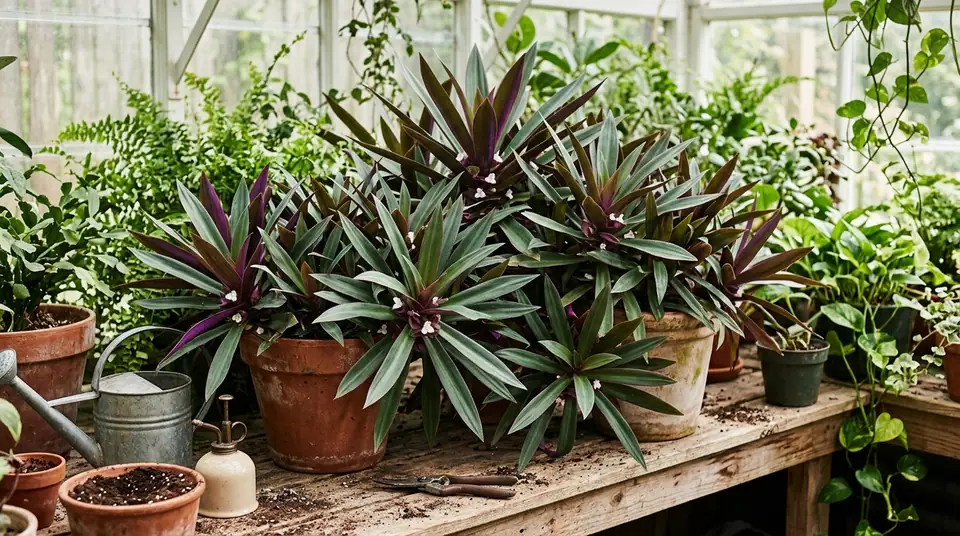
Potted Moses in the cradle plants on a wooden greenhouse workbench
5. Frequently Asked Questions
Why are the leaves on my Moses in the Cradle turning completely green?
Complete greening is almost always a direct reaction to insufficient light exposure. When the plant does not receive enough light, it stops producing the protective purple anthocyanin pigments on the leaf undersides because it needs maximum green chlorophyll to capture scarce light energy. Move the plant closer to an unobstructed, bright window to restore its vibrant bicolored foliage.
Is the Moses in the Cradle plant toxic to cats and dogs?
Yes, the plant is considered toxic to domestic pets. The sap contains calcium oxalate needle-like crystals that irritate the mucous membranes, mouth, and esophagus if chewed or ingested. Ingestion typically results in excessive drooling, pawing at the mouth, vomiting, and difficulty swallowing. Always place this plant well out of reach of pets.
How often should I water my Moses in the Cradle?
Watering frequency depends heavily on your indoor climate, pot size, and ambient humidity. As a general rule, water thoroughly every 7 to 14 days during the spring and summer, allowing the top 2 inches (5 cm) of soil to dry out completely between waterings. In winter, reduce watering frequency to every 14 to 21 days as the plant enters a semi-dormant growth phase.
Can Moses in the Cradle be grown outdoors year-round?
It can only be grown outdoors year-round in USDA Hardiness Zones 9 through 11, where winter temperatures remain consistently above 30°F (-1°C). If you live in a cooler climate, you can summer the plant outdoors in a partially shaded garden bed or patio container, but you must bring it indoors before nighttime temperatures drop below 50°F (10°C).
Related Guides
📋 Table of Contents ▼ Click to expand
Tags:
🌿 Related Plants You Might Like

PlantSavvyWorld
Editorial team
PlantSavvyWorld is an independent botanical education project. Articles are drafted with AI assistance, then edited and checked against university extension services, botanical garden collections and other published horticultural sources.