

How Do You Trim a Fern
Written with AI assistance, edited and checked against horticultural sources.
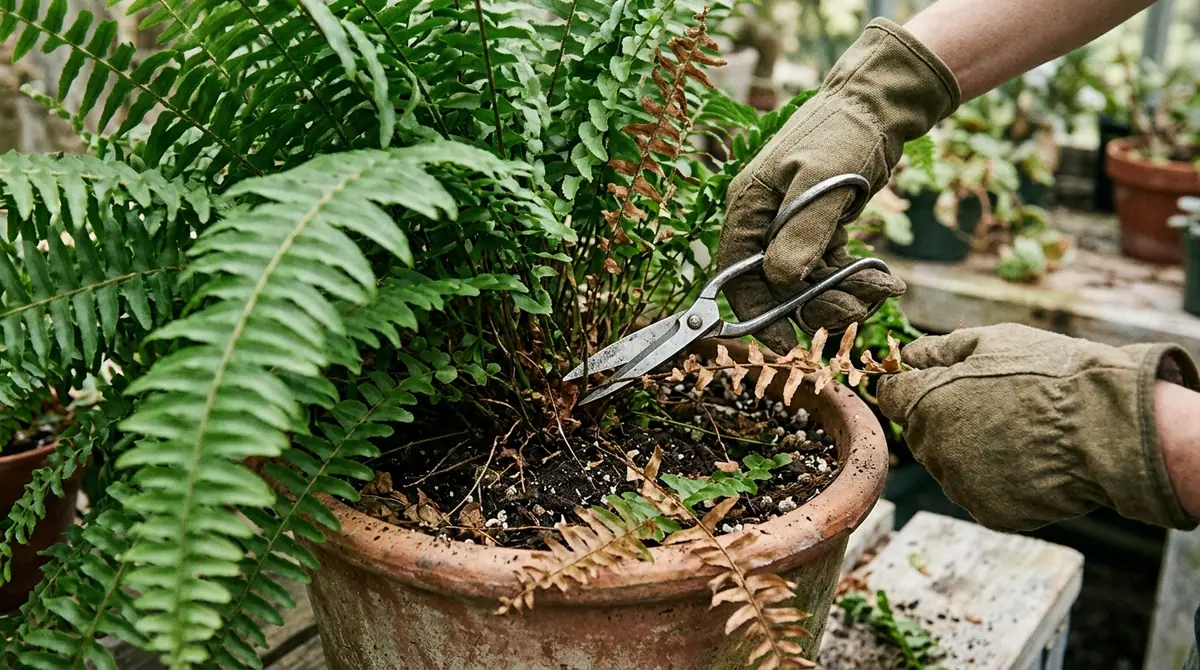
Last Tuesday, I found myself standing over a massive Boston fern (Nephrolepis exaltata) on my back patio, staring at a ring of papery, brown fronds that looked like burnt hair. A gardener had dropped it off for a summer rehabilitation session, whispering that it was "suddenly dying." Of course, it wasn't dying at all. It was simply choked by months of accumulated dead foliage that prevented light and air from reaching the living fiddleheads coiled tightly at the crown. Pulling on my pruning shears, I spent twenty minutes snipping away the spent fronds down to the soil line, instantly transforming a tangled, dusty mass into an open, sculptural fountain of emerald-green growth. Knowing how to properly trim a fern is the single most effective way to jump-start its vigor, clear away disease vectors, and restore its structural elegance.
1. Botanical Overview & Natural Habitat

Understanding how to trim a fern requires a basic grasp of its internal architecture. The central growing point of most terrestrial and epiphytic ferns is a subterranean or surface-level modified stem called a rhizome or crown. New fronds—initially tightly coiled in a corkscrew shape known as a fiddlehead or circinate vernation—emerge directly from this crown. Unlike woody shrubs or trees, ferns do not have secondary growth or woody cambium layers that can heal over a cut. When you trim a frond, you must prune it cleanly at the base of the stem rather than cutting it halfway down, as severed herbaceous frond stems will not regenerate tissue; they simply die back and invite fungal pathogens.
In their native understory habitats—ranging from the damp, mossy floors of the Pacific Northwest temperate rainforests to the dappled, humid canopies of tropical cloud forests—ferns rely on natural decomposition. Old fronds naturally wither and slump to the ground, forming a protective mulch layer that retains soil moisture and recycles nutrients back to the shallow root system. However, in our homes and domesticated garden landscapes, these decaying fronds trapped against the crown restrict essential airflow, harbor insect pests, and detract from the plant's aesthetic vitality.
2. Essential Environmental & Care Requirements
To maintain a fern that rarely requires emergency rescue pruning, you must align your indoor or outdoor growing conditions with its native ecology. Ferns are notoriously unforgiving of dry air and erratic moisture levels, yet they are remarkably resilient when their fundamental environmental baselines are met consistently.
| Parameter | Optimal Condition | Common Mistake | Why It Matters |
|---|---|---|---|
| Light | Bright, indirect light (10,000 to 20,000 lux) | Direct midday sun (over 30,000 lux) | Direct solar radiation scorches delicate frond tissues and bleaches chlorophyll. |
| Temperature | 65°F to 75°F (18°C to 24°C) | Drops below 50°F (10°C) or near drafty vents | Sudden thermal shock causes rapid cellular collapse and catastrophic frond drop. |
| Humidity | 60% to 80% relative humidity | Indoor air below 40% (common in winter) | Low moisture accelerates transpiration, causing brown, crispy frond tips. |
| Watering | Evenly moist, never soggy (water when top 0.5 inches / 1.3 cm dries) | Allowing soil to completely dry out | Dehydration irreversibly damages fine root hairs, halting nutrient uptake. |
💡 Pro-Tip: When increasing ambient humidity for indoor ferns, avoid placing them in dark, stagnant bathrooms. Instead, group them tightly together on a wide pebble tray filled with water kept 0.5 inches (1.3 cm) below the pot base, or run a cool-mist ultrasonic humidifier nearby for 8 hours daily to mimic the natural morning dew of a cloud forest.
3. Step-by-Step Cultivation, Feeding & Propagation
Pruning and general maintenance go hand in hand. Whether you are managing a delicate Maidenhair fern (Adiantum) or a robust Bird's Nest fern (Asplenium nidus), a systematic approach ensures you stimulate new growth without damaging the plant's delicate crown.
Here is the exact step-by-step protocol I use in my own design practice to prune and refresh container and garden ferns:
- Sanitize Your Tools: Wipe your bypass pruners or sharp kitchen shears with a 70% isopropyl alcohol solution or a 10% bleach-to-water mixture. Clean tools prevent the accidental transmission of fungal spores or bacterial leaf spot between plants.
- Assess the Plant: Gently part the healthy fronds with your hands to examine the interior crown. Locate all brown, yellowing, damaged, or diseased fronds that originate from the base.
- Prune at the Base: Grasp the stem of a spent frond firmly and make a clean, horizontal cut as close to the rhizome or soil surface as possible, leaving no more than a 0.25-inch (0.6 cm) stub. Avoid tearing or ripping the stem, which can damage the living crown tissue.
- Remove Debris: Clear away all fallen leaf litter and severed fronds from the surface of the potting mix or garden bed. This eliminates hiding spots for fungus gnats and slug eggs.
- Apply Balanced Nutrition: Feed your fern during its active growing season (spring through summer) using a balanced, water-soluble liquid fertilizer diluted to half-strength (e.g., a 10-10-10 N-P-K formulation applied every 30 days). Never fertilize a dry, stressed, or recently pruned fern, as high salt concentrations will burn the fragile roots.
- Water Thoroughly: Give the container or planting site a deep, thorough watering until it runs freely through the drainage holes, settling the soil around the exposed root zone.
For further reading on maintaining resilient landscape plantings, consult the Royal Horticultural Society pruning guidelines.
4. Common Problems, Pests & Troubleshooting
Even with diligent pruning, environmental stressors can trigger physiological disorders or invite opportunistic pests. Learning to read your fern's diagnostic symptoms saves weeks of guesswork.
⚠️ Important Caution: Never use heavy dormant horticultural oils or harsh synthetic insecticidal soaps on delicate-leaved ferns like Maidenhair or Button ferns (Pellaea rotundifolia). Their thin, porous cuticles absorb oils too rapidly, resulting in immediate phytotoxic leaf burn and total frond skeletonization. Stick to gentle manual removal with a damp microfiber cloth or diluted castile soap solutions.
- Crispy, Brown Frond Tips: Caused by low relative humidity, erratic watering schedules, or excessive chemical fertilizer salts accumulating in the soil. Solution: Flush the soil thoroughly with room-temperature distilled water for 5 minutes to leach out salts, and increase ambient humidity immediately.
- Yellowing Lower Fronds: Usually points to overwatering, compacted soil lacking adequate oxygen, or root-zone suffocation. Solution: Let the top 1 inch (2.5 cm) of soil dry out between waterings, and ensure your container features functional drainage holes.
- Stunted Growth and Sticky Residue: Indicates an infestation of soft scale insects or mealybugs hiding along the protected undersides of frond ribs. Solution: Dip a cotton swab in 70% isopropyl alcohol and dab each visible pest directly, followed by a thorough rinse with lukewarm water.
- Webbing and Faded Stippling: The classic signature of the two-spotted spider mite (Tetranychus urticae), which thrives in hot, dry indoor air. Solution: Isolate the plant and spray all frond surfaces aggressively with a strong jet of water every 48 hours for 10 days to break their reproductive cycle.

5. Frequently Asked Questions
Can I cut my fern all the way down to the ground?
Yes, many deciduous hardy ferns (such as Ostrich ferns, Matteuccia struthiopteris) can be cut completely to the soil line in late winter or early spring just before new fiddleheads emerge. This removes winter-damaged fronds and encourages a flush of pristine green growth. However, for tropical evergreen indoor ferns, never cut off all the fronds at once, as the plant relies on some green foliage for ongoing photosynthesis to sustain its root system.
When is the best time of year to prune a fern?
The optimal time for a major structural prune is early spring, just as the plant exits its winter dormancy period and before vigorous new growth begins. You can, however, remove individual dead, brown, or diseased fronds at any time of the year to maintain plant hygiene and visual appeal.
Why are my fern fronds turning brown after I pruned them?
If fronds turn brown immediately after a pruning session, it is usually due to environmental shock, dry indoor air, or physical damage inflicted on adjacent living stems during the trimming process. Ensure your pruning shears were ultra-sharp to prevent crushing plant cells, and verify that the plant is receiving adequate moisture and humidity.
Do ferns grow back after you cut them?
Yes, provided you cut the fronds cleanly at the base without damaging the central crown or rhizome. New fronds will rapidly unfurl from the living buds stored within the crown, replacing the removed foliage within 30 to 45 days during the active growing season.
Related Guides
📋 Table of Contents ▼ Click to expand
Tags:
🌿 Related Plants You Might Like
PlantSavvyWorld
Editorial team
PlantSavvyWorld is an independent botanical education project. Articles are drafted with AI assistance, then edited and checked against university extension services, botanical garden collections and other published horticultural sources.