

Will Peatmoss Help with Root Rot
Written with AI assistance, edited and checked against horticultural sources.
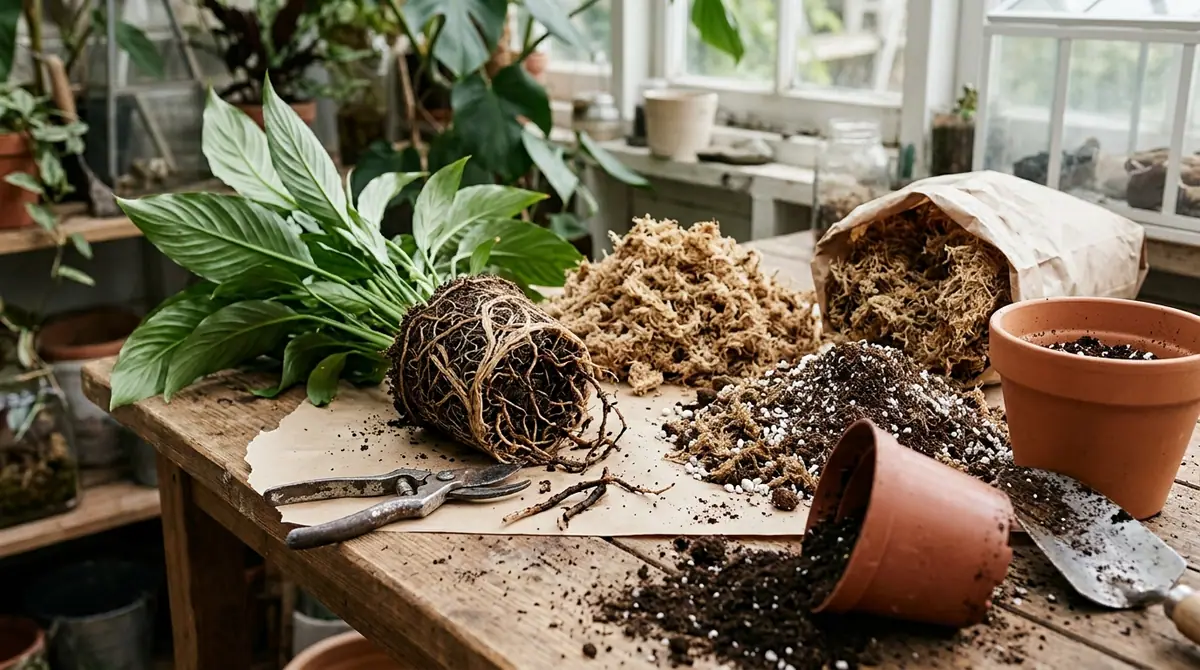

If you are expanding your horticultural horizons beyond indoor containers—perhaps pondering whether exotic vines can survive southern humidity or trying to design a terrace garden with tall privacy plants—understanding soil physics is the foundational skill you need.
1. Botanical Overview & Natural Habitat
To understand why peat moss behaves the way it does in a pot or garden bed, we must first look at where it comes from. Peat moss—primarily harvested from decomposed Sphagnum moss species—originates in boreal peatlands and bogs, predominantly across Canada, Ireland, and Northern Europe. In its native habitat, peat accumulates underwater in conditions defined by extreme saturation, near-total oxygen deprivation, and low temperatures ranging from 35°F to 55°F (1.7°C to 12.8°C).
Because these bogs lack dissolved oxygen, organic matter breaks down at an excruciatingly slow rate over thousands of years. The resulting material is remarkably acidic, boasting a natural pH between 3.0 and 4.5. Structurally, peat moss is composed of microscopic tubular cells that act like a sponge, capable of holding up to 20 times their dry weight in water.
When harvested, dried, and compressed into bales for retail sale, these spongy fibers retain their hyper-absorbent characteristics. In a natural bog ecosystem, this moisture retention supports specialized carnivorous plants and acid-loving flora adapted to stagnant water. But when placed inside a standard 6-inch (15 cm) container or garden bed with typical ornamental plants, that exact retention mechanism creates a localized oxygen desert.
When roots sit in a dense matrix of saturated peat moss, gas exchange halts entirely. Roots cannot respire, cells die back within 48 to 72 hours of constant hypoxia, and opportunistic soil-borne water molds—most notably Pythium, Phytophthora, and Rhizoctonia species—invade the compromised tissue. Thus, adding peat moss to an active case of root rot is akin to throwing a bucket of water onto an electrical fire; it amplifies the precise environmental stressor that caused the failure in the first place.
2. Essential Environmental & Care Requirements
Mitigating and preventing root rot requires balancing moisture retention with rapid air-filled porosity. When designing soil profiles, whether for container specimens or raised landscape beds, I rely on strict physical parameters to ensure roots maintain aerobic respiration.
| Parameter | Optimal Condition | Common Mistake | Why It Matters |
|---|---|---|---|
| Soil Air-Filled Porosity | 15% to 25% total volume | Using 100% fine peat moss (<5%) | Roots require continuous oxygen to fuel cellular division and nutrient uptake; zero air means rapid cell death. |
| Watering Frequency | Allow top 2 to 3 inches (5 to 7.5 cm) to dry | Keeping media constantly wet | Constant saturation breeds water molds (Pythium) and starves root hairs of oxygen. |
| Growing Medium pH | 5.5 to 6.5 for most ornamentals | Unamended peat moss (pH 3.5 to 4.0) | Extreme acidity locks out essential macronutrients like calcium and magnesium, weakening plant immune response. |
| Drainage Infrastructure | Unobstructed holes, 10% container volume | No holes or heavy saucer pooling | Saturated perched water tables prevent gravity from pulling excess moisture away from the root zone. |
Managing these parameters successfully takes precision. If you are experimenting with diverse climates or unique soil amendments—such as checking if subtropical species can thrive in unexpected regions like will kiwi grow in florida—soil structure remains the ultimate arbiter of plant health.
💡 Pro-Tip: Peat moss is hydrophobic when it dries out completely. If you let a peat-heavy pot bake under summer sun exceeding 85°F (29.4°C), the moss shrinks, pulls away from the container edges, and repels water entirely. When you finally water it, the liquid runs straight down the sides without rewetting the core, leading growers to overcompensate and drown the surrounding roots. Always rehydrate compressed peat thoroughly before mixing it into substrates.
3. Step-by-Step Cultivation, Feeding & Propagation
If your plant is currently suffering from root rot, peat moss will not save it. Instead, you must execute a clinical root rescue protocol. Here is the exact, step-by-step methodology I use in my professional practice to rehabilitate rotting specimens.
- Extract and Inspect: Gently unpot the affected plant. Shake and massage away as much of the old, contaminated growing medium as possible. Rinse the entire root system under lukewarm water (70°F–75°F / 21°C–24°C) to expose the structural roots.
- Prune Diseased Tissue: Using sterilized pruning shears (wiped down with 70% isopropyl alcohol between every cut), trim away all brown, black, mushy, or hollow roots. Cut back into firm, white, or light-tan tissue. Do not hesitate; leaving infected tissue guarantees the rot will spread.
- Sterilize the Remaining System: Submerge the cleaned root system for 30 to 60 seconds in a mild sanitizing solution—either a 1:9 ratio of household bleach to water or a biological fungicide containing Bacillus amyloliquefaciens. Rinse thoroughly afterward.
- Discard Old Media: Throw away the old potting soil, especially if it contained high ratios of degraded peat moss. Never reuse infected soil, as resting fungal spores will reinoculate your plant.
- Formulate a Well-Draining Substrate: Mix a fresh, highly aerated growing medium. Combine 40% coarse orchid bark (0.25 to 0.5 inches / 0.6 to 1.2 cm), 30% high-quality horticultural perlite or pumice, 20% aged compost, and no more than 10% pre-moistened peat moss (used strictly for minor buffering, not bulk moisture retention).
- Repot and Situate: Plant the rescued specimen into a clean container featuring multiple bottom drainage holes. Tamp the media down gently to eliminate large air pockets without compressing the soil matrix. Place the plant in bright, indirect light with ambient temperatures maintained between 65°F and 78°F (18.3°C–25.5°C).
- Withhold Heavy Feeding: Do not apply synthetic fertilizers for at least 30 to 45 days. Stressed, recovering roots cannot process chemical salts, and heavy fertilizer will burn delicate new root tips. Keep watering conservative until new top growth signals successful subterranean recovery.
For further scientific grounding on soil microorganisms and plant pathology, consult resources provided by the Royal Horticultural Society or university agricultural extensions like University of Florida IFAS Extension.
4. Common Problems, Pests & Troubleshooting
When diagnosing plant decline, symptoms often overlap. A plant showing yellow leaves and wilting is frequently misdiagnosed as needing more water and more moisture-retentive media like peat moss, when it is actually suffering from the exact opposite.
⚠️ Important Caution: Never assume wilting means underwatering. If the base of the stem feels soft, mushy, or dark brown, and the soil feels heavy and damp 3 inches (7.5 cm) down, you are dealing with root rot. Adding peat moss or watering again will kill the plant within days.
Beyond fungal pathogens, poorly managed soil mixes bring secondary complications. Fungus gnats (Bradysia species) thrive in damp, organic-rich environments where peat moss stays wet for extended periods. Their larvae feed directly on delicate root hairs, compounding the damage done by root rot fungi. If you notice tiny black flies hovering around your containers, it is a glaring red flag that your medium lacks adequate aeration and is holding moisture far too long.

5. Frequently Asked Questions
Can I mix peat moss with perlite to fix root rot?
No. While perlite adds valuable air-filled porosity, mixing it with a high proportion of peat moss still results in a medium that retains excessive moisture at the bottom of the container due to perched water tables. If you are recovering a plant from root rot, your peat ratio should not exceed 10% to 15% of the total volume.
Why do commercial potting soils use so much peat moss if it causes rot?
Commercial soil manufacturers use peat moss because it is lightweight, sterile out of the bag, cheap to ship, and holds water exceptionally well—which appeals to casual consumers who tend to underwater their plants. However, mass-market retail soils are rarely formulated for optimal long-term aeration without heavy grower modifications.
Is coco coir a better alternative to peat moss for root rot prevention?
Generally, yes. While coco coir has similar moisture retention properties to peat moss, it boasts a much more open physical structure that resists compaction, maintains higher air-filled porosity over time, and has a neutral pH (5.2 to 6.8). It dries out more evenly, significantly lowering the risk of accidental over-saturation.
How long does it take for a plant to recover from root rot after repotting?
Depending on the severity of the damage and the species involved, visible root and shoot recovery takes anywhere from 30 to 90 days. During the first 14 days, the plant will focus entirely on generating new, functional root hairs. Keep environmental conditions stable, avoid fertilizing, and let the topsoil dry out between waterings.
Related Guides
📋 Table of Contents ▼ Click to expand
Tags:
Keep reading
🌿 Related Plants You Might Like






PlantSavvyWorld
Editorial team
PlantSavvyWorld is an independent botanical education project. Articles are drafted with AI assistance, then edited and checked against university extension services, botanical garden collections and other published horticultural sources.