

Anthurium Metallicum
Written with AI assistance, edited and checked against horticultural sources.
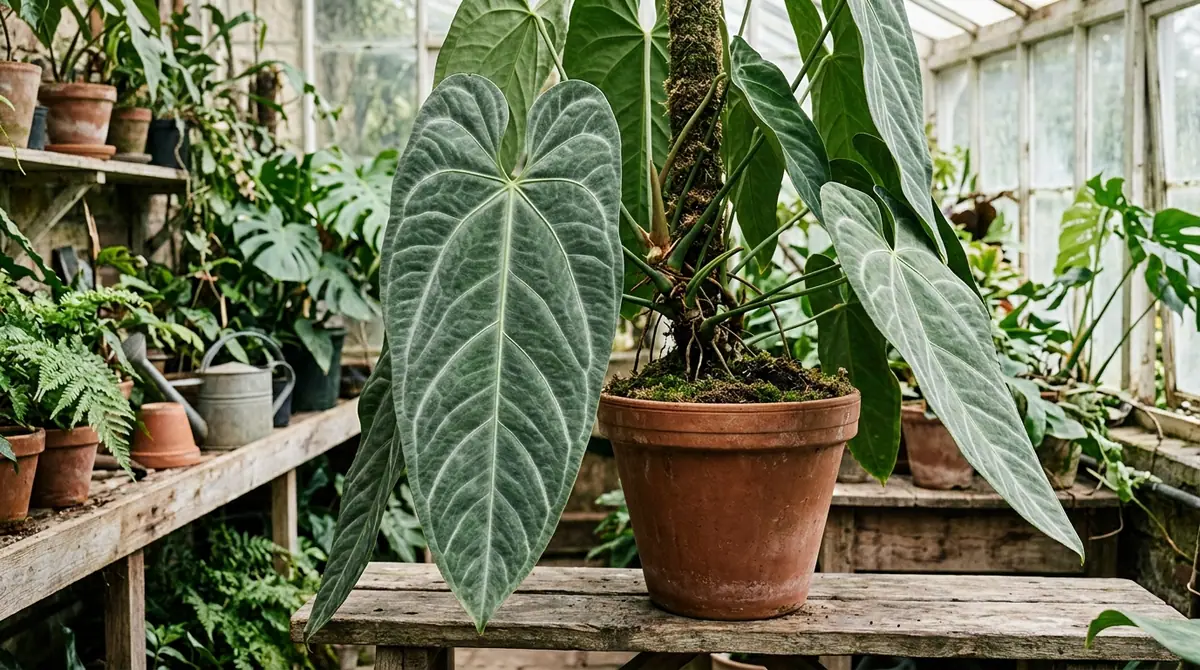
I was holding a newly imported Anthurium metallicum division in my hands, tracing the velvety, dark green lobes with my thumb, when the stark reality of its native canopy hit me. The leaf surface wasn’t just pretty; those prominent pale veins and gunmetal sheen were solar adaptors designed to trap filtered equatorial photons. When I first tried growing this species in standard, dry indoor air, those gorgeous leaves curled inward and crisped within fourteen days. It took a complete substrate overhaul, introducing an oversized mesh pot and dialing my humidity rooms up to a strict 80%, to unlock its true velvety potential. Today, I want to share the exact science-backed protocol that transformed my early struggle into a masterclass for cultivating this magnificent South American arum.
1. Botanical Overview & Natural Habitat
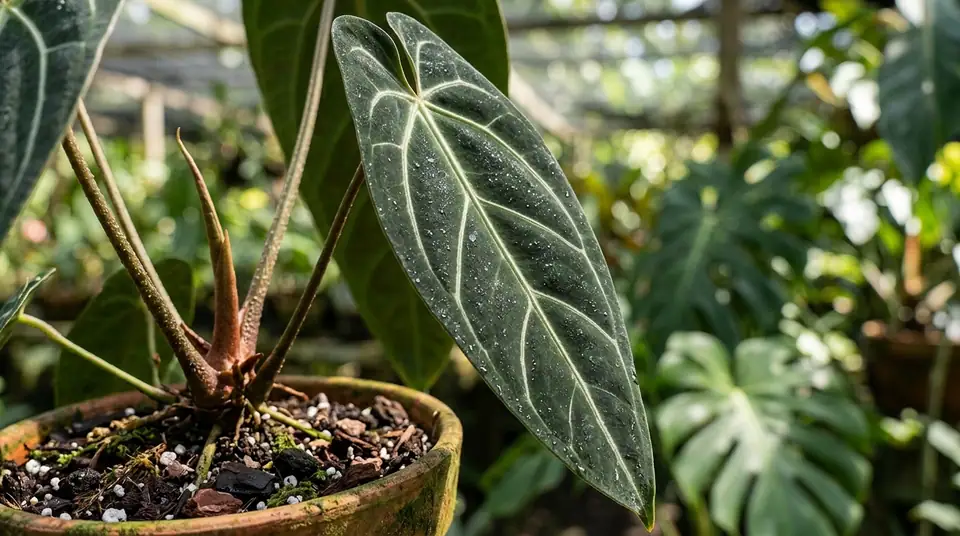
Taxonomically, it belongs to the section Belolonchium. Its most defining visual characteristic is its elongated, deeply lobed cordate (heart-shaped) leaves that feature a distinct bluish-green or gunmetal metallic sheen. The upper leaf surface is intensely velvety to the touch—an adaptation that reduces light reflection and maximizes photon capture under the dim, dappled light of the primary forest understory. The primary and secondary veins are typically lined with a contrasting pale green or silver coloration, creating an intricate, high-contrast network against the dark blade.
Mature specimens can produce leaf blades stretching up to 24 inches (60 cm) in length, suspended on petioles that easily reach 18 inches (45 cm) or longer. Unlike terrestrial houseplants, its root system is dual-purposed: thick, spongy anchor roots latch onto vertical surfaces, while finer, hairy feeder roots forage through loose, highly aerated detritus to absorb moisture and nutrients instantly. Understanding this epiphytic lineage is the single most critical step in moving away from standard potting soil and toward a high-performance cultivation strategy.
2. Essential Environmental & Care Requirements
Replicating the Colombian rainforest in a domestic setting requires disciplined environmental control. Because Anthurium metallicum originates from high-altitude cloud forests, it despises extreme heat combined with stagnant air.
Temperature parameters must remain stable. Day temperatures should range between 75°F and 82°F (24°C to 28°C), while night temperatures must drop slightly to between 65°F and 70°F (18°C to 21°C). This diurnal temperature fluctuation triggers essential metabolic respiration processes.
Humidity is non-negotiable. Maintain relative humidity (RH) between 75% and 85%. Anything below 60% for an extended period will cause the delicate, velvety leaf tips to brown and stall new emergence. However, high humidity must always be paired with continuous air circulation. Gentle cross-ventilation via small oscillating fans prevents fungal spores from germinating on the damp leaf surfaces.
Light levels must mimic filtered canopy conditions. Provide 1,500 to 2,500 foot-candles of bright, indirect light. Direct sunlight will scorch the velvety epidermal cells within 60 minutes, leaving permanent, bleached white scars.
| Parameter | Optimal Condition | Common Mistake | Why It Matters |
|---|---|---|---|
| Substrate Air-Filled Porosity | 50% to 60% air space | Using dense, peat-heavy potting soil | Compacted soil starves thick epiphytic roots of oxygen, causing rapid root rot. |
| Relative Humidity | 75% to 85% RH | Growing in ambient household air (30-40% RH) | Low humidity causes permanent tip burn, stunted leaves, and inhibits unfurling. |
| Light Intensity | 1,500 - 2,500 foot-candles | Direct midday window sun | Intense UV rays destroy chlorophyll and rupture the delicate velvet epidermis. |
| Water Quality | Under 50 PPM (TDS) | Using untreated tap water high in salts | Mineral buildup causes brown leaf margins and damages sensitive root hairs. |
💡 Pro-Tip: If your home naturally runs dry, skip the pebble trays—they only raise humidity by a negligible 2% to 3% at the plant canopy level. Instead, group your Anthurium metallicum inside a dedicated indoor glass cabinet or a small greenhouse tent equipped with a 360-degree ultrasonic fogger running on a timer.
3. Step-by-Step Cultivation, Feeding & Propagation
Growing Anthurium metallicum successfully hinges on specialized potting media and a careful watering schedule. Because root suffocation is the primary killer of this species, your potting mix must prioritize chunkiness and structural longevity over moisture retention.
A proven custom anthurium blend consists of 40% coarse orchid bark (1/2-inch to 3/4-inch nuggets), 20% horticultural-grade perlite or pumice, 20% long-fiber sphagnum moss, and 20% organic-rich horticultural charcoal. This formula creates enormous air pockets that mimic a mossy tree trunk.
Step-by-Step Repotting and Propagation Sequence
- Select an appropriate container: Choose a clear, slotted plastic orchid pot or a mesh net pot between 6 inches (15 cm) and 8 inches (20 cm) in diameter. Clear pots allow you to monitor root health and moisture levels directly.
- Sanitize your tools: Dip your pruning shears or scalpel in a 70% isopropyl alcohol solution for 60 seconds to eliminate potential pathogens.
- Unpot and inspect the root system: Gently slide the plant out of its old container. Use your fingers to tease away old, compacted media. Rinse the roots under lukewarm water to expose the root ball clearly. Use sterilized shears to trim away any brown, mushy, or papery dead roots.
- Identify propagation division points: If your specimen has multiple growth points (offsets or pups) with at least 2 to 3 healthy roots each, use your sterile scalpel to cleanly slice the rhizome, ensuring each division retains its own robust root system.
- Apply a rooting hormone and fungicide: Dust any cut rhizome surfaces with rooting hormone powder containing IBA (Indole-3-butyric acid) and a broad-spectrum organic fungicide like cinnamon or sulfur powder to prevent rot at the wound site.
- Position the plant in the new vessel: Hold the plant so the base of the stem sits precisely at the surface of the medium. Never bury the main stem or crown, as this invites stem rot.
- Fill with custom chunky mix: Pour your bark and perlite blend around the roots, gently tapping the sides of the pot to settle the chunky pieces into major air pockets without compressing them.
- Initial watering and stabilization: Water thoroughly with a dilute seaweed extract solution until water pours freely out of the bottom slots. Stake any heavy top-heavy leaves using soft plant Velcro until the anchor roots establish themselves over the next 30 to 45 days.
Feeding should be approached with a "weakly, weekly" philosophy. Use a balanced, water-soluble orchid or foliage fertilizer diluted to 1/4 strength (aiming for an electrical conductivity of around 0.6 to 0.8 mS/cm). Because arums are sensitive to salt accumulation, flush the pot with pure distilled water or reverse osmosis water every 14 days to leach out unabsorbed mineral ions. For further reading on general tropical plant nutrition and tissue management, consult the guidelines provided by the Royal Botanic Gardens, Kew.
⚠️ Important Caution: Never use heavy chemical leaf-shine products or commercial oils on the velvety leaves of Anthurium metallicum. The microscopic epidermal hairs that create the metallic texture will trap the oil, leading to irreversible chemical burns, necrotic spots, and a total loss of the signature velvety aesthetic.
4. Common Problems, Pests & Troubleshooting
Even with pristine environmental controls, troubleshooting is an inevitable part of advanced anthurium care. Identifying symptoms early prevents catastrophic plant decline.
Leaf Yellowing (Chlorosis)
If lower leaves turn uniformly yellow and drop, the issue is almost always chronic overwatering or a broken-down, anaerobic potting medium. When air pockets vanish, root hairs suffocate and die, halting water uptake. Inspect the roots immediately; healthy roots should be firm and white or light green, while rotted roots are dark brown and pull apart easily in your fingers.
Crispy, Brown Leaf Margins
Crispy edges point directly to low relative humidity combined with drafts or over-fertilization. If your hygrometer reads under 60% RH, increase humidity immediately. If humidity is adequate, test the runoff water with a TDS meter; a reading above 300 PPM indicates salt burn. Flush the substrate thoroughly.
Stubborn, Stuck New Leaves
When a new emergent leaf fails to unfurl and tears inside the cataphyll, it is suffering from localized dryness or mechanical friction. Mist the emergent sheath directly with pure distilled water once daily until the tip slides free, or increase ambient humidity by 10%.
Pests
Because of their soft, nutrient-rich sap, Anthurium metallicum can occasionally attract sap-sucking pests.
- Thrips: Look for silvery, stippled patches on the upper leaf surface alongside tiny black fecal dots. Apply spinosad-based sprays every 7 days for a 21-day cycle to break the lifecycle.
- Spider Mites: Thriving in warm, dry air, these pests spin fine webs on the undersides of leaves, causing a dull, chlorotic stippling. Wipe leaves manually with insecticidal soap diluted according to the manufacturer's directions, and raise humidity above 75%.
5. Frequently Asked Questions
Why are the leaves on my Anthurium metallicum losing their dark, velvety color and turning pale green?
This is typically a sign of excessive light intensity. While Anthurium metallicum requires bright conditions to thrive, direct or overly intense light bleaches the chlorophyll and damages the specialized velvety cells responsible for the dark gunmetal aesthetic. Move your plant back to a shadier zone receiving filtered light between 1,500 and 2,000 foot-candles, and ensure your fertilizer includes adequate micronutrients like iron and magnesium.
Can Anthurium metallicum be grown in a standard pot with regular potting soil?
No. Standard potting soils—especially those containing high percentages of peat moss or heavy compost—retain too much water and compact tightly over time. This starves the thick, epiphytic roots of oxygen, leading to rapid root rot and death. You must use a specialized, ultra-coarse epiphytic mix featuring heavy amounts of orchid bark, perlite, and charcoal to maintain at least 50% air space.
How do I increase humidity for my Anthurium metallicum without causing fungal leaf spot?
The safest and most effective method is to house the plant inside a greenhouse cabinet, Ikea greenhouse conversion, or a clear propagation tent equipped with a small, oscillating internal fan. The fan provides crucial air movement that evaporates standing moisture from the velvety leaf surfaces within minutes, preventing the germination of opportunistic fungal pathogens while keeping the ambient humidity trapped at your target 75% to 85% mark.
How long does it take for a new Anthurium metallicum leaf to fully unfurl?
From the moment the sharp, pointed cataphyll first emerges at the base of the petiole to the time the velvety blade hardens off and darkens completely, the entire process usually takes between 21 and 35 days. The exact duration depends heavily on ambient temperature, root health, and the consistency of your feeding schedule. Never pull or force a stuck leaf open manually, as this will tear the delicate cellular tissue permanently.
Related Guides
📋 Table of Contents ▼ Click to expand
Tags:
🌿 Related Plants You Might Like






PlantSavvyWorld
Editorial team
PlantSavvyWorld is an independent botanical education project. Articles are drafted with AI assistance, then edited and checked against university extension services, botanical garden collections and other published horticultural sources.