

Anthurium Villenaorum Croat
Written with AI assistance, edited and checked against horticultural sources.
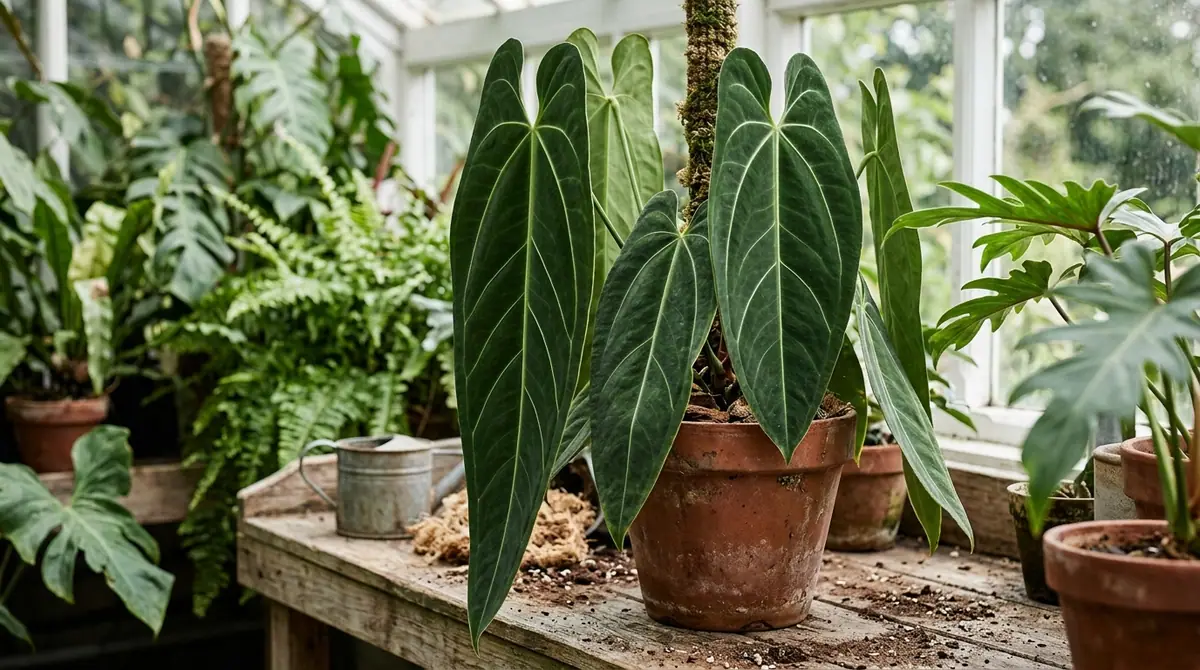
The Anthurium villenaorum Croat features velvety, deeply lobed leaves that command attention, differing from the glossy, plastic-looking Anthurium andraeanum hybrids found in grocery store floral departments. Within forty-eight hours under standard household conditions, the velvety leaf tips can crisp and turn brown, indicating that treating this rare Andean epiphyte like a common houseplant leads to failure. Replicating native cloud forest conditions is essential for keeping Anthurium villenaorum healthy at home.
1. Botanical Overview & Natural Habitat
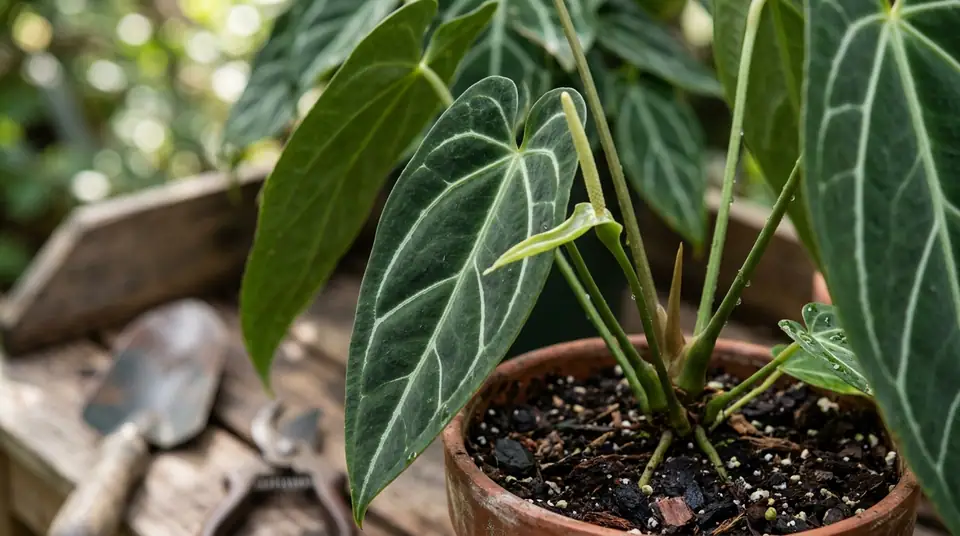
In the wild, Anthurium villenaorum is endemic to Peru, specifically inhabiting the eastern slopes of the Andes at elevations ranging roughly from 3,200 to 5,900 feet (1,000 to 1,800 meters). Here, it typically grows as an epiphyte or a secondary hemiepiphyte, clinging to the mossy trunks of mature rainforest trees where air movement is constant and root systems are perpetually bathed in oxygen-rich humidity.
Morphologically, the species is immediately recognizable by its deeply lobed, cordate (heart-shaped) leaves. The posterior lobes are distinct, often overlapping or spreading gracefully depending on the specific clone and maturity of the plant. The petioles are nearly terete to slightly flattened adaxially, usually measuring between 12 to 24 inches (30 to 60 cm) in length. The cataphylls are typically green and eventually weather into fibrous, persistent remnants at the base of the stem.
For further reading on aroid taxonomy and plant morphology, you can consult the botanical keys maintained by the Missouri Botanical Garden.
2. Essential Environmental & Care Requirements
Recreating an Andean cloud forest in a modern living room requires precision. Let's examine the exact tolerances and optimal parameters for Anthurium villenaorum.
| Parameter | Optimal Condition | Common Mistake | Why It Matters |
|---|---|---|---|
| Temperature | 70°F–80°F (21°C–27°C) days; drop to 60°F–65°F (15°C–18°C) nights | Exposing to sustained heat above 90°F (32°C) or freezing drafts below 50°F (10°C) | Extreme heat accelerates respiration beyond photosynthetic capacity, while cold damages cell walls. |
| Light | 2,000–3,500 lux of bright, indirect light (dappled) | Placing in direct, unfiltered midday sun | Direct rays scorch the delicate velvety epidermis, leaving irreversible white or brown necrotic patches. |
| Humidity | 75%–85% relative humidity | Relying on ambient household air of 30%–40% | Low humidity desiccates the leaf margins, causing tip burn and preventing proper stomatal gas exchange. |
| Air Movement | Gentle, continuous oscillation via a small draft-free fan | Stagnant air trapped inside a sealed cabinet | Stagnant, humid air invites fungal pathogens like Botrytis and bacterial leaf spot. |
💡 Pro-Tip: Do not rely on misting to solve your humidity challenges. Misting provides only a temporary spike in moisture that evaporates within minutes, leaving mineral deposits on the velvety leaves while inviting fungal spores to germinate on wet tissue. Invest in an ultrasonic humidifier paired with a digital hygrometer instead.
3. Step-by-Step Cultivation, Feeding & Propagation
Growing Anthurium villenaorum successfully hinges on root-zone architecture. Because it is an epiphyte, its roots demand a chunky, highly aerated substrate that mimics a tree branch covered in moss and leaf litter.
Step 1: Formulating the Ideal Aroid Substrate
Do not use standard peat-based potting soil. Mix the following components by volume:
- 40% Chunky orchid bark (graded to 0.5 to 1.0 inch / 1.25 to 2.5 cm)
- 20% Horticultural perlite or pumice
- 20% Premium long-fiber sphagnum moss (shredded slightly)
- 10% Horticultural charcoal
- 10% Worm castings or organic-rich compost
Step 2: Repotting Protocol
Select a clear plastic pot or a standard nursery pot with exceptionally generous drainage holes. Clear containers allow you to monitor root health visually.
- Gently unpot your Anthurium villenaorum and tease away the old, compacted medium.
- Inspect the root system; healthy roots are thick, white, or light green with firm, turgid tissue. Trim away any mushy, brown, or hollow roots using sterile shears sterilized in 70% isopropyl alcohol.
- Place a layer of your chunky mix at the bottom of the pot. Position the plant so the crown sits precisely at or slightly above the soil line. Burying the stem too deeply invites stem rot.
- Fill in around the roots with the remaining chunky mix, tapping the sides of the pot gently to settle the pieces without crushing them.
Step 3: Watering Routine
Water thoroughly only when the top 1.5 to 2.0 inches (4 to 5 cm) of the substrate feels dry to the touch. Run tepid water through the pot for at least 45 seconds, ensuring every pocket of media is saturated, and allow it to drain completely for 15 minutes. Never let the pot sit in standing water in a saucer.
Step 4: Nutritional Management
Feed during the active growing season (spring through early autumn) using a balanced, water-soluble fertilizer diluted to one-quarter strength every time you water (the "weakly, weekly" method). Alternatively, apply a controlled-release organic pellet fertilizer once every 90 days. Avoid high-nitrogen chemical spikes, which produce soft, succulent growth that is highly vulnerable to insect pests.
Step 5: Propagation by Stem Cuttings
Because Anthurium villenaorum naturally develops a creeping or short-stemmed growth habit over the years, you can propagate mature specimens safely.
- Identify a stem section featuring at least one healthy node and one viable aerial root.
- Use a sterile razor blade to make a clean cut below the node.
- Dust the cut surfaces with powdered horticultural sulfur or cinnamon to deter pathogens.
- Place the cutting into a propagation chamber filled with moist perlite or pure long-fiber sphagnum moss. Maintain a bottom heat of 75°F–78°F (24°C–25°C) and bright, indirect light. New root initiation typically occurs within 30 to 45 days.
⚠️ Important Caution: Never force your Anthurium villenaorum into oversized pots in an attempt to save repotting time. Excess, uncolonized soil retains water far too long, leading directly to anaerobic conditions and fatal root rot within 14 days.
For authoritative guidelines on plant propagation techniques and tissue culture safety, refer to the resources provided by the Royal Horticultural Society.
4. Common Problems, Pests & Troubleshooting
Even experienced growers encounter hiccups with Andean aroids. Here is how to diagnose and correct them before they threaten your specimen.
- Yellowing Lower Leaves: If older leaves turn uniformly yellow and drop while new growth remains vibrant, you are likely dealing with natural senescence or mild overwatering. Check your watering frequency and ensure your substrate hasn't broken down and lost its aeration.
- Crispy, Brown Leaf Margins: This is the classic signature of low ambient humidity combined with irregular watering. If the air drops below 50% humidity for extended periods, the velvety tissue along the margins cannot maintain turgor pressure and dies back.
- Spider Mites (Tetranychus urticae): These microscopic arachnids thrive in warm, dry indoor air, spinning fine webs on the undersides of leaves and sucking plant sap. You will notice stippling (tiny yellow dots) on the upper surface of the leaf. Treat immediately by wiping leaves down with insecticidal soap or horticultural oil every 7 days for a 21-day cycle to break the egg-laying chain.
- Mealybugs: Look for white, cottony masses in the tight crevices where petioles meet the stem. Dab them individually with a cotton swab soaked in 70% isopropyl alcohol, followed by a systemic or topical horticultural oil spray.
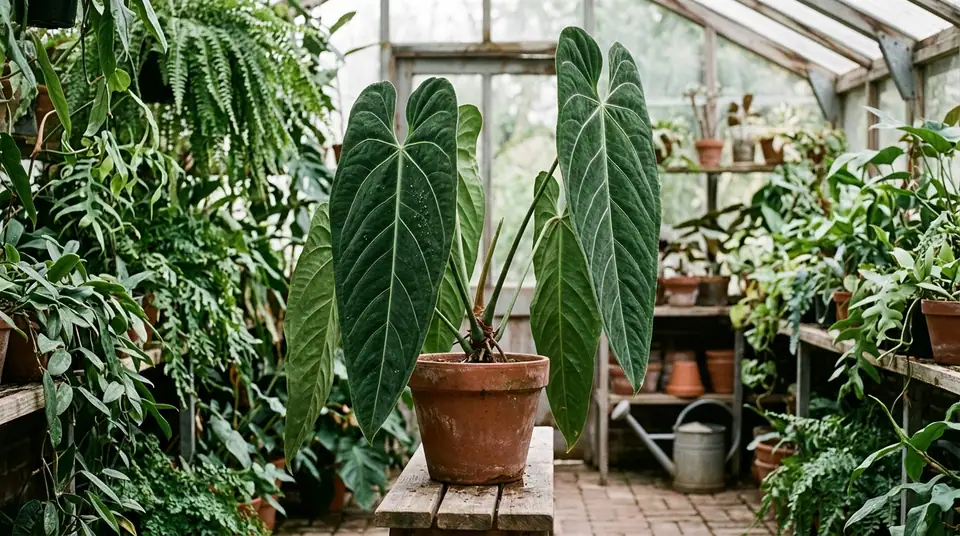
Anthurium villenaorum croat in a terracotta pot inside a bright greenhouse
5. Frequently Asked Questions
Why are the new leaves on my Anthurium villenaorum emerging small and pale?
Small, pale new leaves usually indicate insufficient light intensity or a lack of adequate macronutrients. Anthurium villenaorum requires consistent, bright indirect light to power the production of large, deeply lobed velvety foliage. If your light levels are sufficient, check your fertilization schedule—ensure you are providing adequate nitrogen, phosphorus, and potassium during active growth phases.
Can Anthurium villenaorum be grown successfully in a standard household without a greenhouse cabinet?
Yes, it is entirely possible, provided your baseline indoor environment meets its minimum thresholds. You must maintain ambient relative humidity above 65% through mechanical humidification and ensure adequate air circulation. If your home air drops to dry winter lows of 30%, the plant will suffer chronic leaf tip necrosis unless kept in a terrarium, greenhouse cabinet, or near a dedicated humidifier setup.
How do I prevent water droplets from staining the velvety leaves?
The velvety texture of Anthurium villenaorum leaves features microscopic cuticular structures that catch water, making them prone to unsightly mineral crusting if you use hard tap water. Always use distilled, reverse osmosis, or rainwater when misting or cleaning foliage. If you accidentally get water on the leaves, gently blot them dry with a microfiber cloth immediately.
What is the difference between Anthurium villenaorum and Anthurium clarinervium?
While both belong to the section Cardiolonchium and share dark green, velvety foliage with pale veins, they are distinct species with different geographic origins and leaf shapes. Anthurium clarinervium is native to Mexico and features shorter, stiffer, more intensely rounded heart-shaped leaves with starkly contrasting bright white veins. Anthurium villenaorum is native to Peru, featuring longer, more deeply lobed posterior lobes and veins that often exhibit a more subdued greenish-white or creamy coloration.
Related Guides
📋 Table of Contents ▼ Click to expand
Tags:
🌿 Related Plants You Might Like

PlantSavvyWorld
Editorial team
PlantSavvyWorld is an independent botanical education project. Articles are drafted with AI assistance, then edited and checked against university extension services, botanical garden collections and other published horticultural sources.