
Philodendron Thai Sunrise
Written with AI assistance, edited and checked against horticultural sources.
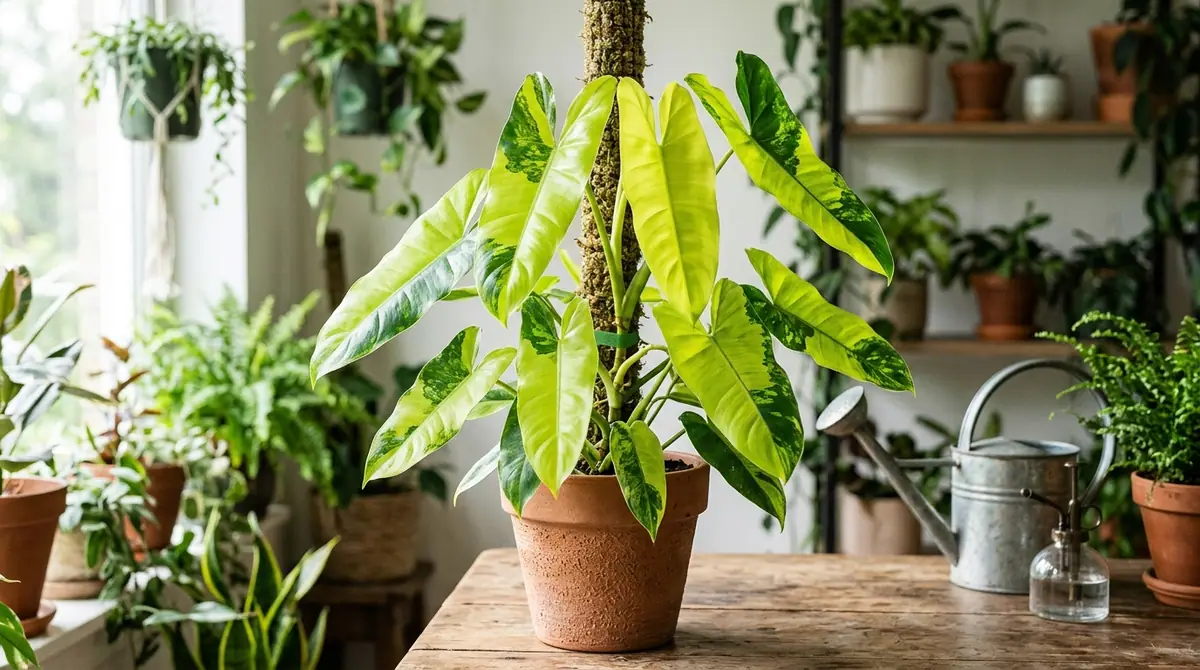
The Philodendron 'Thai Sunrise' is charged with a neon chartreuse radiance that features an electric splash of variegation across dark emerald veins, remaining the crown jewel of conservatory collections. Keeping this plant's signature sunrise glow requires precision, respect for its tropical lineage, and a refusal to cut corners on its care.
1. Botanical Overview & Natural Habitat

Unlike strict climbers with massive juvenile-to-adult leaf transformations, 'Thai Sunrise' maintains a relatively compact, self-heading to semi-vining growth habit. It matures to an average height and spread of 24 to 36 inches (60 to 90 cm). Its most defining characteristic is its striking leaf coloration. New leaves emerge in a brilliant, luminous chartreuse or golden-yellow that gradually deepens to a rich chartreuse-green, often featuring irregular splashes of emerald and dark green along the primary and secondary veins. The petioles are sturdy, channeling water down to the root zone while supporting leaves that reach 10 to 14 inches (25 to 35 cm) in length.
Understanding its evolutionary adaptation to the understory is key to keeping it alive indoors. It evolved beneath high tree canopies where sunlight is broken into shifting dapples known as sunflecks. Replicating this condition—bright, indirect, filtered light—is the baseline for sustaining its vibrant coloration without scorching its tender, pigmented tissues.
2. Essential Environmental & Care Requirements
Growing 'Thai Sunrise' successfully indoors means closely mimicking the stable, high-humidity, warm microclimate of a tropical rainforest floor. Stray too far from these parameters, and you will notice fading variegation, stunted leaf development, or root decay.
| Parameter | Optimal Condition | Common Mistake | Why It Matters |
|---|---|---|---|
| Light | Bright, indirect light (10,000–20,000 lux) | Direct midday sun or deep shade | Too much sun burns leaves; too little fades the yellow variegation to dull green. |
| Temperature | 65°F to 85°F (18°C to 29°C) | Exposing to drafts below 55°F (13°C) | Cold shock halts metabolic processes and causes cell collapse in variegated tissue. |
| Humidity | 60% to 80% relative humidity | Ambient home humidity below 40% | Low humidity causes crispy brown tips and prevents leaves from unfurling cleanly. |
| Soil pH | 5.5 to 6.5 slightly acidic | Heavy, compacted garden loam | Aroids require high oxygen exchange at the root zone to prevent anaerobic rot. |
Light management is your primary daily task. Place your 'Thai Sunrise' within 3 to 5 feet (0.9 to 1.5 meters) of an unobstructed east-facing window, or shield a south-facing window with a sheer white curtain.
Temperature consistency is equally critical. Keep your plants away from drafty exterior doors, air conditioning vents, and heating radiators. Rapid temperature fluctuations cause physiological stress that manifests as yellowing lower leaves. For rigorous botanical care standards, reference the cultivation guidelines maintained by the Royal Horticultural Society.
Watering must follow a strict rhythm. Allow the top 2 to 3 inches (5 to 7.5 cm) of your potting mix to dry out completely before administering water. When you water, drench the substrate thoroughly until excess water pours freely from the pot's drainage holes. Never let the pot sit in standing water in a saucer, as aroids are notoriously susceptible to Phytophthora and Pythium root rots.
3. Step-by-Step Cultivation, Feeding & Propagation
Repotting and propagating 'Thai Sunrise' requires a gentle touch and an understanding of aroid root anatomy. Because variegated cultivars possess less chlorophyll than their all-green counterparts, they grow slightly slower and have a lower energy reserve to recover from root damage.
💡 Pro-Tip: When mixing your own aroid soil, skip standard potting soil entirely. Combine equal parts chunky orchid bark (0.5-inch/1.2-cm nuggets), horticultural perlite or pumice, and high-quality coco coir. This creates massive air pockets that mimic the loose, organic-rich debris found in tropical tree forks.
Step-by-Step Propagation via Stem Cuttings
- Select a Healthy Node: Inspect your mature 'Thai Sunrise' and identify a sturdy stem section featuring at least one active node (the swollen bump where a leaf meets the stem) and one aerial root.
- Sanitize Your Tools: Sterilize a sharp pruning shear or razor blade using 70% isopropyl alcohol to prevent introducing bacterial pathogens to the cut sites.
- Make the Cut: Slice cleanly through the stem approximately 0.5 inches (1.2 cm) below the targeted node. Ensure the cutting includes at least one fully expanded leaf.
- Apply Rooting Hormone (Optional): Lightly dust the exposed cut end and node with rooting hormone powder containing IBA (Indole-3-butyric acid) to accelerate callus formation.
- Choose Your Rooting Medium: Place the cutting into a propagation vessel filled with clean water, moist sphagnum moss, or perlite. If using water, submerge only the node and aerial root while keeping the leaf well above the waterline.
- Provide Optimal Environment: Place the setup in an area receiving bright, indirect light with ambient temperatures maintained between 75°F and 80°F (24°C to 27°C) and high humidity (75%+). Cover water or moss setups with a clear plastic bag to trap moisture.
- Monitor and Transplant: Check the cutting every 3 to 5 days for water freshness or moisture levels. Once secondary roots emerge and measure at least 2 inches (5 cm) long—typically within 21 to 35 days—transplant the cutting into your specialized aroid potting mix.
For feeding, apply a balanced, water-soluble foliage fertilizer diluted to half strength every 4 weeks during the active growing season (spring through late summer). Flush the soil with plain distilled water every 3 months to leach out accumulated mineral salts that can burn sensitive root tips. For additional insights on plant nutrition and soil microbiology, consult the resources provided by University of Florida Extension.
4. Common Problems, Pests & Troubleshooting
Even under expert care, indoor environments present challenges. Recognizing the early symptoms of environmental stress or pest infestation can save your 'Thai Sunrise' from irreversible decline.
Fading Variegation to Solid Green
- Cause: Insufficient light levels. Without adequate photons, the plant produces more chlorophyll to compensate, washing out the bright chartreuse tones.
- Solution: Move the plant closer to a bright light source or supplement with a full-spectrum LED grow light for 12 hours daily.
Brown, Crisp Leaf Tips and Edges
- Cause: Low relative humidity, irregular watering, or excessive fertilizer salt buildup in the root zone.
- Solution: Increase ambient humidity using a cool-mist humidifier, standardize your watering schedule, and flush the soil thoroughly.
Soft, Black Stems and Yellowing Lower Leaves
- Cause: Overwatering combined with dense, poorly aerated soil leading to root rot.
- Solution: Unpot the plant immediately, rinse away contaminated soil, use sterilized shears to prune away brown, mushy roots, and repot in fresh, chunky aroid mix.
⚠️ Important Caution: Do not use heavy, oil-based leaf shine products on 'Thai Sunrise'. These commercial sprays clog the stomata on the leaf surface, suffocating the plant and frequently causing localized tissue necrosis on the delicate variegated sections.
Common Pests
- Spider Mites (Tetranychus urticae): Thriving in warm, dry indoor air, these microscopic pests spin fine webs on the undersides of leaves, causing stippling and pale discoloration. Wipe leaves down weekly with insecticidal soap or neem oil emulsion.
- Mealybugs (Pseudococcus spp.): These cottony white insects hide in leaf axils and petiole junctions, feeding on phloem sap. Spot-treat individual bugs using a cotton swab dipped in 70% isopropyl alcohol.

5. Frequently Asked Questions
Why is my Philodendron Thai Sunrise turning yellow?
Lower leaf yellowing is a natural part of the aging process if it occurs occasionally on the oldest leaves at the base of the plant. However, if multiple leaves turn yellow simultaneously, it is almost always a sign of overwatering, root compaction, or sudden temperature drops. Check your soil moisture and root health immediately.
How do I make my Thai Sunrise grow faster?
Growth speed is directly tied to light intensity, temperature stability, and nitrogen availability. Provide bright, indirect light, maintain ambient temperatures between 75°F and 82°F (24°C to 28°C), ensure high humidity (70%+), and feed regularly with a balanced liquid fertilizer during the active growing months of spring and summer.
Does Philodendron Thai Sunrise need a moss pole?
While it can grow as a semi-self-heading shrub when young, it naturally develops a vining habit as it matures. Providing a damp sphagnum moss pole or cedar plank gives its aerial roots something to anchor into, which triggers hormonal responses that result in larger, more mature leaf development.
Is Philodendron Thai Sunrise toxic to cats and dogs?
Yes. Like all members of the Araceae family, 'Thai Sunrise' contains insoluble calcium oxalate crystals. If chewed or ingested by pets, these needle-like crystals pierce mucosal tissues, causing immediate oral irritation, excessive drooling, difficulty swallowing, and vomiting. Keep this plant well out of reach of curious pets and children.
Related Guides
📋 Table of Contents ▼ Click to expand
Tags:
Keep reading
🌿 Related Plants You Might Like


PlantSavvyWorld
Editorial team
PlantSavvyWorld is an independent botanical education project. Articles are drafted with AI assistance, then edited and checked against university extension services, botanical garden collections and other published horticultural sources.