

Carpenter Bees Versus Honey Bees
Written with AI assistance, edited and checked against horticultural sources.
Stepping out onto my cedar-shingled back porch one humid June morning when the ambient temperature hit 82°F (28°C), I heard a sound that instantly stopped me in my tracks: a deep, resonant buzzing accompanied by a fine shower of fresh sawdust landing on my shoulder. Looking up, I spotted a hefty, glossy-black insect methodically drilling a perfect 0.5-inch (1.27 cm) circular portal into the immaculate overhang. My neighbor across the fence rushed over, clutching a can of industrial insecticide, convinced our local honey bee population had gone rogue and was destroying my home.
Understanding carpenter bees versus honey bees is not merely an exercise in entomology; it is the cornerstone of designing a resilient landscape that supports biodiversity without compromising your architectural investments. Whether you are building out a robust habitat by following our guide on How to Create a Pollinator Garden to Attract Bees and Hummingbirds or simply looking to increase your yields using tips from How to Attract Bees to your Garden, knowing your guests makes all the difference.
1. Botanical Overview & Natural Habitat
To successfully host and manage these insects in a garden ecosystem, we must first understand their taxonomic classifications, physical traits, and natural nesting grounds.
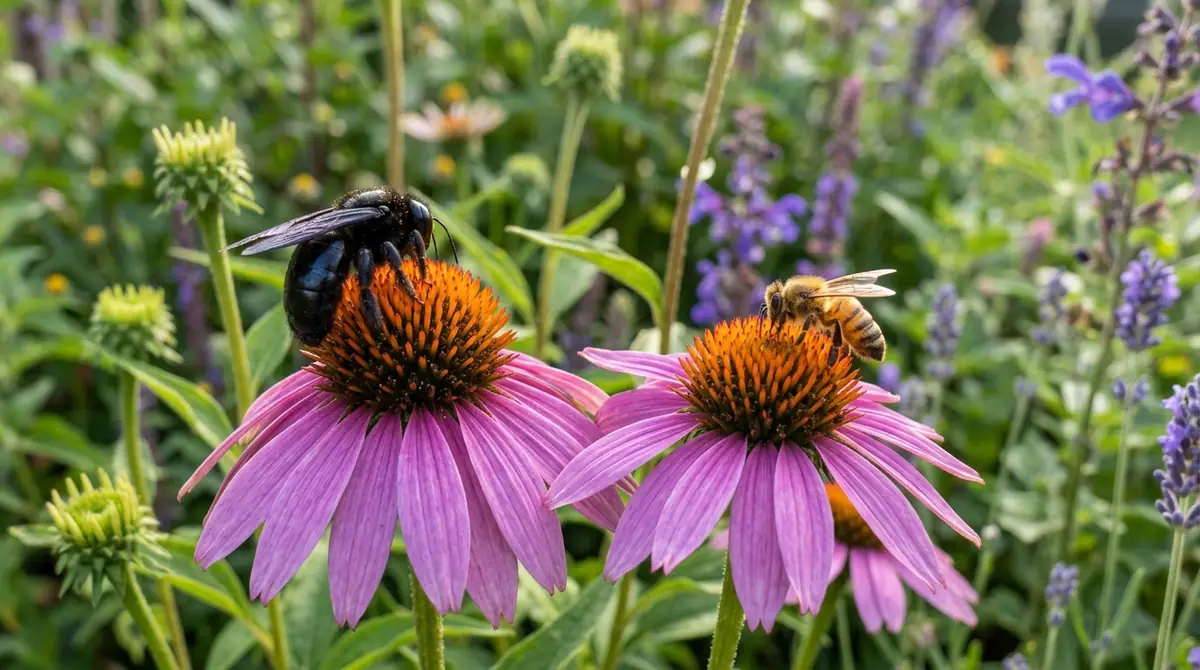
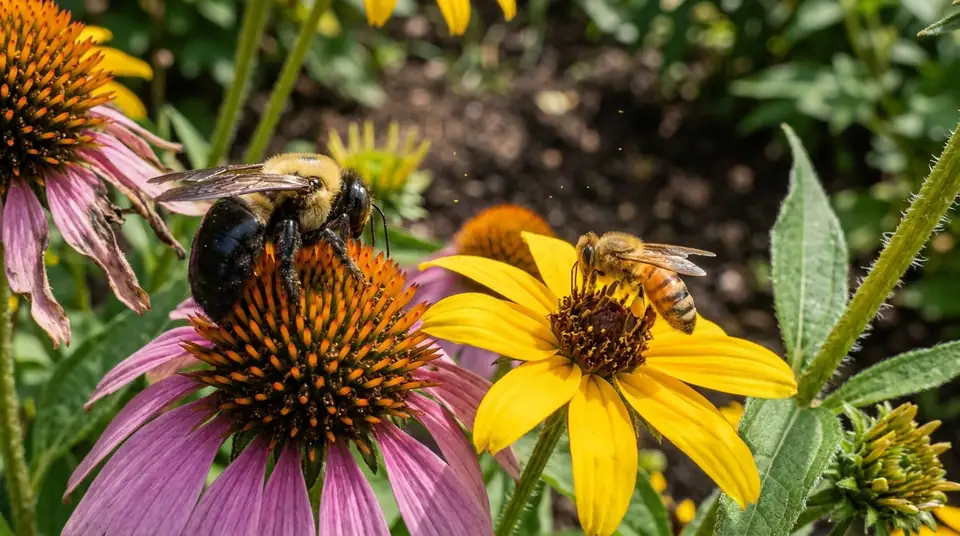
Carpenter bees (Xylocopa spp.) and Western honey bees (Apis mellifera) belong to the order Hymenoptera, but their evolutionary paths diverge drastically. Honey bees are eusocial insects living in massive, highly organized colonies comprising 20,000 to 60,000 workers, a single queen, and a few hundred drones during peak seasons. Their natural habitats are cavities—historically hollow trees, rock crevices, and caves—though today we house them in managed wooden hives. Morphologically, honey bees feature a hairy thorax and abdomen with distinct golden-brown and black striping. Their abdomens are striped all the way down, and they measure roughly 0.5 inches (1.27 cm) in length.
Carpenter bees, conversely, are predominantly solitary or semi-social. Females construct individual nests by boring circular tunnels into seasoned, unpainted hardwoods such as cedar, redwood, pine, and cypress. They prefer wood with a moisture content between 12% and 18%. Visually, a female carpenter bee is easily identified by her large, robust, and strikingly shiny, hairless black abdomen. They are significantly larger than honey bees, often reaching lengths between 0.75 and 1.0 inch (1.9 to 2.54 cm). Males, which possess a characteristic yellow spot on their faces, are entirely harmless—they lack stingers and spend their days performing aggressive territorial flights that frequently terrify uninitiated gardeners.
Ecologically, both species act as keystone pollinators, but their interaction with flora differs. Honey bees are generalist foragers, visiting millions of blossoms to gather nectar and pollen, packing the latter into specialized corbiculae (pollen baskets) on their hind legs. Carpenter bees are famous for "nectar robbing." Because of their large size and short mouthparts, they often slit the base of deep floral tubes—such as those on salvias, blueberries, and passionflowers—to extract nectar without ever touching the anthers, though they still effect pollination when they clumsily brush against floral reproductive structures on open-faced blooms.
2. Essential Environmental & Care Requirements
Creating a landscape that accommodates both carpenter bees and honey bees requires balancing structural preservation with floral abundance. While honey bees require secure apiary placement and consistent water sources, carpenter bees require strategic management of structural wood alongside rich nectar reserves.
Temperature thresholds dictate their daily foraging schedules. Honey bees become active when ambient temperatures rise above 55°F (13°C), with peak foraging occurring between 70°F and 90°F (21°C to 32°C). Carpenter bees are even more cold-tolerant, often emerging on bright, sunny winter or early spring days when temperatures reach just 50°F (10°C).
| Parameter | Optimal Condition | Common Mistake | Why It Matters |
|---|---|---|---|
| Wood Treatment | Painted, stained, or pressure-treated lumber | Leaving structural fascia boards bare and unsealed | Bare, soft woods invite female carpenter bees to excavate deep nesting galleries. |
| Floral Diversity | Continuous succession of blooms from early spring to late autumn | Planting single-season monocultures | Bees require an uninterrupted food supply; gaps cause colony stress or local migration. |
| Water Provision | Shallow birdbaths with pebbles for landing pads | Deep, open water sources | Bees easily drown in deep water; pebbles give them safe footing to drink. |
| Chemical Management | Zero-use of systemic neonicotinoids | Applying broad-spectrum insecticides during peak bloom | Systemics translate into nectar and pollen, systematically wiping out local pollinators. |
💡 Pro-Tip: To redirect carpenter bees away from your home's structural framing without harming them, build a simple "trap nest station" 20 feet (6 meters) away from your house. Mount a block of untreated scrap cedar or pine beneath a protective roof overhang, pre-drilling a 0.5-inch (1.27 cm) starter hole angled slightly upward. The carpenter bees will almost always choose this sacrificial wood over your home.
3. Step-by-Step Cultivation, Feeding & Propagation
Managing a balanced population of carpenter bees and honey bees in your landscape involves a deliberate protocol of floral provisioning, habitat design, and structural defense. Follow this step-by-step sequence to achieve ecological harmony:
- Conduct a Structural Audit: Inspect all exposed wooden surfaces, including decks, fences, pergolas, and window trim, paying special attention to unpainted wood surfaces. Seal any existing holes with silicone caulk and exterior wood filler, then apply two coats of exterior oil-based paint or polyurethane sealant to deter probing females.
- Establish a Succession Planting Calendar: Map out your garden beds to ensure continuous bloom cycles. Plant early spring bulbs like Crocus and Hyacinth, transition to mid-summer perennials such as Echinacea and Monarda, and finish with late-season asters and goldenrod to sustain foragers through autumn chills.
- Incorporate Native Flora for Carpenter Bees: Introduce deep-throated, native flowering perennials. Carpenter bees excel at pollinating crops like tomatoes and eggplants through buzz pollination (sonication), where they vibrate their flight muscles to dislodge tightly held pollen.
- Install Dedicated Water Stations: Place shallow ceramic saucers filled with clean water and flat river rocks throughout the garden. Ensure the stones break the water's surface by at least 0.25 inches (0.64 cm) to give bees safe perches.
- Establish Managed Honey Bee Forage Zones: Plant dense clusters of nectar-rich herbs—such as oregano, thyme, rosemary, and borage—in swathes at least 3 feet (0.9 meters) wide. Honey bees rely on mass-flowering displays to optimize their foraging efficiency.
- Monitor and Maintain: Check your designated carpenter bee trap stations and floral health weekly throughout the growing season. Remove spent blooms to encourage continuous flowering while monitoring structural wood for new drilling activity.
⚠️ Important Caution: Never use high-pressure liquid insecticides or dusts inside active carpenter bee holes if you want to protect local beneficial insect populations. Drift can easily travel to nearby flowering plants where honey bees are actively foraging. If structural intervention is mandatory, plug holes with wooden dowels and wood glue only after confirming the female has emerged, typically in late summer or early autumn.
For further scientific insights into regional bee management and agricultural impacts, consult the University of Florida IFAS Extension and the Royal Horticultural Society (RHS).
4. Common Problems, Pests & Troubleshooting
When managing carpenter bees versus honey bees, gardeners frequently encounter specific friction points. Here is how to diagnose and resolve them:
- Symptom: Piles of coarse, yellow-tan sawdust accumulating at the base of wooden porch columns or deck joists.
- Diagnosis: Female carpenter bee excavation.
- Solution: Do not panic. The structural integrity of the wood is rarely threatened in the first season. Vacuum up the sawdust, allow the female to complete her egg-laying cycle, and plug the gallery with a wooden dowel dipped in carpenter's glue once she abandons the nest in autumn. Paint or seal the wood immediately.
- Symptom: Aggressive, dive-bombing insects hovering directly in front of your face near eaves and overhangs.
- Diagnosis: Male carpenter bees defending their territory.
- Solution: Recognize that male carpenter bees possess no stingers and are entirely harmless. They are simply acting out a bluffing ritual. Wave your hand calmly or ignore them; they will move along within a few seconds.
- Symptom: Sudden, unexplained collapse or lethargy in local honey bee foragers visiting your garden beds.
- Diagnosis: Pesticide contamination or floral nectar dearth.
- Solution: Immediately cease all lawn and garden chemical applications. Provide a clean, chemical-free water station and plant high-energy nectar sources like borage and catmint to revive stressed foragers.
- Symptom: Woodpecker damage puncturing holes into siding or fascia boards.
- Diagnosis: Woodpeckers are hunting for carpenter bee larvae hidden inside the wooden galleries.
- Solution: Repair the underlying carpenter bee infestation first. Woodpeckers will not target the wood once the protein-rich larvae source is eliminated.
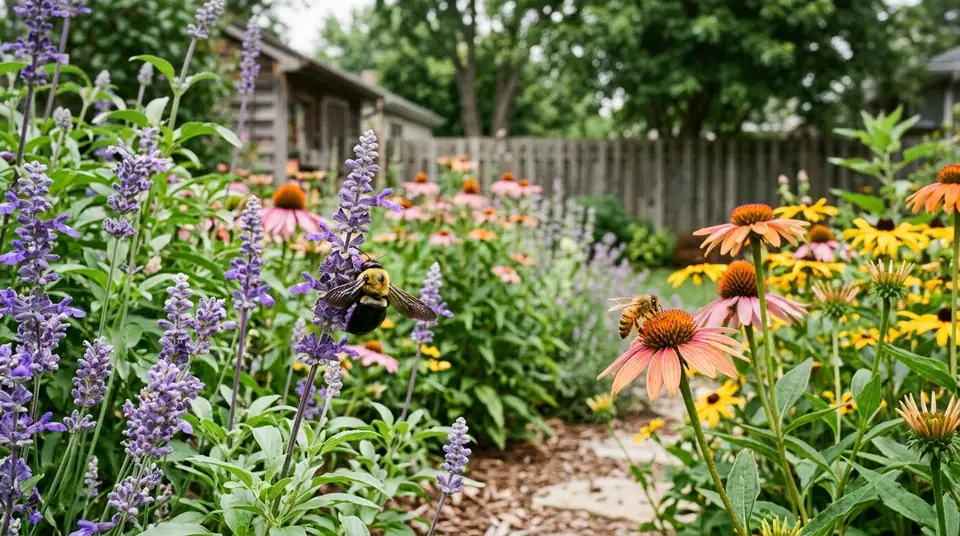
A carpenter bee and a honey bee visiting flowers in a garden
5. Frequently Asked Questions
Can carpenter bees sting humans and pets?
Yes, female carpenter bees do possess a stinger, but they are remarkably docile. They will only sting if trapped, squeezed directly in a hand, or if their nest is actively being destroyed. Male carpenter bees, which make up the vast majority of the bees you see buzzing aggressively around your head, are completely incapable of stinging because they lack a stinger.
Do honey bees cause structural damage to wooden homes?
No, honey bees do not bore into sound, dry structural wood. They require pre-existing cavities—such as hollow tree trunks, wall voids, or empty boxes—to establish their colonies. While a feral honey bee colony might occasionally take up residence inside a building's exterior wall, they occupy space rather than chewing through solid lumber.
How do I permanently get rid of carpenter bees without killing them?
The most effective long-term deterrent is finishing exposed wood. Carpenter bees exclusively target unfinished, unpainted, rough-textured lumber. Sanding down rough wood, applying multiple coats of high-gloss exterior paint or polyurethane, and sealing existing holes with wooden plugs will force them to seek nesting sites elsewhere in the natural environment.
Are carpenter bees and honey bees active at the same time of year?
Both species emerge in spring, but their timelines shift slightly. Carpenter bees often emerge earlier—sometimes as early as late March when temperatures cross 50°F (10°C)—to begin mating and excavating nests. Honey bees scale up their foraging activity slightly later in spring when sustained daytime temperatures consistently exceed 55°F (13°C) and fruit trees burst into bloom.
Related Guides
- How to Create a Pollinator Garden to Attract Bees and Hummingbirds
- How to Attract Bees to your Garden
- Care for Moses in the Cradle Plant
📋 Table of Contents ▼ Click to expand
Tags:
Keep reading
🌿 Related Plants You Might Like






PlantSavvyWorld
Editorial team
PlantSavvyWorld is an independent botanical education project. Articles are drafted with AI assistance, then edited and checked against university extension services, botanical garden collections and other published horticultural sources.