

When to Plant Watermelon in Kansas
Written with AI assistance, edited and checked against horticultural sources.
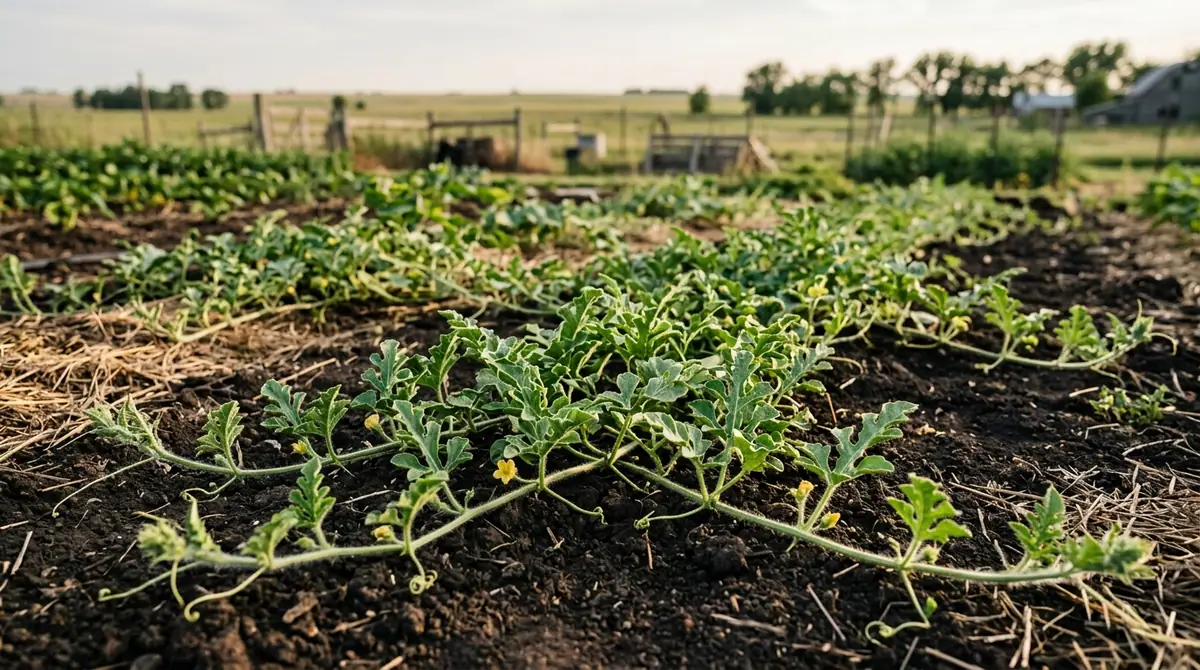
Watermelons are absolute heat-worshippers that refuse to tolerate even a whisper of lingering frost, and rushing them into cold soil sets you up for absolute failure. A sudden late-season drop in ambient air temperature down to a frosty 38°F (3.3°C) can devastate leggy seedlings. Getting the timing right across distinct microclimates—from USDA Hardiness Zone 5b up in the northwest to Zone 7a down south—requires a precise calibration of soil warmth, frost-free dates, and root development. Whether you are transitioning tender starts or planting direct, timing is everything.
1. Botanical Overview & Natural Habitat

Unlike cool-season crops that stall in the heat, Citrullus lanatus undergoes rapid vegetative expansion and fruit development only when thermal units accumulate consistently. Botanically, the plant develops an extensive, aggressive root system that can plunge 3 to 4 feet (91 to 122 cm) deep into the subsoil, searching out moisture while its thick, bristly stems sprawl across the ground up to 10 to 15 feet (3 to 4.5 meters).
Understanding this wild, heat-adapted ancestry dictates how we manage watermelons in the Midwest. When growing plants in Kansas—where spring weather is notoriously volatile—we are essentially attempting to mimic the rapid transition from a dry, baking African dry season to a fertile, irrigated flood plain.
For gardeners looking at regional fruit production, getting your warm-season schedule dialed in is just as crucial as managing other regionally sensitive crops, much like timing your When to Plant Strawberries in Kansas: Zone 6a/6b Seasonal Calendar correctly. If you start too early, cold-induced stunting permanently compromises the vascular system of the vine. If you start too late, you run out of frost-free days before the sugars can fully concentrate in the fruit.
2. Essential Environmental & Care Requirements
To successfully cultivate Citrullus lanatus in Kansas, you must meet specific non-negotiable environmental parameters.
Temperature is your primary metric. Watermelon seeds will not germinate in soil below 70°F (21.1°C), and optimal germination occurs when soil temperatures sit between 80°F and 90°F (26.7°C to 32.2°C). Ambient air temperatures should consistently range between 75°F and 95°F (23.9°C to 35°C) during the growing season.
Soil composition is equally critical. Watermelons demand loose, sandy loam or loamy sand with a pH between 6.0 and 6.8. Heavy Kansas clay will hold too much moisture, suffocating the developing roots and paving the way for soil-borne pathogens like Fusarium oxysporum.
Sunlight exposure must be unhindered: aim for a minimum of 8 to 10 hours of direct, unfiltered sunlight daily.
Water management requires a delicate balance. During the establishment and vegetative phases, provide roughly 1 to 2 inches (2.5 to 5 cm) of water per week via drip irrigation or deep soaking at the base of the plant to protect the foliage from fungal spores. Once the melons reach the net stage and are sizing up, taper off irrigation slightly to maximize sugar concentration in the flesh, but never let the soil dry out completely, which causes blossom-end rot and fruit splitting.
| Parameter | Optimal Condition | Common Mistake | Why It Matters |
|---|---|---|---|
| Soil Temperature | 80°F – 90°F (26.7°C – 32.2°C) | Planting when soil is below 65°F (18.3°C) | Cold soil causes seed rot and stunts young root systems permanently. |
| Soil pH | 6.0 – 6.8 | Planting in highly alkaline or acidic clay | Extreme pH locks out essential micronutrients like phosphorus and iron. |
| Sunlight | 8 – 10+ hours direct sun | Shading under taller garden structures | Insufficient light reduces sugar production and lowers fruit yield. |
| Plant Spacing | 3 – 5 feet (90 – 150 cm) apart | Overcrowding vines in a tight grid | Poor airflow breeds powdery mildew and dampens fruit pollination rates. |
💡 Pro-Tip: In northern and western Kansas (Zones 5b and 6a), pre-warm your planting beds two weeks prior to installation by laying black plastic mulch over the hills. This absorbs solar radiation, elevates soil temperatures by 5 to 10 degrees Fahrenheit (-15 to -12 degrees Celsius), and accelerates early-season growth exponentially.
3. Step-by-Step Cultivation, Feeding & Propagation
Growing high-yielding watermelons in the Kansas wind and sun demands a structured, meticulous cultivation protocol. Because our growing season in central and northern counties is compressed, starting seeds indoors or timing direct sowing precisely is vital. For related root-zone structural insights when transplanting delicate starts, review our guide on How Deep Do Pepper Plant Roots Go? Pot Size & Substrate Depth Guide.
Follow this step-by-step sequence to establish your crop:
- Calculate Your Timeline: In Kansas, look up your local average last spring frost date. Direct-sow seeds or transplant hardened-off seedlings 1 to 2 weeks after this date, once the soil has naturally sustained a temperature of 70°F (21.1°C) at a 4-inch (10 cm) depth. This typically falls between May 1st in Wichita (Zone 7a) and May 20th in Colby (Zone 5b).
- Prepare the Planting Hills: Space your planting locations 4 to 6 feet (1.2 to 1.8 meters) apart in rows that are 6 to 8 feet (1.8 to 2.4 meters) apart. Amend each hill with a 2-inch (5 cm) layer of aged compost and a handful of organic, low-nitrogen, high-phosphorus fertilizer to encourage root and fruit development rather than excessive vine growth.
- Sow or Transplant with Care: If direct-sowing, plant 3 to 4 seeds per hill at a depth of 1 inch (2.5 cm). If transplanting greenhouse-grown starts, handle the root balls with extreme gentleness to prevent root shock—borrowing techniques from When to Transplant Cucumber Seedlings: Stop Root Shock & Boost Growth. Set the root ball level with the surrounding soil surface.
- Thin and Establish: Once direct-sown seedlings reach 3 inches (7.6 cm) tall and have two true leaves, thin each hill down to the two strongest, most vigorous vines using sharp shears. Snip the rejected seedlings at the soil line rather than pulling them to avoid disturbing the root systems of the survivors.
- Mulch and Train: Apply an organic mulch, such as clean straw, around the base of the plants once the soil is thoroughly warm. This suppresses weeds, retains critical summer moisture, and keeps developing melons from sitting directly in mud.
- Monitor Pollination: Watermelons produce separate male and female flowers on the same vine. Ensure pollinators have clear access to the garden. Bees are the primary vector for transferring pollen from male blooms to the female flowers (which feature a tiny, miniature watermelon at the base of the petals).
⚠️ Important Caution: Avoid high-nitrogen commercial fertilizers once the vines begin to run. Excess nitrogen forces lush, dark green vegetative growth at the absolute expense of blossoms and fruit set, leaving you with massive vines and zero watermelons.
For official state-specific agricultural planting dates and regional trial data, consult the Kansas State University Research and Extension Horticulture Service. Additionally, general botanical classifications and pest tracking references can be cross-checked with the Royal Horticultural Society.
4. Common Problems, Pests & Troubleshooting
Kansas weather can turn on a dime, presenting the gardener with a litany of environmental stressors and biological pests. Recognizing symptoms early prevents total crop loss.
Blossom-End Rot
Appearing as a sunken, leathery, black patch on the blossom end of the developing fruit, this disorder is caused by calcium fluctuation within the plant tissue, usually triggered by inconsistent watering or irregular soil moisture swings. Remedy this by maintaining steady, even soil moisture and ensuring your soil pH is properly balanced to allow calcium uptake.
Cucumber Beetles (Striped and Spotted)
These yellow-and-black pests attack young seedlings and transmit bacterial wilt, a fatal pathogen that causes the entire vine to suddenly collapse and die. Control them immediately upon detection using floating row covers over young plants, or apply neem oil or pyrethrin-based sprays in the late evening when pollinators are inactive.
Powdery Mildew

5. Frequently Asked Questions
What is the exact calendar date to plant watermelon in Kansas?
Because Kansas spans USDA Zones 5b through 7a, the exact date varies by region. In southern Kansas (Wichita/Winfield area), plant outdoors between May 1st and May 10th. In central Kansas (Salina/Manhattan area), aim for May 10th to May 20th. In northern and western Kansas (Goodland/Colby area), wait until May 20th to June 1st to ensure soil temperatures have stably surpassed 70°F (21.1°C) and all threat of a late freeze has passed.
Can I start watermelon seeds indoors in Kansas, and when should I do it?
Yes, starting seeds indoors is highly recommended for northern Kansas to maximize the short growing season. Sow seeds in biodegradable peat pots 3 to 4 weeks before your average last spring frost date. Maintain indoor soil temperatures around 85°F (29.4°C) using a seedling heat mat. Transplant them outdoors carefully within 2 to 3 weeks of sprouting; leaving them in containers too long causes irreversible root-binding.
How do I know when my Kansas watermelons are ripe and ready to harvest?
Look for three definitive botanical indicators: First, the ground spot—where the watermelon rests on the soil—must transition from a pale white or green color to a deep, rich buttery yellow or cream. Second, the tendril closest to the point where the fruit stem attaches to the vine should turn completely brown and dry up. Third, give the melon a sharp tap with your knuckles; a ripe watermelon produces a dull, hollow thud rather than a sharp, metallic ring.
Why are my watermelon flowers falling off without producing fruit?
The first flowers produced by watermelon vines are exclusively male, and they naturally drop off the plant after shedding their pollen—this is completely normal and expected. Female flowers, which appear roughly a week or two later, feature a small, immature melon ovary at the base of the petals. If female flowers are dropping, it is typically due to poor pollination caused by lack of bees, extreme heat stress, or excessive nitrogen fertilizer application.
Related Guides
- When to Plant Beets in Kansas
- When to Plant Asparagus in Kansas
- When to Plant Sweet Potatoes in Kansas
- When to Plant Watermelon in Georgia
- When to Plant Watermelon in Az
📋 Table of Contents ▼ Click to expand
Tags:
Keep reading
🌿 Related Plants You Might Like




PlantSavvyWorld
Editorial team
PlantSavvyWorld is an independent botanical education project. Articles are drafted with AI assistance, then edited and checked against university extension services, botanical garden collections and other published horticultural sources.