

True Bloom Roses
Written with AI assistance, edited and checked against horticultural sources.
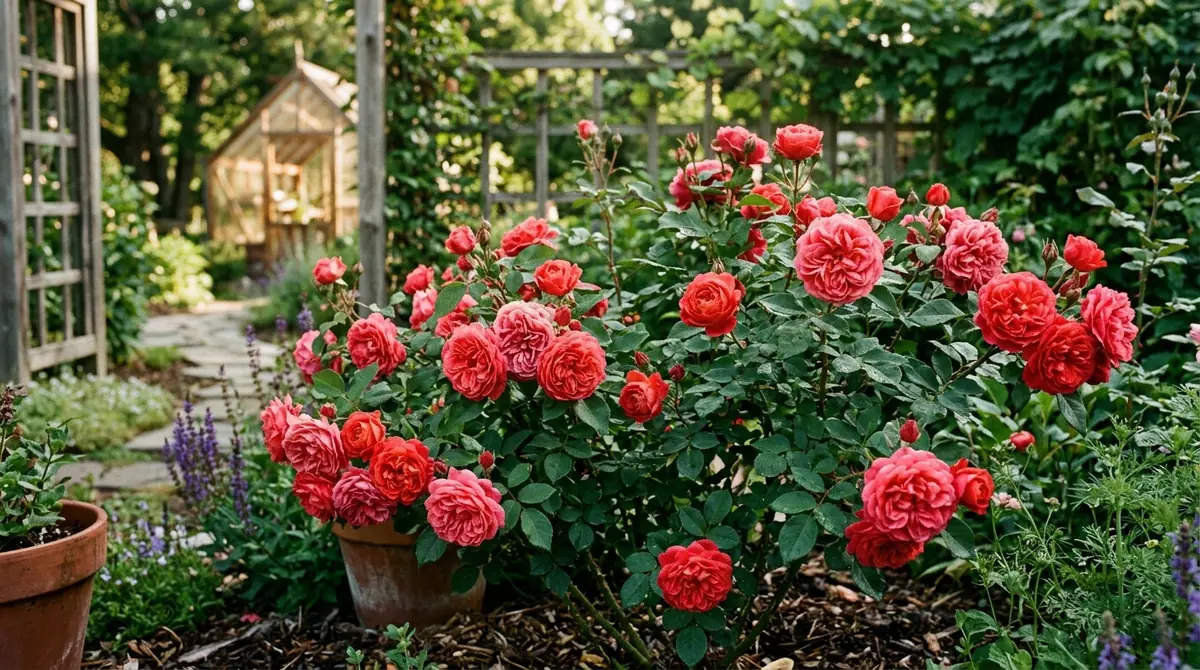
I was down on my knees in a gardener's south-facing Chicago courtyard last June, sweating through my heavy canvas apron, when the stark difference hit me. To my left, a row of notoriously finicky hybrid teas sat defoliated and weeping black spot after a damp, 70°F (21°C) spring. To my right stood a newly installed block of 'True Bloom' roses, completely untouched, throwing up glossy emerald flush after emerald flush of vivid crimson petals. That is the exact moment I stopped viewing modern shrub rose breeding as a marketing gimmick and started specifying True Bloom cultivars across every residential design project demanding high visual impact with low chemical maintenance.
1. Botanical Overview & Natural Habitat

Morphologically, these plants display a dense, self-cleaning habit. Unlike older garden roses that drop messy, spent brown petals and require relentless deadheading to look tidy, True Bloom cultivars feature foliage that cascades densely along sturdy, thorn-moderated canes. Leaves are notably coriaceous—thick, leathery, and deeply cut with a high cuticle wax layer. This specific leaf chemistry acts as a natural mechanical barrier against fungal spore penetration, which is why they breeze through humid summers without dropping their coats.
In terms of scale, expect a mature plant to fill a distinct architectural niche in your garden design. Most cultivars mature to a compact, rounded shrub measuring between 3 to 4 feet (90 to 120 cm) in height and roughly 3 feet (90 cm) in spread. Their root systems are predominantly deep-anchoring taproots supplemented by a dense, fibrous surface mat, making them remarkably resilient once established.
To understand how to situate these plants in a sophisticated landscape plan, it helps to compare their growing mechanics to other specialty ornamentals. For instance, while delicate indoor specimens like moth orchids demand hyper-controlled humidity and vertical bark substrates—as outlined in our guide on how to care for indoor orchids to make them bloom again—True Bloom roses are absolute garden warriors that thrive on ambient natural stress, provided their foundational root zone and solar budgets are respected.
2. Essential Environmental & Care Requirements
True Bloom roses are remarkably adaptable, but unlocking their maximum genetic potential—which translates to continuous, heavy flushes of 3-to-4-inch blooms from late spring until the first hard autumn freeze—requires dialing in their environmental parameters.
| Parameter | Optimal Condition | Common Mistake | Why It Matters |
|---|---|---|---|
| Light Exposure | Full sun: minimum 6 to 8 direct sunlight hours daily. | Planting in dappled shade or eastern-only exposures. | Insufficient photons reduce photosynthetic capacity, leading to weak stem elongation and minimal bud set. |
| Soil Texture | Loamy, well-draining soil rich in organic matter. | Heavy, compacted clay that retains standing water. | Prolonged root saturation starves roots of oxygen and invites Phytophthora root rot. |
| Soil pH | Slightly acidic to neutral, between 6.0 and 6.5. | Highly alkaline soils above 7.5. | Extreme pH locks out essential micronutrients like iron, causing chlorosis and stunted leaf development. |
| Irrigation | 1 to 1.5 inches (2.5 to 3.8 cm) of water per week via drip irrigation. | Frequent, shallow overhead sprinkler watering. | Wet foliage combined with warm evening temperatures provides a primary breeding ground for fungal pathogens. |
Temperature tolerance is another major strength of this series. They are reliably winter-hardy down to USDA Zone 5 (tolerating minimum winter lows of -20°F to -10°F / -29°C to -23°C) and cruise effortlessly through sultry summer heatwaves up to Zone 9 (reaching persistent highs of 95°F to 100°F / 35°C to 38°C) without dropping their bud counts.
💡 Pro-Tip: When planning a border with True Bloom roses, resist the urge to crowd them against foundations or dense privacy hedges. Allow a minimum air circulation buffer of 36 inches (90 cm) on all sides. Unobstructed air movement across the lower canopy is your single best defense against opportunistic garden diseases.
3. Step-by-Step Cultivation, Feeding & Propagation
Getting these roses established correctly in your landscape sets the stage for years of effortless performance. Follow this precise protocol for planting and maintaining your own specimens.
- Site Preparation and Trenching: Select a full-sun location in early spring or mid-autumn. Dig a hole twice as wide as the nursery container—approximately 24 inches (60 cm) across—and equal in depth to the root ball, roughly 12 to 15 inches (30 to 38 cm).
- Soil Amendment: Mix 30% fully composted organic matter (such as aged manure or leaf mold) into the native backfill soil to improve microbial life and crumb structure. Avoid raw, uncomposted materials which can tie up soil nitrogen.
- Planting Depth Adjustment: Unpot the rose and gently tease out any circling roots. Place the plant in the hole, ensuring the bud union (the swollen knot where the scion meets the rootstock) sits 2 inches (5 cm) above the soil line in warm climates, or level with the soil line in freezing winter regions to prevent frost heaving.
- Initial Watering-In: Backfill halfway, tamp gently by hand to remove large air pockets, and flood the planting basin with water. Finish backfilling, tamp lightly again, and apply a second deep saturation.
- Mulching: Apply a 3-inch (7.5 cm) layer of shredded hardwood bark or pine straw across the root zone to retain moisture and suppress weeds. Keep the mulch pulled back 2 inches (5 cm) away from direct contact with the main woody canes to prevent stem rot.
- Seasonal Feeding Regimen: Apply a balanced, slow-release granular organic rose fertilizer (such as a 5-10-5 formulation) just as new spring leaves unfurl in April. Repeat this application once in mid-summer after the first massive flush of blooms fades to fuel the secondary and tertiary flowering cycles.
Propagation of patented True Bloom varieties via home cuttings is legally restricted due to plant patent laws, but studying their stem anatomy reveals why they root so vigorously for commercial nurseries. Hardwood cuttings taken in late autumn or semi-hardwood cuttings taken in mid-summer strike with high success rates under mist benches due to the high density of dormant adventitious meristematic cells clustered just beneath the bark node rings. For home gardeners, division of mature own-root shrubs in early spring is occasionally viable if the root clump separates cleanly into distinct, multi-stemmed divisions with intact root systems.
⚠️ Important Caution: Never apply high-nitrogen synthetic lawn fertilizers directly over or near your rose beds. Excess nitrogen triggers a massive, succulent flush of weak, sappy foliage that acts as a beacon for piercing-sucking insects like aphids, completely overriding the plant's natural pest defenses.
4. Common Problems, Pests & Troubleshooting
Even though True Bloom roses are bred for extraordinary resistance, no plant is entirely bulletproof. When environmental stress or poor cultural practices occur, issues can arise.
Black Spot and Powdery Mildew: While traditional roses succumb to these fungi at the first sign of rain, True Bloom varieties typically resist them. However, if planted in deep shade with poor air circulation, you may occasionally spot minor fungal stippling. Prune away affected interior canes immediately, rake up fallen leaves from the soil surface to break the pathogen's overwintering cycle, and apply a preventative spray of horticultural neem oil or potassium bicarbonate at dawn. For authoritative guidance on diagnosing stubborn plant pathogens, consult the University of California Integrated Pest Management Program.
Aphids and Thrips: These sap-sucking pests target tender new bud growth during warm, dry spells. You will notice distorted, sticky leaves or distorted, brown-edged flower petals. Blast them off with a sharp jet of water from your garden hose early in the day, or introduce beneficial predatory insects such as lady beetles (Coccinellidae) and green lacewings to your landscape design.

5. Frequently Asked Questions
Do True Bloom roses need to be deadheaded?
No, True Bloom roses are engineered with self-cleaning flowering habits. Spent petals drop cleanly away, and new buds quickly form right over the old flowering stems without requiring manual snipping. However, if you prefer a hyper-manicured aesthetic, a light shearing after a heavy bloom cycle will instantly tidy the canopy.
How do I prune True Bloom roses in the spring?
Pruning should occur in early spring just as the winter buds begin to swell and turn a vibrant red. Use sterilized bypass pruners to cut back the overall shrub by one-third to one-half to shape a dense, rounded framework. Always cut at a 45-degree angle about 1/4 inch (0.6 cm) above an outward-facing bud eye, and completely remove any dead, damaged, or crossing canes.
Are True Bloom roses fragrant?
Yes, unlike many modern disease-resistant landscape roses that sacrifice scent entirely for durability, True Bloom cultivars feature a moderate, classic sweet-tea rose fragrance. The aromatic volatile compounds are most concentrated during warm, humid mornings when the newly opened blooms first release their essential oils into the garden air.
Can True Bloom roses grow successfully in pots and containers?
They perform exceptionally well in large patio containers. Select a heavy-duty frost-proof pot measuring at least 18 inches (45 cm) in diameter and depth to accommodate their developing root mass. Use a high-quality, soil-less potting mix blended with 20% compost, and ensure your container features multiple drainage holes to prevent root asphyxiation during heavy rainstorms.
Related Guides
- Can You Transplant Roses in the Fall
- Why My Hydrangea Doesn't Bloom
- Why Didn't My Hydrangea Bloom This Year
- Hydrangea Did Not Bloom
- How to Care for Indoor Orchids to Make Them Bloom Again
📋 Table of Contents ▼ Click to expand
Tags:
Keep reading
🌿 Related Plants You Might Like



PlantSavvyWorld
Editorial team
PlantSavvyWorld is an independent botanical education project. Articles are drafted with AI assistance, then edited and checked against university extension services, botanical garden collections and other published horticultural sources.