

Why My Hydrangea Doesn't Bloom
Written with AI assistance, edited and checked against horticultural sources.
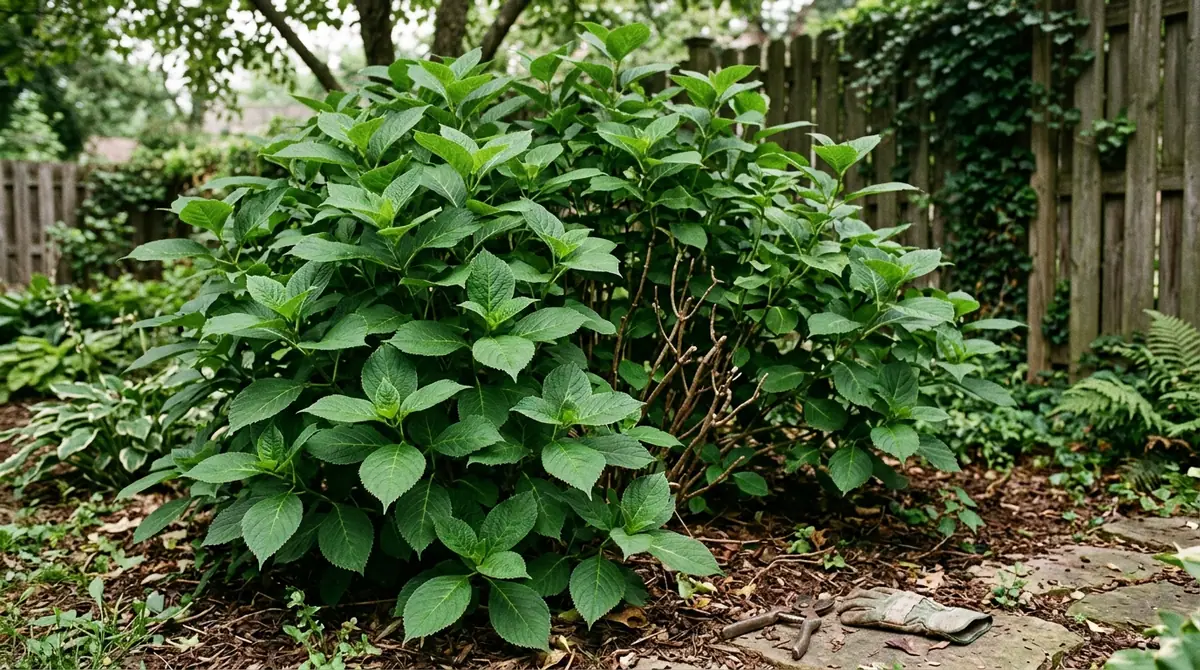
Standing in my Zone 6 display garden three summers ago, I stared at a magnificent, sprawling Hydrangea macrophylla 'Endless Summer' that was nothing more than a dense wall of lush, emerald-green foliage. Not a single mophead of blue or pink graced the branches. My neighbor leaned over the fence and offered the classic, misguided advice: "Just give it more high-nitrogen lawn fertilizer." I knew better. I reached for my secateurs, checked the bud scars on the old wood, and realized exactly where my pruning shears had gone wrong the previous autumn. A budless hydrangea is one of the most frustrating sights in horticulture, but it is always speaking a botanical language. Let's decode it together.
1. Botanical Overview & Natural Habitat

Understanding their natural habitat explains their temperamental behavior in suburban yards. In the wild, hydrangeas grow in dappled shade where the soil remains perpetually cool, rich in organic matter from decomposing leaf litter, and consistently moist without becoming waterlogged. The root systems are characteristically fibrous and shallow, spreading horizontally rather than plunging deep into the earth. This root architecture makes them acutely sensitive to surface-level moisture fluctuations and mechanical damage.
The five most common garden species—Hydrangea macrophylla (mopheads and lacecaps), Hydrangea paniculata (panicle hydrangeas), Hydrangea arborescens (smooth hydrangeas like 'Annabelle'), Hydrangea quercifolia (oakleaf hydrangeas), and Hydrangea anomala petiolaris (climbing hydrangea)—each possess unique bud-setting habits. The failure to bloom almost always stems from a mismatch between the gardener's care routine and the specific physiological triggers of the plant's species type, particularly regarding when flower buds are initiated.
For instance, H. Macrophylla and H. Quercifolia set their floral buds during the late summer (typically July and August in the Northern Hemisphere) of the previous growing season. If you prune these plants in autumn, winter, or early spring, you are quite literally clipping away next year's blooms. Conversely, H. Paniculata and H. Arborescens set buds on new wood—the current season's growth—meaning they bloom reliably even if pruned back hard in late winter.
| Parameter | Optimal Condition | Common Mistake | Why It Matters |
|---|---|---|---|
| Light Exposure | Morning sun (3–6 hours) with afternoon shade (temperatures below 85°F / 29°C) | Deep, dark shade or blazing, scorching midday sun | Too little light prevents bud formation; too much light fries foliage and desiccates buds. |
| Soil Moisture | Consistently moist, draining freely (1–2 inches / 2.5–5 cm of water weekly) | Allowing soil to dry out completely between waterings | Drought stress causes bud abortion and wilting, stunting all seasonal floral development. |
| Pruning Timing | Post-bloom for old wood; late winter/early spring for new wood | Pruning old-wood varieties in autumn, winter, or spring | Removes overwintering flower buds before they have a chance to open in the spring. |
| Nutrient Balance | Balanced, slow-release organic fertilizer low in nitrogen | Over-applying high-nitrogen lawn fertilizers (e.g., 29-0-4) | Excess nitrogen triggers massive vegetative leaf growth at the direct expense of floral buds. |
2. Essential Environmental & Care Requirements
To diagnose why your hydrangea refuses to bloom, you must systematically evaluate its environmental conditions against its native woodland blueprint.
Light and Temperature Dynamics
Light is the primary energy driver for floral initiation. While many gardeners believe hydrangeas are total shade lovers, planting them in a gloomy north-facing corner under a dense evergreen canopy starves them of the necessary photosynthetic energy to produce buds. Conversely, baking them in a south-facing exposure where ambient temperatures exceed 90°F (32°C) causes severe heat stress. When temperatures spike, the plant prioritizes cellular survival and transpiration over reproductive output, often causing existing flower buds to desiccate and turn brown before they ever open. The sweet spot is a planting site receiving 4 to 6 hours of gentle morning sun, shielded from harsh 2:00 PM to 5:00 PM solar radiation.
Soil Composition, pH, and Moisture
Hydrangeas demand soil rich in humus with a high cation exchange capacity. They thrive in a pH range between 5.5 and 6.5. Interestingly, soil pH also dictates flower color in Hydrangea macrophylla: acidic soils (pH below 6.0) release aluminum ions, resulting in vivid blue flowers, while alkaline soils (pH above 7.0) lock up aluminum, yielding pink or red blooms. However, extreme pH shifts or nutrient locks can stress the plant enough to inhibit blooming altogether.
Moisture management is equally critical. Because their root zones rarely extend deeper than 12 to 18 inches (30 to 45 cm), a dry spell lasting merely 7 to 10 days during bud development can cause irreversible floral blast.
💡 Pro-Tip: Apply a 3-inch (7.5 cm) layer of shredded hardwood bark or leaf mold mulch around your hydrangeas, keeping it 2 inches (5 cm) away from the actual woody stems. This mimics the forest floor, stabilizing soil temperatures by up to 10°F (5.5°C) and retaining the exact moisture levels required for optimal bud set.
Nutrient Management
Feeding hydrangeas requires restraint. The most common nutritional error is showering the plant with quick-release, high-nitrogen fertilizers designed for turfgrass. Nitrogen fuels rapid cell elongation and chlorophyll production, meaning your shrub will look like a vibrant, leafy giant while producing zero flowers. Instead, use a balanced, slow-release organic fertilizer formulated for acid-loving shrubs, applied just as spring growth begins. For deeper botanical insights on managing plant stress and root environments, consult the University of Georgia Extension.
3. Step-by-Step Cultivation, Feeding & Propagation
If your hydrangea has missed a season of blooms, resetting your care protocol will get it back on track. Follow this step-by-step remediation sequence to restore floral production.
- Conduct a Species Audit: Identify your exact hydrangea variety. Examine the stems in early spring. If they are woody and rigid with plump lateral buds, you likely have an old-wood bloomer (H. Macrophylla or H. Quercifolia). If the stems emerge entirely from the ground or green shoots sprout from a woody base, you are dealing with a new-wood bloomer (H. Arborescens or H. Paniculata).
- Adjust Your Pruning Window: Cease all pruning on old-wood varieties immediately. If pruning is necessary to remove dead wood, do so strictly within 21 days after the flowers fade in mid-summer. For new-wood varieties, prune hard in late winter (February to March) before new buds break dormancy.
- Perform a Soil and Moisture Check: Insert your index finger 2 inches (5 cm) into the soil beneath the drip line. If it feels dry, install a drip irrigation system or soak the root zone deeply twice a week, delivering roughly 1 inch (2.5 cm) of water per week.
- Calibrate Fertilizer Applications: Stop using synthetic, high-nitrogen fertilizers. Broadcast a balanced organic granular fertilizer (such as a 10-10-10 or specialized shrub formula) at a rate of 1 cup per mature plant just as leaf buds swell in spring.
- Implement Winter Protection (For Cold Climates): If you live in USDA Zones 4 or 5, sudden winter temperature drops below -10°F (-23°C) or late spring frosts can kill overwintering flower buds. Protect old-wood hydrangeas in late November by wrapping them in burlap stuffed with dry straw or oak leaves, securing the cage with garden twine until all danger of frost passes in spring.
⚠️ Important Caution: Never shear hydrangeas into geometric hedges with hedge trimmers. This sloppy technique mutilates emerging bud sites, removes old wood indiscriminately, and guarantees a foliage-only shrub for the upcoming season. Always use clean, sharp bypass pruners to cut back individual stems selectively.
4. Common Problems, Pests & Troubleshooting
When flowers fail to appear, the culprit is often environmental trauma or pest interference rather than total plant failure.
Late Spring Frost Damage
This is the silent killer of bigleaf hydrangea blooms. In regions experiencing volatile spring weather, warm March spells can trick the plant into breaking dormancy early. When a sudden hard freeze hits in April—dropping temperatures below 28°F (-2°C)—the delicate, water-filled embryonic flower buds inside the stems rupture and die. The plant will survive and push out new green leaves from backup vegetative buds, but the floral display for that year is completely lost.
Improper Transplant Shock
If you recently moved a hydrangea from a nursery pot to your garden, or relocated an established shrub, its hormonal signaling is disrupted. Transplanting severs the delicate peripheral feeder roots. The plant responds by entering a survival mode, redirecting all photosynthates toward root regeneration and foliar stability. It is entirely normal for a transplanted hydrangea to skip blooming for one, sometimes two, full seasons.
Pests and Fungal Pathogens
While pests rarely eat the flowers before they form, fungal diseases like Cercospora leaf spot or powdery mildew can severely defoliate a plant in late summer. Severe defoliation exhausts the plant's carbohydrate reserves, leaving it too weak to successfully initiate flower buds for the following year. Maintain good air circulation around the shrub's base, clear away fallen infected leaves in autumn, and apply a copper-based fungicide at the first sign of spotting.

5. Frequently Asked Questions
Why is my hydrangea growing huge leaves but no flowers?
This is almost always caused by an excess of nitrogen in the soil, which stimulates vegetative growth at the expense of floral development. It can also happen if you pruned an old-wood hydrangea (Hydrangea macrophylla) in late winter or spring, accidentally cutting off the flower buds that had already formed the previous summer.
Will cutting off dead flower heads make my hydrangea bloom again?
It depends entirely on the variety. For old-wood bloomers, deadheading should be done carefully by cutting just below the old flower head down to the first pair of healthy leaves immediately after flowering finishes in summer. If you cut lower down the stem on these varieties, you risk removing next year's flower buds. For reblooming cultivars (like 'Endless Summer') and new-wood species, deadheading encourages secondary flushes of growth and blooms.
How do I know if my hydrangea buds are dead after winter?
Scratch the bark of a stem gently with your fingernail or a pocketknife. If the tissue underneath is plump and green, the stem and its buds are alive and healthy. If the tissue is brown, brittle, and dry, that stem has suffered winterkill and will not produce flowers. Wait until late spring to prune out these dead stems after you can clearly see where new growth is emerging.
Can I force a potted hydrangea to bloom indoors?
Yes, but it requires managing a strict dormancy cycle. Potted florist hydrangeas are forced into bloom early in greenhouses. To keep them alive and encourage repeat blooming, keep them in a bright, cool indoor spot while flowering, then plant them outdoors in the garden after the final spring frost passes. Hydrangeas are woody perennial shrubs and generally do not perform well as permanent indoor houseplants over multiple years.
Related Guides
- Why Didn't My Hydrangea Bloom This Year
- Hydrangea Did Not Bloom
- True Bloom Roses
- How to Care for Indoor Orchids to Make Them Bloom Again
- Hydrangea with Red Stems
📋 Table of Contents ▼ Click to expand
Tags:
Keep reading
🌿 Related Plants You Might Like






PlantSavvyWorld
Editorial team
PlantSavvyWorld is an independent botanical education project. Articles are drafted with AI assistance, then edited and checked against university extension services, botanical garden collections and other published horticultural sources.