

Seed Names
Written with AI assistance, edited and checked against horticultural sources.
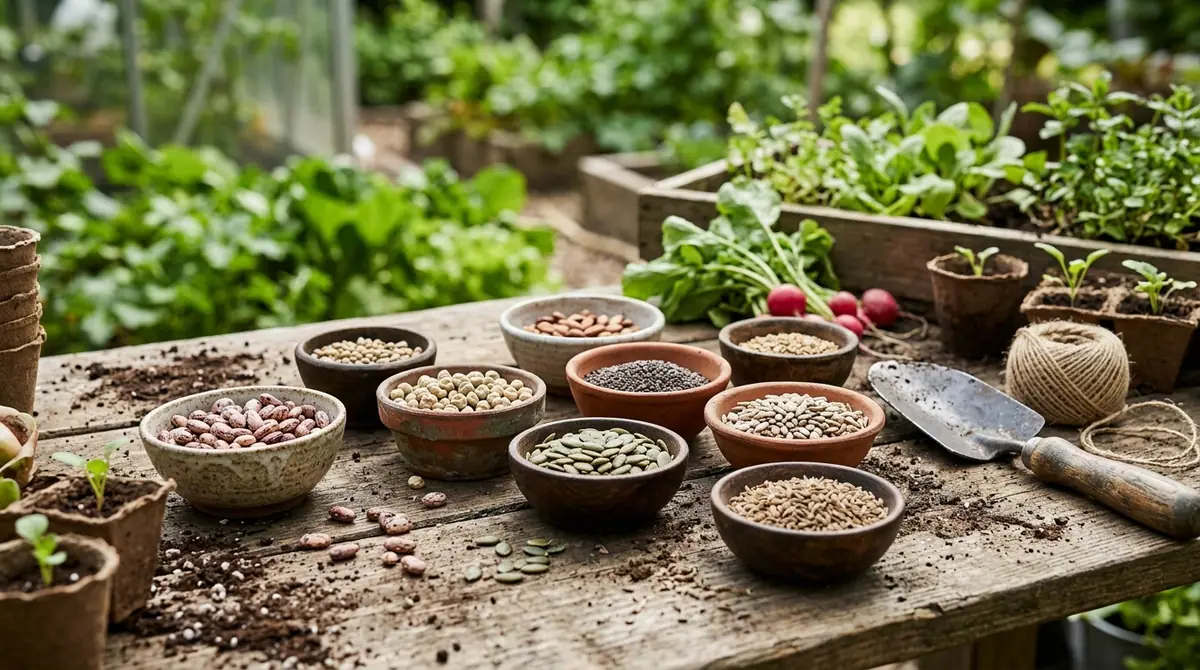
Foil packets labeled Solanum tuberosum 'Russet Burbank' and Lactuca sativa 'Black Seeded Simpson' contain simple "seed names," but each represents an entirely different botanical universe: one requiring chitting tubers at 50°F (10°C) and the other needing microscopic surface-sowing at 68°F (20°C). Understanding seed names is not just about reading labels; it is the master key to unlocking dormancy, predicting germination velocity, and understanding the evolutionary lineage of every plant in your landscape.
1. Botanical Overview & Natural Habitat

Botanically, a seed is a mature ovule comprising an embryonic plant, stored food (endosperm), and a protective seed coat (testa). The name assigned to a seed packet or botanical specimen tells a deeply specific story. For instance, open-pollinated heirlooms carry names passed down through generations, reflecting regional adaptations. F1 hybrids carry alphanumeric designations that signal deliberate cross-breeding for vigor and uniformity.
Understanding these classifications requires looking at how plants distribute and name their progeny in nature:
- Wild-Type Species (Species nov./spp.): These carry Latin binomials (e.g., Echinacea purpurea) reflecting exact natural habitats, such as the dry prairies of North America where seeds experience freezing winter stratifications down to 15°F (-9.4°C) before breaking dormancy.
- Cultivars (Cultivated Varieties): Enclosed in single quotes (e.g., Echinacea purpurea 'Magnus'), these are human-selected lineages bred for specific traits like petal color, stem strength, or disease resistance.
- Botanical Varieties (Var.): Naturally occurring regional variations within a species that have distinct physical traits, such as differing seed coat thicknesses or drought tolerance thresholds.
Whether you are organizing your seed vault or planning a perennial border, knowing how to decode these names prevents costly misidentifications. If you are venturing into root crops, be sure to cross-reference our guide on When Can You Plant Seed Potatoes to understand why true botanical potato seeds behave fundamentally differently than the tuber pieces we typically plant. For rigorous taxonomic verification, professional horticulturists regularly consult the Royal Horticultural Society Plant Finder to cross-check nomenclature and parentage.
2. Essential Environmental & Care Requirements
Different seed names command completely different environmental parameters for germination and early growth. You cannot treat a micro-seeded alpine perennial the same way you treat a large-seeded legume.
| Parameter | Optimal Condition | Common Mistake | Why It Matters |
|---|---|---|---|
| Germination Soil Temp | 65°F–75°F (18°C–24°C) for most warm-season crops | Planting in soil below 55°F (13°C) | Cold, wet soil causes seed rot (damping-off fungi) before the radicle can emerge. |
| Sowing Depth | 2 to 3 times the diameter of the seed | Burying fine seeds (e.g., lettuce) 0.5 inches (1.3 cm) deep | Tiny seeds lack the carbohydrate reserves to push through heavy soil layers. |
| Light Requirements | Varies: Full light for photoblastic seeds; complete dark for non-photoblastic | Exposing light-requiring seeds to deep soil burial | Light triggers phytochrome receptors in specific species to break dormancy. |
| Moisture Tension | Evenly moist, like a wrung-out sponge (80% field capacity) | Alternating between waterlogged and bone-dry substrate | Dehydration kills emerging radical tips; saturation starves the embryo of oxygen. |
To dive deeper into the physiological requirements of seed preservation and wild provenance, the Kew Royal Botanic Gardens Seed Information Database offers exhaustive research on specific genera and their natural germination triggers.
💡 Pro-Tip: Always check if your seed name denotes a "hard-seeded" (dormant) species like lupines or sweet peas. These require physical scarification—nicking the seed coat with a file—followed by a 24-hour soak in room-temperature water at 70°F (21°C) to allow water imbibition before sowing.
3. Step-by-Step Cultivation, Feeding & Propagation
Reading a seed name correctly tells you whether direct sowing or indoor starting is required. Follow this rigorous protocol to transition seeds from nomenclature to established landscape plants:
- Verify and Audit the Packet: Read the botanical name, batch test date, and days to maturity (typically ranging from 45 to 120 days). Discard expired seeds or store them in a climate-controlled vault at 35°F–40°F (1.6°C–4.4°C).
- Sanitize Propagation Trays: Wash cell flats in a 10% bleach solution or quaternary ammonium compound. Fill them with a sterile, fine-milled peat and perlite seed-starting mix, pre-moistened to achieve a temperature of 68°F–72°F (20°C–22°C).
- Sow According to Size: Place seeds at the precise depth dictated by their botanical class. Micro-seeds (less than 1mm) like campanula stay on the surface, pressed gently into the soil. Large seeds like beans get buried exactly 1.0 inch (2.5 cm) deep.
- Deploy Controlled Bottom Watering: Set seed trays into a shallow basin of water for 20 minutes, allowing capillary action to saturate the medium without displacing surface-sown seeds. Cover trays with clear humidity domes to maintain 90% relative humidity.
- Manage Light and Thermal Regimes: Place trays under full-spectrum LED grow lights delivering 1500–2500 lumens at a distance of 3 to 6 inches (7.6 to 15.2 cm) for 14–16 hours daily. Maintain ambient air temperatures between 65°F and 70°F (18°C and 21°C).
- Initiate Weaning and Hardening Off: Once true leaves emerge (typically 14 to 28 days post-sowing), remove humidity domes and introduce gentle air movement via an oscillating fan set on low. Over 10 days, gradually expose seedlings to outdoor conditions, starting with 1 hour of filtered morning sun at 55°F (13°C) and building up to full exposure.
⚠️ Important Caution: Never use untreated garden soil for indoor seed starting. Native soil contains fungal spores such as Pythium and Rhizoctonia, which rapidly destroy tender seedlings via damping-off disease within 48 hours of emergence.
4. Common Problems, Pests & Troubleshooting
Even when seed names are correctly matched to your climate zone, unexpected hurdles can derail germination. Here is how to diagnose and correct them:
- Problem: Delayed or Zero Germination After 21 Days
- Cause: Incorrect temperature thresholds or sowing seeds too deep that require light.
- Correction: Check the species' specific thermal requirements. If seeds are non-photoblastic and buried too deep, gently unearth them or restart under correct light/temperature protocols.
- Problem: Stems Pinching at the Soil Line and Toppling Over
- Cause: Damping-off caused by over-saturation, stagnant air, and unsterilized media.
- Correction: Discard affected cells immediately. Dust remaining seedlings with cinnamon (a natural antifungal) or dilute copper fungicide, reduce watering frequency, and increase airflow immediately.
- Problem: Pale Yellow Leaves (Chlorosis) in Newly Emerged Seedlings
- Cause: Nitrogen or iron deficiency in the sterile seed-starting mix, which lacks native nutrients.
- Correction: Once the first set of true leaves develops, apply a balanced, water-soluble organic fertilizer diluted to one-quarter strength (e.g., 2-1-1 fish emulsion) every 14 days.

5. Frequently Asked Questions
What is the difference between an open-pollinated seed name and an F1 hybrid seed name?
Open-pollinated seeds are fertilized by natural mechanisms like insects, wind, or self-pollination, resulting in offspring that are nearly identical to the parent plant. Their names often reflect historic heirlooms. F1 hybrid seeds are the intentional cross of two distinct inbred parent lines; their names typically include alphanumeric codes. Saving seeds from F1 hybrids does not yield true-to-type plants in the next generation, whereas open-pollinated seeds do.
Why do some seed packets list a botanical Latin name alongside the common name?
Common names vary wildly by region and culture—what one gardener calls a "love-in-a-mist," another calls "devil-in-the-bush." The botanical Latin binomial (Nigella damascena) provides a universal, unambiguous identifier ensuring you purchase the exact species, growth habit, and medicinal or ornamental properties you intend to grow.
How long do seed names stay viable in storage?
Seed viability varies dramatically by species. Parsnip and onion seeds drop in germination rates drastically after just 1 year. Conversely, beans, squash, and tomatoes can remain viable for 4 to 6 years if stored in a dark, airtight container maintained at a cool, stable temperature of 35°F–40°F (1.6°C–4.4°C) with low relative humidity below 35%.
Can I save seeds from a patented plant cultivar name?
Legally, no. Many modern plant cultivars carrying specific trademarked or patented names are protected under Plant Variety Protection (PVP) acts or utility patents. Propagating, selling, or distributing seeds harvested from patented cultivars for commercial purposes constitutes an infringement of intellectual property law.
Related Guides
📋 Table of Contents ▼ Click to expand
Tags:
Keep reading
🌿 Related Plants You Might Like
PlantSavvyWorld
Editorial team
PlantSavvyWorld is an independent botanical education project. Articles are drafted with AI assistance, then edited and checked against university extension services, botanical garden collections and other published horticultural sources.