

Suebelle Sapote
Written with AI assistance, edited and checked against horticultural sources.
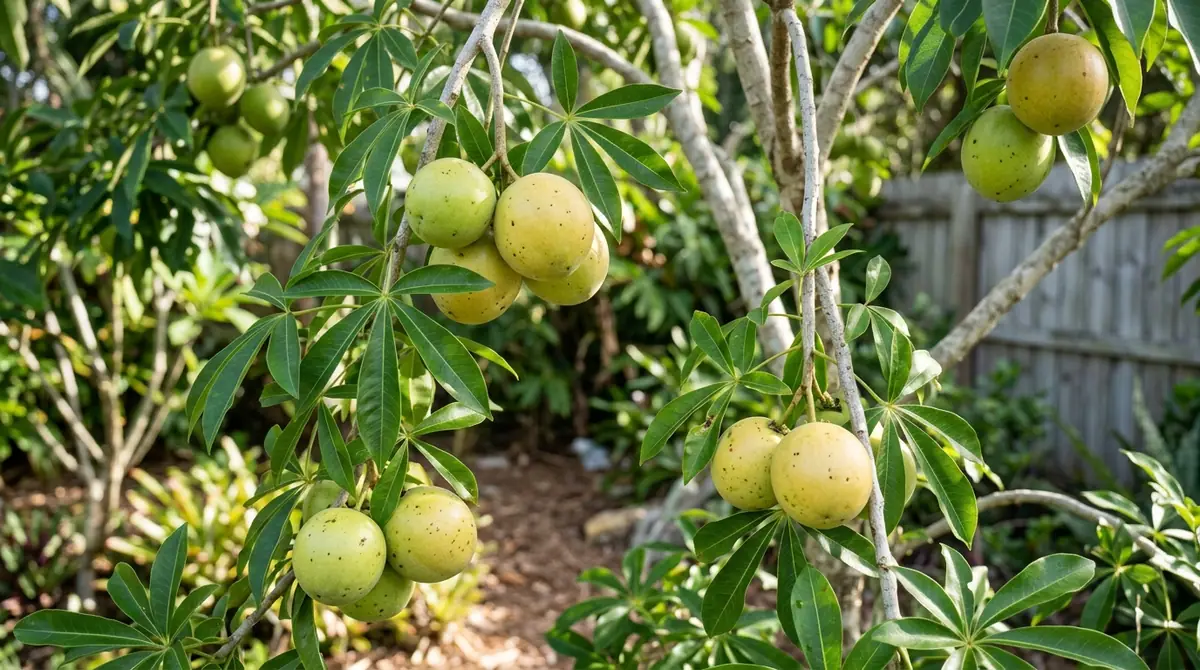
The morning I first tasted a perfectly ripe 'Suebelle' sapote out in my trial orchard, the sticky, sweet custard on my fingers instantly erased three years of impatient waiting. I had stood there watching its distinct weeping canopy sway in a 10 mph breeze, marveling at how a tree with such delicate, lanceolate leaves could produce fruit so heavy with dense, caramel-brown flesh. I often tell growers that choosing fruit trees is an exercise in delayed gratification, but the Suebelle white sapote (Casimiroa edulis 'Suebelle') rewards your patience with a buttery, custard-like harvest that tastes remarkably like a blend of peach, banana, and vanilla. If you are looking to add an extraordinary, evergreen focal point to your landscape that produces high yields of dessert-quality fruit without taking up an acre of land, you are in the right place. Let's dive deep into everything it takes to grow this exceptional cultivar successfully.
1. Botanical Overview & Natural Habitat

In terms of physical architecture, 'Suebelle' is considered a dwarf to semi-dwarf selection compared to seedling white sapotes. While a wild seedling can easily tower to 50 feet (15.2 meters), a grafted 'Suebelle' typically matures at a much more manageable height of 15 to 20 feet (4.6 to 6.1 meters) with a comparable spread. Its growth habit is naturally weeping and open, featuring alternate, palmately compound leaves usually composed of 3 to 5 leaflets that measure 3 to 6 inches (7.6 to 15.2 cm) in length.
The flowers are small, greenish-yellow, and radially symmetrical, appearing in terminal panicles during late winter to early spring. Unlike many other subtropical fruit trees, 'Suebelle' is reliably self-fertile, meaning a single tree will set heavy crops of fruit without needing a cross-pollinator nearby, though insect pollinators like bees and flies certainly help boost yields. The fruit itself is round to oblate, measuring 2 to 4 inches (5 to 10 cm) in diameter, transitioning from a pale green to a yellowish-green when ripe. Beneath the thin skin lies a soft, buttery, cream-colored pulp that melts on the tongue, encasing 1 to 5 large seeds.
To help you manage its growing parameters successfully, refer to the agronomic snapshot below.
| Parameter | Optimal Condition | Common Mistake | Why It Matters |
|---|---|---|---|
| Hardiness Zones | USDA 9a – 11b (-6.7°C to 10°C minimums) | Planting in frost pockets | Severe freezes below 26°F (-3.3°C) will defoliate and can kill young wood. |
| Soil Texture | Sandy loam or well-amended clay | Heavy, waterlogged soils | Poor drainage leads directly to Phytophthora root rot. |
| Soil pH | 6.0 to 7.5 (Slightly acidic to neutral) | Ignoring extreme alkalinity | Locks out essential micronutrients like iron and manganese. |
| Sun Exposure | Full sun (6–8+ hours daily) | Deep shade planting | Results in leggy growth, sparse flowering, and drastically reduced yields. |
For further reading on subtropical fruit adaptation and regional suitability, you can consult the California Rare Fruit Growers repository, which maintains extensive documentation on regional performance.
2. Essential Environmental & Care Requirements
Creating the ideal microclimate for 'Suebelle' begins with understanding its highland tropical roots. It thrives in Mediterranean and subtropical climates where winters are mild and summers are warm, but it fiercely resents stagnant, humid heat combined with soggy soil.
Temperature is your primary environmental boundary. 'Suebelle' trees can tolerate brief dips down to 26°F to 28°F (-3.3°C to -2.2°C) once established, but nursery stock and young trees under three years old will suffer structural damage or death if exposed to temperatures dropping below 30°F (-1.1°C) without frost cloth protection. On the upper end, it handles summer highs of 100°F (37.8°C) gracefully, provided its root zone remains adequately hydrated.
Water management requires a disciplined approach. During its first two years in the ground, a young 'Suebelle' needs consistent moisture: deliver 10 to 15 gallons (37.8 to 56.8 liters) of water every 7 to 10 days during dry spells. Once established (typically by year three), the tree develops a deep, robust root system that confers moderate drought tolerance. However, prolonged drought will cause premature leaf drop and fruit shriveling.
⚠️ Important Caution: Never allow 'Suebelle' sapote roots to sit in standing water for more than 24 hours. The species is exceptionally vulnerable to root-rotting oomycetes, and a single instance of waterlogging can permanently destabilize or kill an otherwise healthy specimen.
Fertilization should be approached with a light hand. White sapotes are heavy mineral feeders but sensitive to high salt concentrations in synthetic fertilizers. Apply a balanced, slow-release granular organic fertilizer (such as a 6-4-6 formulation with added micronutrients) three times a year: in early spring (March), late spring (May), and mid-summer (July). Spread the fertilizer evenly from 1 foot (30 cm) away from the trunk out to the drip line, then water it thoroughly.
3. Step-by-Step Cultivation, Feeding & Propagation
Growing 'Suebelle' successfully from a nursery container to a productive landscape anchor relies on precise mechanical steps. Because 'Suebelle' is a named cultivar, it must be propagated via grafting or budding; growing it from seed will not yield true-to-type fruit and will result in a much larger, unruly tree.
- Site Selection and Soil Preparation: Choose a location in full sun that receives at least 8 hours of direct sunlight daily. Dig a hole twice as wide as the nursery container—approximately 36 inches (91.4 cm) across—and equal in depth to the root ball, roughly 14 to 18 inches (35.6 to 45.7 cm). Loosen the soil at the base and sides of the hole to encourage lateral root penetration.
- Planting the Tree: Gently slide the 'Suebelle' sapote out of its container, lightly teasing apart any circling roots. Set the tree into the hole, ensuring that the root flare sits 1 to 2 inches (2.5 to 5 cm) above the surrounding grade to account for settling. Backfill with native soil, tamping down gently to remove large air pockets without compacting the earth.
- Initial Watering and Mulching: Build an earthen basin 3 feet (91.4 cm) in diameter around the perimeter of the root ball. Slowly saturate the root zone with 15 gallons (56.8 liters) of water. Apply a 3-inch (7.6 cm) layer of coarse wood chip mulch across the basin, keeping the mulch 6 inches (15 cm) away from the trunk to prevent collar rot.
- Structural Pruning (Late Winter): In the third year, after the harvest concludes, prune out any crossing, diseased, or vertically aggressive branches. Because of its weeping nature, lightly tip-prune the lower branches to encourage lateral branching and prevent them from dragging heavily on the ground.
- Ongoing Feeding and Maintenance: Implement your seasonal organic feeding schedule starting in spring. Monitor soil moisture weekly using a soil probe, and supplement with irrigation whenever the top 3 inches (7.6 cm) feel dry to the touch.
💡 Pro-Tip: When planting your 'Suebelle' in heavy clay soils, avoid amending just the planting hole with rich organic compost. This creates a "bathtub effect" that traps water around the roots. Instead, amend a massive area (at least a 5-foot/1.5-meter radius) or build an elevated raised mound 18 inches (45.7 cm) high to guarantee superior drainage.
For official guidelines on selecting disease-free grafted stock and regional planting calendars, consult the University of Florida IFAS Extension database, which offers rigorous horticultural publications on subtropical fruit production.
4. Common Problems, Pests & Troubleshooting
Even with meticulous care, you may occasionally encounter environmental stress or pest pressures when cultivating 'Suebelle' sapote. Recognizing the early warning signs saves seasons of frustration.
- Fruit Drop and Premature Ripening: If your tree drops marble-sized fruit in the early summer, it is undergoing natural fruit thinning due to heat stress or irregular irrigation. Ensure deep, consistent watering cycles during dry spells.
- Leaf Spot and Powdery Mildew: High humidity can trigger fungal leaf spots and powdery mildew on tender new flushes. Space your landscape plantings to allow good cross-ventilation, and apply a preventative copper fungicide or horticultural sulfur spray early in the spring if historical humidity is an issue.
- Scale Insects and Mealybugs: These sap-sucking pests frequently colonize the undersides of leaves and branch crotches, excreting sticky honeydew that fosters black sooty mold. Treat minor infestations by washing the canopy with a strong jet of water, followed by an application of horticultural neem oil applied at dusk to avoid leaf scorching.
- Chlorosis (Yellowing Leaves with Green Veins): This points directly to iron or zinc deficiency, frequently caused by alkaline soils locking up available nutrients. Correct this by applying chelated iron (Fe-EDDHA for high pH soils) directly to the root zone and foliar-feeding with a micronutrient spray.

5. Frequently Asked Questions
How do I know when a 'Suebelle' sapote is ready to harvest?
White sapotes do not ripen successfully on the tree; if left too long, they rot or fall and bruise. Harvest them when the fruit changes from a dark, shiny green to a dull, pale yellowish-green, and yields slightly to gentle palm pressure. Clip them from the branch with a short stem attached, and let them soften on your kitchen counter for 3 to 5 days until they feel like a ripe avocado.
Does 'Suebelle' sapote require a pollination partner to bear fruit?
No, 'Suebelle' is self-fruiting and sets heavy crops entirely on its own. Planting a second tree will not significantly increase your fruit set, making it an ideal choice for urban yards or compact landscape designs where space is at a strict premium.
How fast does a 'Suebelle' sapote grow?
Growth is moderately fast under optimal conditions. A healthy grafted nursery tree will typically add 2 to 3 feet (0.6 to 0.9 meters) of vertical and lateral growth per year until it reaches its mature height of 15 to 20 feet (4.6 to 6.1 meters). You can expect your first meaningful harvest by the third or fourth year after planting.
Can I grow 'Suebelle' sapote in a container on a patio?
Yes, due to its naturally smaller, dwarf habit, 'Suebelle' adapts surprisingly well to large container culture. Select a pot that holds at least 25 to 35 gallons (94.6 to 132.5 liters) of potting mix, ensure it has exceptional drainage holes, and use a coarse, fast-draining potting soil formulated for citrus and fruit trees. Keep in mind that container-grown trees require more frequent, controlled irrigation and annual root pruning to prevent root-bound stress.
Related Guides
📋 Table of Contents ▼ Click to expand
Tags:
🌿 Related Plants You Might Like



PlantSavvyWorld
Editorial team
PlantSavvyWorld is an independent botanical education project. Articles are drafted with AI assistance, then edited and checked against university extension services, botanical garden collections and other published horticultural sources.