

Grey Clay Soil
Written with AI assistance, edited and checked against horticultural sources.
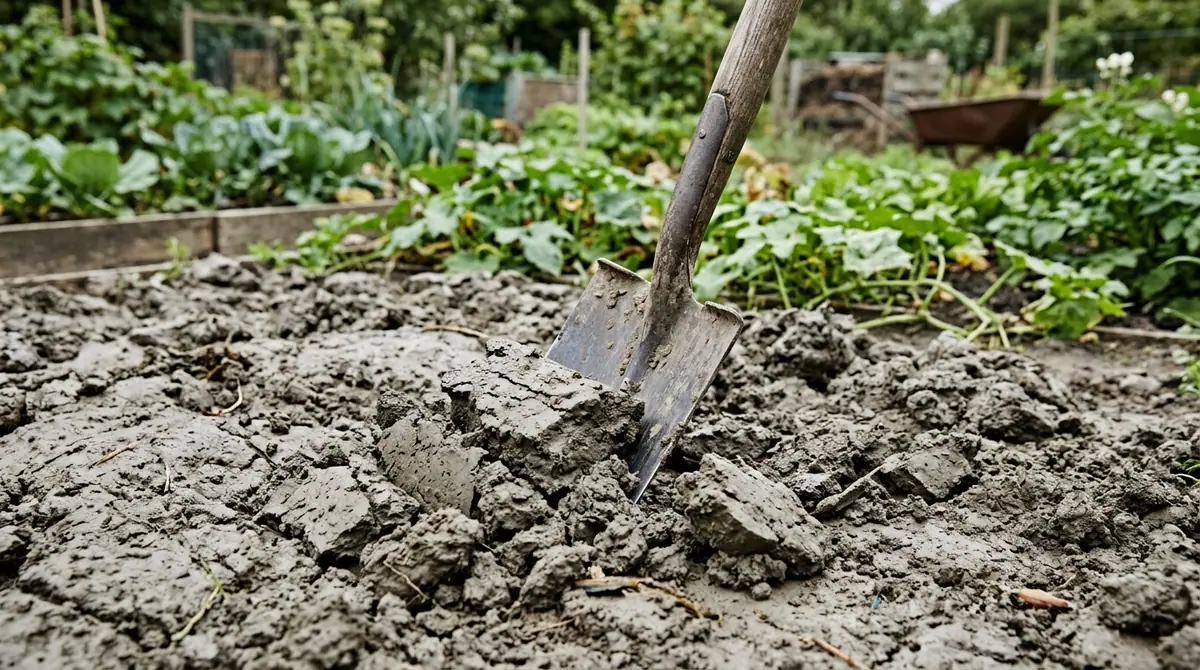
I jammed my stainless-steel garden spade a full 8 inches (20 cm) into what I thought was a workable perennial bed, stepped down with all my weight, and the blade didn't budge a single millimeter. When I finally yanked it out, it came away bearing a dense, slick ribbon of cold, gunmetal-grey earth that smelled faintly of stagnant pond water and absolute defiance. Growers stood beside me, holding a tray of delicate woodland phlox, asking if we could plant them by lunch. I had to look her in the eye and explain that we were dealing with a horticultural fortress: heavy grey clay soil. Over many seasons I have learned to respect this stubborn medium rather than fight it. Let's break down how to tame it.
1. Botanical Overview & Natural Habitat

The distinctive grey coloration is not a pigment from organic matter, but rather a chemical indicator of gleysation. When soil remains waterlogged for weeks at a time, aerobic microorganisms consume all available oxygen. Anaerobic bacteria then take over, chemically reducing iron from its oxidized, rust-colored ferric state ($Fe^{3+}$) to a pale, reduced ferrous state ($Fe^{2+}$). This process transforms what might have been reddish or brown clay into a uniform, cold slate-grey.
Because the particles are so microscopic, they pack tightly together, leaving virtually zero macropores for air movement. This creates an environment where soil temperatures lag far behind the ambient spring air. While sandy soils might warm to 60°F (15°C) by mid-April, grey clay often lingers stubbornly below 48°F (9°C) at a depth of 4 inches (10 cm), severely delaying seed germination and root activation. Understanding this native wetland-adjacent heritage is the first step in designing a successful landscape over grey clay.
2. Essential Environmental & Care Requirements
Managing plants in grey clay requires mastering moisture retention, aeration, and fertility dynamics that differ radically from loamy garden soils.
| Parameter | Optimal Condition | Common Mistake | Why It Matters |
|---|---|---|---|
| Soil Drainage | Slow percolation (0.2–0.5 inches per hour) with perimeter tile drains | Installing non-native plants that require rapid, sharp drainage | Prevents catastrophic root rot driven by anaerobic pathogens like Phytophthora |
| Organic Matter | 5% to 8% sustained incorporation via annual surface mulching | Tilling deep sand or raw peat directly into the clay matrix | Tilling disrupts soil aggregates; improper mixing creates localized perched water tables |
| pH Range | 6.2 to 6.8 for balanced nutrient availability | Assuming all grey clay is universally alkaline or acidic without testing | Extreme pH locks up vital micronutrients like phosphorus, iron, and manganese |
| Tillage Timing | Working only when soil moisture is at friable field capacity | Working the soil when wet (sticky) or bone dry (concrete-hard) | Wet tilling shatters soil structure into rock-hard clods that persist for years |
Before planting a single perennial, you must evaluate your site's chemical profile. If you are unsure of your baseline acidity, learn how to test garden soil ph without a kit using simple household methods. Furthermore, because grey clay traps cold water and delays spring warming, monitoring soil temperature fluctuations is critical before sowing direct crops; using the best soil thermometer for a head start in your vegetable garden ensures you never plant seeds into a frozen, hypoxic mud pit. For a deeper academic dive into soil mechanics, consult the USDA Natural Resources Conservation Service Soil Science Division.
💡 Pro-Tip: Never walk directly on wet grey clay beds. Every footstep exerts up to 15 pounds per square inch of pressure, instantly collapsing delicate pore spaces and turning your garden beds into an impervious brick layer. Lay down wide wooden scaffold boards to distribute your weight evenly whenever you are planting or weeding.
3. Step-by-Step Cultivation, Feeding & Propagation
Working with grey clay requires patience and a "no-till" or "sheet-mulch" philosophy. Tilling wet clay destroys whatever natural crumb structure it possesses. Instead, adopt this step-by-step protocol to establish robust planting beds.
- Assess and Test Moisture: Wait for a dry window in late spring. Squeeze a handful of grey clay; if it forms a slick, plastic ribbon that doesn't break when stretched to 2 inches (5 cm), it is too wet to touch. Wait 4 to 7 days and test again until it crumbles apart under moderate pressure.
- Apply Surface Amendments: Do not dig sand or gypsum into the entire subsoil—this can inadvertently create a concrete-like mortar mix. Instead, layer 3 inches (7.6 cm) of well-rotted compost, aged leaf mold, and shredded bark directly onto the surface of the clay.
- Incorporate Bio-Activators: Scatter a light dusting of agricultural limestone (if your pH is below 6.0) and mycorrhizal fungi inoculants across the organic layer to encourage beneficial microbial colonization.
- Plant High: Dig planting holes twice as wide as your root ball, but only 90% as deep. Set the root flare 1 inch (2.5 cm) above the surrounding grade.
- Mound and Cap: Backfill around the root ball with a 50/50 blend of native grey clay and compost, then gently slope the earth away from the stem to shed surface water.
- Mulch Heavily: Apply a 3-inch (7.6 cm) blanket of coarse arborist wood chips over the entire bed, keeping the material 2 inches (5 cm) away from plant stems to prevent crown rot.
For comprehensive regional guidance on soil management practices suited to heavy soils, reference the Royal Horticultural Society Soil Management Guide.
4. Common Problems, Pests & Troubleshooting
Grey clay presents unique pathological hurdles. The most prevalent issue is root asphyxiation, which occurs when heavy spring rains saturate the soil profile. Without oxygen, root tips die back within 48 to 72 hours, inviting opportunistic soil-borne fungi such as Pythium and Rhizoctonia. You will notice sudden yellowing of lower foliage, stunted growth, and a sour, anaerobic odor when digging near the root zone.
Compaction is another constant enemy. When summer arrives, grey clay rapidly loses moisture through evaporation, shrinking violently and forming deep, jagged fissures up to 2 inches (5 cm) wide. These cracks tear delicate feeder roots apart. To combat this, avoid exposing bare clay to direct sunlight; maintain a thick organic mulch layer year-round to buffer moisture loss and regulate soil temperatures.
⚠️ Important Caution: Never add pure sand to a heavy clay garden bed in an attempt to "lighten" it. Unless you mix sand at a ratio of 50% or more by total volume—an economically and physically impossible feat for established gardens—you will inadvertently create a medium with the exact physical consistency of concrete.

5. Frequently Asked Questions
Can I grow vegetables in grey clay soil?
Yes, but you must select deep-rooted, resilient crops like brassicas (cabbage, kale, and broccoli), root vegetables grown in raised berms, and bush beans. Avoid shallow-rooted crops unless you transition to raised garden beds filled with a balanced loamy soil mix.
Why is my grey clay soil so hard in the summer?
Grey clay consists of microscopic plate-like mineral particles that lock tightly together as water evaporates. As the soil dries out, these particles pull inward, causing severe surface crusting and deep fissures that can snap plant roots.
How do I fix poor drainage in heavy grey clay?
True subsurface drainage requires installing perforated corrugated PVC French drains wrapped in geotextile fabric at a depth of 18 to 24 inches (45 to 60 cm) to channel perched water away from your garden beds. Surface amendments like compost help improve topsoil infiltration over time.
What plants naturally thrive in heavy grey clay?
Native wetland and riparian plants love grey clay because they have evolved mechanisms to handle periodic root hypoxia. Excellent landscape choices include Cornus sericea (red-twig dogwood), Physocarpus opulifolius (ninebark), Iris sibirica (Siberian iris), and Amsonia tabernaemontana (bluestar).
Related Guides
- How Long for Sunlght to Dry Soil
- Best Soil for Plumeria
- Hoya Soil
- Plumeria Potting Soil
- How to Test Garden Soil Ph Without a Kit
📋 Table of Contents ▼ Click to expand
Tags:
Keep reading
🌿 Related Plants You Might Like
PlantSavvyWorld
Editorial team
PlantSavvyWorld is an independent botanical education project. Articles are drafted with AI assistance, then edited and checked against university extension services, botanical garden collections and other published horticultural sources.