Written with AI assistance, edited and checked against horticultural sources.
I lost three hundred dollars worth of heirloom Brandywine tomato seeds back in the spring of 2014 because I trusted the calendar instead of the earth. The air felt warm enough at 72°F (22°C), and the seed packet simply said "sow after danger of frost." I planted them two inches deep into soil that was still hovering at a deceptive 48°F (9°C). Instead of germinating, those damp seeds sat in the cold mud and rotted within a week. That was the expensive lesson that forced me to stop guessing and start measuring. Ever since I introduced a reliable soil thermometer into my landscape design workflow, my germination rates have climbed past 95%, and my vegetable crops consistently beat local harvest timelines by two to three weeks.
1. Botanical Overview & Natural Habitat
Vegetable crops are not passive inhabitants of their substrate; they are finely tuned biological engines whose metabolic rates are dictated almost entirely by thermal energy. In their natural habitats, wild ancestors of our domestic garden vegetables evolved alongside distinct seasonal thermal cues. A seed does not possess calendar awareness. It reads soil temperature as its primary ecological signal to break dormancy, metabolize endosperm, and deploy its radicle downward.
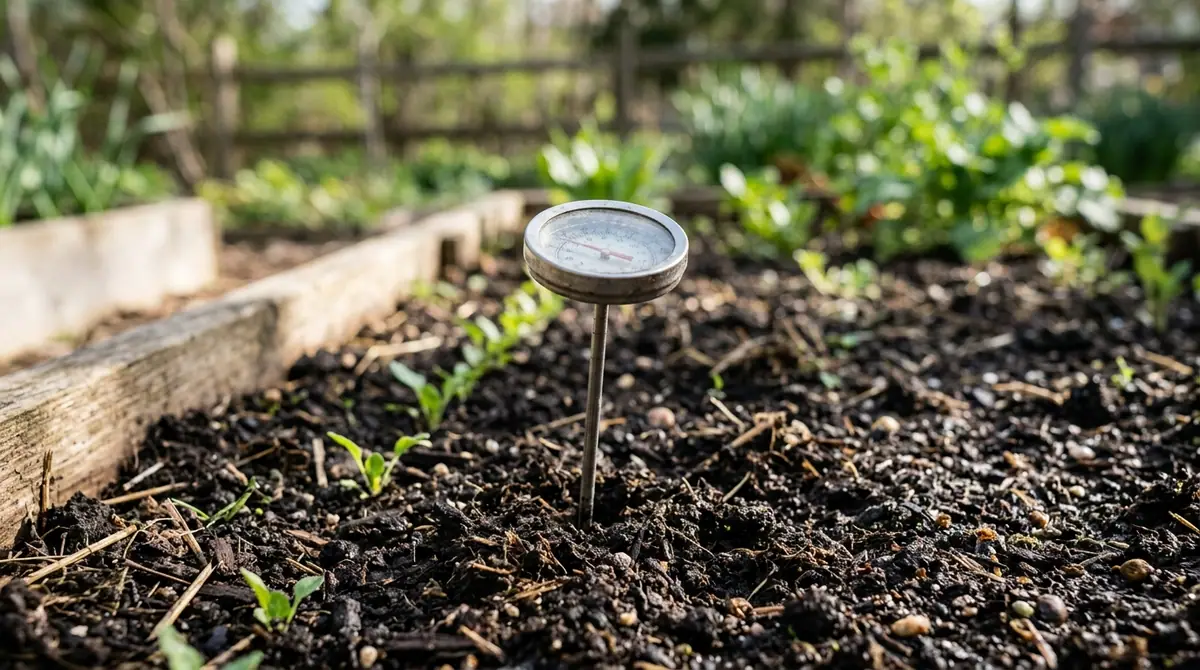
Soil thermometer inserted in dark garden bed near small vegetable seedlings
When we look at the rhizosphere—the narrow region of soil directly influenced by root secretions and associated soil microorganisms—temperature governs enzymatic activity. At cold soil temperatures, typically below 50°F (10°C) for warm-season crops like tomatoes (Solanum lycopersicum) and peppers (Capsicum annuum), water molecules become more viscous, and cell membranes in plant roots become rigid. This prevents the active transport of essential mineral ions, particularly phosphorus. Consequently, plants grown in cold soil display classic purple-tinted foliage, not from a lack of fertilizer in the bed, but from thermal lock-out.
Conversely, cool-season crops such as spinach (Spinacia oleracea) and kale (Brassica oleracea var. acephala) exhibit peak enzymatic efficiency when soil temperatures sit between 45°F and 65°F (7°C to 18°C). If soil temperatures climb past 75°F (24°C), these same cool-season champions interpret the thermal stress as an end-of-life signal, triggering premature bolting—the rapid production of a flowering stalk that renders the leaves bitter and unmarketable. Understanding these natural thresholds transforms you from a casual gardener into an ecological manager who works in harmony with thermodynamic reality. For a broader look at how landscape plants interact with demanding soil constraints, you can review our guide on 15 Best Trees for Driveways That Won't Crack Concrete.
2. Essential Environmental & Care Requirements
Mastering the thermal environment of your vegetable patch requires tracking three distinct variables: depth, time of day, and substrate composition. A surface reading taken at 2:00 PM under direct sun tells you nothing about the dark, damp root zone four inches down where your delicate transplants will soon reside.
Parameter
Optimal Condition
Common Mistake
Why It Matters
Measurement Depth
2 to 4 inches (5 to 10 cm) for seeds; 6 inches (15 cm) for transplants
Measuring only the top 1/2 inch of soil
Surface soil heats and cools rapidly, giving false readings for the actual root zone.
Timing
Early morning (7:00 AM to 9:00 AM)
Measuring at 3:00 PM on a sunny afternoon
Early morning provides the true baseline minimum daily temperature of the root zone.
Thermometer Type
Digital stainless-steel probe or dial gauge with a 5+ inch stem
Using a standard glass air thermometer pushed into dirt
Air thermometers lack the durability and mass needed to accurately conduct ground temperature.
Substrate Moisture
Consistently moist, well-draining loam
Bone-dry soil or waterlogged muck
Dry or flooded soil transfers heat poorly, skewing readings and stressing emerging roots.
To achieve a true head start in your vegetable garden, you must monitor these parameters daily for at least one week before sowing seeds or buying starts. If you are planting cool-season root crops like carrots (Daucus carota), aim for a steady baseline of 45°F to 55°F (7°C to 13°C) at a 2-inch (5 cm) depth. For tender summer crops like sweet corn (Zea mays) and summer squash (Cucurbita pepo), wait until the 4-inch (10 cm) depth reads a reliable 60°F (15°C) or higher for three consecutive mornings.
💡 Pro-Tip: Keep your soil thermometer tucked into your back pocket or harvest basket like a trusty trowel. When walking your garden beds, plunge it into different zones—shaded corners vs. Full-sun beds—to map out thermal micro-climates before deciding where to plant your heat-loving nightshades.
Using a soil thermometer effectively is a deliberate practice that bridges the gap between raw earth and high-yield crop production. Follow this systematic protocol to secure that coveted early-season head start without risking seed rot or transplant shock.
Select the Right Tool: Acquire a rugged, waterproof soil thermometer. Dial-face thermometers with 5-inch (13 cm) stainless steel stems are affordable and reliable, while digital probe models offer instant readouts and hold functions. Ensure the stem is long enough to reach past the surface thermal fluctuations.
Establish Your Testing Stations: Mark out your raised beds or in-ground rows. Do not rely on a single reading. Designate at least two testing spots per bed: one in a high-exposure sunny zone and one near a wall, fence, or shade line.
Take Baseline Readings at Dawn: Insert the thermometer probe vertically into the soil to a depth of 3 inches (7.5 cm) for seeds or 6 inches (15 cm) for established transplants. Do this consistently between 7:00 AM and 9:00 AM. Record these numbers in a garden journal.
Calculate the 7-Day Moving Average: Add your morning readings together for seven consecutive days and divide by seven. If planting warm-season crops, do not proceed until this average crosses your target threshold (e.g., 65°F / 18°C for peppers).
Implement Thermal Modification (If Needed): If your soil is lagging behind your desired planting date by 5°F to 10°F, deploy clear polyethylene plastic sheeting or black silage tarps over the beds for 14 days prior to planting. This passive solar technique traps radiant energy and accelerates soil warming.
Sow or Transplant with Precision: Once your target temperature is verified, remove any tarps, amend the soil with aged compost to support microbial awakening, and sow your seeds or plant your starts at the exact depth matching your thermometer readings.
Verify Post-Planting Stability: Continue monitoring the soil for the next 14 days. Unseasonably cold spring cold snaps can plunge soil temperatures overnight, requiring temporary row covers or low tunnels to protect vulnerable germinating embryos.
For authoritative guidelines on regional soil testing practices and seasonal crop selection, consult the University of Minnesota Extension Service, which provides exceptional research-backed data on northern climate vegetable production.
4. Common Problems, Pests & Troubleshooting
Even with a precise soil thermometer, gardeners frequently encounter environmental anomalies that disrupt early-season plantings.
The most common issue is false thermal reading inflation. If you measure your soil on a bright, sunny afternoon, solar radiation can heat the upper crust of the soil to 75°F (24°C) while the actual root zone at 4 inches remains at a sluggish 52°F (11°C). If you plant warm-season crops based on that afternoon reading, your seeds will fail. Always rely on early-morning baseline temperatures.
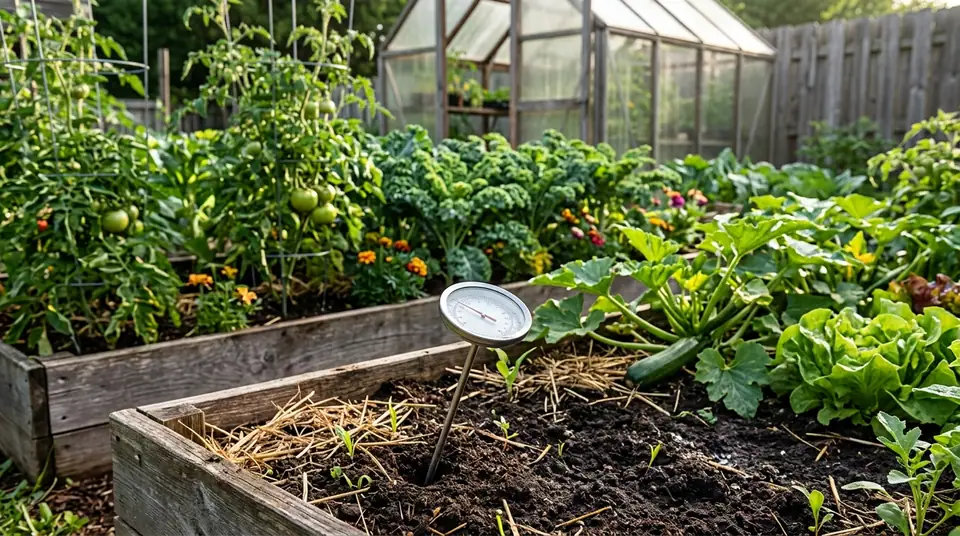
Another frequent challenge is thermal stratification in raised beds. Elevated wooden or metal beds warm up significantly faster than in-ground garden beds because air circulates underneath them. However, they also lose heat much faster during sudden spring frosts. If your raised bed thermometer reads 65°F (18°C) during a warm afternoon in March, check it again at sunrise. If it has plummeted below 50°F (10°C), your tender squash seedlings will suffer severe root stress.
Pest pressures also intersect directly with soil temperature. Soil-borne pathogens such as Pythium and Rhizoctonia—the primary agents responsible for damping-off disease—thrive in cold, waterlogged soils where seed germination is sluggish. When seeds sit motionless in mud below 50°F (10°C), these fungi have ample time to attack the seed coat. By using a soil thermometer to wait for optimal thermal ranges, you dramatically accelerate germination speed, allowing the seedling to outpace and naturally resist fungal pathogens before they can strike.
⚠️ Important Caution: Never force a stiff dial-face or digital soil thermometer into frozen, crusted, or heavily compacted clay soil. Bending or twisting the metal stem will crack the internal bi-metallic coil or break the waterproof seal, rendering your instrument permanently inaccurate. Always loosen stubborn soil with a hand fork or water the spot lightly before inserting your probe.
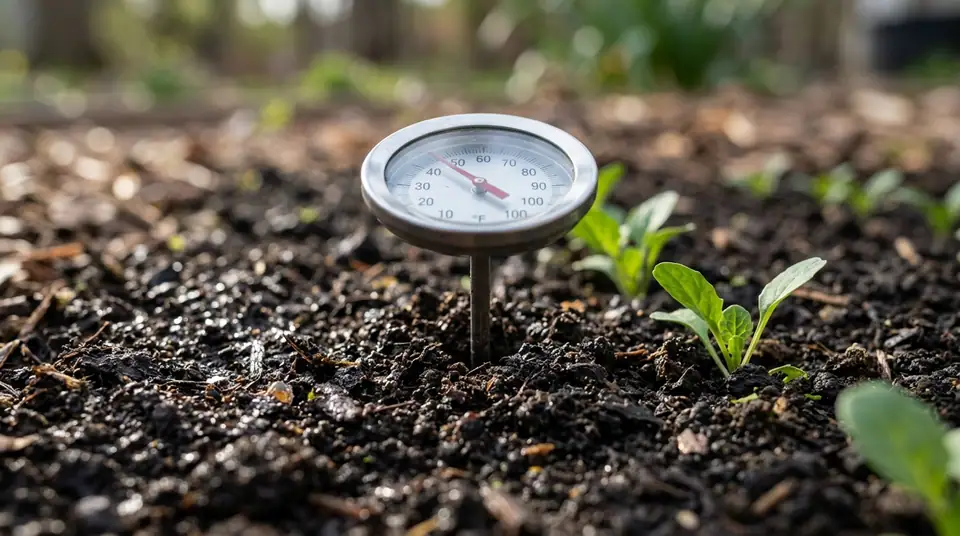
Soil thermometer planted in a garden bed with young vegetable sprouts
5. Frequently Asked Questions
Can I just use a regular kitchen meat thermometer to check my garden soil?
You can use a digital kitchen probe thermometer in a pinch, provided the stainless-steel stem is long enough (at least 5 inches) and the unit is water-resistant. However, standard meat thermometers are rarely waterproof at the housing joint, meaning repeated exposure to wet garden soil and morning dew will quickly ruin the internal electronics. Dedicated soil thermometers are built to withstand corrosive soil chemistry and moisture.
What is the absolute minimum soil temperature for planting tomatoes?
Tomatoes will tolerate marginal soil down to 55°F (13°C), but their metabolic processes stall completely at this level, and nutrient uptake—especially phosphorus—shuts down. For true vigor and to prevent transplant check, wait until your 4-inch morning soil temperature reads a consistent 60°F to 65°F (15°C to 18°C) for at least three consecutive days before putting tomato starts in the ground.
Why does my soil thermometer read differently in different parts of the same garden bed?
Soil temperature is heavily influenced by moisture distribution, organic matter content, soil compaction, and shade. Darker soils high in organic matter absorb and retain solar radiation more efficiently than pale, sandy, or compacted clay soils. Additionally, areas near stone walls or concrete pathways absorb radiant heat during the day and release it slowly at night, creating localized warm micro-climates.
How deep should I push the soil thermometer when checking for seeds versus transplants?
For direct-sown seeds (such as beans, corn, and squash), insert the thermometer to a depth of 2 inches (5 cm), which matches the seed bed zone. For established transplants (such as tomatoes, peppers, and eggplants), push the probe down to 6 inches (15 cm) to measure the complete root ball environment where the plant will establish its primary structural roots. For comprehensive regional guidelines on vegetable root depths and soil management, visit the Royal Horticultural Society.
PlantSavvyWorld is an independent botanical education project. Articles are drafted with AI assistance, then edited and checked against university extension services, botanical garden collections and other published horticultural sources.