Written with AI assistance, edited and checked against horticultural sources.
I was standing on a humid, mist-shrouded ridge in Costa Rica when I first understood why conventional potting soil fails so many of our most breathtaking tropicals. I had just pried a mature Tillandsia utriculata away from the rough bark of a fallen branch, expecting to find a deep root system choked in soil. Instead, I found roots like thick wire, gripping naked hardwood with absolute tenacity, completely exposed to the wind and tropical downpours. When we try to force these canopy-dwellers into standard nursery pots filled with heavy peat, we suffocate them. Recreating that natural tree-perch in a domestic space through a custom epiphytic plant mount is the single most transformative skill you can develop as an indoor grower, unlocking the true wild architecture of orchids, ferns, and aroids.
1. Botanical Overview & Natural Habitat
Epiphytes are plants that grow upon other plants—most commonly trees—physically using them for structural support rather than nutrients. They are not parasites; they extract zero water or photosynthates from their host. Instead, they climb into the canopy to access high-intensity light that never reaches the dark, crowded forest floor.
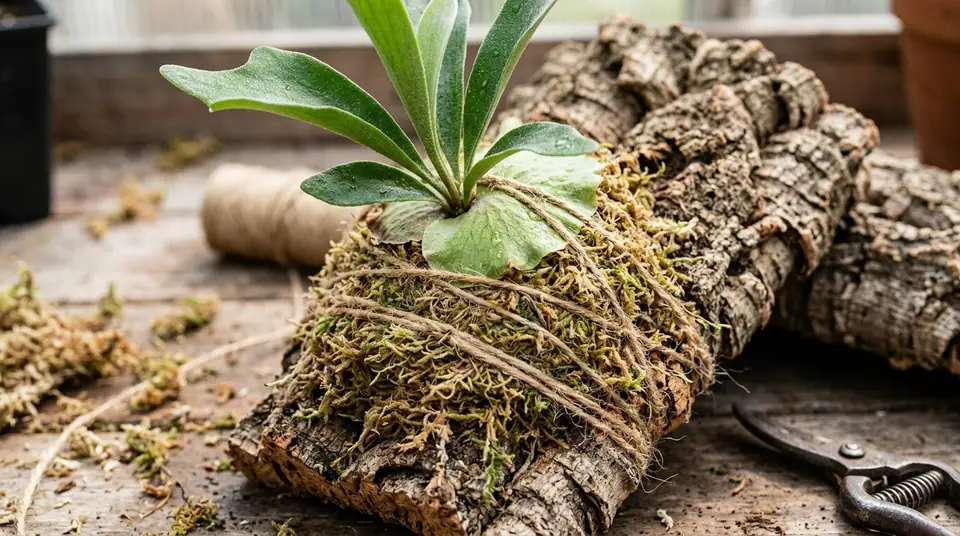
Staghorn fern mounted on bark with moss and twine on a workbench
Because they lack access to terrestrial water tables, epiphytes have evolved radical morphological adaptations. Their root systems are coated with a specialized, spongy, dead-cell layer called velamen. When dry, velamen is silvery-white and filled with air, insulating the root against scorching heat and high evaporation rates. When drenched by rain, velamen acts like a microscopic sponge, turning translucent green as it absorbs water and dissolved nutrients in seconds, before sealing the moisture inside.
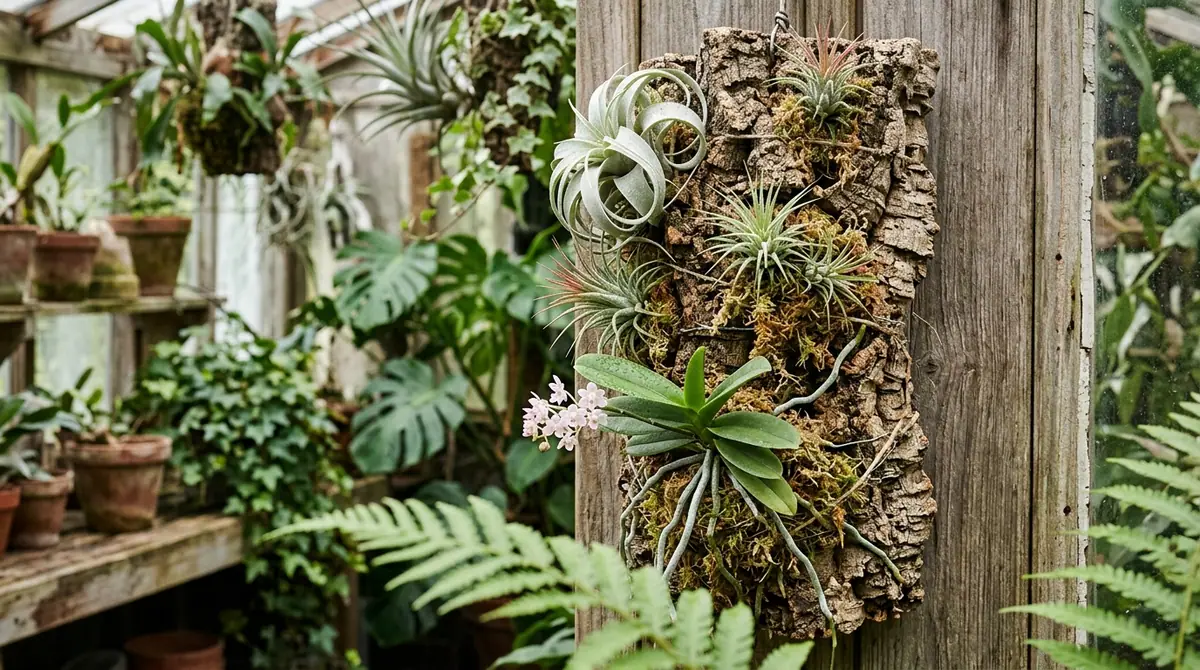
To anchor themselves against tropical gales, epiphytes secrete adhesive root hairs or sticky biochemical exudates that cement the root tip directly into microscopic crevices of tree bark. This strategy allows them to thrive on vertical surfaces where soil would instantly wash away. When you build an epiphytic plant mount, you are mimicking the fissured bark of a rainforest emergent tree, providing a permanent scaffold that encourages this natural root-cements reaction.
While epiphytes are stars of the tropical display house, their lessons in specialized micro-climates apply to many niche growing environments, much like understanding specific seasonal windows for cool-season crops, such as timing When to Plant Carrots in Zone 8a or knowing precisely When to Plant Brussels Sprouts in Zone 7. In both cases, success relies entirely on matching your intervention to the plant's evolutionary survival triggers.
2. Essential Environmental & Care Requirements
Managing an epiphyte on a mount requires a fundamental shift in your watering psychology. In nature, mounted plants experience torrential drenching followed by rapid, wind-driven drying. You must replicate this wet-dry cycle.
Parameter
Optimal Condition
Common Mistake
Why It Matters
Light Intensity
2,500–5,000 foot-candles (bright, indirect to filtered morning sun)
Placing in deep interior shadows or baking in harsh midday sun
Continuous gentle airflow (2 to 4 mph / 3 to 6 km/h)
Stagnant, dead air in enclosed terrariums or corners
Stagnation breeds fungal pathogens and bacterial rots on exposed tissues.
Water Quality
Total Dissolved Solids (TDS) under 100 ppm, pH 5.5–6.5
Using heavy, mineral-rich tap water
Mineral salts accumulate in the velamen, burning root tips and causing premature tissue death.
Relative Humidity
60% to 80% RH
Letting ambient humidity drop below 40% for extended periods
Extremely dry air causes the velamen to desiccate too quickly between waterings, starving the plant of hydration.
Temperature thresholds must mirror native canopy conditions. Maintain day temperatures between 75°F and 85°F (24°C to 29°C) and night temperatures dropping to 60°F to 68°F (15°C to 20°C). This 10-to-15-degree drop is vital; without it, many epiphytic orchids and bromeliads fail to trigger metabolic rest and eventual blooming cycles.
For further deep dives into specialized horticultural structures and microclimates, consult the resources provided by the Royal Horticultural Society for plant physiology insights, or review foundational cultivation protocols outlined by the Missouri Botanical Garden.
Mounting an epiphyte is a precise craft. You are designing an artificial branch ecosystem that must hold moisture just long enough for the plant to drink, without staying soggy enough to rot the roots.
Materials Needed
A rot-resistant hardwood slab (Cork oak Quercus suber, sinker cypress, or mopani wood) measuring roughly 8 inches by 12 inches (20 cm by 30 cm).
A thin layer of long-fiber New Zealand sphagnum moss (soaked in rain-water and wrung out until damp).
Monofilament fishing line (4-lb to 8-lb test) or green cotton twine (cotton rots away over 12 months, by which time the plant must be self-attached).
Stainless steel staples or galvanized copper tacks.
Your epiphytic plant (e.g., Phalaenopsis, Epidendrum, Tillandsia, or small-form Anthurium).
Step-by-Step Execution
Prepare the Wood Mount: Soak your chosen hardwood slab in clean water for 24 hours to leach out potentially toxic tannins and hydrate the wood so it does not pull moisture away from your moss pad.
Position the Moss Pad: Take a golf-ball-sized clump of damp New Zealand sphagnum moss, flatten it to a thickness of 0.5 inches (1.2 cm), and press it firmly against the lower-center of the wood slab. This acts as an interim moisture reservoir while roots establish.
Position the Plant: Remove your epiphyte from its nursery container. Gently massage and rinse all old, degraded organic potting mix or bark away from the roots using lukewarm water. Spread the bare root system directly over the damp moss pad, ensuring the crown or base of the stem sits flush against the wood without being buried.
Anchor with Twine: Tie one end of your fishing line or cotton twine tightly around a secured tack on the back of the wood. Bring the line diagonally across the root mass, pulling it taut. Wrap the line in a criss-cross "figure-eight" pattern over the roots and moss, spacing wraps approximately 1.0 inch (2.5 cm) apart.
Secure and Inspect: Tie off the line securely to a second anchor tack on the back of the wood. Gently tug on the plant; it should not wobble or shift on the mount. Trim any loose debris and hang the finished epiphytic plant mount in a bright, humid location with good air circulation.
💡 Pro-Tip: Never wrap twine directly over the growth eyes, pseudobulbs, or the central growth crown of your epiphyte. Always cross your binding lines strictly over the root mass; wrapping tender stems will crush vascular pathways and cause rapid rot.
For feeding, apply a balanced, urea-free orchid or epiphyte fertilizer diluted to 1/4 strength every 10 to 14 days during active spring and summer growth. Flush the mount with pure, unfertilized water once a month to leach out accumulated fertilizer salts.
Propagation on a mount is remarkably straightforward. When your mounted mother plant produces side offsets, keikis, or division-ready rhizome segments with at least three healthy roots measuring a minimum of 2.0 inches (5 cm) long, use a sterile razor blade to separate the clone. Mount the division onto its own small wooden plaque using the exact five-step protocol detailed above. This propagation mindset is just as methodical as planning seasonal food crops—much like calculating the precise days to maturity when scheduling When to Plant Bok Choy Zone 7 or determining When to Plant Beets in Utah.
4. Common Problems, Pests & Troubleshooting
Mounted plants display stress quickly because their root systems lack the buffer of a large soil mass. Learning to read these visual cues is the hallmark of an expert grower.
Shriveled, Paper-Thin Pseudobulbs or Leaves: This indicates severe underwatering or extreme ambient aridity where the moss pad dries out in under 12 hours. Remedy this by soaking the entire mount in a bucket of water for 20 minutes every 2 days until turgor pressure returns.
Black, Mushy Root Tips and Stems: A classic symptom of overwatering combined with stagnant air. The sphagnum moss is holding too much water without enough oxygen exchange. Cut away all decayed black roots with sterilized shears, reduce watering frequency, and introduce a small oscillating fan to increase ambient air movement.
Yellowing Leaves with Brown Leaf Tips: Usually caused by fertilizer salt buildup within the velamen or the use of hard tap water high in sodium, calcium, or chlorine. Flush the mount thoroughly with distilled water or reverse-osmosis water, and cut back your fertilizer concentration by half.
Mealybugs and Scale Insects: These sap-sucking pests adore the protected nooks between roots and wood grain. Because mounted plants cannot be easily treated with systemic soil drenches, use a cotton swab dipped in 70% isopropyl alcohol to manually dab and dissolve every visible pest, followed by a thorough spray of horticultural insecticidal soap.
⚠️ Important Caution: Never use pressure-treated lumber, painted wood, or chemically treated pressure-sealed plywood for your epiphytic plant mount. The copper, arsenic, and synthetic resins leaching from these treated woods will systematically poison and kill sensitive epiphyte roots within days.
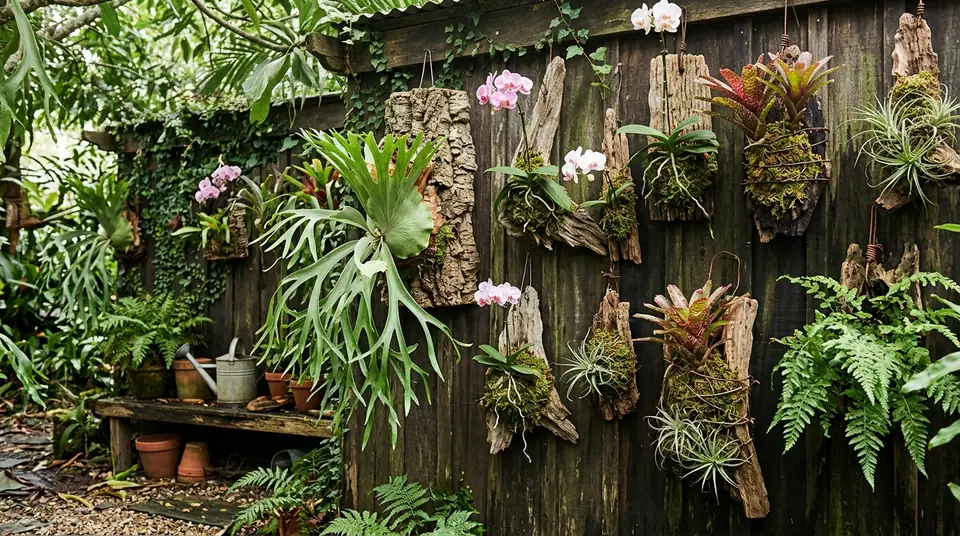
Epiphytic plants mounted on bark and wood hanging on a wooden wall
5. Frequently Asked Questions
How often do I need to water an epiphytic plant mount?
Watering frequency depends entirely on your indoor humidity, temperature, and airflow. In a typical home with 50% relative humidity, most mounted epiphytes require daily misting or a complete submersion of the mount in water for 5 to 10 minutes every 2 to 3 days. In dry winter months, you may need to submerge them daily. Always check the sphagnum moss pad: if it feels dry and crisp to the touch, it is time to water.
Can any houseplant be grown on a mount?
No. Only true epiphytes and accidental semi-epiphytes (such as certain Hoya, Dischidia, epiphytic cacti like Schlumbergera, and tropical ferns) possess the specialized velamen root structures required to survive exposed on a vertical mount. Terrestrial plants with soft, fine root hairs that rely on constant contact with dense soil particles will rapidly desiccate and die if mounted on bare wood.
How do I water a heavy plant attached to a large wall mount?
For large mounts that cannot be easily unhooked and taken to a sink, use a pump sprayer or a dedicated garden pressure sprayer filled with pure rainwater or reverse-osmosis water. Thoroughly saturate the moss pad and root zone until water streams freely off the bottom. Catch the runoff using a decorative basin or waterproof tray placed directly beneath the mount on the wall.
What are the best woods to use for plant mounts?
The gold standard is cork oak bark because it is lightweight, highly rot-resistant, highly textured for root gripping, and naturally contains harmless tannins. Other excellent, durable options include sinker cypress, mopani wood, Malaysian driftwood, and Manzanita branches. Avoid soft, resinous conifers like pine or fir, which repel water and secrete sticky, toxic resins.
PlantSavvyWorld is an independent botanical education project. Articles are drafted with AI assistance, then edited and checked against university extension services, botanical garden collections and other published horticultural sources.