
Velvet Elvis Plant
Written with AI assistance, edited and checked against horticultural sources.

1. Botanical Overview & Natural Habitat
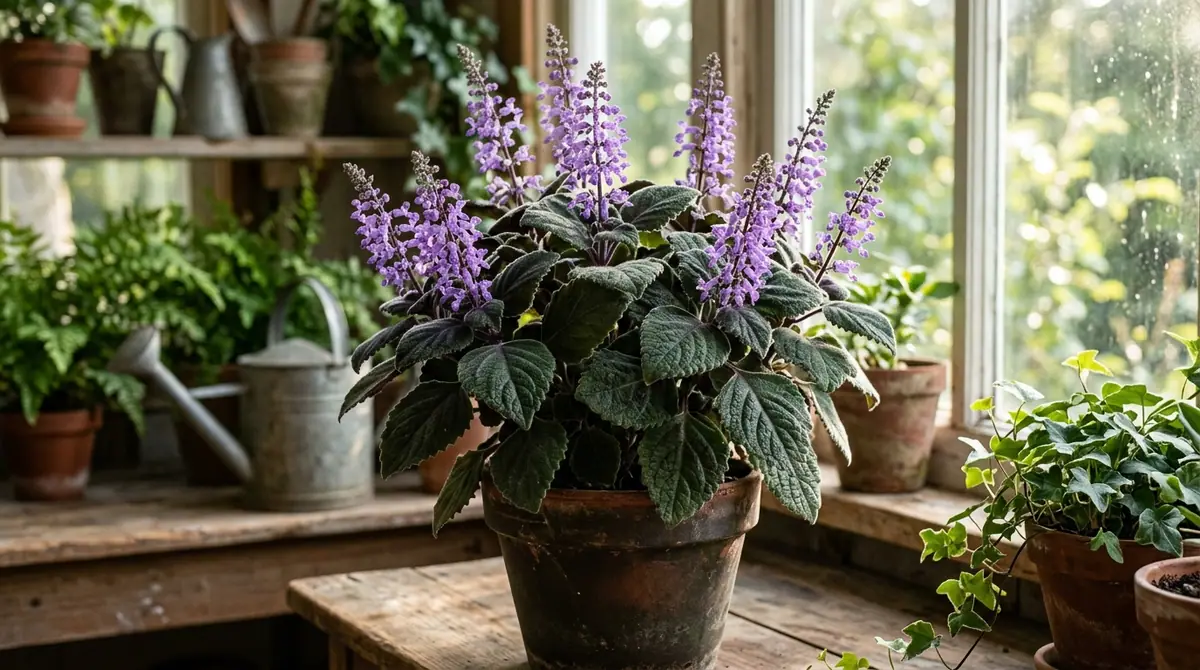
The 'Velvet Elvis' plant is a patented hybrid cultivar belonging to the genus Plectranthus, sitting firmly within the mint family, Lamiaceae. While many gardeners casually refer to it as a spur flower, its taxonomic lineage connects it directly to the frost-tender subshrubs native to the dappled, moist understories and rocky escarpments of southern and eastern Africa.
Unlike its flat-leafed herbaceous cousins, 'Velvet Elvis' develops a semi-woody base over time, maturing into a robust perennial subshrub that reaches heights of 3 to 4 feet (90 to 120 cm) with a generous spread of 3 feet (90 cm). The foliage is its primary architectural feature: ovate, scalloped leaves measure roughly 3 to 5 inches (7.5 to 12.5 cm) in length, carrying a rich dark green hue on the upper surface and a striking purplish-velvet underside. This coloration is a classic evolutionary adaptation against intense ultraviolet exposure in high-altitude native habitats.
💡 Pro-Tip: Run your hand gently over the foliage of your 'Velvet Elvis' on a warm afternoon. The glandular trichomes release a subtle, camphoraceous, and minty fragrance that acts as a natural deterrent against browsing deer and rabbits, making it an exceptional choice for semi-rural woodland edges where mammal pressure is high.
Blooming primarily from late summer through the short days of autumn—and year-round in frost-free indoor settings—it produces elongated spikes of tubular, rich violet-blue flowers. These blossoms provide a critical late-season nectar source for local pollinators, including bumblebees, hummingbirds, and sphinx moths. Because its flowering cycle is heavily triggered by the shortening day lengths of autumn, you will notice the most intense floral flush right as your summer annuals are starting to fade. If you are timing your landscape cleanups around this period, you might find yourself juggling your perennial care with cool-season food crops, much like trying to figure out When to Plant Brussel Sprouts in Zone 7 or scheduling root crops like When to Plant Beets in Utah before the ground freezes solid.
2. Essential Environmental & Care Requirements
Replicating the native cloud-forest and river-bank conditions of the African sub-tropics is the secret to unlocking the full potential of 'Velvet Elvis'. This plant cannot tolerate extremes of baking, arid sunlight or stagnant, waterlogged muck.
Light exposure dictates the vigor and color saturation of your plant. In USDA hardiness zones 10 through 11, it demands morning sun and strict afternoon shade; unfiltered mid-day rays will quickly scorch the delicate leaf margins. In cooler zones 8 through 9, it can handle full sun for 4 to 6 hours daily, provided the root zone remains consistently damp. When grown indoors as a houseplant, place it directly in an east-facing window or a few feet back from a south-facing window where it receives bright, indirect light for at least 6 hours daily.
Temperature management is equally critical. 'Velvet Elvis' is reliably perennial only in USDA Zones 10a through 11b, where winter temperatures rarely dip below 30°F (-1°C). Foliage damage occurs rapidly at 28°F (-2°C), and a hard freeze will kill the root crown if it is unmulched. If you live in a cooler climate, treat it as a tender perennial or a container specimen that you bring indoors before the first autumn frost drops below 40°F (4°C).
Watering must be approached with precision. Thanks to its succulent-leaning stems, it possesses moderate drought tolerance once established, but extended dryness will cause lower leaves to yellow and drop prematurely. Aim to water thoroughly when the top 1.5 to 2 inches (3.8 to 5 cm) of soil have dried out completely.
| Parameter | Optimal Condition | Common Mistake | Why It Matters |
|---|---|---|---|
| Soil pH | 6.0 to 6.8 (Slightly acidic to neutral) | Heavy, unamended clay soils | Alkaline, compact soils lock out iron and cause fatal root rot. |
| Light | Morning sun, afternoon shade (4-6 hours) | Scorching full-day summer exposure | Intense heat bleaches leaf color and causes leaf margin necrosis. |
| Watering | Deep irrigation when top 2 inches dry | Keeping soil constantly soggy | Stagnant moisture invites Phytophthora and stem rot. |
| Min. Temp | 35°F to 40°F (1.6°C to 4.4°C) active low | Exposing to hard freezes below 30°F | Frost liquefies cell walls in the succulent stems, killing the plant. |
Soil composition must prioritize drainage above all else. A rich, loamy medium amended with 30% organic compost and perlite or coarse horticultural sand works wonders. For an exhaustive breakdown of soil biology and optimal drainage profiles, consult the Royal Horticultural Society Plectranthus Guide.
3. Step-by-Step Cultivation, Feeding & Propagation
Establishing a healthy 'Velvet Elvis' specimen requires a deliberate approach to planting, pruning, and multiplication. Because of its rapid growth rate, a single cutting can become a robust 3-foot shrub within a single growing season.
Step 1: Site Selection and Soil Preparation
Select a location that receives filtered morning light and is protected from harsh, drying winds that can snap the brittle, succulent stems. Dig a hole twice as wide as the nursery container and equal in depth. Amend the native soil with equal parts well-rotted leaf mold or compost to boost biological activity and drainage.
Step 2: Planting and Root Establishment
Remove the plant from its container, gently tease out any encircling roots, and set the root ball so the crown sits level with the surrounding soil grade. Firm the soil gently around the base and water thoroughly with 1 gallon (3.7 liters) of water to settle air pockets. Apply a 2-inch (5 cm) layer of organic bark mulch around the base, keeping it 1 inch (2.5 cm) away from the actual stem to prevent collar rot.
Step 3: Fertilization Schedule
Feed your 'Velvet Elvis' monthly during the active growing season (spring through late summer) using a balanced, water-soluble fertilizer diluted to half-strength (such as a 10-10-10 formulation). Cease all fertilization by early autumn to allow the plant to harden off its stems before cooler weather arrives.
Step 4: Pruning for Bushiness
Pinch back the growing tips of young stems when the plant reaches 12 inches (30 cm) in height. Repeat this every 4 to 6 weeks until mid-summer. This encourages lateral branching, prevents the plant from becoming leggy, and doubles your eventual flower spike count.
Step 5: Propagation via Stem Cuttings
Take 4-inch (10 cm) tip cuttings from healthy, non-flowering stems in late spring or early summer using sterilized shears. Strip the leaves from the lower half of the cutting, dip the base in rooting hormone powder, and insert it 1.5 inches (3.8 cm) deep into a pre-moistened mix of 50% perlite and 50% peat moss. Place the tray under high humidity (using a clear plastic dome) in bright, indirect light. Roots will reliably form within 14 to 21 days, at which point you can pot them up individually.
⚠️ Important Caution: Never take stem cuttings from a 'Velvet Elvis' that is actively flowering or stressed by drought. Flowering redirects carbohydrates away from vegetative tissue, resulting in poor root initiation and high failure rates during propagation.
When planning your broader garden layout around this schedule, make sure your propagation timing doesn't clash with your other horticultural obligations, such as deciding When to Plant Beets in Kansas or mapping out When to Plant Pumpkins in Southern California for autumn harvest festivals.
4. Common Problems, Pests & Troubleshooting
Even with pristine care, growers occasionally encounter issues. Diagnosing them early separates a thriving specimen from a compost pile candidate.
Stem rot is the single most destructive issue facing Plectranthus species. It presents as sudden, dark lesions at the soil line, followed by rapid wilting of the entire plant despite wet soil. This is almost exclusively caused by overwatering or dense, unamended clay soil that traps moisture around the root collar. To save an affected plant, take healthy uninfected tip cuttings immediately and discard the root ball.
Leaf drop during autumn or winter is often a simple environmental response rather than a disease. When brought indoors for the winter, 'Velvet Elvis' frequently sheds older leaves as it adjusts to lower light levels and indoor heating drafts. Mitigate this by placing a pebble tray filled with water beneath the container to boost local humidity, and ensure temperatures do not fluctuate wildly between day and night.

5. Frequently Asked Questions
Can I grow 'Velvet Elvis' indoors year-round as a houseplant?
Yes, absolutely. While it performs exceptionally well outdoors as a seasonal accent, 'Velvet Elvis' adapts readily to indoor life if given a bright, south- or east-facing window with at least 4 to 6 hours of indirect light daily. Maintain indoor temperatures between 60°F and 75°F (15°C to 24°C) and reduce watering frequency slightly during the winter months, allowing the top 3 inches (7.5 cm) of soil to dry out between waterings.
Why are the leaves on my 'Velvet Elvis' turning pale and losing their purple undersides?
Pale foliage and washed-out purple undersides are a direct indicator of insufficient light exposure. When grown in too much shade, the plant lacks the photosynthetic stimulus and ultraviolet exposure required to produce the anthocyanin pigments responsible for the deep velvety tones. Move the plant to a location that receives bright morning sun or stronger filtered light throughout the day.
Is the 'Velvet Elvis' plant toxic to cats and dogs?
According to major botanical toxicity databases, Plectranthus species are generally considered non-toxic to domestic household pets like cats and dogs. However, because the plant contains volatile aromatic oils and camphoraceous compounds, ingestion of large quantities of raw foliage can occasionally cause mild gastrointestinal upset, vomiting, or excessive drooling in particularly sensitive animals. It is always best practice to keep prized specimens elevated out of reach of curious pets.
How do I overwinter my outdoor 'Velvet Elvis' in a cold climate?
If you live in USDA Zone 9 or colder, your outdoor plant will not survive a freezing winter in the ground. You have two reliable options: take 4-inch (10 cm) stem cuttings in late August and root them indoors to serve as your spring starts, or dig up your mature garden plant in September, cut it back by one-third, pot it into a clean container with fresh potting mix, and bring it inside before nighttime temperatures drop below 45°F (7°C).
Related Guides
📋 Table of Contents ▼ Click to expand
Tags:
🌿 Related Plants You Might Like
PlantSavvyWorld
Editorial team
PlantSavvyWorld is an independent botanical education project. Articles are drafted with AI assistance, then edited and checked against university extension services, botanical garden collections and other published horticultural sources.