Written with AI assistance, edited and checked against horticultural sources.
When a solitary leafcutter bee aggressively slices a neat, half-moon crescent out of prized Echinacea purpurea foliage, reaching for organic spray is unnecessary. Those green disks are typically tucked into hollow bamboo stakes in DIY insect hotels mounted the previous autumn. Landscapes are not static oil paintings, but dynamic ecosystems where every creature—from lacewings to mason bees—has a functional job to execute. Treat insect hotels not as rustic lawn ornaments, but as critical botanical infrastructure designed to boost garden biodiversity.
1. Botanical Overview & Natural Habitat
In pristine natural ecosystems, insects find nesting sites in standing deadwood, hollow plant stems, leaf litter, and exposed mineral soil. Modern garden maintenance—which prizes immaculate pruning, tidied borders, and the removal of spent perennial stalks—strips away these vital micro-habitats. When we clear out hollow-stemmed plants like fennel (Foeniculum vulgare), Joe Pye weed (Eutrochium purpureum), and ornamental grasses down to the soil line in autumn, we inadvertently evict the cavity-nesting beneficial insects that pollinate our crops and regulate pest populations.
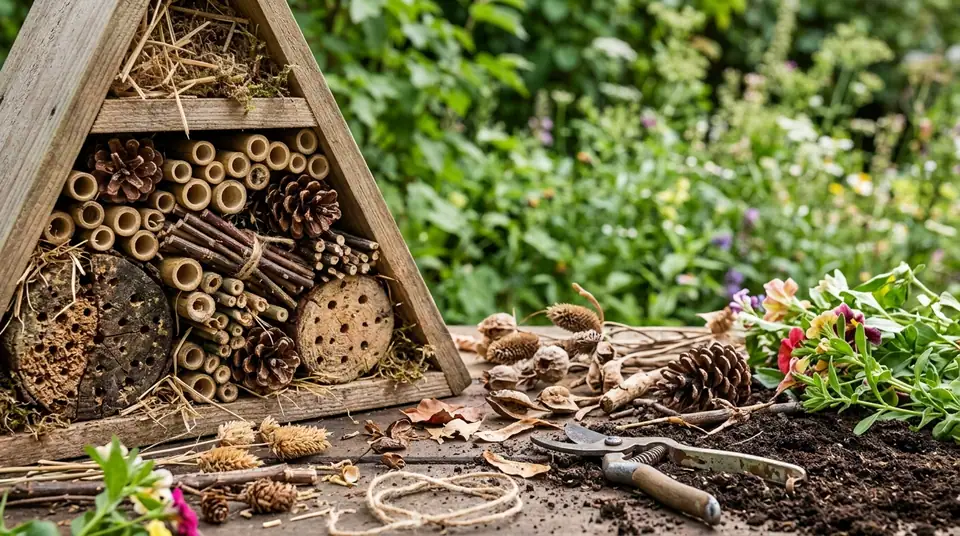
Wooden insect hotel filled with bamboo, pinecones, and twigs sitting on a garden table with pruners
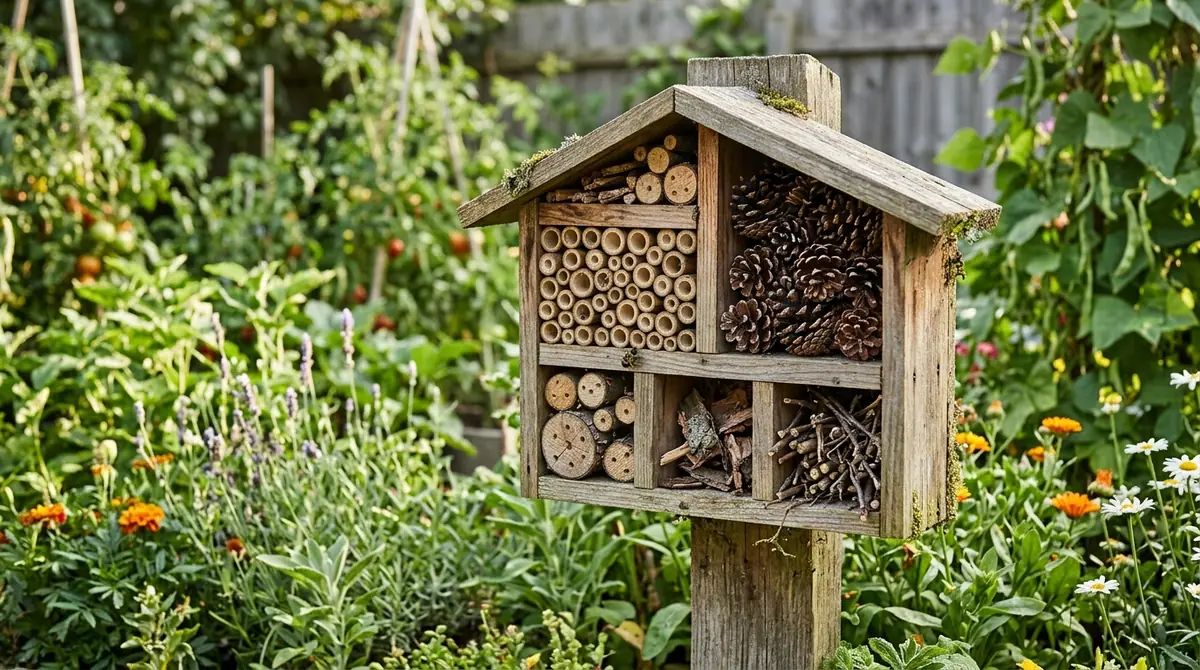
A DIY insect hotel is a deliberate architectural proxy for standing deadwood and hollow vegetation. Ecologically, these structures mimic the architectural variety found in old-growth forest edges. Different insect guilds require radically different cavity sizes, substrates, and elevations. For instance, solitary bees such as mason bees (Osmia species) and leafcutters (Megachile species) seek out rigid cylindrical tunnels measuring 0.12 to 0.4 inches (3 to 10 mm) in diameter and 4 to 6 inches (10 to 15 cm) in depth. Meanwhile, predatory beetles, lacewings, and overwintering ladybugs require loose, protected crevices packed with porous organic matter like pinecones, dry bark, and corrugated cardboard.
By integrating these tailored nesting spaces into your landscape design, you bridge the gap between ornamental aesthetics and ecological resilience. Integrating these habitats directly influences pollination rates, reducing the need for chemical inputs while aligning with guidelines set out by organizations like the Royal Horticultural Society Wildlife Gardening.
2. Essential Environmental & Care Requirements
Placing an insect hotel in your garden requires the same rigorous site analysis as planting a sensitive shrub. If you mount your structure in a damp, shaded corner, the internal nesting tubes will collect moisture, fostering pathogenic fungi and molds that devastate developing bee larvae.
Environmental parameters must be calibrated to mimic the microclimates beneficial insects naturally select in the wild. The structure must face south or southeast to capture morning sunlight, which warms the developing pupae and triggers emergence when spring temperatures hit 50°F to 55°F (10°C to 13°C). Elevation matters just as much as orientation. Mount your hotel between 3 and 6 feet (0.9 to 1.8 meters) above ground level to protect ground-foraging predators from subterranean dampness while keeping it clear of domestic pets and splashing soil-borne pathogens.
Parameter
Optimal Condition
Common Mistake
Why It Matters
Orientation
South or Southeast
Facing North or deep shade
Requires morning sun to warm pupae for spring emergence
Height
3 to 6 feet (0.9 to 1.8 m)
Directly on damp soil
Protects against ground moisture, fungal spores, and predators
Shelter
Overhanging roof (2+ inches / 5+ cm)
Flat, exposed top
Prevents rain ingress from rotting nesting materials and larvae
Stability
Rigidly fixed to a wall or post
Hanging and swaying in the wind
Solitary females reject unstable cavities that compromise egg safety
To dive deeper into the specific microclimatic needs of native pollinators, consult the Xerces Society Pollinator Conservation Resource Center. Their research outlines precisely how thermal exposure dictates native bee survival rates across varying climate zones.
Constructing an ecologically sound insect hotel requires durable framing materials and safe, untreated interiors. Avoid treated lumber infused with copper or arsenic compounds, and steer clear of flimsy cardboard tubes that degrade within 30 days of exposure to ambient humidity.
Here is my field-tested, multi-step protocol for building and populating a high-performance insect hotel for garden biodiversity:
Build the Weatherproof Frame: Construct a rectangular housing unit using untreated exterior-grade cedar or oak, measuring roughly 12 inches wide, 16 inches high, and 8 inches deep (30 x 40 x 20 cm). Ensure the roofline features a downward slope with a 2-inch (5 cm) overhang to shed driving rain.
Incorporate Solid Wood Drilling: Secure a seasoned hardwood block (such as maple, oak, or ash) measuring at least 4x4 inches into the lower third of the frame. Drill nesting holes into the end-grain—never the side-grain, which splits and splinters—in graduating diameters from 0.12 inches to 0.4 inches (3 mm to 10 mm). Drill holes to a depth of 3.5 to 5.5 inches (9 to 14 cm), ensuring you never drill all the way through the back.
Bundle Hollow Stems: Collect dry, hollow stems from last year's garden growth, such as bamboo, reed grass, or elderberry. Cut them cleanly with pruners into lengths matching your frame's depth (approx. 6 inches / 15 cm), ensuring that a natural node seals the back of each tube. Bundle them tightly with twine and wedge them firmly into a dedicated compartment.
Pack Loose Overwintering Chambers: Fill the remaining upper compartments with loose, untreated materials: pinecones for lacewings and ladybugs, rolled corrugated cardboard for earwigs, and rough bark pieces for predatory ground beetles.
Mount the Structure Securely: Anchor the finished hotel directly to a sturdy garden wall, fence post, or outbuilding using rust-resistant screws. Check the frame with a level to guarantee absolute stability against high winds.
Establish Companion Foraging Flora: Plant high-nectar, pollen-rich perennials within a 15-foot (4.5 meter) radius of the hotel. Focus on succession-blooming natives such as purple coneflower (Echinacea), bee balm (Monarda), and mountain mint (Pycnanthemum).
💡 Pro-Tip: When drilling wood blocks for solitary bees, always take a piece of fine-grit sandpaper (120-grit) and smooth the inside of every single bored hole. Splintered wood tears the delicate wings of emerging female bees as they force their way out of the cell, rendering them flightless and unable to provision future generations.
4. Common Problems, Pests & Troubleshooting
Even well-designed insect hotels face ecological pressures. If your hotel remains unpopulated after 60 days of peak spring activity, evaluate your local habitat variables. Often, a lack of nesting activity stems from a sterile surrounding landscape devoid of mud sources for mason bees (which use damp clay to seal their brood cells) or a lack of continuous floral blooms within a 300-foot (90-meter) radius.
Mold is the single greatest biological hazard inside an insect hotel. If you notice white or green fungal hyphae coating the inside of your bamboo tubes or wooden bores, discard those materials immediately. Mold thrives when the hotel is mounted too low or lacks an adequate roof overhang, allowing relative humidity inside the cavities to exceed 80%.
Parasitic wasps, particularly Chalcid wasps, present another biological challenge. These tiny predators lay their eggs inside bee larvae, piercing the mud seals of the nesting chambers. While this is part of the natural food web, you can control parasite outbreaks by utilizing removable paper inserts inside your wooden or bamboo tubes. Replace these paper inserts every autumn once the active season concludes, typically around 180 days after spring installation.
⚠️ Important Caution: Never paint, stain, or treat the interior nesting cavities of an insect hotel with chemical preservatives or volatile organic compounds (VOCs). Solitary bees and beneficial insects possess highly sensitive chemoreceptors; synthetic chemical fumes will cause them to completely abandon the site or poison developing larvae outright.
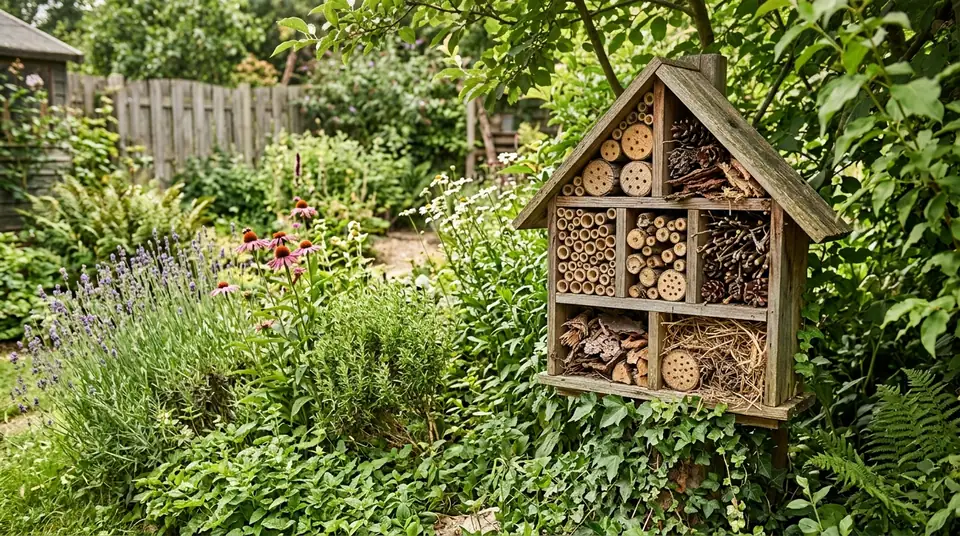
Wooden insect hotel nestled among lush garden foliage with lavender and coneflowers
5. Frequently Asked Questions
When is the best time of year to put up a DIY insect hotel?
Mount your insect hotel in late winter or early spring—ideally 30 days before native spring temperatures consistently exceed 50°F (10°C). This timing ensures the structure is dry, weathered, and fully accessible when emerging solitary queens and beneficial insects begin actively scouting for nesting cavities.
How do I clean and maintain an insect hotel?
Maintenance should occur annually in late autumn after all brood activity has ceased, roughly 200 days after spring emergence. Remove replaceable paper tube inserts and discard them. For fixed wooden blocks, use a stiff bottle brush to clear out residual debris, and sanitize the surface using a 10% bleach solution followed by 7 days of complete air-drying in the sun.
Why are insects ignoring my insect hotel?
If insects are not utilizing your hotel after 90 days, check your local ecosystem variables. Common culprits include improper hole sizing (holes outside the 0.12 to 0.4-inch / 3 to 10-mm range), a lack of chemical-free mud sources within 50 feet (15 meters), or a severe shortage of continuous seasonal blooms within the immediate foraging radius.
Can an insect hotel attract pests or dangerous stinging insects?
Solitary bees (such as mason and leafcutter bees) are exceptionally docile and lack a hive to defend; they will only sting if squeezed directly against human skin. Social wasps, such as hornets or yellowjackets, rarely nest in DIY insect hotels because they require large, enclosed, spherical paper nests rather than linear cavities.
PlantSavvyWorld is an independent botanical education project. Articles are drafted with AI assistance, then edited and checked against university extension services, botanical garden collections and other published horticultural sources.