Written with AI assistance, edited and checked against horticultural sources.
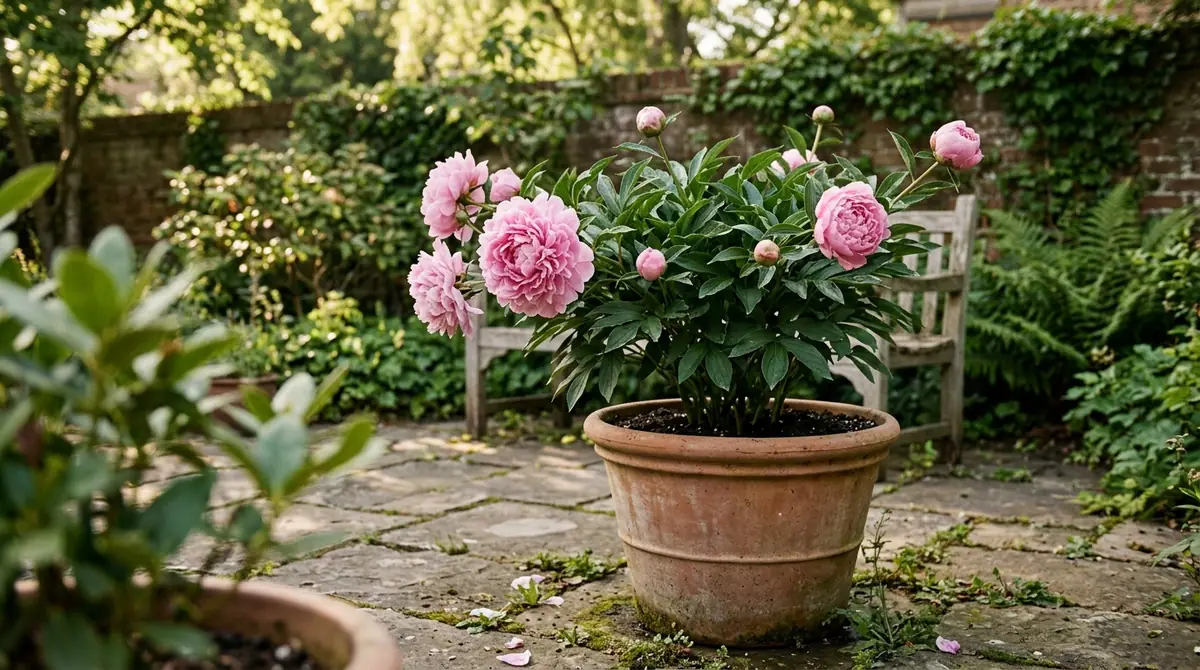
A bare-root Paeonia lactiflora 'Sarah Bernhardt' weighing nearly as much as a bowling ball can thrive on a windy, south-facing seventh-floor balcony, producing sixteen to twenty massive, fragrant blossoms every June when locked safely inside a twenty-inch terracotta container, despite the plant's reputation for sprawling across Midwestern estate gardens.
Can peony be planted in pots? Absolutely. But containers change the rules of engagement completely. I can tell you that container-grown peonies require a precise understanding of root mechanics, thermal buffering, and strict winter chilling schedules. Let’s dig into the botanical science and actionable steps required to grow magnificent peonies in pots.
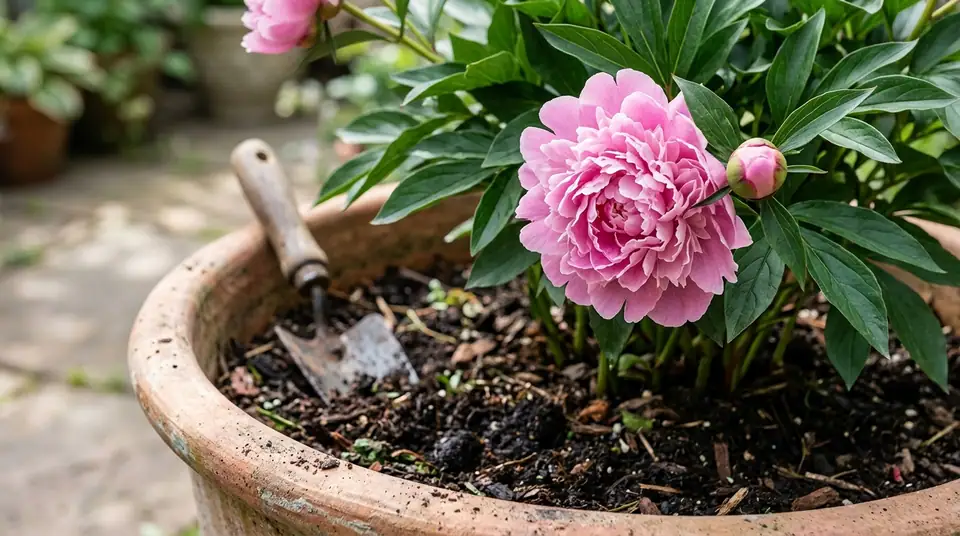
Pink peony blooming in a large terracotta pot with a garden trowel resting in the soil
1. Botanical Overview & Natural Habitat
Peonies belong to the family Paeoniaceae and the sole genus Paeonia. To understand how they behave in containers, we must first look at their evolutionary design. In their native habitats across temperate regions of Asia, Europe, and Western North America, herbaceous and intersectional (Itoh) peonies build massive, fleshy, tuberous root systems that dive deep into the soil profile—often reaching depths of 24 inches (60 cm) or more—seeking out moisture and mineral reserves during droughts.
These roots are storage organs. They accumulate starches and sugars during the growing season to fuel the explosive spring flush. When you confine these roots to a pot, you alter their natural geometry. Instead of spreading outward and downward infinitely, the root ball hits a hard boundary. Herbaceous peonies (Paeonia lactiflora) die back to the ground entirely every winter, while tree peonies (Paeonia suffruticosa) maintain woody stems above the soil line, and Itoh hybrids sit somewhere in between with semi-woody stems.
Container cultivation shifts the management of soil temperature, moisture evaporation rates, and nutrient availability. Because pots lack the thermal mass of the earth, a peony root ball is exposed to extreme weather fluctuations. A pot sitting in full summer sun can easily see root-zone temperatures soar past 95°F (35°C), while winter freezes can penetrate thin container walls and kill the dormant buds (eyes) if not properly insulated.
Success with container peonies starts with matching the cultivar to the container size. Standard herbaceous cultivars like 'Festiva Maxima' can grow up to 36 inches (90 cm) tall and wide, demanding at least a 15- to 20-gallon (57- to 75-liter) container with a minimum diameter of 20 inches (50 cm). For smaller urban balconies, look for dwarf or compact selections bred specifically for tighter spaces, such as 'Little Red Gem' or patio tree peonies.
2. Essential Environmental & Care Requirements
Peonies are notoriously sun-worshipping perennials. When grown in pots, they require a minimum of 6 to 8 hours of direct, uncompromised sunlight daily. Without adequate light, your potted peonies will stretch, produce weak stems that flop under the weight of the blooms, and frequently drop their flower buds before they even open—a physiological phenomenon known as bud blast.
Parameter
Optimal Condition
Common Mistake
Why It Matters
Container Size
15–20 gallons (57–75L), min. 20 inches (50 cm) wide and deep
Planting in undersized 2-gallon nursery pots
Fleshy roots need physical volume to store energy and access moisture.
Soil Temperature
60°F–75°F (15°C–24°C) active growth; 20°F–40°F (-6°C–4°C) winter dormancy
Allowing pots to bake in summer or freeze solid below 10°F (-12°C)
Insufficient light halts flower bud development and causes weak, leggy stems.
Soil pH
6.5 to 7.0 (slightly acidic to neutral)
Using heavy, unamended native garden clay
Compacted clay suffocates roots and causes fatal Phytophthora root rot.
Water management is the single greatest hurdle when answering whether peonies can thrive in pots. While garden-grown peonies tolerate dry spells once established, potted specimens rely entirely on you. During the peak growing season of spring, water your pots deeply whenever the top 2 inches (5 cm) of soil feel dry to the touch. Never let them sit in saucers filled with standing water. Conversely, do not allow the root ball to dry out completely, or the plant will go into premature dormancy and fail to set blooms for the following year.
Soil composition must balance moisture retention with rapid drainage. Never dig up native garden soil and put it into a container; it compacts rapidly under irrigation and lacks proper aeration. For deeper insights into managing soil structures and moisture in confined root environments, consult the University of Minnesota Extension guide on container gardening. For a contrasting look at how water behaves in alternate non-porous environments, take a look at our guide on How to Grow Plants in Glass Pots, which highlights the critical importance of drainage.
Care Aspect
Spring (Active Growth)
Summer (Bloom & Expansion)
Autumn (Senescence)
Winter (Dormancy)
Watering
Moderate; keep evenly moist as shoots emerge
Heavy; water deeply when top 2 inches are dry
Light; taper off as foliage yellows
Minimal; water only if soil is bone-dry and unfrozen
Feeding
Balanced slow-release organic fertilizer at bud break
Liquid kelp or bone meal once blooms fade
None; allow plant to harden off
None
Pruning
Remove any dead or broken stems
Deadhead spent flowers immediately
Cut herbaceous stems down to 2 inches (5 cm) above soil
Planting a peony in a pot requires absolute precision regarding planting depth. This is the number one reason container-grown peonies fail. If you plant a herbaceous peony too deep, it will produce lush green foliage year after year but will flatly refuse to flower.
Here is your step-by-step protocol for planting a bare-root or potted peony into a container:
Select and Prepare the Container: Choose a heavy-duty container (terracotta, heavy resin, or fiberglass) with a minimum volume of 15 gallons (57 liters) and multiple large drainage holes at the base. Elevate the pot slightly on pot feet to ensure unobstructed water drainage.
Mix the Ideal Soil Media: Create a rich, well-draining potting matrix composed of 40% high-quality organic compost, 40% coarse potting soil, and 20% perlite or horticultural grit to ensure maximum aeration.
Establish the Drainage Layer: Place a 1-inch (2.5 cm) layer of broken pottery or coarse gravel at the base of the pot, followed by a layer of your soil mix until the container is roughly half full.
Position the Root Correctly: Place the peony root in the center of the pot. Crucial rule: The uppermost pink growth buds (eyes) must sit no more than 1 to 2 inches (2.5 to 5 cm) below the final soil surface if you live in a cold climate, or exactly 1 inch (2.5 cm) deep in warmer regions. If planting a tree peony, position the graft union 3 to 4 inches (7.5 to 10 cm) below the soil line.
Backfill and Settle: Fill in around the roots with the soil mixture, gently tamping down with your hands to eliminate large air pockets. Do not pack the soil down too aggressively, as this destroys soil structure.
Water In and Mulch: Water the pot thoroughly until water streams freely from the bottom drainage holes. Apply a 2-inch (5 cm) layer of shredded hardwood mulch across the top, keeping the mulch a half-inch away from the actual stems to prevent crown rot.
Feeding container peonies requires a steady hand. Because watering leaches nutrients out of potting soil faster than garden beds, you must replenish them. Apply a low-nitrogen, high-phosphorus organic fertilizer (such as bone meal or a balanced 5-10-5 granular slow-release formula) just as the red shoots emerge from the soil in early spring. Avoid high-nitrogen fertilizers at all costs; they stimulate excessive, weak foliage growth at the expense of flower production and invite fungal diseases like Botrytis.
💡 Pro-Tip: If you live in USDA Hardiness Zones 3 through 6, your potted peony needs winter chilling to produce flowers, but the roots inside a freestanding pot are vulnerable to extreme freezes. Bury your container directly into the ground in your garden for the winter months, or wrap the outside of the pot with thick layers of burlap and bubble wrap to shield the roots from ambient temperatures dropping below 10°F (-12°C).
For those interested in scaling up their urban container gardens, the strategies required for heavy root systems overlap significantly with what you need when you Best Tomatoes for Containers and Grow in Pots, where soil volume and nutrient management dictate your harvest success.
4. Common Problems, Pests & Troubleshooting
Container gardening concentrates both benefits and risks. Without the buffering capacity of open earth, environmental stress shows up rapidly on your peony's foliage and stems.
Botrytis Blight (Botrytis paeoniae) is the most frequent fungal adversary of container-grown peonies. It thrives in damp, stagnant air and overcrowding. You will notice young stems suddenly turning black and rotting at the soil line, or brown spots appearing on the leaves and flower buds. To combat this, never crowd your pots against solid walls; ensure unobstructed airflow around every plant. Remove and destroy any infected plant tissue immediately. Never compost diseased material. Apply a copper-based bio-fungicide at the first sign of extended damp weather.
Root Rot (Phytophthora species) occurs when pots lack sufficient drainage or when the potting medium breaks down over time into a dense, soggy sludge. The leaves will turn yellow, wilt even when the soil is damp, and the root crown will feel soft and smell foul. If you catch it early, unpot the plant, slice away black, mushy roots with a sterile blade, dust the remaining healthy root tissue with cinnamon or sulfur powder, and repot into fresh, dry potting media.
Bud Blast is a frustrating physiological issue where flower buds form, turn brown, and drop off without opening. This is usually triggered by one of three things: extreme temperature swings during bud development, severe drought stress, or a lack of winter chill hours. Ensure your container gets consistent moisture and is protected from erratic late-spring freezes.
⚠️ Important Caution: Never use heavy chemical systemic insecticides on container-grown peonies sitting on balconies or patios where local pollinators—such as bumblebees and honeybees—frequent the blooms. Peonies produce copious, highly accessible pollen, and systemic chemicals can inadvertently poison beneficial insects visiting the flowers.
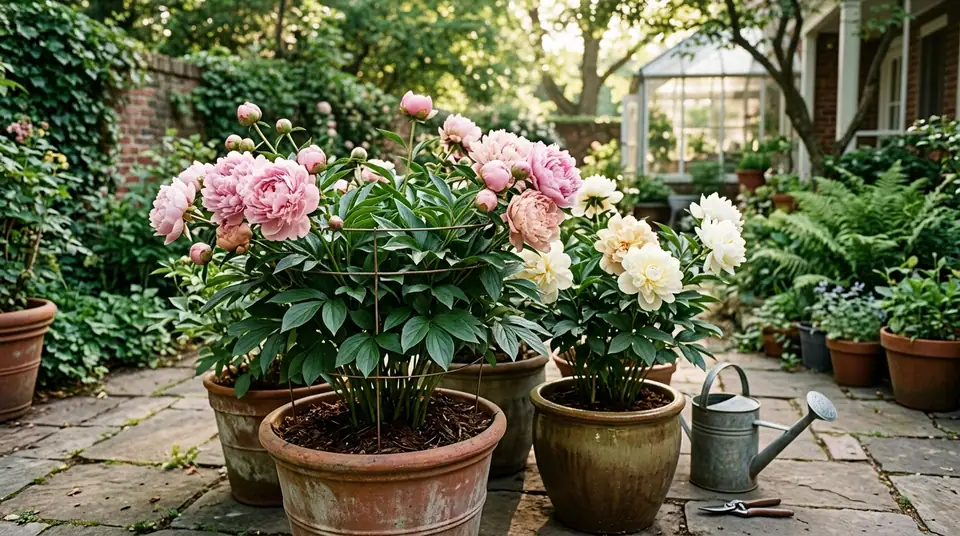
Lush potted peony plants with pink and white blooms on a stone patio
5. Frequently Asked Questions
Do potted peonies need to be brought indoors for the winter?
No, herbaceous peonies actually require a specific period of cold dormancy—typically 500 to 1,000 hours of temperatures below 40°F (4°C)—to trigger the hormonal changes necessary for spring flower bud development. Bringing them inside a warm house for the winter will trick the plant into thinking it is spring prematurely, resulting in weak growth and zero flowers. However, if you live in extremely harsh climates below USDA Zone 3, the extreme freeze can kill the potted roots; insulate the exterior of the pot instead.
How often do I need to repot a container peony?
Peonies hate being disturbed, but when grown in containers, they exhaust the available soil nutrients and outgrow their space every 3 to 4 years. The best time to divide and repot a container peony is in early autumn (September or October), just as the plant goes dormant. Tip the plant out of its container, gently hose away the old soil to inspect the roots, use a sterile serrated knife to divide the root clump ensuring each section has at least 3 to 5 robust eyes, and replant into fresh soil.
Why are my potted peony leaves turning brown and crispy at the edges?
Crispy, brown leaf margins on a container peony are usually caused by one of two factors: fertilizer salt buildup or inconsistent moisture combined with intense midday heat reflection from nearby walls or concrete balconies. Flush your container's soil thoroughly twice a year by running a heavy stream of water through the drainage holes for several minutes to wash away accumulated mineral salts. Ensure you are watering deeply rather than giving the plant frequent, shallow sips.
Can I grow tree peonies in pots just as easily as herbaceous ones?
Yes, tree peonies (Paeonia suffruticosa) actually make magnificent container plants because their woody framework provides architectural interest year-round, even after they drop their leaves in winter. Ensure you select a slightly deeper container—at least 20 gallons (75 liters)—and remember that tree peony stems do not die back to the ground. Never prune the woody stems of a tree peony in autumn, as you will inadvertently cut off next spring's flower buds.
PlantSavvyWorld is an independent botanical education project. Articles are drafted with AI assistance, then edited and checked against university extension services, botanical garden collections and other published horticultural sources.