

Planting Landscaping Under Pine Trees
Written with AI assistance, edited and checked against horticultural sources.
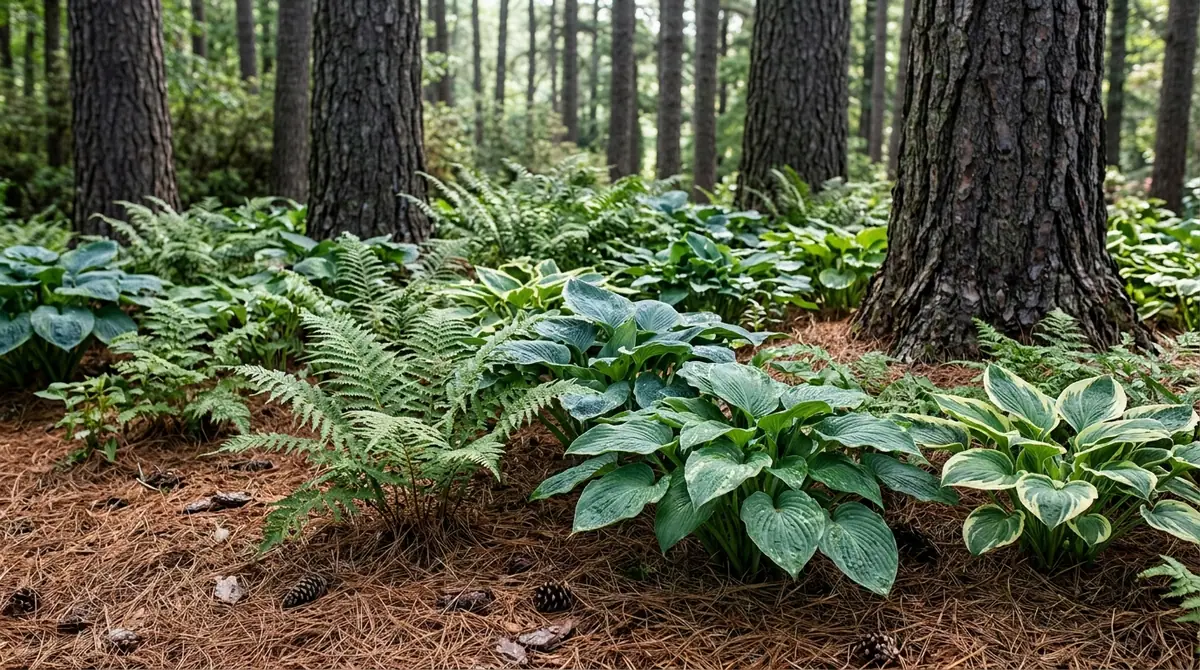
Standing in a gardener's suburban backyard in Chapel Hill last spring, I watched muddy water pool around the base of a majestic, fifty-year-old Loblolly pine (Pinus taeda). The homeowner had spent $500 on flat-leaved hostas and delicate impatiens, planting them directly into the heavy carpet of dry, russet needles. Within three weeks, the hostas had turned a sickly yellow, the impatiens had rotted at the crown, and the soil beneath the canopy felt as hydrophobic as a dense felt pad. Pines are notoriously difficult landscape neighbors, and attempting to force standard shade-garden plants into their root zones is a masterclass in frustration. Over many seasons I have learned that successful landscaping under pine trees requires working with their biology, not against it.
1. Botanical Overview & Natural Habitat

Pines develop extensive root systems. While some species possess a deep taproot when young, mature pines rely heavily on a vast, spreading network of lateral roots situated primarily in the top 12 to 24 inches (30 to 60 cm) of soil. These roots act like thirsty sponges, greedily absorbing water and macro-nutrients before anything else can reach them.
Furthermore, pine needles are frequently misunderstood. A widespread garden myth claims that falling pine needles drastically acidify the soil as they decompose, poisoning other plants. Botanically speaking, fresh green needles are indeed acidic, with a pH typically ranging from 3.2 to 3.8. However, once those needles hit the ground and begin the decomposition process over 90 to 180 days, soil microbes neutralize most of that acidity. The enduring challenge of pine needles isn't extreme pH—it is their slow breakdown rate, which creates a thick, water-repellent mulch layer that sheds light rain showers and smothers low-growing seedlings.
| Parameter | Optimal Condition | Common Mistake | Why It Matters |
|---|---|---|---|
| Soil pH | 4.5 – 6.0 (Moderately Acidic) | Adding massive amounts of agricultural lime | Drastic pH swings shock native soil microbes and stress pine feeder roots. |
| Moisture Access | Deep, infrequent soaking (1.5 inches / 3.8 cm weekly) | Frequent, shallow daily sprinklers | Shallow watering encourages surface root competition and invites fungal crown rots. |
| Mulch Depth | 2 to 3 inches (5 to 7.5 cm) of loose organic matter | Piling 6 to 12 inches (15 to 30 cm) of dense needles or bark against the trunk | Deep, wet mulch against the bark suffocates the root flare and invites collar rot. |
| Planting Depth | Root ball flush with or 1 inch (2.5 cm) above grade | Burying the root crown in imported topsoil | Adding more than 2 inches (5 cm) of soil over pine roots suffocates gas exchange. |
2. Essential Environmental & Care Requirements
Creating a sustainable landscape under a conifer requires managing three major limiting factors: heavy shade or filtered high-intensity sun, severe root competition, and low moisture availability.
Light levels beneath pines vary wildly depending on the species and pruning history. White pines (Pinus strobus) cast a dense, low shade, while longleaf pines (Pinus palustris) allow dappled light to filter through high canopies. You must evaluate your specific site to determine whether you are dealing with dry shade, part-sun, or deep shade before selecting plant material.
Water management is equally critical. A mature pine tree can transpire hundreds of gallons of water daily during peak summer temperatures of 85°F to 95°F (29°C to 35°C). Any understory plants must be drought-tolerant once established, or you must install a dedicated drip-irrigation system that delivers water deeply to both the trees and the understory plants.
Nutrient management requires a gentle touch. Pine soils are naturally low in nitrogen and phosphorus. When fertilizing your understory plants, use slow-release, organic fertilizers formulated for acid-loving plants. Avoid high-nitrogen synthetic fertilizers applied in broad broadcasts, as they can burn shallow pine roots and force a flush of weak, disease-prone growth in your landscape plants.
💡 Pro-Tip: Never use heavy mechanical rototillers under a pine tree's canopy. Chopping through lateral roots larger than 1 inch (2.5 cm) in diameter creates entry wounds for virulent pathogens like Armillaria root rot, which can destabilize and ultimately kill a 60-foot (18-meter) pine tree. Always use hand tools like a narrow trowel or a soil knife (hori-hori) to carve out small planting pockets between major roots.
3. Step-by-Step Cultivation, Feeding & Propagation
When establishing a new planting bed under an established pine tree, precision and patience are your best tools. Follow this strict protocol to protect the tree while successfully establishing your new landscape beds.
- Mapping the Root Zone: Gently scrape away the top layer of loose needles using a leaf rake until you encounter the firm structural roots. Mark these zones with garden stakes so you avoid digging directly on top of primary structural roots larger than 2 inches (5 cm) in diameter.
- Clearing and Raking: Remove excess needle buildup down to a manageable 2-inch (5-cm) layer. Do not strip the soil completely bare, as a thin layer of natural mulch protects surface microbial life.
- Selecting Tough Understory Species: Choose proven performers suited for dry, acidic conditions. Excellent choices include evergreen groundcovers like creeping Liriope (Liriope spicata), tough ferns like the Christmas fern (Polystichum acrostichoides), and acid-loving shrubs like Drooping Leucothoe (Leucothoe fontanesiana). If you are looking to integrate hardscape elements or transition your landscape layout near structural boundaries, review our guide on 15 Best Trees for Driveways That Won't Crack Concrete to understand how different root systems interact with managed spaces.
- Excavating Planting Pockets: Using a sharp hand trowel, dig individual holes only as deep as the nursery container and twice as wide. Space your planting holes at least 6 to 12 inches (15 to 30 cm) away from major lateral tree roots to minimize root shock.
- Soil Amendment & Planting: Tease out the root ball of your container-grown perennial or shrub to break any circling roots. Place the plant in the hole, ensuring the top of the root ball sits 0.5 inches (1.2 cm) above the surrounding soil grade to account for minor settling. Backfill with a 50/50 mix of native soil and well-aged leaf mold or compost.
- Initial Watering & Settling: Soak the new plantings immediately with a slow, deep trickle for 45 minutes per square yard to settle air pockets around both the new plants and the exposed pine roots.
- Mulching: Apply a conservative 2-inch (5-cm) layer of shredded pine bark or shredded hardwood mulch around the new plants. Maintain a 3-inch (7.5-cm) clearance circle completely free of mulch around the base of all shrub stems and the pine tree's trunk collar.
⚠️ Important Caution: Never dump excess fill dirt or raise the soil grade by more than 2 inches (5 cm) across the root zone of a mature pine tree. Piling deep soil over the root system cuts off essential oxygen diffusion to the feeder roots, leading to a slow, irreversible decline known as "fill tree decline," which can kill the pine within 3 to 5 years.
4. Common Problems, Pests & Troubleshooting
Landscaping under pines presents unique diagnostic challenges. If your newly installed understory plants are struggling, run through this troubleshooting checklist.
- Symptom: Rapid Wilting Despite Regular Watering.
- Cause: Water interception. The dense canopy of the pine tree can catch up to 30% of a light rainfall before it ever hits the ground, and the pine's feeder roots are likely stealing moisture from your newly planted root balls.
- Solution: Install a dedicated drip emitter directly over each understory plant's root zone, running it for 30 minutes twice a week during dry spells.
- Symptom: Chlorosis (Yellowing Leaves with Green Veins).
- Cause: Iron lockout due to improper watering or soil compaction rather than true nutrient deficiency.
- Solution: Test your soil pH. If the pH has drifted above 6.5 due to municipal water runoff or concrete leaching, apply elemental sulfur at a rate of 1 lb per 100 square feet (0.5 kg per 9 square meters) to gently lower the pH back into the optimal range.
- Symptom: Sudden Plant Collapse and White Mycelial Mats.
- Cause: Armillaria root rot (shoestring root rot), a native fungus that feeds on decaying wood and can transition to living stressed plants.
- Solution: Remove infected plants immediately along with their root balls. Ensure you do not pile fresh wood chips directly against the stems of your understory plants. For authoritative management guidelines on regional fungal pathogens, consult the Clemson University Cooperative Extension Service.

5. Frequently Asked Questions
Will pine needles kill the plants I put under my pine tree?
No. While fresh pine needles are acidic and can create a physical barrier that prevents light rain from reaching the soil, they do not chemically poison other plants. Once needles decompose into humus, they contribute to a healthy, acidic forest floor. The real threats to your plants are moisture competition from the pine roots and deep shade, not the needles themselves.
Can I grow grass under a pine tree?
Generally, no. Most turfgrasses—such as Kentucky bluegrass, tall fescue, or Bermuda grass—require at least 4 to 6 hours of direct sunlight and ample, unobstructed soil moisture to thrive. Pine trees block too much sunlight and outcompete turf for water and nutrients. Instead of struggling to maintain patchy, yellow grass, convert these dry shade zones into mulch beds with shade-tolerant groundcovers or native woodland perennials.
How do I plant flowers around a pine tree without hurting the tree?
You must plant in small pockets between the major lateral roots rather than digging a continuous trench. Use small starter plants (plugs or 4-inch containers) rather than large, root-bound 3-gallon shrubs, as smaller plants require much smaller planting holes. Never cut roots thicker than your thumb, and keep all soil additions under 2 inches (5 cm) in depth across the root zone.
What are the best shrubs to plant under pine trees?
The best shrubs are acid-loving, drought-tolerant species native to woodland understories. Excellent performers include Mountain Laurel (Kalmia latifolia), Pinxterbloom Azalea (Rhododendron periclymenoides), American Beautyberry (Callicarpa americana), and Oakleaf Hydrangea (Hydrangea quercifolia). For comprehensive plant lists suited to specific geographic hardiness zones, refer to the Royal Horticultural Society database for regional performance data.
Related Guides
- How Fast Does Pine Grow
- Is Pine Bark Mulch Good
- Texas Landscaping Ideas
- Creative Landscaping Ideas Around Tree Roots
- Best Native Plants for Sustainable Backyard Landscaping
📋 Table of Contents ▼ Click to expand
Tags:
🌿 Related Plants You Might Like






PlantSavvyWorld
Editorial team
PlantSavvyWorld is an independent botanical education project. Articles are drafted with AI assistance, then edited and checked against university extension services, botanical garden collections and other published horticultural sources.