

 Mary Kate
I remember standing in a client's newly purchased half-acre plot in Clemson, South Carolina, holding a flat of tender heirloom tomatoes and a map that flat-out lied to me. The old zone map said we were a USDA Zone 7, but the soil was baked dry by a relentless July sun, and an unexpected late-spring freeze back in April had already decimated the local peach buds at 28°F (-2.2°C). That day taught me a vital lesson that every gardener in the Palmetto State learns the hard way: asking "what zone is south carolina for plants" is only the opening chapter of a much more complex horticultural story.
1. Botanical Overview & Natural Habitat
South Carolina spans USDA Plant Hardiness Zones 7b through 9a, stretching from the chill-prone Blue Ridge Mountains down to the humid, subtropical Atlantic coastline. Across this roughly 32,000-square-mile expanse, minimum winter temperatures drop anywhere from 5°F to 25°F (-15°柏 to -3.9°C), creating vastly different ecological niches that dictate what will thrive and what will wither.

In the Upstate region—encompassing Greenville, Spartanburg, and Clemson—you are typically dealing with Zones 7b and 8a. Here, minimum winter temperatures hover between 5°F and 15°F (-15°C to -9.4°C). Soils here are heavily weathered, iron-rich red clay packed with kaolinite, which drains poorly and compacts easily into a brick-like consistency when dry.
Moving down through the Midlands (Columbia, Aiken, Orangeburg), the state shifts firmly into Zone 8b. Winters here are milder, with lows dipping only to 15°F to 20°F (-9.4°C to -6.7°C). The soil transitions into the Sandhills region—an ancient coastline of deep, nutrient-poor quartz sands that demand careful moisture and fertilizer management.
Finally, the Lowcountry and Coastal Plain (Charleston, Beaufort, Hilton Head) bask in Zone 9a, where winter lows rarely plunge below 20°F to 25°F (-6.7°C to -3.9°C). Gardeners here face high humidity, sandy-loam soils, and salt-spray challenges, but enjoy a frost-free growing season that can stretch past 240 days.
To master this diverse landscape, it helps to cross-reference official data. You can verify your exact microclimate using the official USDA Plant Hardiness Zone Map, and consult regional planting calendars through the Clemson University Home & Garden Information Center.
2. Essential Environmental & Care Requirements
Because South Carolina's hardiness zones vary so dramatically by elevation and proximity to the ocean, your plant care routine must adapt to regional realities rather than a blanket state-wide rule.
| Parameter | Optimal Condition | Common Mistake | Why It Matters |
|---|---|---|---|
| Soil pH | 6.0 to 6.5 for most vegetables and ornamentals | Assuming native soil is balanced (Upstate clay is often 5.0–5.5) | Low pH locks out essential macronutrients like phosphorus and calcium |
| Irrigation Depth | 1 to 1.5 inches (2.5 to 3.8 cm) of water per week | Frequent, shallow sprinkling that encourages surface root growth | Deep watering forces roots downward to survive summer droughts |
| Mulch Layer | 2 to 3 inches (5 to 7.6 cm) of organic hardwood bark | Piling mulch directly against plant stems ("volcano mulching") | Trapped moisture causes collar rot and invites boring insects |
| Sun Exposure | 6 to 8 hours of morning sun with afternoon relief | Placing shade-loving species in scorching South Carolina west exposures | Intense afternoon radiation above 90°F (32.2°C) causes irreversible leaf scorch |
💡 Dr. Mary Kate's Pro-Tip: When dealing with the heavy red clay in the Upstate, never amend just the planting hole. Digging a rich pocket in dense clay creates a subterranean bathtub that drowns root systems during heavy summer thunderstorms. Always amend the entire planting bed uniformly.
3. Step-by-Step Cultivation, Feeding & Propagation
Establishing a resilient garden in South Carolina requires precise timing. Follow this step-by-step cultivation protocol to give your plants the strongest start possible:
- Conduct a Comprehensive Soil Test: Collect 10 to 15 core samples from your garden beds at a depth of 6 inches (15 cm). Mix them in a plastic bucket and send the sample to your local extension office to determine exact lime and fertilizer requirements.
- Amend and Build Beds: Incorporate 2 inches (5 cm) of aged compost into the top 8 inches (20 cm) of soil. If you are growing heavy feeders like tomatoes, apply techniques detailed in our guide on How to Grow Huge Tomato Plants: Pruning, Trenching & Heavy Yields to maximize your harvest.
- Time Your Planting Windows: In the Upstate (Zone 7b/8a), plant cool-season crops in late August for a fall harvest, and spring crops after the last average frost date of April 5th. In the Lowcountry (Zone 9a), you can plant warm-season crops up to three weeks earlier.
- Install Drip Irrigation: Lay down half-inch drip tubing with emitters spaced 12 inches (30 cm) apart. Cover the lines with 3 inches (7.6 cm) of pine straw or shredded hardwood bark to drastically reduce soil evaporation during 95°F (35°C) July afternoons.
- Establish a Feeding Schedule: Apply a balanced, slow-release organic granular fertilizer (such as a 4-3-4 formulation) at a rate of 2 lbs per 100 square feet (1 kg per 9.3 square meters) at planting time, followed by liquid fish emulsion every 14 days during peak vegetative growth.
- Propagate for Success: Take 4-inch (10 cm) softwood cuttings from healthy perennial shrubs in June, dip the cut ends in 0.3% indole-3-butyric acid rooting hormone, and place them in a 1:1 perlite and peat medium under intermittent mist.
⚠️ Important Caution: Do not apply heavy nitrogen fertilizers to shrubs or trees past August 1st anywhere in South Carolina. Late-season nitrogen flushes soft, succulent new growth that will be instantly killed by the first hard autumn frost, opening the plant up to bacterial and fungal infections.
4. Common Problems, Pests & Troubleshooting
South Carolina's long, humid summers create a breeding ground for plant stress, pests, and pathogens. Recognizing the symptoms early saves crops.
Blossom-End Rot on Tomatoes and Peppers: Caused by irregular watering coupled with a calcium deficiency in the fruit tissue. The bottom of the fruit develops a sunken, leathery black patch. Solution: Maintain consistent soil moisture using drip irrigation and spray foliage with calcium chloride at the first sign of flowering. For more tips on managing high-yield summer crops, check out Sweet Potato Companion Plants: 8 Best Garden Friends & 3 Foes to Avoid to optimize your companion planting layout.
Root-Knot Nematodes: Particularly devastating in the sandy soils of the Midlands and Lowcountry. Plants stunt, yellow, and display swollen, knotted root systems. Solution: Rotate susceptible crops annually and plant marigolds (Tagetes patula) as a cover crop to naturally suppress nematode populations.
Powdery Mildew: Thrives in the high humidity of the Coastal Plain, coating leaves in a white, talcum-powder-like substance. Solution: Prune interior branches to maximize airflow, water only at the base in the early morning, and apply a preventative bio-fungicide containing Bacillus subtilis.
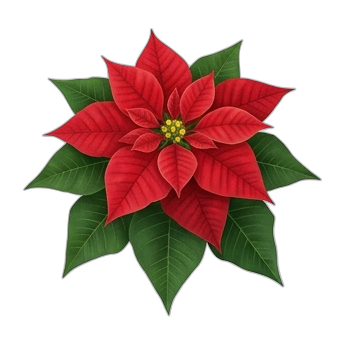
For gardeners transitioning outdoor specimens indoors or managing seasonal display plants when temperatures fluctuate, refer to our Holiday Plants Care Guide: How to Force Poinsettias to Rebloom & Holiday Cacti ID for specific indoor environmental controls.

5. Frequently Asked Questions
What zone is South Carolina for planting perennials?
South Carolina spans zones 7b through 9a. Most traditional perennials like coneflowers, black-eyed Susans, and hostas will thrive statewide, though gardeners in Zone 9a should provide afternoon shade for cool-climate perennials that struggle with extreme summer heat.
When is the last frost date in South Carolina?
Average last frost dates vary widely by region. In the Upstate (Zone 7b), expect the last frost around April 5th. In the Midlands (Zone 8b), it's typically March 25th, and in the Lowcountry (Zone 9a), the risk of frost drops significantly by March 10th.
Can tropical plants survive winters in South Carolina?
True tropicals like standard banana plants and citrus can survive winters in the Lowcountry (Zone 9a) with light frost protection. In the Upstate (Zone 7b/8a), these same tropicals must be container-grown and brought indoors or into a greenhouse before temperatures drop below 40°F (4.4°C).
Which South Carolina zone gets the most cold weather?
The Blue Ridge Mountain region in the extreme northwest corner of the state experiences the coldest temperatures, occasionally dipping into Zone 7a (-5°F to 0°F / -20.6°C to -17.8°C) during severe winter polar vortex events.
Related Guides
- What Zone is South Carolina in for Planting
- What Zone is South Carolina for Planting
- When to Plant Pumpkins in South Carolina
- When to Plant Pumpkins in North Carolina
- What Hardiness Zone is Sacramento
📋 Table of Contents ▼ Click to expand
Tags:
🌿 Related Plants You Might Like

Mary Kate
Botanist & Founder
With over 10 years of experience researching sustainable horticulture and landscape architecture, I am on a mission to strengthen the bond between humans and nature.