

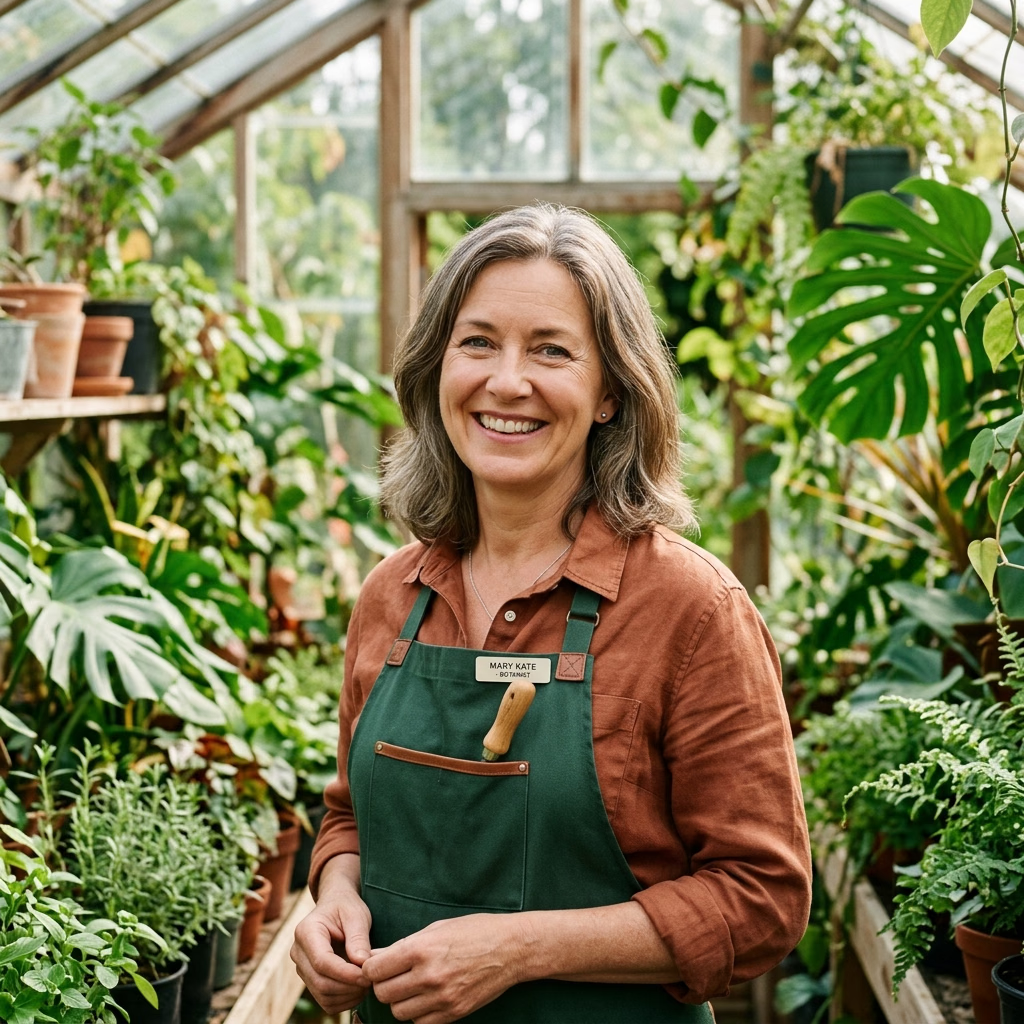
 Mary Kate
Standing in a sprawling Charleston courtyard last April, I watched a disheartened client try to grow tender Mediterranean lavender in dense, poorly draining coastal clay, entirely unaware that her specific patch of South Carolina sat in a completely different microclimate than her neighbor's garden just two blocks away. When people ask me "what zone is sc in for planting," they usually want a single, neat number to hand to a nursery clerk, but South Carolina's botanical reality is far more nuanced, spanning USDA Hardiness Zones 7a through 9b.
As a Senior Botanist and landscape designer, I have spent decades mapping the transition from the chill-heavy Blue Ridge mountains down to the humid, subtropical maritime forests of the Atlantic coast. Understanding South Carolina's growing zones is the single most important step you can take to move your garden from mere survival to absolute botanical abundance.

1. Botanical Overview & Natural Habitat
South Carolina occupies a unique ecological bridge in the southeastern United States, characterized by a north-to-south temperature gradient and significant topographical shifts. The state transitions rapidly from the high-elevation Blue Ridge region in the northwest down through the rolling Piedmont and across the Fall Line into the expansive, flat Coastal Plain.
Because of this varied topography, the state spans multiple USDA Hardiness Zones, updated recently by the USDA Agricultural Research Service to reflect warming winter trends.
- In the northwestern corner, cities like Travelers Rest and Pickens experience Zone 7a, where average annual extreme minimum temperatures dip to 0°F to 5°F (-17.8°C to -15.0°C).
- Moving southeast into the Piedmont—including Greenville, Spartanburg, and Columbia—the state largely occupies Zones 7b, 8a, and 8b, with extreme winter lows ranging from 5°F to 20°F (-15.0°C to -6.7°C).
- Finally, the coastal regions, encompassing Charleston, Beaufort, and Hilton Head, sit comfortably in warm Zones 9a and 9b, where winter temperatures rarely drop below 20°F to 30°F (-6.7°C to -1.1°C).
Native plant communities vary dramatically across these zones. In the cooler, acidic soils of the Upstate, you will find rich Appalachian cove forests dominated by deciduous trees like the Eastern Hemlock (Tsuga canadensis) and various understory rhododendrons. In the central Piedmont, loblolly pine (Pinus taeda) and mixed oak-hickory forests take over, thriving in heavy red clay rich in iron oxides. As you approach the maritime ecosystems of the Lowcountry, the flora shifts to salt-tolerant live oaks (Quercus virginiana), sabal palms (Sabal palmetto), and lush understories of resurrection fern (Pleopeltis polypodioides).
Understanding your specific patch within South Carolina requires looking beyond state borders and evaluating your exact county, elevation, and proximity to major bodies of water or urban heat islands. For official, hyper-local verification, I always direct growers to consult the USDA Plant Hardiness Zone Map.
2. Essential Environmental & Care Requirements
Garden success in South Carolina hinges on managing two primary climatic variables: intense summer heat combined with high relative humidity, and highly variable regional soil structures. Across the state, summer daytime temperatures regularly exceed 90°F (32.2°C) from June through September, with humidity levels that challenge plants prone to fungal pathogens.
Soil types present the next major hurdle. In the Upstate and Piedmont, gardeners contend with Ultisols—heavy, weathered red clay soils that compact easily and drain poorly. In contrast, the Sandhills and Coastal Plain feature sandy, highly porous soils that leach nutrients and dry out rapidly between rain events.
| Parameter | Optimal Condition | Common Mistake | Why It Matters |
|---|---|---|---|
| Soil Texture (Upstate/Piedmont) | Loam amended with organic compost | Planting directly into raw, unamended red clay | Heavy clay suffocates root systems and causes water-logging root rot during summer storms. |
| Soil Texture (Lowcountry) | Sandy loam rich in decomposed humus | Allowing organic matter to deplete completely | Pure sand cannot retain essential macro-nutrients or moisture during prolonged dry spells. |
| Watering Regimen | 1 to 1.5 inches (2.5 to 3.8 cm) per week | Frequent, shallow surface sprinkling | Deep, infrequent irrigation encourages roots to grow downward, surviving summer droughts. |
| Sun Exposure | Morning sun, afternoon shade for tender taxa | Exposing shade-loving plants to harsh 3 PM rays | Intense southern afternoon sun causes severe leaf scorch and heat stress in non-native species. |
Managing soil pH is equally vital. South Carolina soils naturally lean acidic, often ranging between pH 5.0 and 6.2, which is exceptional for blueberries, camellias, and azaleas, but may require agricultural limestone amendments for vegetable gardens that prefer a neutral pH of 6.5 to 7.0.
💡 Dr. Mary Kate's Pro-Tip: When planting in South Carolina's heavy Piedmont clay, never dig a smooth-sided, vertical-walled planting hole. Use a garden fork to rough up the sides of the hole. Smooth clay acts like a slick flowerpot, trapping water and causing circling, suffocating roots that doom your shrub or tree within two seasons.
3. Step-by-Step Cultivation, Feeding & Propagation
Establishing a resilient perennial or vegetable garden in South Carolina requires precise timing. Because the state enjoys a long frost-free growing season—ranging from roughly 180 days in the mountains to over 240 days along the coast—successional planting is entirely possible and highly encouraged.
Follow this step-by-step protocol for establishing new perennials or woody plants in South Carolina soils:
- Site Assessment and Soil Testing: Collect core soil samples from a depth of 6 to 8 inches (15 to 20 cm) across your planting area. Send these to the Clemson University Home & Garden Information Center for professional nutrient and pH analysis before buying amendments.
- Bed Preparation: Clear all competing weeds and turfgrass within a 3-foot (91 cm) radius of the planting site. Spread a 3-inch (7.6 cm) layer of well-rotted leaf mold or compost over the surface and gently incorporate it into the top 6 inches (15 cm) of native soil to improve microbial life and crumb structure.
- Excavation: Dig a shallow, saucer-shaped planting hole that is two to three times wider than the root ball, but crucially, keep the top of the root ball 1 to 2 inches (2.5 to 5 cm) above the surrounding grade to allow for natural settling.
- Hydration and Placement: Submerge the nursery container in water until air bubbles cease rising, indicating complete root-ball saturation. Gently tease apart any circling roots on container-grown plants, place the specimen in the center of the hole, and backfill using unamended native soil.
- Mulch Application: Apply a 2-inch (5 cm) layer of shredded hardwood bark or pine straw across the root zone. Maintain a clear 2-inch (5 cm) gap between the mulch collar and the main stem of the plant to prevent collar rot and pest intrusion.
- Initial Irrigation: Deliver a deep watering of at least 1 inch (2.5 cm) immediately after planting. Maintain a strict irrigation schedule of twice-weekly deep waterings for the first 60 days to establish deep root anchorage.
- Nutrient Management: Withhold synthetic granular fertilizers during the first planting season to prevent root burn. Instead, apply a balanced, slow-release organic fertilizer or fish emulsion in early spring of the second year as new foliar growth emerges.
4. Common Problems, Pests & Troubleshooting
Gardening in South Carolina's warm, humid climate presents specific stressors that can quickly decimate an unvigilant planting plan. Fungal diseases are public enemy number one. High relative humidity and warm evening temperatures create prime breeding grounds for powdery mildew (Erysiphe spp.), black spot on roses (Diplocarpon rosae), and root rots caused by Phytophthora species sitting in waterlogged soils after torrential summer thunderstorms.
To combat fungal issues, prioritize morning watering at the soil level rather than overhead sprinkling, and ensure proper plant spacing to maximize air circulation through the canopy.
Pests also thrive in the Palmetto State. Japanese beetles (Popillia japonica) emerge in late spring to skeletonize the foliage of favored hosts like crape myrtles, roses, and fruit trees. Aphids and spider mites multiply rapidly during hot, dry spells, while root-knot nematodes present a persistent challenge in sandy coastal soils, attacking vegetable roots and stunting growth.
⚠️ Important Caution: Avoid using broad-spectrum chemical insecticides indiscriminately in your South Carolina garden. They wipe out vital populations of native pollinators, predatory wasps, and beneficial lady beetles, often resulting in a severe rebound of secondary pest outbreaks like spider mites.
Nutrient deficiencies frequently manifest as chlorosis—yellowing leaves with green veins—particularly in iron-starved alkaline garden beds or heavily leached sandy soils. Address this by applying chelated iron foliar sprays and working organic matter into the root zone to buffer pH extremes.

5. Frequently Asked Questions
What planting zone is Columbia, South Carolina in?
Columbia, South Carolina is located in USDA Hardiness Zone 8b, experiencing average annual extreme minimum temperatures between 15°F and 20°F (-9.4°C to -6.7°C). This allows gardeners to successfully grow a wide range of subtropical and temperate plants, though occasional winter freezes still require frost protection for tender tropicals.
When should I plant tomatoes in South Carolina?
Planting timing depends entirely on your specific region's last spring frost date. In the Upstate (Zone 7), set out tomato transplants around mid-April. In the Midlands (Zone 8), you can plant by late March, and along the coast (Zone 9), planting can safely begin as early as mid-to-late March once soil temperatures consistently exceed 60°F (15.6°C).
Can I grow citrus trees in South Carolina?
Yes, but with caveats based on your zone. In the coastal Lowcountry (Zones 9a and 9b), cold-hardy citrus varieties like Satsuma mandarins, Meyer lemons, and kumquats thrive outdoors year-round. In the Upstate and Piedmont (Zones 7 and 8), citrus must be grown in containers and brought indoors or into a greenhouse before temperatures drop below 28°F (-2.2°C).
How do I deal with heavy red clay in my South Carolina garden?
Do not attempt to amend isolated planting holes with sand or peat moss, which creates an underground "bathtub" effect that traps water. Instead, build raised beds, practice no-till gardening by layering organic compost directly on top of the soil, or select native plants specifically adapted to heavy clay, such as sweetbay magnolia (Magnolia virginiana) and beautyberry (Callicarpa americana).
Related Guides
- What Hardiness Zone is Sacramento
- What Planting Zone is Sacramento Ca
- What Zone is Columbus Ohio
- What Planting Zone is Virginia in
- Zone 9 Plants Full Sun
📋 Table of Contents ▼ Click to expand
Tags:
🌿 Related Plants You Might Like






Mary Kate
Botanist & Founder
With over 10 years of experience researching sustainable horticulture and landscape architecture, I am on a mission to strengthen the bond between humans and nature.