

Weeds with Blue Flowers Identification
Written with AI assistance, edited and checked against horticultural sources.
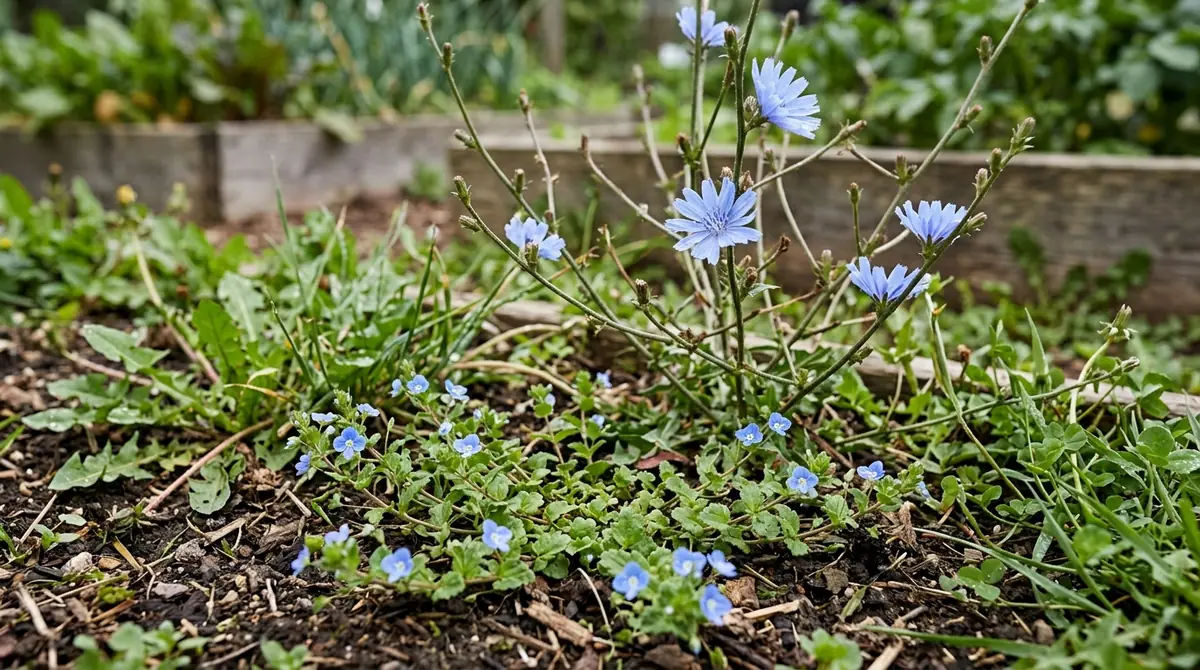
I was flat on my stomach in a gardener's newly terraced perennial border in upstate New York, staring down a carpet of deceptively charming sky-blue blossoms, when I realized we were fighting a losing battle with Veronica persica. The homeowner had spent hundreds of dollars on cultivar salvias, yet Persian speedwell had seeded in from the neighboring fallow field, its shallow, fibrous roots anchoring it firmly into the poorly amended clay. In landscape design, blue flowers are fiercely coveted for their cool, receding aesthetic—yet in the realm of weed identification, those same cerulean and violet petals often signal opportunistic invaders that can outcompete your carefully curated plantings if you do not understand their life cycles.
1. Botanical Overview & Natural Habitat

The primary culprits typically fall into a few distinct families: Boraginaceae (the Borage family), Lamiaceae (the Mint family), and Asteraceae (the Aster family).
Consider Chicory (Cichorium intybus), a ubiquitous roadside invader. It features striking, bright blue, dandelion-like ray flowers on tough, grooved stems that can easily reach 3 to 5 feet (90 to 150 cm) in height. Its basal leaves are deeply lobed, resembling a dandelion, but its woody taproot can plunge down 36 inches (90 cm) or more into the soil profile.
Another frequent invader is Asiatic Dayflower (Commelina communis), belonging to the Commelinaceae family. It is instantly identifiable by its irregular, mouse-ear-like blossoms sporting two vibrant blue upper petals and one inconspicuous white lower petal. Its stems are succulent, rooting freely at the nodes wherever they touch moist soil, which makes mechanical pulling notoriously frustrating if every fragment is not retrieved.
Ground Ivy, also known as Creeping Charlie (Glechoma hederacea), creeps through shady turfgrasses and garden beds with square stems (a dead giveaway for the mint family) and scalloped, kidney-shaped leaves. Its funnel-shaped, bluish-purple flowers emerge in small clusters from leaf axils, usually in early spring when soil temperatures hover around 50°F to 55°F (10°C to 13°C).
For a deeper dive into regional weed management strategies and accurate identification keys, I frequently direct growers to the Cornell University Weed Ecology and Management Lab for localized extension data.
2. Essential Environmental & Care Requirements
Understanding what helps these weeds thrive is the most effective way to eliminate them. Because "weed" is simply a human designation for a plant growing where it is not wanted, these blue-flowering species are biological opportunists equipped with aggressive environmental adaptations.
Most blue-flowering weeds are indicators of specific soil conditions. Creeping Charlie and Veronica species heavily favor damp, compacted soils with low organic matter and high shade, thriving in pH ranges from 6.0 to 7.0. Conversely, Chicory and Viper's Bugloss (Echium vulgare) revel in poor, well-drained, gravelly soils under blazing full sun, where native perennials might struggle to establish.
| Parameter | Optimal Condition | Common Mistake | Why It Matters |
|---|---|---|---|
| Soil Moisture | Variable; many prefer moist, poorly drained sites | Overwatering surrounding landscape beds | Stimulates shallow root branching in species like Commelina communis |
| Light Exposure | Full sun to partial shade (species dependent) | Leaving canopy dense over shade-tolerant weeds | Allows plants like Glechoma hederacea to dominate turf under trees |
| Soil Compaction | High bulk density, low aeration | Neglecting core aeration in turf and borders | Creates the exact pneumatic conditions that favor taprooted weeds like Chicory |
| Soil pH | 6.0 – 7.5 | Applying lime blindly without a soil test | Can inadvertently lock out nutrients for ornamentals while feeding opportunistic weeds |
If you want to understand the physiological tolerance of these plants under stress, consult the Royal Horticultural Society Weed Control Guidelines for rigorous, scientifically backed control frameworks.
💡 Pro-Tip: When dealing with weeds that possess creeping stems or runners, such as Glechoma hederacea, standard weeding by hand often leaves microscopic nodes behind. Instead of pulling upward, loosen the soil 2 inches (5 cm) deep with a hori-hori knife and slide it underneath the runner to lift the entire root network horizontally.
3. Step-by-Step Cultivation, Feeding & Propagation
While you are certainly not trying to cultivate weeds, understanding how they propagate and spread is the secret to eradicating them from your landscape designs. When unwanted blue-flowering weeds take over, your control protocol must interrupt their reproductive cycle before seed set.
- Map and Monitor (Days 1–7): Inspect your landscape in early spring when soil temperatures reach 45°F (7°C). Identify whether your blue weed is an annual (like Asiatic Dayflower), a biennial (like Chicory in its first vegetative year), or a perennial (like Creeping Charlie).
- Exhaust the Seed Bank (Days 8–14): For annuals and biennials, apply a pre-emergent organic corn gluten meal at a rate of 20 lbs per 1,000 square feet (approx. 1 kg per 10 square meters) in early spring before weed seeds germinate.
- Mechanical Extraction (Days 15–30): Target taprooted species like Chicory when the soil is damp after a heavy rain of at least 1 inch (2.5 cm). Insert a root-weeder tool straight down at a 45-degree angle 3 inches (7.5 cm) away from the crown to sever the taproot below the growth node.
- Deplete Stoloniferous Weeds (Days 31–60): For creeping perennials, apply a targeted iron-chelate selective herbicide or smother the area with a 3-inch (7.5 cm) layer of shredded hardwood mulch over cardboard sheet-mulching to block 100% of photosynthetically active radiation.
- Establish Competitor Planting (Days 61–90): Immediately fill bare soil voids with dense, desirable groundcovers or turfgrass seeded at a rate of 4 lbs per 1,000 square feet (2 kg per 100 square meters) to eliminate the ecological niche the weeds exploited.
⚠️ Important Caution: Never compost weeds with mature blue flowers or viable seed heads in a cold compost pile. Many weed seeds remain viable even after enduring internal pile temperatures of 110°F (43°C); municipal green waste or bagged landfill disposal is safer for heavily seeded specimens.
4. Common Problems, Pests & Troubleshooting
Even when attempting to remove weeds, landscape designers and gardeners frequently run into frustrating roadblocks. Here is how to diagnose and solve them:
- Symptom: You pulled up a patch of Asiatic Dayflower, but within two weeks, a denser carpet has returned.
- Cause: Fragmented succulent stems left on top of damp soil have successfully rooted at every single node.
- Solution: Stop surface pulling. Use a flame cultivator or a localized post-emergent spray containing horticultural vinegar (20% acetic acid) on a windless day when ambient temperatures are above 70°F (21°C).
- Symptom: Chicory plants keep returning in the exact same gravel pathway year after year despite hand-pulling.
- Cause: The remaining 1 to 2 inches (2.5 to 5 cm) of the broken taproot has regenerated new adventitious shoots from dormant subsurface buds.
- Solution: Dig down a full 8 inches (20 cm) with a sharp spade to excise the entire crown, or apply a systemic herbicide containing glyphosate directly to the freshly cut stem surface immediately after slicing it off at ground level.
- Symptom: Blue-flowered weeds are thriving inside a dense shrub border where you cannot safely spray herbicides.
- Cause: Excessive overhead watering and thin mulch layers are creating moist, unshaded pockets of bare earth.
- Solution: Switch from overhead sprinklers to drip irrigation emitters placed directly at the base of your desired shrubs, and deepen your organic mulch layer to a strict 3 inches (7.5 cm), keeping it 2 inches (5 cm) away from woody stems.

5. Frequently Asked Questions
What is the most common weed with small blue flowers in lawns?
The most frequent offender is Creeping Charlie (Glechoma hederacea). It forms dense mats in lawns and gardens, sporting small, funnel-shaped, bluish-purple flowers and scalloped leaves on square stems. It thrives in damp, shady areas with compacted soils.
Are weeds with blue flowers poisonous to dogs and cats?
It depends on the specific species. While plants like Chicory are generally considered non-toxic and are even consumed by humans, others like Viper's Bugloss contain pyrrolizidine alkaloids that can cause liver damage if ingested in large quantities by pets or livestock. Always verify the exact binomial nomenclature before letting grazing animals near unknown weeds.
How do I get rid of chicory permanently?
Because Chicory grows a deep, thick taproot, pulling it by hand rarely works unless the soil is thoroughly saturated. To eliminate it permanently, dig out the root crown at least 4 to 6 inches (10 to 15 cm) below the soil surface using a spade, or treat the rosette with a systemic herbicide during its active growth phase in late spring.
Why do blue-flowered weeds suddenly appear in my mulch?
Mulch often acts as a transport medium for dormant weed seeds if it was improperly composted or sourced from sites with heavy weed pressure. Furthermore, wind and birds frequently drop seeds onto fresh, nutrient-rich mulch beds where they find ideal germination conditions during spring rains.
Related Guides
- Best Tools for Removing Deep Rooted Garden Weeds
- Hibiscus Edible Flowers
- Why Are My Peace Lily Flowers Green
- What Zone is Ohio for Planting Flowers
📋 Table of Contents ▼ Click to expand
Tags:
Keep reading
🌿 Related Plants You Might Like






PlantSavvyWorld
Editorial team
PlantSavvyWorld is an independent botanical education project. Articles are drafted with AI assistance, then edited and checked against university extension services, botanical garden collections and other published horticultural sources.