Written with AI assistance, edited and checked against horticultural sources.
My thumb was jammed against the unforgiving handle of a cheap, stamped-steel trowel when the tool bent backward at a pathetic 45-degree angle, leaving me kneeling in damp mid-spring soil with half a dandelion taproot still firmly anchored in the earth. It was 5:15 PM on a Tuesday in late April, soil temperatures hovered at a stubborn 52°F (11°C), and I was staring down a three-year-old patch of Taraxacum officinale and Rumex crispus that had colonized my ornamental border. That single mechanical failure cost me two hours of tedious hand-digging and taught me an unforgiving lesson: fighting deep-rooted taproots with generic garden tools is a fool's errand. Over two decades of designing landscapes and studying plant physiology for PlantSavvyWorld, I have tested every weed-removal contraption on the market. Below is my definitive, field-tested guide to the absolute best tools for removing deep-rooted garden weeds once and for all.
1. Botanical Overview & Natural Habitat
To select the correct mechanical weapon against persistent weeds, you must first understand the enemy's structural biology. Deep-rooted weeds are broadly categorized into two groups: taprooted broadleaves and aggressive perennial grasses or vines with subterranean storage structures.
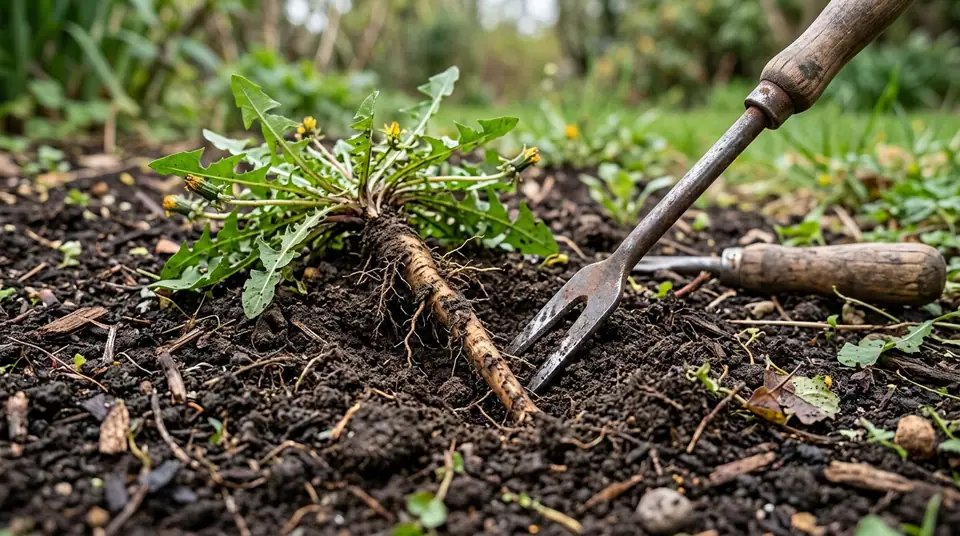
Dandelion weed with a long taproot lying in garden soil next to a weeding fork
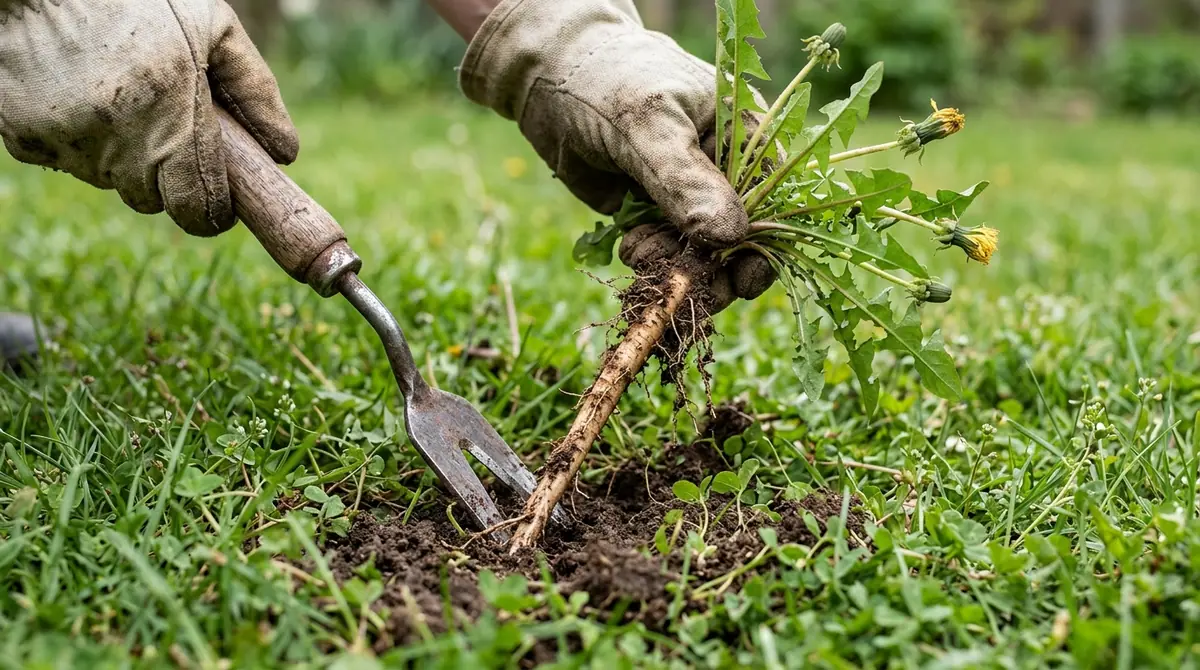
Taprooted species such as dandelions (Taraxacum officinale), curly dock (Rumex crispus), and burdock (Arctium minus) develop a primary vertical root designed for two critical evolutionary functions: energy storage and deep water access. During their first growing season, these species drive a central axis straight downward into the earth. In compacted clay or loamy garden beds, a mature taproot can easily reach depths of 8 to 12 inches (20 to 30 cm), and under drought stress, certain specimens will plunge down to 24 inches (60 cm) or more in search of moisture tables.
Simultaneously, plants like Canada thistle (Cirsium arvense) and field bindweed (Convolvulus arvensis) employ a dual system: a deep vertical taproot paired with horizontal creeping roots known as rhizomes. If you snap a taproot at a depth of 3 inches (7.5 cm) during routine hoeing, any remaining root fragment sitting deeper than 4 inches (10 cm) retains dormant adventitious buds. Within 14 to 21 days, these hidden nodes will generate multiple brand-new shoots, turning a single weed into a dense cluster. Understanding this physiological reality shifts our strategy from surface-level scraping to absolute extraction of the entire root architecture. When designing resilient planting beds—much like planning for infrastructure clearances such as selecting 15 Best Trees for Driveways That Won't Crack Concrete to avoid sub-surface disruption—subterranean spatial awareness is non-negotiable.
2. Essential Environmental & Care Requirements
Tool selection is entirely dependent on soil moisture and structural composition. If you attempt to use a heavy-duty stainless steel weed popper in bone-dry soil compacted to a bulk density above 1.4 g/cm³, you will either snap your tool handle or shatter the root, leaving the vital growing tip underground.
To maximize the efficiency of mechanical weed removal, certain environmental parameters must be met prior to stepping foot into the garden.
Parameter
Optimal Condition
Common Mistake
Why It Matters
Soil Moisture
60% field capacity (damp, friable loam)
Pulling in bone-dry soil or waterlogged mud
Dry soil grips taproots tightly; wet soil causes root breakage and severe compaction.
Soil Temperature
55°F to 70°F (13°C to 21°C)
Weeding during hard freezes or extreme summer heat
Moderate temperatures encourage root expansion without triggering rapid re-sprouting from stress nodes.
Timing
24–48 hours post soaking rain or deep irrigation
Weeding during high noon sun
Post-irrigation soil lubricates the root channel, allowing the entire structure to slide out cleanly.
Tool Material
Forged stainless steel or high-carbon steel
Using cast aluminum or stamped sheet metal
Forged steel handles torque exceeding 30 ft-lbs without bending or shearing at the neck.
💡 Pro-Tip: Always time your deep-root weeding sessions for the morning hours when plant turgor pressure is highest. Crisp, fully hydrated roots are brittle and less likely to stretch and snap when leverage is applied.
While we are discussing eradication rather than traditional cultivation, approaching weed removal with a systematic, horticultural protocol ensures permanent results rather than temporary suppression. Follow this five-step extraction sequence to completely clear deep-rooted invaders.
Assess and Hydrate: Inspect the target weed zone. If natural rainfall has not occurred within the past 7 days, apply 1 inch (2.5 cm) of water via drip irrigation or soaker hoses 24 hours prior to extraction to saturate the soil profile down to a depth of 10 inches (25 cm).
Select the Proper Tool: Match the weed species to your implement. For solitary, thick taproots like dock or dandelion, deploy a long-shafted, forged-steel dandelion digger (often called a 'gout weed fork') or a stand-up lever-action weed puller. For densely tangled perennial weeds in mixed borders, use a Japanese hori hori knife.
Insert at the Correct Angle: Position your tool 1 to 2 inches (2.5 to 5 cm) away from the crown of the weed. Push the blade straight down parallel to the main taproot to a depth of at least 6 to 8 inches (15 to 20 cm), ensuring you bypass the structural choke point where the stem meets the root.
Apply Controlled Leverage: Use the fulcrum of the tool (such as an integrated curved neck or a wooden block placed under the tool head) to lift upward smoothly. Apply steady, continuous pressure rather than a sudden jerk, which causes the root to snap mid-shaft.
Inspect and Extract Fragments: Pull the loosened weed gently from the soil. Examine the extracted root tip: if it terminates in a clean point, you have successfully removed the entire organism. If the end is ragged, use your hori hori knife to probe the remaining hole and extract any lingering lower segments.
For comprehensive insights on managing subterranean depths and soil profiles, consult academic resources like the Royal Horticultural Society weed management guidelines.
4. Common Problems, Pests & Troubleshooting
Even the finest weed-removal tools present challenges when deployed incorrectly or under adverse soil conditions. Here is how to diagnose and correct common extraction failures.
Problem: The taproot snaps cleanly at a depth of 4 inches (10 cm), leaving the lower half intact.
Cause: Soil was too dry, or the tool was inserted too close to the stem, cutting the root instead of prying around it.
Solution: Immediately drive a soil knife or narrow trowel down alongside the remaining root fragment to excavate the lower bulb before it can send up secondary shoots.
Problem: Lever-action stand-up weeders leave massive 3-inch-wide craters in the lawn or garden bed.
Cause: Using a tined claw puller in loose soil or applying excessive foot pressure on the leverage pedal.
Solution: Switch to a narrow-bladed hand tool like a hori hori for delicate perennial beds, reserving stand-up pullers strictly for broad lawn areas where back-filling with topsoil is easy.
Problem: Weeds return with renewed vigor in the exact same spot 14 days after removal.
Solution: Apply a 3-inch (7.5 cm) layer of organic compost topped with shredded bark mulch immediately after weeding to smother any microscopic lingering root buds by blocking light penetration.
⚠️ Important Caution: Never place deep-rooted perennial weeds containing viable taproots or seed heads into a cold backyard compost pile. Internal pile temperatures rarely sustain the 140°F (60°C) required for 14 consecutive days to kill weed seeds and dormant root crowns; instead, bag them for municipal green waste collection.
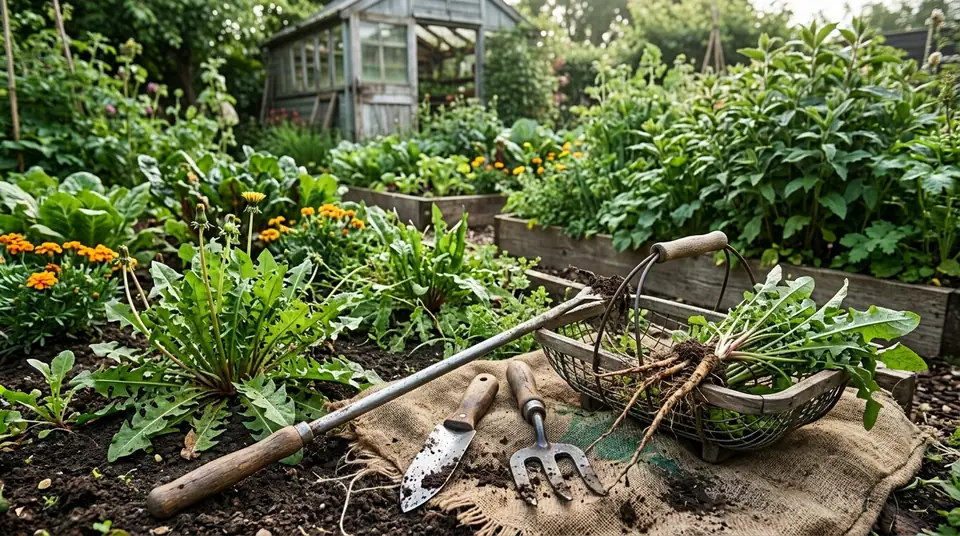
Weeding tools and a basket of uprooted dandelions in a garden
5. Frequently Asked Questions
What is the single best tool for removing dandelions and thistle with deep taproots?
The forged-steel Japanese hori hori knife is the most versatile and effective hand tool for deep-rooted weeds. Its concave, serrated blade slices through dense soil and lateral roots while reaching up to 7 inches (18 cm) straight down to sever or extract the main taproot intact. For gardeners with back mobility issues, a stand-up 4-claw lever weed puller with a foot pedal offers excellent extraction depth without requiring kneeling.
Should I pull weeds when the soil is wet or dry?
You should always pull deep-rooted weeds when the soil is damp, ideally 24 to 48 hours after a thorough soaking rain or deep irrigation. Pulling weeds in dry soil causes the brittle taproot to snap, leaving the lower portion behind to regenerate. Conversely, pulling in mud causes structural soil compaction and strips the soil away from the root without providing clean leverage.
How do I stop deep taproot weeds from growing back after I pull them?
Prevention requires removing at least the top 6 inches (15 cm) of the taproot to eliminate all dormant growing nodes. Once the weed is removed, immediately cover the bare patch with a pre-emergent organic mulch layer at least 3 inches (7.5 cm) deep. For persistent patches, solarization using clear UV-stabilized polyethylene sheeting for 6 to 8 weeks during peak summer temperatures of 85°F (29°C) or higher will sterilize remaining root fragments.
Are chemical weed killers better than manual hand tools for deep roots?
Systemic herbicides like glyphosate translocate down to the root tips, but they pose significant environmental risks to beneficial soil microbiomes, pollinators, and nearby ornamental plantings. Manual tools provide targeted, immediate extraction without chemical runoff or collateral damage. For established garden beds, high-quality mechanical tools paired with consistent mulching yield superior, long-term ecological results.
PlantSavvyWorld is an independent botanical education project. Articles are drafted with AI assistance, then edited and checked against university extension services, botanical garden collections and other published horticultural sources.