

How to Keep Rabbits Out of the Garden 5 Humane Solutions That Work
Written with AI assistance, edited and checked against horticultural sources.
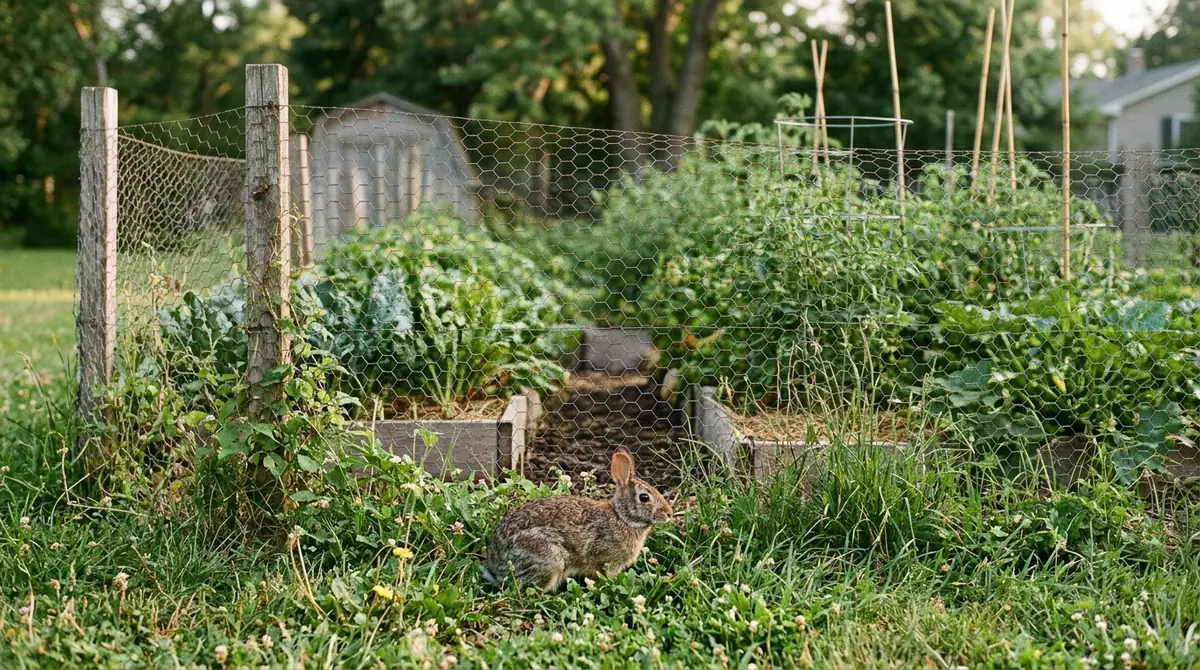
It was 5:45 AM on a brisk June morning when I stepped onto my back patio with a freshly brewed cup of coffee, only to watch a plump eastern cottontail casually hop away from my prized heirloom 'Brandywine' tomato plants. Half the foliage was stripped bare, and my lowest, reddest fruit had a neat, incisor-cut crater taken right out of its side. I felt that familiar mix of botanical grief and professional challenge. Rabbits are relentless, adorable little nibblers, but they can decimate a growing season in a single weekend. I have tested dozens of deterrents, and I am here to share the five most effective, strictly humane strategies that protect your harvest without harming a single whisker.
1. Botanical Overview & Natural Habitat

Rabbits have panoramic vision spanning nearly 360 degrees, allowing them to spot predators from almost any angle, but they have a distinct blind spot directly in front of their noses. Their dental formula is specialized for shearing: two pairs of sharp upper incisors (with a smaller pair hiding right behind the front ones) that continuously grow throughout their lives at a rate of roughly 0.04 inches (1 mm) per week. This biological imperative to wear down their teeth is why they make clean, angled 45-degree cuts on tender plant stems rather than tearing them like deer do.
In a natural habitat, rabbits forage primarily during crepuscular hours—dawn and dusk—though urban and suburban populations adapt quickly to human schedules, venturing out on overcast days or warm nights when temperatures hover between 55°F and 75°F (13°C to 24°C). Their home ranges are remarkably small, typically spanning just 2 to 7 acres. If your garden sits within that radius, you are not dealing with a rotating cast of forest wildlife; you are hosting local residents who view your raised beds as their personal, year-round farm-to-table bistro.
2. Essential Environmental & Care Requirements
To successfully outsmart rabbits while maintaining a thriving ecosystem, you must balance plant health with structural exclusion zones. The table below outlines the environmental parameters and structural thresholds required to keep your garden resilient against rabbit pressure.
| Parameter | Optimal Condition | Common Mistake | Why It Matters |
|---|---|---|---|
| Barrier Depth | 6 to 12 inches (15 to 30 cm) underground | Laying fence purely on the surface | Rabbits are exceptional diggers and will readily burrow underneath standard fencing. |
| Fence Mesh Size | Maximum 1 inch (2.5 cm) grid | Using 2x4 inch welded wire | Juvenile rabbits can squeeze through any opening larger than 1.5 inches. |
| Repellent Application | Every 7 to 10 days, post-rain | Applying once and forgetting it | Weather degrades scent and taste deterrents rapidly; reapplication maintains efficacy. |
| Buffer Zone Width | 3-foot (0.9 m) gravel or mulch strip | Planting dense ground cover up to beds | Rabbits dislike crossing open, exposed terrain where they feel vulnerable to aerial predators. |
| Scentscape Diversity | Alternating sulfur and capsaicin bases | Relying on a single scent profile | Rabbits habituate quickly to recurring chemical profiles if not rotated seasonally. |
💡 Pro-Tip: When selecting mulch for your garden perimeter, swap out shredded bark for sharp, angular pea gravel or crushed stone in a 3-foot (0.9 m) band around your raised beds. Rabbits hate the unstable, uncomfortable texture under their sensitive paw pads and will actively choose to detour away from your plot.
3. Step-by-Step Cultivation, Feeding & Propagation
Implementing humane rabbit control requires a systematic, multi-layered approach. You cannot rely on a single fix; instead, you must construct a defensive matrix that makes your garden unappealing, inaccessible, and intimidating. Here is how to execute the 5 core humane solutions in a logical sequence.
- Install Hardware Cloth Sub-Surface Barriers: Excavate a trench 8 inches (20 cm) deep around your garden perimeter or individual raised beds. Insert 19-gauge vinyl-coated hardware cloth (with a 1/2-inch mesh) so that 24 inches (60 cm) remains above ground and 8 inches (20 cm) bends outward at a 90-degree angle at the bottom of the trench. Backfill the trench firmly. This stops both climbers and diggers dead in their tracks.
- Deploy Strategic Interplanting and Companion Defense: Surround your vulnerable brassicas, beans, and lettuces with unpalatable botanical buffers. Interplant strong-smelling herbs like rosemary, lavender, and thyme, alongside alliums like chives and garlic. Rabbits despise volatile aromatic oils and sulfur compounds, making these borders a natural olfactory shield. For deeper insights into companion plant resilience, consult the RHS Companion Planting Guide.
- Apply Rotational Liquid and Granular Repellents: Spray foliage with a homemade or commercial deterrent containing putrescent egg solids, garlic, or capsaicin. Apply every 7 days during periods of active plant growth, and always reapply after a heavy rainfall exceeding 0.5 inches (1.3 cm). Rotate between taste-based (spicy) and scent-based (sulfurous/predator urine) formulas every three weeks to prevent olfactory habituation.
- Construct Physical Row Covers and Cloches: During the vulnerable early seedling stage—when plants are under 4 inches (10 cm) tall—cover crops with lightweight floating row covers supported by PVC hoops. Secure the edges completely with landscape staples or heavy stones spaced no more than 12 inches (30 cm) apart.
- Incorporate Motion-Activated Psychological Deterrents: Install a solar-powered, motion-activated sprinkler or ultrasonic noise emitter near primary rabbit entry points. The sudden burst of water or high-frequency sound mimics the startle response of a predator, conditioning the rabbits to associate your garden zone with immediate danger without causing them physical harm.
⚠️ Important Caution: Never use chemical poisons or snap traps intended for larger vertebrate pests. Not only are they intensely cruel and ecologically devastating to beneficial non-target wildlife, but poisoned rabbits also pose a secondary poisoning risk to neighborhood raptors, foxes, and domestic pets.
4. Common Problems, Pests & Troubleshooting
Even with robust defenses in place, you may encounter subtle breaches in your rabbit-management system. Diagnosing the issue quickly saves your harvest.
- Symptom: Clean, diagonal 45-degree cuts on stems 2 to 6 inches (5 to 15 cm) off the ground.
- Diagnosis: Rabbit browsing. Deer leave ragged, torn edges because they lack upper incisors, whereas rodents leave clean architectural bevels.
- Symptom: Plants vanishing entirely overnight without a trace of foliage or stems left behind.
- Diagnosis: Voles or mice rather than rabbits. While rabbits graze on top growth, small subterranean rodents often pull entire seedlings down into their burrows or tunnel directly underneath the root zone.
- Symptom: Repellents suddenly stop working after a month of perfect protection.
- Diagnosis: Olfactory habituation. Rabbits have realized the scent does not correlate with actual physical danger. Time to rotate your active ingredients from putrescent egg solids to a hot pepper extract.
- Symptom: Plants inside a fenced zone are still being chewed down.
- Diagnosis: Gaps in your mesh perimeter exceeding 1.5 inches (3.8 cm), or low-hanging branches from nearby trees allowing wildlife to drop directly into the interior of the garden.

5. Frequently Asked Questions
What smells do rabbits hate the most?
Rabbits are extremely sensitive to pungent, volatile organic compounds. They intensely dislike the smell of garlic, crushed onions, rotting eggs (putrescent egg solids), fresh blood meal, strong mints, and spicy capsaicin oils. Planting lavender, marigolds, and rosemary around your perimeter adds an extra layer of fragrant confusion to their scent receptors.
Will coffee grounds keep rabbits out of the garden?
Sprinkling used coffee grounds can offer a mild, short-term deterrent due to their strong aroma and rough texture, but they are not a reliable standalone solution. Once the grounds dry out or are washed away by irrigation, their scent fades rapidly. Furthermore, adding excessive coffee grounds directly to planting beds can alter soil pH and hinder nitrogen availability, so use them sparingly.
How high does a fence need to be to keep rabbits out?
Unlike deer, rabbits are not high jumpers; they rarely clear vertical obstacles taller than 24 inches (60 cm) unless startled or chased. A 2-foot fence is generally sufficient for exclusion, provided the bottom is securely anchored underground to prevent tunneling. However, if you also contend with hares or mixed wildlife pressure, a 3-foot fence offers a safer margin.
Do ultrasonic rabbit repellers actually work?
Ultrasonic devices that emit high-frequency sound waves can offer temporary relief, but their real-world efficacy is mixed. Rabbits, like many animals, adapt quickly to predictable environmental noises, especially if food motivation is high. For best results, pair ultrasonic units with motion-activated sprinklers and physical barriers rather than relying on sound alone.
Related Guides
📋 Table of Contents ▼ Click to expand
Tags:
Keep reading
🌿 Related Plants You Might Like



PlantSavvyWorld
Editorial team
PlantSavvyWorld is an independent botanical education project. Articles are drafted with AI assistance, then edited and checked against university extension services, botanical garden collections and other published horticultural sources.