

Chinese Money Plant
Pilea peperomioides
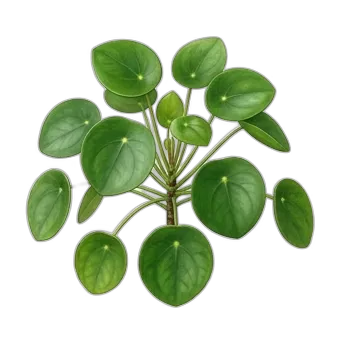
I watched my first Pilea peperomioides drop half its coin-shaped leaves in a single drafty October week back in 2014, simply because I treated it like a standard tropical fern. It wasn’t until I examined its native limestone crevices in the Yunnan province that I realized this plant demands bright, indirect exposure and lean, well-draining soil rather than a swampy, dark corner. Today, I see the Chinese Money Plant in countless modern interiors—often thriving, just as frequently struggling against over-watering and low light.

1. Botanical Overview & Natural Habitat
Pilea peperomioides belongs to the Urticaceae (nettle) family, though you will find no stinging hairs here. Native to the damp, shaded limestone cliffs of the Sichuan and Yunnan provinces in southern China, this perennial succulent-like evergreen evolved to grip vertical rock faces where water drains instantly and air circulation is constant.
Discovered for Western science by Scottish botanist George Forrest in 1912, and later collected by Norwegian missionary Agnar Espegren in 1946 (who brought cuttings back to Scandinavia, sparking the European common name "Missionary Plant"), the species features distinct peltate leaves. A peltate leaf attaches its petiole to the underside of the lamina rather than the edge, creating that iconic flat, coin-like green disc that earned it the moniker "Chinese Money Plant" or "Pancake Plant."
In a mature indoor setting, Pilea peperomioides reaches a height and spread of 12 to 16 inches (30 to 40 cm). The central woody stem thickens over time, shedding its lowest leaves to reveal a distinctive trunk reminiscent of a miniature palm. Tiny, non-showy white or pale pink flowers occasionally emerge on branching panicles under intense indoor or cool winter conditions, though indoor specimens are primarily grown for their architectural foliage. For growers interested in other unique growth habits and trailing tropical flora, you might also enjoy our deep-dive on the Lipstick Plant (Aeschynanthus Radicans) Complete Care & Bloom Guide.
2. Essential Environmental & Care Requirements
Replicating a Himalayan limestone cliff inside a modern living room requires attention to four primary environmental factors: light, substrate drainage, temperature, and atmospheric moisture.
Light
Provide bright, indirect sunlight for 6 to 8 hours daily. An east-facing window or a spot two feet back from a south- or west-facing window is ideal. Direct, unfiltered afternoon sun will scorch the peltate leaves, bleaching them white or burning brown, necrotic patches into the center of the lamina. Conversely, low light causes leggy, stunted growth, downward-cupped leaves, and loss of the dense, bushy rosette form.
Substrate and Potting Depth
Because of its cliff-dwelling ancestry, the root system hates sitting in heavy, saturated media. Use a fast-draining potting mix composed of 50 percent standard indoor potting soil, 25 percent perlite or pumice, and 25 percent orchid bark or coarse sand. When repotting, ensure the crown sits level with the soil surface; burying the stem too deep invites stem rot, while planting too shallow leaves the structural root ball exposed. For a better understanding of how container depth impacts root architecture across different species, compare this with our guide on How Deep Do Pepper Plant Roots Go? Pot Size & Substrate Depth Guide.
Temperature and Airflow
Maintain ambient temperatures between 60°F and 75°F (15°C to 24°C). Temperatures dropping below 50°F (10°C) will trigger dormancy or shock, leading to rapid defoliation. Keep the plant away from drafty windows, air conditioning units, and heating vents. Good horizontal air movement prevents fungal leaf spots and strengthens the central stem against lodging.
| Parameter | Optimal Condition | Common Mistake | Why It Matters |
|---|---|---|---|
| Light | Bright, indirect light (6–8 hours/day) | Direct afternoon sun or deep shade | Prevents leaf scorching while maintaining compact, symmetrical growth |
| Watering | Soak-and-dry method (top 2 inches dry) | Keeping soil constantly damp | Prevents Pythium and Phytophthora root rots common in dense media |
| Substrate | 50% soil, 25% perlite, 25% bark | Heavy peat-based mixes without aeration | Mimics natural cliffside drainage and ensures oxygen reaches the roots |
| Temperature | 60°F–75°F (15°C–24°C) | Exposure to drafts under 50°F (10°C) | Avoids cold-shock and sudden, stress-induced leaf drop |
💡 Pro-Tip: Rotate your Pilea peperomioides 90 degrees every single week. Because their peltate leaves act like solar panels tracking the brightest light source, they will rapidly lean sideways. Regular rotation is the only way to maintain a straight, upright central stalk without staking.
3. Step-by-Step Cultivation, Feeding & Propagation
Propagation is where the Chinese Money Plant truly earns its moniker of the "Pass-It-On Plant." It naturally produces subterranean runners (stolons) that sprout baby plantlets around the base of the mother plant or directly through the potting soil.
Step-by-Step Propagation Protocol
- Select a Healthy Pup: Allow the basal offshoot (pup) to reach a height of at least 2 to 3 inches (5 to 7.5 cm) and develop 4 to 6 functional leaves. Smaller pups lack the carbohydrate reserves to root successfully on their own.
- Expose the Soil Line: Gently brush away the top 1 inch (2.5 cm) of potting mix around the base of the pup to locate its attachment point to the main underground stolon or root system.
- Make a Clean Cut: Using a disinfected razor blade or horticultural snips sterilized in 70% isopropyl alcohol, sever the pup as close to the main stem or parent stolon as possible without damaging the mother plant. Ensure you capture at least a fraction of tiny root fibers if they have already formed.
- Treat the Wound: Allow the cut surface of the pup to callus over in a shaded, dry area for 12 to 24 hours. This prevents soil pathogens from entering the fresh tissue.
- Plant in Specialized Media: Plant the callused pup into a small 3-inch (7.5-cm) terra cotta pot filled with a pre-moistened mix of equal parts perlite and peat-free potting soil. Plant it to the exact depth it grew next to the mother plant.
- Create a High-Humidity Environment: Enclose the pot in a clear plastic bag or propagation dome for 14 days to maintain high relative humidity while roots establish. Open the bag for 30 minutes daily to prevent mold growth.
- Transition to Ambient Air: Once new top growth appears—typically within 21 to 28 days—remove the humidity cover and begin normal watering protocols.
Feeding Schedule
Feed your Chinese Money Plant with a balanced, water-soluble liquid houseplant fertilizer diluted to half-strength once every 4 weeks during the active growing season (spring through summer). Cease fertilization entirely from November through February when natural daylight hours drop and the plant enters a semi-dormant resting phase. For authoritative insight on general indoor plant nutrition and physiological care, consult the Royal Horticultural Society (RHS).
⚠️ Important Caution: Never over-fertilize in an attempt to speed up growth. Excess salts in the substrate will burn the delicate root tips, resulting in brown leaf margins, stunted growth, and eventual root collapse. Always water the soil thoroughly before applying liquid fertilizer to protect the root system.
4. Common Problems, Pests & Troubleshooting
Even with meticulous care, indoor environments present unexpected variables. Here is how to diagnose and correct common stress responses in your Pilea peperomioides.
Lower Leaves Turning Yellow and Dropping
Natural aging causes the lowest, oldest leaves on the main trunk to turn completely yellow and drop off, leaving a woody stem. However, if multiple leaves yellow simultaneously, you are likely over-watering or the soil is retaining moisture for too long. Check the root ball; trim away any black, mushy, foul-smelling roots with sterilized shears, and repot into fresh, dry, fast-draining media.
Leaves Cupping Downward or Curling
When peltate leaves cup inward like miniature bowls, it is usually a physiological response to inadequate light intensity or thermal stress from a nearby heating vent. Move the plant closer to an unobstructed window and shield it from hot or cold drafts. For outdoor gardeners looking at seasonal climatic transitions, adjustments in positioning are equally vital—similar to planning schedules found in resources like When to Plant Strawberries in Kansas: Zone 6a/6b Seasonal Calendar or regional updates like When to Plant Onions in Southern California (Zone 9 & 10 Planting Calendar).
White Crust on Leaf Undersides or Pot Rim
If you notice small, crystalline white dots on the underside of the leaves or ringing the edge of your terracotta pot, do not panic. These are harmless mineral deposits of calcium and magnesium excreted by specialized water-stoma (hydathodes) after absorbing hard tap water. Switch to filtered or rainwater to eliminate the buildup, and gently wipe the leaves with a damp microfiber cloth.
Pests: Mealybugs and Spider Mites

5. Frequently Asked Questions
Why is my Chinese Money Plant losing its lower leaves?
Natural lower leaf drop is a normal part of the plant's growth habit as it matures and develops its woody central trunk. However, if leaves are turning yellow and dropping rapidly in large numbers, it indicates over-watering, poor drainage, or insufficient light. Allow the top 2 inches (5 cm) of soil to dry out completely between watering sessions.
How often should I water my Pilea peperomioides?
Water your plant thoroughly only when the top 2 inches (5 cm) of the soil is completely dry to the touch. In standard indoor home environments (65°F to 72°F / 18°C to 22°C), this typically translates to every 7 to 10 days during spring and summer, and every 14 to 21 days during the winter months. Always discard any excess water that collects in the saucer after 15 minutes to prevent root rot.
Can I grow a Chinese Money Plant in low light?
While Pilea peperomioides can survive in lower light conditions temporarily, it will not thrive. In low light, the stems become weak and leggy, the leaves grow smaller and cup downward, and the plant loses its dense, attractive shape. Position it where it receives bright, indirect light for at least 6 hours a day.
How do I make my Chinese Money Plant branch out?
Pilea peperomioides naturally grows as a single-stemmed vertical column with pups emerging from the base. To encourage a bushier appearance, you can plant multiple rooted stems (3 to 4 plants) together in a single container. Pruning the main growing tip is rarely recommended because it can disrupt the plant's apical dominance unpredictably, though it will occasionally force lateral buds to activate along the woody trunk.
📋 Table of Contents ▼ Click to expand
Tags:





