

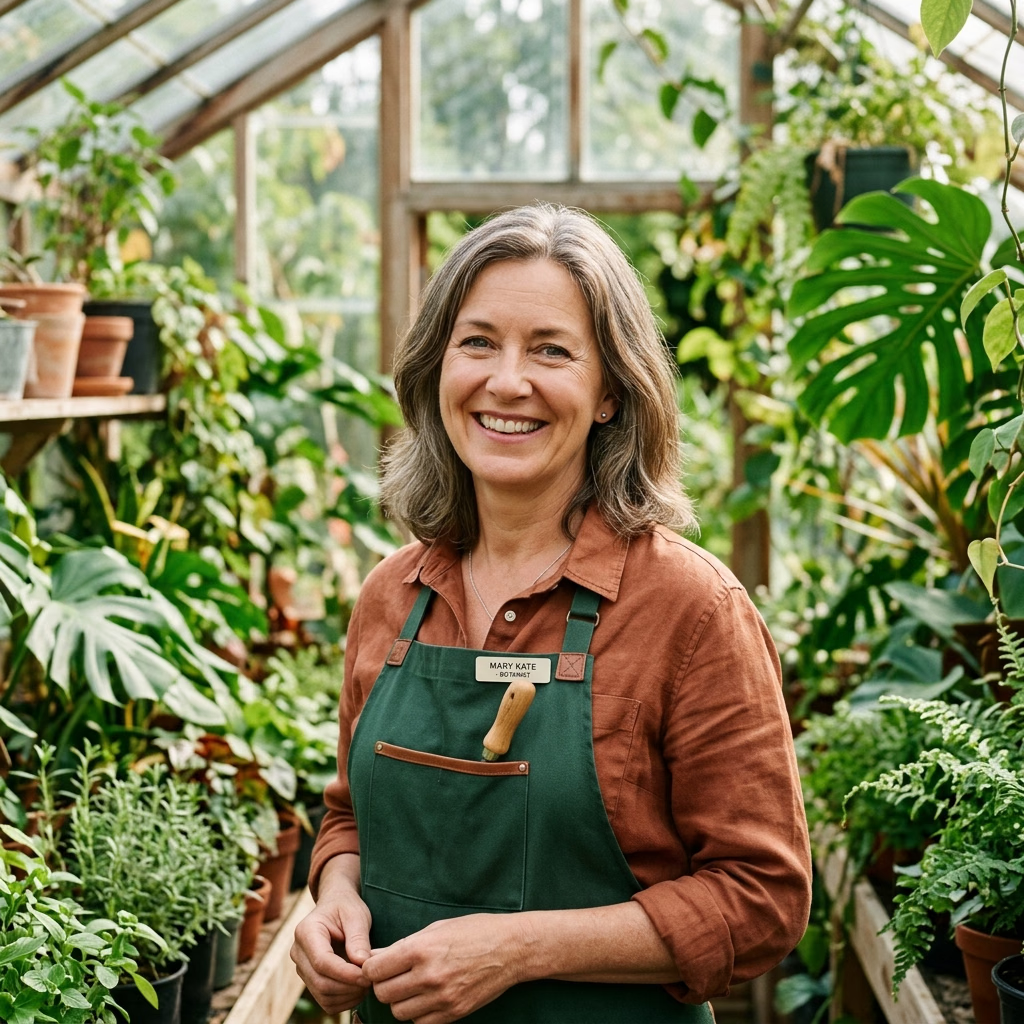
 Mary Kate
I stood knee-deep in red clay at my Charlottesville acreage three springs ago, staring down a row of heirloom beefsteak tomato starts that were refusing to put on vertical growth. The morning air was deceptively balmy at 68°F (20°C), but down at the 2-inch (5-cm) soil mark, the earth was registering a stubborn 48°F (9°C). I had fallen into the classic trap of planting by the calendar rather than reading my hardiness zone's microclimates. Virginia is a wonderfully complex patchwork of growing environments, and understanding how our zones dictate every shovel turn changed my entire landscape design practice.
1. Botanical Overview & Natural Habitat
Virginia spans a remarkable climatic transition zone, shifting dynamically from the coastal plains of the Atlantic to the jagged peaks of the Blue Ridge Mountains. If you are asking what zone Virginia is for planting, the short answer is that the Commonwealth encompasses USDA hardiness zones 5a through 8b, with average annual minimum winter temperatures ranging from -20°F to 20°F (-29°C to -6°C).

In the western high elevations of Highland and Tazewell counties, you will find Zone 5b or 6a, where winter lows dip to -15°F (-26°C). Contrast this with the balmy Eastern Shore and coastal Hampton Roads, sitting securely in Zone 8a and 8b, where winter lows rarely plunge past 15°F (-9°C). The rolling Piedmont region—encompassing Richmond, Charlottesville, and Lynchburg—predominantly occupies Zone 7a and 7b, averaging winter lows between 0°F and 10°F (-18°C to -12°C).
Understanding these zones requires looking at how native plant communities distribute themselves across this gradient. The eastern coastal plain supports maritime forests dominated by Quercus virginiana (Southern Live Oak) and Pinus taeda (Loblolly Pine), which thrive in sandy, well-draining soils with mild winters. Move inland to the Piedmont, and the dominant canopy shifts to Quercus alba (White Oak) and Cornus florida (Flowering Dogwood), adapted to heavy clay subsoils and distinct four-season weather patterns. High up in the Appalachian zones, you encounter montane spruce-fir forests dominated by Picea rubens (Red Spruce), echoing sub-alpine Canadian habitats far to our north.
As a landscape designer, I always tell clients that Virginia's plant geography is dictated as much by summer humidity and relative humidity indices as it is by winter lows. Our mid-summer days frequently hover at 90°F (32°C) with dew points climbing past 70°F (21°C), creating heavy disease pressures that northern zones never experience.
2. Essential Environmental & Care Requirements
Mastering gardening in Virginia demands strict attention to soil composition, moisture management, and frost date tracking. Most of our Piedmont and Valley regions feature Ultisols—heavily weathered red and yellow clays that compact easily, hold moisture aggressively, and turn concrete-hard during July dry spells. Conversely, the Coastal Plain features sandy loam soils that leach nutrients rapidly and require constant organic amendments.
💡 Dr. Mary Kate's Pro-Tip: Never amend planting holes for individual trees or shrubs with rich compost in heavy Virginia clay. Doing so creates a "bathtub effect," where water drains through your loose organic amendment and gets trapped in the surrounding clay basin, ultimately rotting the root ball. Instead, amend a broad, shallow area 3 to 5 times the width of the root ball to encourage lateral root expansion.
Light and water requirements fluctuate wildly based on your specific Virginia sub-region. Coastal gardens face salt spray and sandy drought conditions, requiring tough, salt-tolerant species like Morella cerifera (Wax Myrtle). Mountain gardens face shorter growing seasons—averaging 140 to 160 frost-free days—requiring quick-maturing vegetable cultivars. Meanwhile, Piedmont and Tidewater gardeners enjoy a generous 180 to 210 frost-free days, allowing for extended autumn harvests and double-cropping strategies.
| Parameter | Optimal Condition | Common Mistake | Why It Matters |
|---|---|---|---|
| Soil pH | 6.0 to 6.8 for general perennials; 4.5 to 5.5 for ericaceous plants (azaleas, blueberries) | Assuming all Virginia soil is naturally neutral without testing | Highly acidic or alkaline soil locks out vital macronutrients like phosphorus and iron, causing chlorosis and stunted growth. |
| Soil Temperature for Planting | 60°F to 65°F (15°C to 18°C) for warm-season crops | Planting summer vegetables based on calendar date rather than soil thermistor readings | Seeds and root systems rot in cold, wet spring clay when soil drops below 55°F (13°C). |
| Mulch Application Depth | 2 to 3 inches (5 to 7.5 cm) kept 2 inches away from stems | "Volcano mulching" piled directly against tree trunks and shrub stems | Piling mulch against bark traps moisture, inviting wood-boring insects, fungal pathogens, and rodent nesting. |
| Watering Volume | 1 inch (2.5 cm) of total water per week via rain or deep irrigation | Frequent, shallow surface watering that encourages shallow root development | Deep, infrequent watering forces roots to drive downward into the soil profile to survive summer droughts. |
3. Step-by-Step Cultivation, Feeding & Propagation
Successful cultivation in Virginia relies on timing your interventions with our predictable spring warming trends and brutal summer transitions. Whether you are establishing a perennial border or planting a vegetable plot, follow this rigorous step-by-step protocol.
- Perform a Comprehensive Soil Test: Collect 10 to 15 core samples from your planting bed at a depth of 6 inches (15 cm). Send these to the Virginia Tech Soil Testing Laboratory to determine exact pH and nutrient deficiencies before buying amendments.
- Clear and Broadfork the Bed: Strip existing turfgrass and weeds. If working in heavy Piedmont clay, drive a broadfork vertically into the earth every 6 inches (15 cm) and rock it back and forth to fracture compacted subsoil layers without inverting soil horizons.
- Incorporate Organic Matter: Spread a 2-inch (5-cm) layer of well-rotted leaf mold or compost across the bed surface. Gently work it into the top 4 inches (10 cm) of soil using a garden fork.
- Monitor Soil Temperature: Insert a digital soil thermometer 3 inches (7.5 cm) deep into the soil at 9:00 AM. Wait until consistent readings hit 60°F (15°C) before sowing tender annual seeds or transplanting warm-season starts.
- Dig Proper Planting Holes: Dig holes twice as wide as the root mass but slightly shallower—leaving the top 0.5 inches (1.3 cm) of the root flare exposed above the surrounding grade to account for settling.
- Apply Initial Hydration and Mulch: Water the root ball thoroughly until saturated. Apply a 3-inch (7.5-cm) layer of shredded hardwood bark across the bed, maintaining a clear 2-inch (5-cm) perimeter around plant stems.
- Establish a Feeding Schedule: Feed heavy-feeding perennials and vegetables every 4 to 6 weeks during active growth (April through August) using a balanced, slow-release organic granular fertilizer containing mycorrhizal fungi.
⚠️ Important Caution: Never fertilize trees, shrubs, or perennials in Virginia after August 15th. Late-season nitrogen applications stimulate a flush of tender, succulent new growth that cannot harden off before our first autumn frosts, leaving the plant highly vulnerable to winter kill.
4. Common Problems, Pests & Troubleshooting
Virginia's high summer humidity is the primary catalyst for most plant pathologies in the region. Fungal diseases thrive when stagnant, humid air mixes with morning dew and afternoon thunderstorms.
- Powdery Mildew (Erysiphe spp.): Appears as a white, powdery dusting on the leaves of bee balm, phlox, and crape myrtles. Prevention: Space plants at least 3 feet (1米) apart, prune interior branches to maximize airflow, and water exclusively at the base using drip irrigation rather than overhead sprinklers. Treat active outbreaks with potassium bicarbonate or bio-fungicides containing Bacillus subtilis.
- Japanese Beetles (Popillia japonica): These metallic green pests emerge in late June, skeletonizing the leaves of roses, fruit trees, and hibiscus. Action: Hand-pick beetles early in the morning when they are sluggish and drop them into a bucket of soapy water. Avoid pheromone traps, as they frequently lure more beetles into your garden than they catch.
- Root Rot (Phytophthora spp.): A devastating water mold that attacks plants sitting in poorly drained clay soils after heavy spring rains. Leaves turn yellow, wilt rapidly, and roots appear brown, mushy, and slough off easily. Remedy: There is no chemical cure for established root rot. Remove the infected plant and surrounding soil, improve local drainage by incorporating coarse horticultural grit, and replant with resistant native species.
For localized pest identification and regionally specific management strategies, consult the resources provided by the Virginia Cooperative Extension, which offers incredible publications tailored precisely to our distinct county-by-county conditions.

5. Frequently Asked Questions
What is the average last frost date in Virginia?
The average last spring frost date varies considerably by region. In the Coastal Plain (Zone 8), the last frost typically occurs between March 15 and March 30. In the Piedmont (Zone 7), look for the last frost between April 10 and April 25. In the Mountain and Valley regions (Zones 5 and 6), gardeners must wait until May 1 to May 20 to safely plant tender annuals outdoors without row covers.
Can I grow citrus outdoors in Virginia?
Generally, no. Standard citrus varieties like sweet oranges and lemons cannot survive winter temperatures in Zones 5 through 7. However, gardeners in the Zone 8b coastal pockets of southeastern Virginia and the Eastern Shore can successfully grow cold-hardy citrus varieties such as 'Owari' Satsuma Mandarin (Citrus unshiu) or 'Meyer' lemon outdoors if planted in protected, south-facing microclimates against a brick wall and wrapped during hard freezes. For inland gardeners, containerized citrus must be brought indoors to a sunny windowsill or greenhouse before autumn temperatures drop below 40°F (4°C).
Which zone is Richmond, Virginia in?
Richmond is officially classified as USDA Hardiness Zone 7b, with average annual minimum temperatures dropping down to 5°F to 10°F (-15°C to -12°C). However, urban heat island effects within the city limits often push certain microclimates into a mild Zone 8a, allowing heat-loving Mediterranean herbs and marginally hardy broadleaf evergreens to thrive through standard winters.
What are the best drought-tolerant native plants for Virginia clay?
If you garden in the Piedmont or heavy clay regions and want to eliminate supplemental summer irrigation, plant deep-rooted native perennials and shrubs. Excellent choices include Echinacea purpurea (Purple Coneflower), Amsonia tabernaemontana (Blue Star), Asclepias tuberosa (Butterfly Weed), and woody shrubs like Aesculus parviflora (Bottlebrush Buckeye). These species possess robust taproots capable of penetrating heavy clay subsoils and enduring 4 to 6 weeks of mid-summer drought without flinching.
Related Guides
- What Planting Zone is Virginia in
- What Zone is West Virginia for Planting
- What Zone is Virginia for Plants
- When Do You Plant Potatoes in Virginia
- What Hardiness Zone is Sacramento
📋 Table of Contents ▼ Click to expand
Tags:
🌿 Related Plants You Might Like






Mary Kate
Botanist & Founder
With over 10 years of experience researching sustainable horticulture and landscape architecture, I am on a mission to strengthen the bond between humans and nature.