

What Zone is Tucson
Written with AI assistance, edited and checked against horticultural sources.
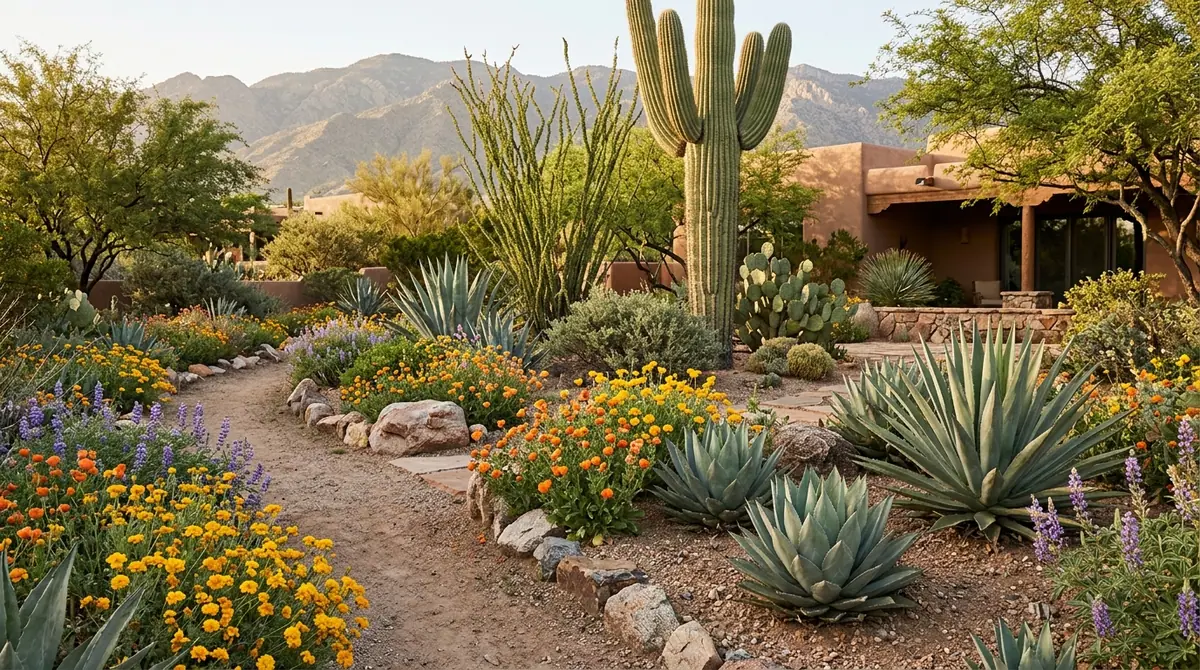
Gardening in Tucson requires throwing out standard rules of thumb and embracing a climate defined by extreme thermal swings, intense solar radiation, and a bifurcated growing season, which explains why imported English lavender turns crispy and brown within forty-eight hours at mid-July temperatures of 108°F (42.2°C) and why a single USDA designation tells only half the story.
1. Botanical Overview & Natural Habitat

However, hardiness zones only measure winter minimums. They do not account for Tucson’s scorching summers, where daytime temperatures regularly exceed 100°F (37.8°C) for weeks on end, occasionally peaking at 115°F (46.1°C). The Sunset Western Garden Book categorizes Tucson within Zone 12, encompassing the arid Arizona desert where thermal adaptation is everything.
Native flora here has evolved ingenious strategies for survival. Plants like the Saguaro cactus (Carnegiea gigantea) and Palo Verde (Parkinsonia) are masters of resource management. Saguaros feature accordion-like pleats that expand to store hundreds of gallons of water during seasonal rains, paired with shallow root systems that extend outward as far as the plant is tall—often 50 feet (15.2 meters)—to capture every drop of surface moisture. Palo Verde trees drop their tiny leaves during droughts to halt transpiration, relying instead on their green bark to photosynthesize.
For the home gardener, success hinges on mimicking these adaptations. You must select species that can handle soil temperatures exceeding 130°F (54.4°C) while maintaining structural integrity during monsoon microbursts that bring winds gusting over 60 mph (96.5 km/h).
2. Essential Environmental & Care Requirements
Creating a thriving landscape in Tucson requires rigorous management of sun exposure, soil composition, and irrigation depth. The Sonoran Desert is not a monolith; microclimates dictate whether a plant thrives or fries.
| Parameter | Optimal Condition | Common Mistake | Why It Matters |
|---|---|---|---|
| Soil Composition | Caliche-free, coarse sandy loam with <2% organic matter, pH 7.5 to 8.5 | Amending planting holes heavily with rich compost | Creates a "bathtub effect" where water pools in the amended hole, rotting roots |
| Irrigation Depth | 18 to 24 inches (45.7 to 61 cm) for established trees and shrubs | Frequent, shallow surface watering | Encourages weak, shallow root systems vulnerable to drought and heat |
| Sun Exposure | Morning sun with afternoon shade for non-natives; full sun (6+ hours) for cacti | Placing shade-loving plants on west-facing walls | Intense afternoon solar radiation causes irreversible leaf scorch and cell collapse |
| Mulch Application | 2 to 3 inches (5 to 7.6 cm) of mineral mulch (granite gravel) | Using deep organic mulch directly against stems | Organic mulch traps excessive moisture and heat, inviting collar rot and pests |
Soil preparation is the ultimate hurdle in Tucson. Much of the valley sits atop caliche—a hardened layer of calcium carbonate that acts like concrete 12 to 36 inches (30.5 to 91.4 cm) below the surface. If you do not break through this layer with a pickaxe or mechanical auger, water cannot drain, and your plants will drown in their own juices.
Watering frequency must shift with the seasons. During the arid pre-summer in June, when relative humidity drops below 10%, plants need deep, infrequent soakings to drive roots downward. During the winter dormancy period (December through February), irrigation should be dialed back by 70% to prevent root rot in cooling soils. For authoritative guidance on local soil management, consult the University of Arizona Cooperative Extension.
💡 Pro-Tip: When installing new desert-adapted plants, pull your drip emitters 12 inches (30.5 cm) away from the main stem and place them at the canopy drip line. This forces the root system to expand outward in search of moisture, anchoring the plant securely against monsoon storm winds.
3. Step-by-Step Cultivation, Feeding & Propagation
Gardening in Tucson’s Zone 9b/10a requires a counterintuitive schedule. Your primary planting season is not spring, but autumn (September through November), when soil temperatures are still warm enough to encourage root growth, but the air is cool enough to prevent transplant shock.
Follow this proven protocol for establishing perennial desert landscapes:
- Site Assessment and Digging: Dig a basin two to three times wider than the nursery pot, but crucially, no deeper than the root ball. The top of the root ball must sit 1 inch (2.5 cm) above the surrounding grade to account for settling.
- The Perforation Test: Fill the excavated hole with water. If it does not drain completely within 4 hours, you have hit a heavy clay or caliche layer and must break through the bottom using a soil bar or drill.
- Unpotting and Root Teasing: Gently massage the root mass of container-grown plants. If roots are circling tightly, score the outer root mat vertically in four places with a clean razor blade to break apical dominance and stimulate outward growth.
- Backfilling Without Amendments: Backfill the hole with the native unamended soil you dug out. Tamp it down gently with your hands or feet—never stomp it—to eliminate large air pockets while maintaining soil structure.
- Basin Construction and Watering: Build a 4-inch (10.2 cm) earthen berm around the perimeter of the planting hole, matching the diameter of the canopy. Fill this basin slowly with water to settle the soil, then apply a 2-inch (5 cm) layer of mineral mulch, keeping it 2 inches away from the trunk.
- Fertilization Strategy: Apply a low-nitrogen, slow-release granular fertilizer (such as a 5-10-10 formulation) once a year in early spring. High nitrogen forces succulent, tender growth that attracts sap-sucking insects and fries instantly when summer hits.
Propagation in Tucson is remarkably successful with native cuttings taken during the monsoon season (July and August), when ambient humidity spikes and rooting hormones are naturally active. Take 6-inch (15.2 cm) terminal cuttings from brittlebush or fairy duster, let them callus in a shaded, dry area for 7 days, and insert them into a 50/50 mix of perlite and coarse sand.
4. Common Problems, Pests & Troubleshooting
Even the best-managed Tucson landscapes encounter environmental and biological pressures. Sunscald is a primary culprit on young trees; the relentless southwest afternoon sun heats up the bark, killing the cambium layer underneath.
Another frequent issue is chlorosis—manifesting as yellowing leaves with dark green veins—caused by Tucson’s alkaline soils (often pH 8.0+), which lock up iron and manganese. Do not blindly dump iron amendments into the soil without a test; instead, apply chelated iron (Fe-EDDHA) directly to the root zone via liquid drench.
Pest-wise, the Palo Verde beetle (Derobrachus hovorei) wreaks havoc on established trees during the summer monsoon rains. The larvae spend up to three years underground chewing through structural roots, often causing a seemingly healthy tree to suddenly collapse in a storm.
⚠️ Important Caution: Never use broad-spectrum synthetic insecticides to combat minor pest outbreaks in the Sonoran Desert. Tucson is home to fragile pollinators, native bees, and beneficial predatory insects. Broad-spectrum sprays wipe out natural predators like assassin bugs and green lacewings, triggering secondary outbreaks of spider mites and whiteflies that are far harder to control.

5. Frequently Asked Questions
What zone is Tucson Arizona for planting?
Tucson spans USDA Hardiness Zones 9b and 10a, with average annual extreme minimum temperatures ranging from 25°F to 35°F (-3.9°C to 1.7°C). However, because of extreme summer heat and intense solar radiation, gardeners must also consider heat-zone maps and microclimates when choosing plants. For localized climate data, refer to the Desert Botanical Garden.
When should I plant vegetables in Tucson?
Because of Tucson's unique climate, you have two distinct vegetable gardening seasons: a fall/winter season (planted from September through November for harvests between October and May) and a spring/summer season (planted in February/March, and again during the July monsoon for fall harvest). Avoid planting cool-season crops like broccoli and lettuce between May and August, as soil temperatures will cause them to bolt and turn bitter immediately.
How often should I water desert plants in Tucson?
Newly installed plants require frequent irrigation—every 2 to 3 days for the first two weeks, tapering off over several months. Once established (usually after 1 to 2 years), native and adapted desert plants like palo verde, jojoba, and desert marigold need deep watering only once every 10 to 14 days during the peak of summer, and every 4 to 6 weeks in winter.
Can I grow citrus in Tucson?
Yes, citrus thrives in Tucson if planted in protected microclimates away from cold-air drainage channels. Valencia oranges, Eureka lemons, and Lisbon limes do exceptionally well. Protect young citrus trees from winter freezes when temperatures drop below 28°F (-2.2°C) by draping frost cloth over a rigid frame that reaches all the way to the ground, anchoring the edges with stones.
Related Guides
- What Hardiness Zone is Sacramento
- What Planting Zone is Sacramento Ca
- What Zone is Columbus Ohio
- What Planting Zone is Virginia in
- Zone 9 Plants Full Sun
📋 Table of Contents ▼ Click to expand
Tags:
🌿 Related Plants You Might Like

PlantSavvyWorld
Editorial team
PlantSavvyWorld is an independent botanical education project. Articles are drafted with AI assistance, then edited and checked against university extension services, botanical garden collections and other published horticultural sources.