

Tomato Hornworm Droppings
Written with AI assistance, edited and checked against horticultural sources.
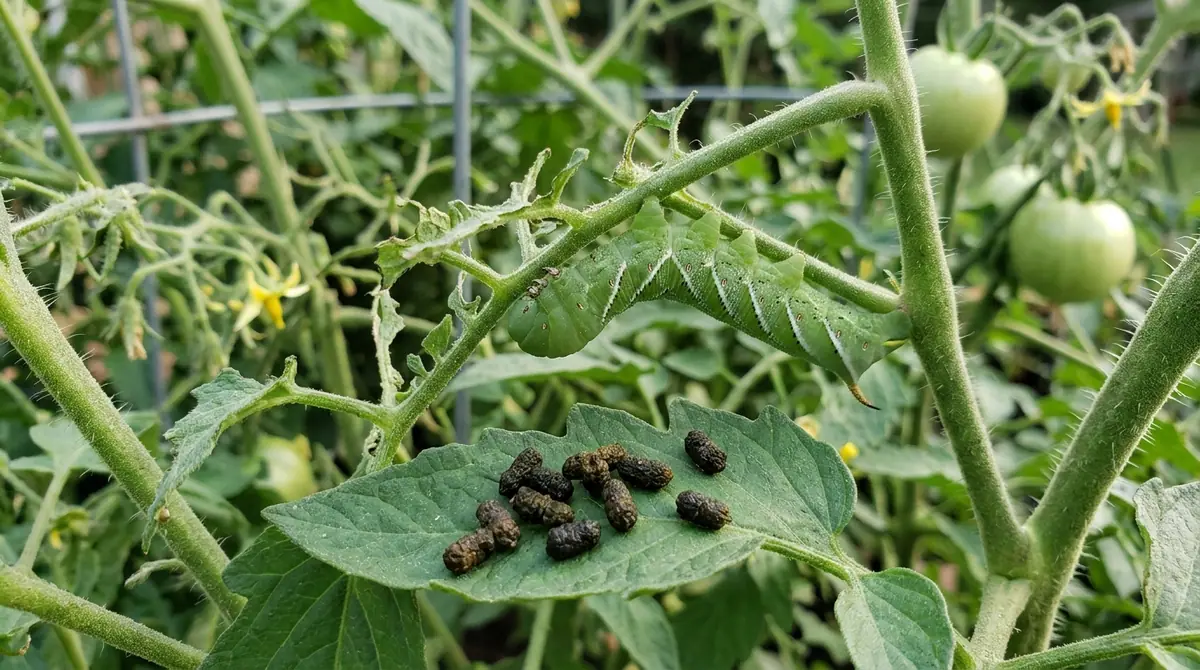
I was kneeling in my experimental polyculture plot last July, delicately tying up an indeterminate 'Cherokee Purple' vine, when my thumb brushed against something unexpected. It was not a pest, but rather a small, dark green, perfectly cylindrical package resting on the upper surface of a leaf below. It looked remarkably like a miniature olive or a tiny green barrel. When I looked up and scanned the foliage directly above that dropping—known formally as frass—I spotted the culprit: a four-inch-long neon green caterpillar with a menacing black horn, blending so perfectly into the compound leaves that it defied detection. Tomato hornworm droppings are the unmistakable smoking gun of the garden, alerting you to a voracious caterpillar that can defoliate an entire plant in under 48 hours if left unchecked.

1. Botanical Overview & Natural Habitat
Tomato hornworms are the larval stage of the Manduca quinquemaculata, commonly known as the five-spotted hawkmoth, as well as its close relative the tobacco hornworm (Manduca sexta). Scientifically, these insects belong to the family Sphingidae. Their natural habitat encompasses nearly all of North America, where wild solanaceous plants—such as horsenettle, jimsonweed, and buffalo bur—serve as their ancestral hosts. When we introduce cultivated tomatoes (Solanum lycopersicum), eggplants, peppers, and potatoes into our landscapes, we are essentially rolling out an all-you-can-eat buffet that mirrors their native food sources.
Morphologically, the frass (droppings) of the tomato hornworm is your primary diagnostic indicator. Because hornworms consume large quantities of fibrous green plant material, their droppings are expelled as distinct, hard, cylindrical pellets ranging from 0.12 inches to 0.25 inches (3 mm to 6 mm) in length. Fresh frass is typically moist, dark green to black, and marked with distinctive longitudinal ridges and faceted segments. As it dries in the sun, it fades to a dull grey-green or brown and becomes brittle.
When analyzing tomato hornworm droppings, position is everything. If you find small, dark frass pellets resting on leaves, look directly upward at the canopy 6 inches to 12 inches (15 cm to 30 cm) above. Caterpillars feed voraciously on the upper, tender growth and push their waste downward. The size of the dropping corresponds directly to the instar (developmental stage) of the caterpillar. Early first-instar frass is microscopic, while fifth-instar frass is substantial enough to make an audible ticking sound if it falls onto broad foliage below during a quiet afternoon. For optimal crop health monitoring, consult the University of California Integrated Pest Management Program for regional lifecycle tracking.
2. Essential Environmental & Care Requirements
Managing the ecosystem around your solanaceous crops helps deter hornworm infestations and mitigates the damage signaled by their droppings. Hornworms thrive in warm, dry summer conditions where daytime temperatures consistently hover between 75°F and 90°F (24°C to 32°C). Their metabolic rate accelerates in this temperature band, causing them to consume more foliage and produce exponentially more frass.
To keep your plants resilient against heavy feeding pressure, you must maintain precise environmental and soil parameters. Proper spacing, consistent moisture, and nutrient balance prevent the lush, succulent soft growth that hornworms prefer. For growers refining their establishment timelines, refer to our guide on When to Plant Tomato Plants in California to align your growing seasons with regional insect emergence cycles.
| Parameter | Optimal Condition | Common Mistake | Why It Matters |
|---|---|---|---|
| Soil Temperature | 65°F–75°F (18°C–24°C) | Planting too early in cold soil | Weak root systems produce stressed plants vulnerable to pests. |
| Soil Moisture | Consistent 1–2 inches (2.5–5 cm) weekly | Alternating drought and heavy soaking | Fluctuating water disrupts nutrient uptake, weakening leaf tissue. |
| Plant Spacing | 24–36 inches (60–90 cm) apart | Overcrowding plants in tight beds | Dense canopies hide hornworm frass and restrict beneficial insect access. |
| Nitrogen Levels | Moderate, balanced N-P-K | Over-fertilizing with high nitrogen | Excess nitrogen creates soft, succulent foliage that accelerates hornworm growth. |
💡 Pro-Tip: Never rely solely on visual checks of the outer canopy. Take a flashlight out at dusk or dawn and sweep the beam horizontally across the lower stems; tomato hornworm frass and the caterpillars themselves possess a mild natural fluorescence when exposed to direct light, making them instantly visible against the dark soil and foliage.
3. Step-by-Step Cultivation, Feeding & Propagation
When you spot tomato hornworm droppings on your mulch or lower leaves, immediate tactical intervention is required. Follow this rigorous, step-by-step protocol to eliminate the infestation, protect your yields, and support the broader plant architecture—techniques that pair exceptionally well with our advanced guide on How to Grow Huge Tomato Plants: Pruning, Trenching & Heavy Yields.
- Conduct a Frass Audit: Scan the ground and leaves directly beneath the freshest, largest droppings. Trace a vertical line upward into the canopy to locate the feeding site.
- Hand-Pick and Relocate or Destroy: Put on garden gloves and gently pluck the hornworm from the stem. If the caterpillar's back is covered in white, rice-like silken cocoons, leave it in place—these are pupae of the beneficial braconid wasp (Cotesia congregata), a natural parasitic control agent. If it is clean, drop the caterpillar into a bucket of soapy water.
- Apply Biological Controls: If you discover frass across multiple plants, spray the foliage with Bacillus thuringiensis subspecies kurstaki (Bt). This naturally occurring soil bacterium is harmless to humans, pets, and beneficial pollinators, but when ingested by the hornworm, it paralyzes its digestive tract within 24 to 48 hours.
- Prune Damaged Foliage: Remove severely defoliated stems and leaves where heavy frass accumulation has begun to rot or attract secondary fungal pathogens. Use sanitized bypass pruners sterilized in a 10% bleach solution or isopropyl alcohol.
- Amend and Tillage Management: At the end of the growing season, till the top 4 inches to 6 inches (10 cm to 15 cm) of soil. This disrupts the overwintering pupae—which look like brown, jug-like structures with a distinct "handle" containing the moth's future proboscis—effectively breaking the reproductive cycle for the following year.
⚠️ Important Caution: Never use broad-spectrum synthetic insecticides like carbaryl or permethrin to combat tomato hornworms. These chemicals decimate populations of predatory ladybugs, minute pirate bugs, and paper wasps that naturally hunt hornworm eggs and small larvae, often resulting in a severe secondary spider mite or aphid outbreak.
4. Common Problems, Pests & Troubleshooting
Diagnosing garden pests requires separating hornworm damage from other common solanaceous ailments. Here is how to troubleshoot frass and foliage symptoms accurately:
- Symptom: Small, round, powdery frass pellets scattered with chewed fruit edges.
- Diagnosis: Tomato fruitworms (Helicoverpa zea), not hornworms. Fruitworms bore directly into green and ripening tomatoes, leaving a dark entry hole accompanied by fine, granular frass.
- Solution: Bag developing fruit clusters in fine mesh netting or apply spinosad spray directly to the flower clusters. For official diagnostic protocols, consult the Royal Horticultural Society (RHS) pest management guidelines.
- Symptom: Large cylindrical frass pellets, but no caterpillar visible after extensive searching.
- Diagnosis: The caterpillar has either migrated down the stem to pupate in the soil, or it has been consumed by a vertebrate predator like a mockingbird or brown thrasher.
- Solution: Check the soil line within a 12-inch (30 cm) radius of the plant base for disturbed earth or pupal chambers.
- Symptom: Sudden defoliation accompanied by shiny, sticky frass trails rather than dry pellets.
- Diagnosis: Slug or snail infestation, or early-season armyworms. Hornworm frass is characteristically dry and segmented, never slimy.
- Solution: Set out iron phosphate-based bait traps around the perimeter of the tomato bed.

5. Frequently Asked Questions
What do tomato hornworm droppings look like?
Tomato hornworm droppings, or frass, look like small, dark green or brown cylindrical pellets that measure roughly 0.12 inches to 0.25 inches (3 mm to 6 mm) long. They feature distinct longitudinal ridges and faceted segments. Fresh frass is moist and dark, while older frass dries into a brittle, greyish-green pellet that often accumulates on the leaves and mulch directly beneath the caterpillar's feeding zone.
How can I find a tomato hornworm using its droppings?
When you spot fresh frass on a leaf or on the ground, look directly upward into the canopy 6 inches to 12 inches (15 cm to 30 cm) above that exact spot. Hornworms feed on the tender upper growth and deposit waste downward. Because their camouflage is exceptional, look for missing leaf veins and stripped stems, or use a UV flashlight at dusk to make the caterpillar and its frass glow faintly.
Are tomato hornworm droppings poisonous to my plants or soil?
No, the frass is not chemically toxic to your plants or soil. It is simply digested organic plant matter. However, heavy accumulations of rotting frass on damaged leaves can create a breeding ground for opportunistic fungi and bacteria, which is why pruning heavily soiled, damaged leaves is an essential part of plant hygiene.
Should I kill a tomato hornworm if it has white cocoons on its back?
No, you should leave it alone in the garden. Those white, rice-like bumps are the cocoons of the beneficial braconid wasp. The wasp larvae feed inside the hornworm and eventually spin cocoons on its exterior. Once these wasps hatch, they will seek out and parasitize dozens of other hornworms and garden pests, providing free biological control for your entire landscape.
Related Guides
- Can Goats Eat Tomato Plants
- How Long Does It Take for Tomatoes to Grow Tomato Growing and Harvesting Guide
- When to Start Tomato Seeds Indoors Zone 6
- When to Plant Tomato Plants in California
📋 Table of Contents ▼ Click to expand
Tags:
Keep reading
🌿 Related Plants You Might Like






PlantSavvyWorld
Editorial team
PlantSavvyWorld is an independent botanical education project. Articles are drafted with AI assistance, then edited and checked against university extension services, botanical garden collections and other published horticultural sources.