

How to Build a Rain Garden to Prevent Yard Flooding
Written with AI assistance, edited and checked against horticultural sources.
1. Botanical Overview & Natural Habitat
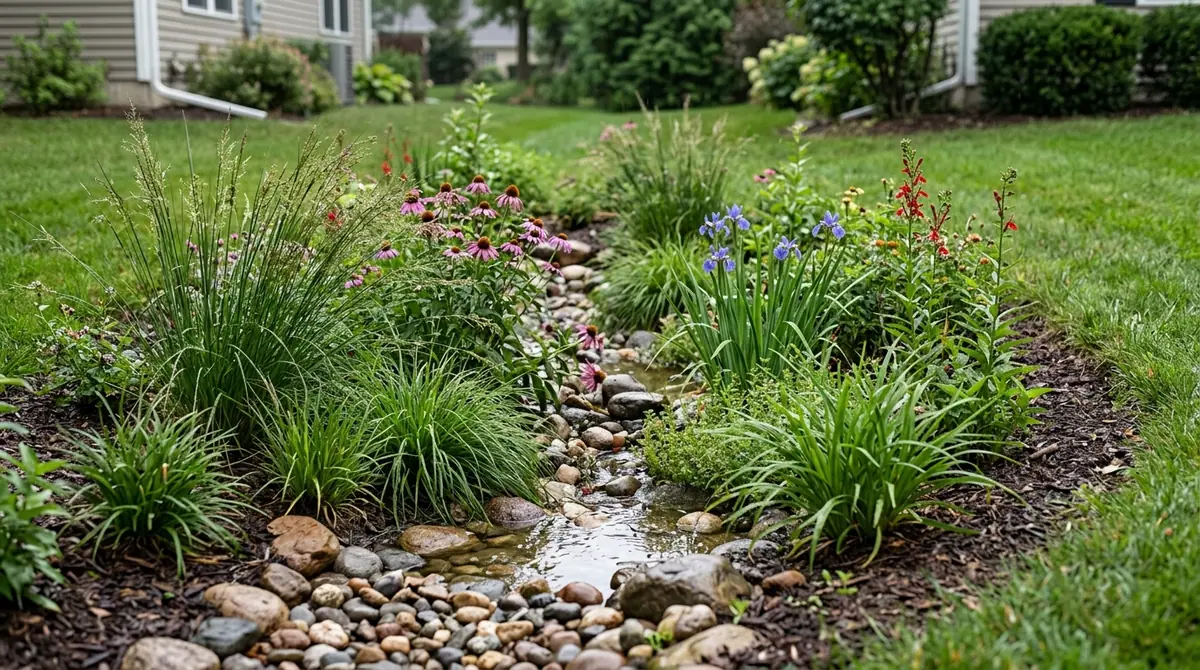
During a torrential downpour, water running over red clay can carve a muddy canyon, scour topsoil, and threaten to undermine concrete patios, which is why designing with the slope using a rain garden is effective. A rain garden is not merely a hole filled with pretty flowers; it is a bio-retention ecosystem engineered to mimic the sponge-like hydrology of a native woodland floor or an uncultivated prairie swale.

The structural integrity of this system relies heavily on the root architecture of its inhabitants. Native perennials like Switchgrass (Panicum virgatum) and Swamp Milkweed (Asclepias incarnata) develop fibrous root systems that can pierce compacted clay soils up to 36 inches (91 cm) deep. These living channels break up hardpan layers, drastically increasing the saturated hydraulic conductivity of the soil. According to research from the University of Wisconsin-Madison Division of Extension, a well-designed rain garden can absorb 30% more water than a conventional lawn of the same size, significantly reducing peak runoff velocities during storms that drop 2 inches (5 cm) or more of rain in a 12-hour window.
2. Essential Environmental & Care Requirements
Before driving a single spade into your turf, you must understand the environmental parameters that dictate whether your rain garden will thrive or turn into an anaerobic mud pit. Light exposure, soil percolation rates, and watershed sizing determine everything from plant selection to basin depth.
Sunlight dictates species composition. Most rain garden plants perform best in full sun—defined as 6 to 8 hours of direct solar radiation daily—though woodland-edge rain gardens can be designed for partial shade (3 to 6 hours). Soil texture is the single most critical environmental factor. You cannot simply dig a hole and hope for the best; you must test your drainage.
💡 Pro-Tip: Always perform a percolation test before finalizing your garden footprint. Dig a test hole 12 inches (30 cm) deep and 12 inches (30 cm) wide, fill it with water to let it saturate the surrounding soil, empty it, and then refill it. Measure the drop in water level over precisely 1 hour. If the water drops less than 1 inch (2.5 cm) per hour, your soil is too heavy in clay and will require significant amendment with coarse sand and compost, or the installation of an under-drainage tile system.
| Parameter | Optimal Condition | Common Mistake | Why It Matters |
|---|---|---|---|
| Soil Percolation | 1 to 3 inches (2.5–7.6 cm) per hour | Assuming clay will drain naturally | Slow drainage causes standing water past 48 hours, rotting roots and breeding mosquitoes |
| Distance to Foundation | Minimum 10 feet (3 meters) downslope | Placing the garden directly against a basement wall | Water must infiltrate away from structural foundations to prevent hydrostatic pressure and basement flooding |
| Basin Depth | 6 to 8 inches (15–20 cm) deep | Digging too deep (over 18 inches / 46 cm) | Excess depth creates a steep, unsafe drop-off and drowns non-aquatic root systems |
| Inflow / Outflow Slopes | 1% to 2% gradient entering the garden | Creating a sudden 90-degree waterfall drop | Steep entry points cause severe soil erosion instead of safely spreading out incoming water |
3. Step-by-Step Cultivation, Feeding & Propagation
Building a functional rain garden is an exercise in applied earth-moving and ecological assembly. Follow this exact sequence to ensure your system captures runoff without washing away.
- Calculate Sizing and Map the Watershed: Measure the square footage of the impervious surfaces (roofs, driveways, sidewalks) draining toward your problem area. Multiply that area by 0.20 if your soil drains quickly (sandy loam), 0.30 for medium soils (silt loam), or 0.40 for heavy clay. This gives you the target square footage for your rain garden basin.
- Locate and Call Before You Dig: Call your national or local utility marking service (e.g., 811 in the US) at least 3 business days prior to excavation to ensure you do not strike underground gas, water, or fiber-optic lines.
- Excavate the Basin and Form the Berm: Dig out the designated footprint, keeping the bottom completely flat. Take the excavated soil and pack it firmly on the downslope side to build a level berm (lip) 6 to 9 inches (15–23 cm) high. This berm traps water inside the garden until it reaches capacity, at which point an overflow notch cut into the lowest point of the berm safely directs excess water away.
- Amend and Condition the Soil: Till the top 6 inches (15 cm) of the newly exposed basin floor. Incorporate a 3-inch (7.5 cm) layer of well-rotted leaf compost and, if dealing with heavy clay, clean concrete sand to improve aggregate structure and microbial life.
- Zone Your Plant Selection: Divide your plants into three distinct planting zones:
- Zone 1 (The Bottom): Requires plants that tolerate brief complete submersion and saturated soils for 48 hours (e.g., Blue Flag Iris Iris versicolor, Buttonbush Cephalanthus occidentalis).
- Zone 2 (The Slopes): Requires plants that handle alternating wet and dry spells (e.g., Butterfly Milkweed Asclepias tuberosa, Purple Coneflower Echinacea purpurea).
- Zone 3 (The Berm/Edge): Requires drought-tolerant species since this zone sits highest and dries out fastest (e.g., Little Bluestem Schizachyrium scoparium).
- Install Plant Material and Apply Hardwood Mulch: Space perennials 12 to 18 inches (30–45 cm) apart to encourage fast canopy closure. Apply a uniform 3-inch (7.5 cm) layer of shredded hardwood bark mulch (avoid lightweight dyed chips or nuggets that float away in a heavy downpour). The mulch acts as a physical armor, preventing weed germination and surface soil compaction.
- Establish Irrigation and Maintenance Routine: Provide 1 inch (2.5 cm) of water per week for the first 60 days to help plants establish deep roots. Hand-weed monthly during the first growing season. Once established in year two, fertilizing is entirely unnecessary, as incoming stormwater provides all required nitrogen and phosphorus.
4. Common Problems, Pests & Troubleshooting
Even expertly designed rain gardens encounter establishment hurdles. Here is how to diagnose and correct the most frequent issues.
The most common complaint is standing water lingering past the 72-hour mark. This indicates that your soil's infiltration rate has dropped, often due to silt and fine clay particles washing off the roof or lawn and sealing the soil surface like a glaze. To fix this, rake away the mulch in the affected area, aerate the soil matrix with a garden fork, and top-dress with coarse compost to restore soil porosity.
Weed pressure is particularly intense during the first growing season because rain garden soils are nutrient-rich and moist. Invasive annuals like crabgrass (Digitaria) and nutsedge (Cyperus) will try to outcompete your native plugs. Do not use systemic herbicides within the basin, as chemical runoff can wash directly into the local watershed table; instead, rely on hand-pulling after rain events when soil is softest.
⚠️ Important Caution: Never introduce mosquito dunks containing Bacillus thuringiensis israelensis (Bti) into a rain garden that drains within 48 hours. Mosquito larvae require a minimum of 7 to 10 days of standing water to complete their aquatic life cycle. If your rain garden holds water long enough for mosquitoes to breed, your basin is failing to drain properly, and you must fix the underlying percolation issue rather than relying on chemical larvicides.

5. Frequently Asked Questions
Will a rain garden breed mosquitoes in my yard?
No. A properly constructed rain garden drains completely within 24 to 48 hours after a storm event concludes. Mosquitoes require stagnant water to remain undisturbed for at least 7 to 10 days to hatch and develop from larvae to flying adults. Because the water infiltrates rapidly into the soil profile, mosquitoes cannot complete their life cycle in a functioning rain garden.
Do I need to water a rain garden after it gets established?
Only during prolonged drought periods lasting longer than 3 to 4 weeks without rainfall. During their first growing season (the first 12 months), rain garden plants need regular supplemental irrigation to establish their deep root systems. By year two and beyond, native species with deep taproots and fibrous networks will easily survive on natural rainfall alone.
Can I build a rain garden if my yard has heavy clay soil?
Yes, but you must modify your construction approach. Heavy clay requires you to dig slightly deeper—adding an extra 4 to 6 inches (10–15 cm)—and backfilling the base with a custom soil mix containing 50% native clay, 30% coarse builder's sand, and 20% organic compost. This breaks up the tight clay particle bonds and allows water to percolate downward at an acceptable rate.
How close to my house can I put a rain garden?
You must site your rain garden at least 10 feet (3 meters) away from your home’s foundation. Placing it closer risks channeling concentrated stormwater toward your basement walls, leading to structural seepage, foundation shifting, and basement flooding. Always ensure the garden slopes gently away from all permanent structures.
Related Guides
- How to Build Vertical Gardens for Small Urban Balconies
- Black Mold in Yard
- Overgrown Yard Cleanup Tips
- 10 Best Low Maintenance Front Yard Landscaping Ideas for Small Spaces
📋 Table of Contents ▼ Click to expand
Tags:
Keep reading
🌿 Related Plants You Might Like





PlantSavvyWorld
Editorial team
PlantSavvyWorld is an independent botanical education project. Articles are drafted with AI assistance, then edited and checked against university extension services, botanical garden collections and other published horticultural sources.