
Zebra Plant
Haworthiopsis attenuata

1. Botanical Overview & Natural Habitat
The Zebra Plant, scientifically classified as Haworthiopsis attenuata (formerly Haworthia attenuata), is a perennial succulent belonging to the Asphodelaceae family. Native to the Eastern Cape province of South Africa, this species evolved under harsh, arid conditions characterized by erratic rainfall and intense sunlight.
In its natural habitat, Haworthiopsis attenuata grows under the protective canopy of larger shrubs and rocks, which shields it from the blistering midday sun. This understory adaptation dictates its modern indoor care needs: it loves brilliant light, but scorching, unshaded UV rays will quickly bleach its dark green leaves. The plant forms compact rosettes typically reaching 4 to 6 inches (10 to 15 cm) in height and spreading up to 6 to 8 inches (15 to 20 cm) wide through the production of underground offsets, or "pups."
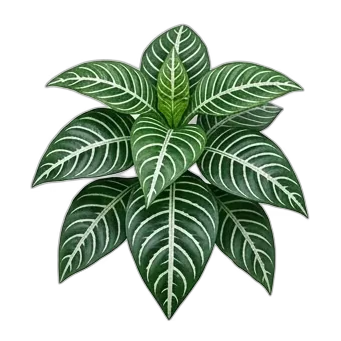
The most striking feature of the Zebra Plant is its foliage. The stiff, lance-shaped, dark green leaves are heavily encrusted with raised, chalky-white tubercles (wart-like bumps) arranged in horizontal bands. These white bands are not just ornamental; they serve a biological function by reflecting excess solar radiation and helping to shade the plant's photosynthetic tissues in high-light environments.
For those looking to diversify their indoor jungle with other resilient, textured species, you might enjoy pairing your Haworthiopsis with cascading varieties like the Lipstick Plant (Aeschynanthus Radicans) Complete Care & Bloom Guide, which offers a brilliant contrast of glossy foliage and vibrant red blooms. Alternatively, if you are expanding your container gardening horizons outdoors into edible crops, understanding root constraints is just as vital for succulents as it is when exploring How Deep Do Pepper Plant Roots Go? Pot Size & Substrate Depth Guide.
2. Environmental & Care Requirements
Growing Haworthiopsis attenuata successfully requires mimicking the well-drained, nutrient-poor soils and bright, indirect light of the South African veld.
Light is the primary driver of plant health. Position your Zebra Plant within 3 feet (1 meter) of an east- or west-facing window, or directly on a bright southern windowsill shielded by a sheer curtain. It requires a minimum of 4 to 6 hours of bright, indirect light daily. Insufficient light results in etiolation—stretched, pale, weak leaves that lose their iconic white banding pattern.
Temperature management is straightforward. Indoor temperatures between 65°F and 85°F (18°C to 29°C) are ideal. While they can tolerate brief dips down to 40°F (4°C) if the soil is completely dry, they are not frost-hardy and will sustain cellular damage and rot if exposed to freezing temperatures.
Watering is where most growers fail. The "soak and dry" method is mandatory. Water the potting mix thoroughly until water runs out of the drainage holes, then allow the soil to dry out completely—down to the bottom of the container—before watering again. Depending on your indoor humidity and ambient temperature, this interval typically ranges from 14 to 21 days in the summer and 30 to 45 days in the winter dormancy period.
| Parameter | Optimal Condition | Common Mistake | Why It Matters |
|---|---|---|---|
| Light | 4–6 hours bright, indirect light | Placing in dark corners or direct blazing noon sun | Prevents stretching (etiolation) and sunburn while maintaining white bands |
| Soil Mix | 50% grit (perlite/pumice) + 50% organic potting soil | Using heavy, dense garden soil or standard peat | Prevents water retention that causes fatal root and stem rot |
| Watering | Complete dry-out between waterings (14–21 days summer) | Frequent, shallow sips or keeping soil constantly damp | Allows delicate root hairs to breathe; prevents fungal pathogens |
| Pot Type | Unglazed terracotta with drainage hole | Non-porous plastic or glass containers without drainage | Terracotta breathes, evaporating excess moisture from the root zone |
💡 Pro-Tip: When checking your Zebra Plant's soil moisture, do not rely on a surface finger test. The top 1 inch (2.5 cm) dries out rapidly. Instead, use a wooden dowel inserted all the way to the bottom of the pot. If any soil or moisture clings to the wood when pulled out, withhold water for another week.
3. Step-by-Step Cultivation, Propagation & Feeding
Propagating Haworthiopsis attenuata is remarkably straightforward because the plant naturally produces basal offsets, or pups, around its base. Division is the fastest and most reliable method for expanding your collection.
Step-by-Step Propagation Guide via Offset Division
- Select a Mature Pup: Wait until the offset reaches at least 1.5 to 2 inches (3.8 to 5 cm) in diameter and has developed its own nascent root system. This usually occurs during the active spring growing season.
- Unpot the Mother Plant: Gently slide the entire root ball out of its container and brush away excess soil from the base to expose the connection point between the mother rosette and the pup.
- Cleanly Separate: Using a sterile, sharp blade or pruning shears, cut the offset away as close to the main stem as possible, ensuring you retain at least two or three tiny roots on the pup.
- Callous the Wound: Place the separated pup in a warm, dry, shaded location for 3 to 5 days. This allows the cut surface to form a hard, protective callous, preventing soil-borne pathogens from entering when planted.
- Pot into Dry Substrate: Plant the calloused pup into a small 2-to-3-inch (5-to-7.5-cm) terracotta pot filled with a dry, gritty succulent mix (equal parts standard potting soil and coarse perlite or pumice).
- Wait Before Watering: Keep the newly potted pup completely dry for 10 to 14 days. This stimulates the plant to push out new roots in search of moisture without risking rot on fresh wounds. Begin gentle watering after two weeks.
Feeding your Zebra Plant should be approached with restraint. In the wild, they grow in lean soils. Fertilize only during the active growing season (spring through early summer) using a balanced, water-soluble succulent fertilizer diluted to one-quarter strength. Apply once every 6 weeks. Never fertilize in autumn or winter when the plant enters dormancy, as excess salts will burn the root system.
⚠️ Important Caution: Never use leaf cuttings to propagate Haworthiopsis attenuata. Unlike true Echeveria or Sedum, haworthias and haworthiopsias almost never regenerate new plants from pulled individual leaves; the leaf will simply rot or wither away without producing an offset.
4. Common Problems, Pests & Troubleshooting
Even with careful attention, environmental shifts or cultural mistakes can cause issues. Here is how to diagnose and correct them.
Rot and Overwatering
Symptoms include translucent, yellow, or mushy lower leaves that easily detach from the stem. The base of the plant may turn brown and soft.
- Cause: Overwatering, poorly draining soil, or a pot lacking drainage holes.
- Correction: Unpot the plant immediately. Cut away all rotting, black, or mushy roots and leaves using a sterile blade. Dust the remaining healthy tissue with sulfur powder or ground cinnamon as a natural antifungal. Allow the plant to bare-root dry in the air for 7 days before repotting into fresh, dry, gritty mix. For broader botanical context on growing conditions and plant health, consult resources from the Royal Horticultural Society.
Leaf Tip Dieback and Browning
Tips of the leaves turn crispy, brown, and dry.
- Cause: Underwatering, severe root-binding in a pot that is too small, or low ambient humidity combined with direct, scorching heat.
- Correction: Soak the root ball thoroughly if underwatering is the culprit. If the plant is root-bound (roots circling densely inside the pot or emerging from drainage holes), transplant it into a container that is only 1 inch (2.5 cm) wider than the previous one during the spring.
Pest Infestations (Mealybugs)
White, cottony masses tucked deep in the leaf axils or along the base of the rosettes.
- Cause: Low air circulation, dry indoor air, or introducing an infested plant into your collection.
- Correction: Dip a cotton swab in 70% isopropyl alcohol and dab it directly onto every visible mealybug to dissolve their protective wax coating. Follow up by spraying the entire plant with insecticidal soap or horticultural oil, repeating the treatment every 7 days for a total of three applications to eradicate hidden eggs. For additional research-backed horticultural practices, refer to guidelines provided by University of California Agriculture and Natural Resources.

5. Frequently Asked Questions
Why is my Zebra Plant turning pale green or losing its white stripes?
When a Zebra Plant turns pale or loses the sharp contrast of its white tubercles, it is almost always receiving insufficient light (etiolation). The plant attempts to maximize light absorption by producing more chlorophyll, which drowns out the white banding. Move the plant closer to a bright window with a few hours of gentle direct sun, but do so gradually over 7 to 10 days to prevent sunburn.
Do Zebra Plants need to be pruned?
Zebra Plants do not require structural pruning. The only maintenance required is removing lower leaves that naturally dry up, turn brown, and paper-thin as the plant matures. Simply wait until these old leaves are completely desiccated and gently pull them away from the stem to discourage pests from hiding underneath them.
Are Zebra Plants toxic to cats and dogs?
No, Haworthiopsis attenuata is non-toxic to cats, dogs, and humans. According to the ASPCA, ingestion of this plant will not cause systemic poisoning. However, the stiff, pointed leaf tips and fibrous texture can cause mild gastrointestinal upset, vomiting, or mouth irritation if a curious pet chews on a large amount of foliage.
Why are the leaves of my Zebra Plant curling inward?
Inward curling is a classic defensive posture indicating acute dehydration. When the roots fail to take up water—either because the soil has become hydrophobic and repels water, or because the roots have rotted away—the plant conserves moisture by curling its leaves tightly inward to reduce its surface area exposed to dry air. Check the roots immediately: if they are firm and dry, a thorough watering will revive the plant within 48 to 72 hours. If they are mushy, follow the rot-remediation protocol outlined in section 4.
📋 Table of Contents ▼ Click to expand
Tags: