

Pecans for Squirrels
Written with AI assistance, edited and checked against horticultural sources.
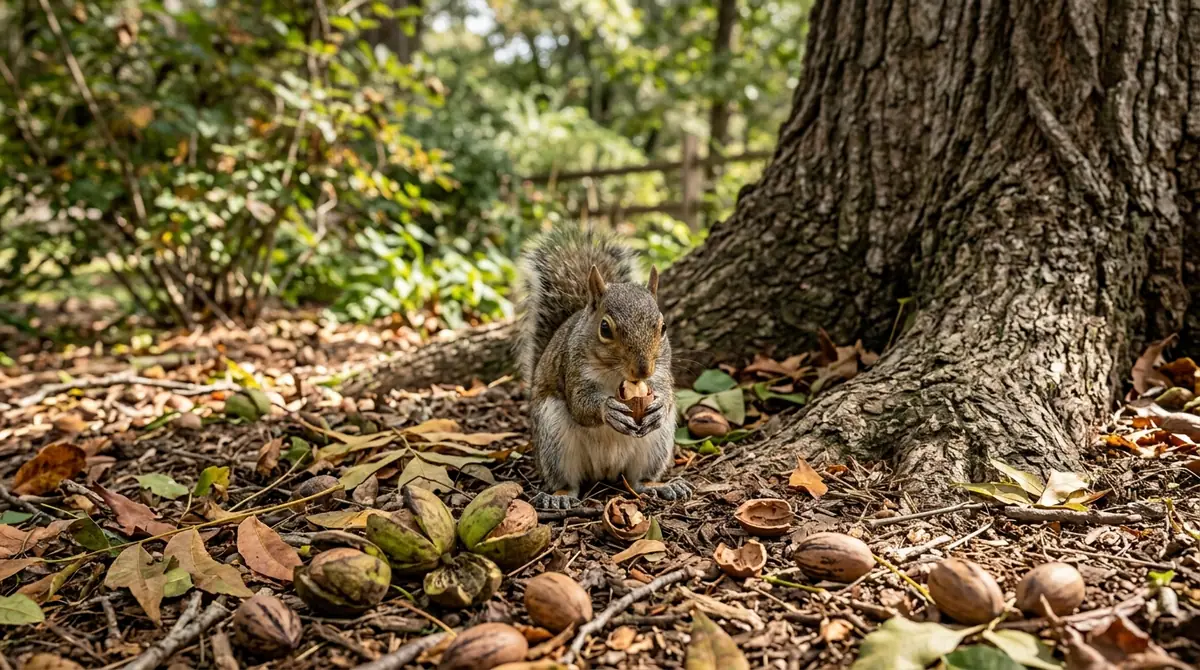
Homeowners across the American South and Midwest search for "pecans for squirrels" because wildlife engages in frantic burying, acrobatic theft, and relentless cracking around mature 'Desirable' pecan trees. Growing Carya illinoinensis for squirrels requires a delicate balance of arboriculture and ecology: you must nourish the trees to produce mast, while managing the undeniable appetite of your backyard wildlife.
1. Botanical Overview & Natural Habitat

In natural habitats, pecans act as a cornerstone species. Their heavy annual or biennial drop of energy-dense nuts provides critical caloric sustenance for omnivores preparing for winter dormancy. Squirrels, particularly the Eastern gray squirrel (Sciurus carolinensis) and the fox squirrel (Sciurus niger), have a co-evolutionary relationship with Carya illinoinensis. They don't just eat the pecans; they act as primary dispersers through scatter-hoarding. A single squirrel can bury thousands of pecans across a landscape each autumn, forgetting a significant percentage of them, which naturally germinates the next generation of floodplain forests.
Understanding this natural habitat dictates how we landscape with them. Pecans demand deep, well-draining soils with consistent access to moisture, mirroring the rich alluvial bottomlands where they evolved. When you plant pecans to support wildlife, you are stepping into an ancient ecological loop. You must provide conditions that satisfy both the tree's massive physiological needs and the high-octane nutritional demands of the wildlife it feeds.
2. Essential Environmental & Care Requirements
Growing healthy pecans capable of producing heavy nut yields requires strict adherence to environmental parameters. If you neglect these requirements, your tree will drop its nuts prematurely or fail to produce the high-fat kernels squirrels crave.
| Parameter | Optimal Condition | Common Mistake | Why It Matters |
|---|---|---|---|
| Soil pH | 6.0 to 7.0 | Planting in heavily alkaline or extremely acidic soil | Nutrient lock-up occurs outside this range, causing severe zinc and iron deficiencies. |
| Watering Depth | 2 inches (5 cm) of water weekly via rain or deep irrigation | Frequent, shallow surface sprinkling | Shallow watering forces root systems to stay near the topsoil, rendering the tree drought-vulnerable. |
| Temperature Range | 65°F to 95°F (18°C to 35°C) during the growing season | Expecting high yields in USDA zones below 5 | Insufficient heat units prevent the nuts from fully filling out their kernels. |
| Sun Exposure | Full sun (minimum 8 hours of direct light daily) | Planting in partial shade under a forest canopy | Shaded pecan trees stretch upward, produce weak wood, and suffer drastically reduced nut sets. |
Soil preparation is your foundational step. Pecans develop a deep taproot early in life, plunging rapidly into the earth to source water. Ensure your planting site has at least 4 feet (1.2 meters) of uncompacted soil before hitting bedrock or a hard clay pan.
Fertilization is equally non-negotiable. Mature pecan trees are heavy feeders, requiring balanced applications of nitrogen, phosphorus, and potassium, alongside micronutrients. Zinc is the single most critical trace element for pecans; without it, leaves become chlorotic and twisted, and nut production plummets. Consult the Texas A&M AgriLife Extension Pecan Management Guide for specific regional soil testing and fertilizer application schedules.
💡 Pro-Tip: Never apply nitrogen fertilizers to newly planted bare-root pecan trees until they have broken dormancy and pushed at least 6 inches (15 cm) of new terminal growth. Forcing early vegetative growth before the root system is established will shock or kill the young tree.
3. Step-by-Step Cultivation, Feeding & Propagation
Whether you are establishing a grove to feed local wildlife or planting a single specimen tree in a large suburban yard, follow this precise protocol for successful establishment.
- Select Compatible Cultivars: Purchase grafted trees rather than growing from seed, as seedlings produce unpredictable, often bitter nuts. Choose two different cultivars—such as 'Cape Fear' and 'Pawnee'—that have overlapping pollination periods (Type I and Type II) to ensure cross-pollination and a reliable nut drop for your backyard squirrels.
- Dig the Planting Hole: Excavate a hole 3 to 4 feet (90 to 120 cm) deep to accommodate the fragile taproot, ensuring the hole is twice as wide as the root ball. Do not amend the backfill soil with heavy compost; native soil encourages the roots to venture outward into the surrounding landscape.
- Plant the Tree: Position the bare-root tree or container-grown specimen so the root flare sits 1 inch (2.5 cm) above the surrounding grade. Backfill halfway, tamp gently to remove large air pockets, and thoroughly saturate the soil with 5 gallons (19 liters) of water to settle the earth.
- Apply Mulch and Guard: Finish filling the hole, then apply a 3-inch (7.6 cm) layer of shredded hardwood mulch in a 3-foot (1-meter) radius around the trunk, keeping the mulch 2 inches (5 cm) away from the bark to prevent collar rot. Install a hardware cloth cylinder around the trunk to protect the young bark from foraging rodents and rabbits.
- Establish Irrigation Routine: Provide 1 inch (2.5 cm) of water every 7 to 10 days during the first two growing seasons. As the tree matures, transition to deep, infrequent soakings that penetrate down to 36 inches (91 cm).
- Execute Annual Maintenance: Apply a slow-release, zinc-fortified fruit and nut tree fertilizer in early spring just as buds swell. Prune out crossing or dead branches strictly during the dormant winter window (December through February) to prevent the spread of fungal pathogens.
4. Common Problems, Pests & Troubleshooting
Managing pecans for wildlife means accepting that you share the harvest, but pest pressures can jeopardize the health of the entire tree before the squirrels even get a chance to climb the branches.
Pecan scab (Cladosporium caryigenum) is the most destructive fungal disease facing growers, thriving in humid environments. It manifests as black, velvety lesions on leaves, twigs, and developing shucks, frequently causing the nuts to drop prematurely in July and August. Preventative fungicide applications timed with leaf expansion are often necessary in high-humidity zones.
Insect pests also demand vigilance. The pecan nut casebearer (Acanthoryctria caryae) bores into young nuts during May, destroying the interior kernel. Scout for these greenish-gray larvae by watching for small silken webs at the base of nut clusters. Similarly, the hickory shuckworm targets the outer husk late in the season, preventing the husks from splitting cleanly.
⚠️ Important Caution: If you plan to consume any pecans yourself alongside your local squirrels, strictly adhere to pre-harvest intervals (PHIs) when applying any chemical insecticides or fungicides. Many commercial formulations are unsafe for human consumption if applied within 30 to 60 days of nut harvest.

5. Frequently Asked Questions
Do squirrels prefer native pecan trees over grafted cultivars?
Squirrels are opportunistic foragers and will readily harvest both native seedlings and cultivated varieties. However, native pecans often feature thinner shells and smaller, oil-rich kernels that squirrels find exceptionally easy to crack and highly palatable.
How many pounds of pecans does a mature tree produce for wildlife?
A mature, healthy standard pecan tree aged 15 to 20 years can produce anywhere from 50 to 150 pounds (22 to 68 kg) of nuts annually. This heavy mast production provides more than enough calories to sustain a local population of squirrels through the autumn and winter months.
Are green pecan shucks poisonous to squirrels or dogs?
The green outer shucks of pecans are not inherently poisonous, but they can harbor molds, particularly Aspergillus species, which produce dangerous mycotoxins. While wild squirrels instinctively avoid moldy nuts, domestic dogs can suffer severe neurological tremors and gastrointestinal distress if they ingest moldy pecan shucks or fallen decaying nuts from the ground.
Why do squirrels bury some pecans and eat others immediately?
This behavior is driven by an instinctive survival strategy called scatter-hoarding versus scatter-eating. When pecans are abundant in autumn, squirrels eat the high-sugar, soft-kernel nuts on the spot for immediate energy, while burying the firmer, late-maturing nuts to create a dispersed food reserve for lean winter and early spring months.
Related Guides
📋 Table of Contents ▼ Click to expand
Tags:
🌿 Related Plants You Might Like






PlantSavvyWorld
Editorial team
PlantSavvyWorld is an independent botanical education project. Articles are drafted with AI assistance, then edited and checked against university extension services, botanical garden collections and other published horticultural sources.