

Palo Verde Seedling
Written with AI assistance, edited and checked against horticultural sources.
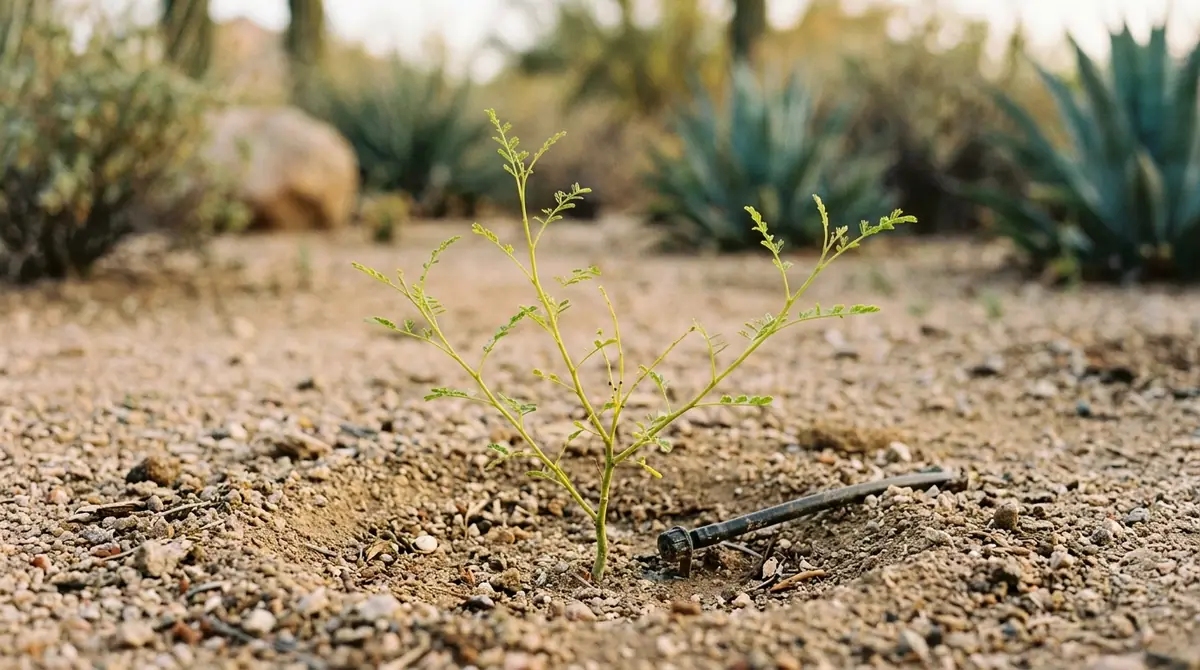

1. Botanical Overview & Natural Habitat
Palo verde trees—predominantly species within the Parkinsonia genus, most notably Parkinsonia florida (Blue Palo Verde) and Parkinsonia microphylla (Foothill Palo Verde)—belong to the Fabaceae (pea or legume) family. Their defining botanical adaptation is chlorophyll-infused bark. Unlike most trees that rely strictly on their leaves for photosynthesis, palo verdes drop their tiny, bipinnate leaves during periods of drought or extreme heat to conserve water, shifting the entire photosynthetic burden to their vibrant green trunks and branches.
In their native Sonoran and Mojave Desert habitats, palo verde seedlings germinate following rare, torrential summer monsoons or winter rains. They encounter baking surface temperatures that frequently exceed 120°F (49°C) and native alkaline soils with an extremely low organic matter content, often registering a pH between 7.5 and 8.5.
To survive these punishing conditions, a palo verde seedling immediately halts above-ground shoot growth to invest an immense amount of energy underground. Within the first 60 to 90 days of life, a seedling will routinely plunge a taproot 12 to 24 inches (30 to 60 cm) deep into the earth to chase vanishing moisture tables, while the visible stem might only measure a modest 2 to 4 inches (5 to 10 cm) tall.
2. Essential Environmental & Care Requirements
Replicating these harsh desert conditions in a landscape or nursery setting is the secret to strong structural development. Palo verde seedlings demand blazing solar exposure and absolute drainage perfection.
| Parameter | Optimal Condition | Common Mistake | Why It Matters |
|---|---|---|---|
| Light Exposure | Full sun (6–8+ hours of direct, unshaded light daily) | Growing seedlings on a shaded, north-facing patio or indoors | Low light causes etiolation, producing weak, leggy stems that cannot support the canopy weight. |
| Soil Medium | Gritty, highly porous desert mix (50% native mineral soil, 50% coarse sand/pumice) | Planting in rich, heavy organic potting compost | Organic-heavy soils retain moisture far too long, inviting fatal Pythium and Phytophthora fungal pathogens. |
| Watering Frequency | Deep, infrequent irrigation allowing total dry-out between cycles | Frequent, shallow daily waterings | Shallow watering encourages a weak surface root system rather than the deep taproot essential for survival. |
| Ambient Temperature | Warm daytime highs of 85°F to 95°F (29°C to 35°C) | Exposing young seedlings to prolonged indoor drafts or freezing air | Extreme cold damages cellular walls before the wood hardens, while constant indoor humidity breeds rot. |
Soil composition is particularly critical when transitioning container-grown seedlings to the landscape. According to the University of Arizona Cooperative Extension, desert natives thrive in unamended native soils because heavy organic amendments create a perched water table effect in planting holes, effectively drowning the root system.
💡 Pro-Tip: Never fertilize a palo verde seedling with high-nitrogen commercial plant foods. As legumes, they form a symbiotic relationship with native Rhizobium soil bacteria that fix their own atmospheric nitrogen. Forcing them with synthetic fertilizers results in rapid, sappy green growth that breaks easily in high winds and attracts sucking insects like aphids.
3. Step-by-Step Cultivation, Feeding & Propagation
Growing a palo verde seedling from seed requires breaking the hard, impermeable physical dormancy of the seed coat. In nature, this is achieved by the scouring action of flash floods carrying abrasive gravel, or the digestive acids of desert herbivores.
- Scarify the Seed Coat: Gently nick the hard seed coat using a clean metal nail file or fine-grit sandpaper until you barely expose the lighter-colored inner cotyledon tissue, taking extreme care not to damage the internal embryo.
- Perform Hot Water Scarification: Place the scarified seeds into a heat-proof container, pour boiling water (212°F or 100°C) over them, and let them steep undisturbed for 24 hours. The seeds should visibly swell to at least double their original dry volume.
- Prepare the Propagation Container: Fill a deep, narrow tree-pot (often called a "treepot" or "drip tube," measuring at least 8 to 10 inches / 20 to 25 cm in depth) with a sterile mix of 70% coarse perlite and 30% sandy loam to accommodate the aggressive vertical taproot.
- Sow at the Proper Depth: Plant the plumped seeds at a depth of 0.5 inches (1.2 cm). Press the medium down firmly to ensure solid seed-to-soil contact.
- Provide Bottom Heat and Moisture: Place the container in a warm location maintaining ambient temperatures between 80°F and 85°F (27°C to 29°C). Mist the surface lightly to keep it damp—never soggy—until germination occurs, which typically happens within 7 to 14 days.
- Harden Off the Seedling: Once true leaves emerge, transition the container directly into full, unfiltered outdoor sunlight over a period of 7 days to trigger the tree's natural photosynthetic green-bark adaptation.
- Transplant with Care: Move the seedling to its permanent landscape location when it is roughly 6 to 12 inches (15 to 30 cm) tall, ensuring you slide it gently out of its deep pot without disturbing or coiling the delicate vertical taproot.
4. Common Problems, Pests & Troubleshooting
Even with meticulous care, palo verde seedlings will occasionally signal distress. Because these trees are exceptionally tough, their problems are almost always environmental rather than pathological.
If you notice the green stem turning a dull, mushy yellow-brown at the soil line, you are dealing with root rot, known scientifically as Phytophthora or Pythium crown rot. This occurs when the soil stays wet for more than 48 consecutive hours. Immediately cease all watering, remove the seedling from the soggy medium, trim away black or rotting root material with sterilized shears, and repot into bone-dry, gravelly soil.
If the seedling's stem begins to stretch rapidly upward while leaning at a severe angle toward the nearest window or patio edge, it is suffering from severe light starvation. Relocate it immediately to a spot receiving direct, unhindered sun.
You may occasionally spot minor infestations of palo verde aphids or psyllids clustering on the tender tip growth during damp spring weeks. These insects secrete a sticky honeydew.
⚠️ Important Caution: Do not apply systemic insecticides or heavy chemical sprays to young palo verde seedlings. Their juvenile tissue is exceptionally sensitive to chemical burn. Instead, blast offending insects off the plant using a sharp, direct stream of clean water from a garden hose early in the morning.

5. Frequently Asked Questions
How fast does a palo verde seedling grow?
In its first year, a palo verde seedling invests nearly all of its metabolic energy into establishing a deep, subterranean taproot, meaning above-ground vertical growth is typically quite slow, averaging only 6 to 12 inches (15 to 30 cm) in height. Once the root system is firmly anchored—usually by year two or three—annual branch growth accelerates dramatically, often pushing out 2 to 3 feet (60 to 90 cm) of new canopy per year under optimal full-sun conditions.
Can I grow a palo verde seedling indoors as a houseplant?
No, growing a palo verde seedling indoors on a windowsill is virtually impossible to sustain long-term. Indoor environments lack the intense ultraviolet radiation, high ambient temperatures, and air movement required to trigger the tree's bark photosynthesis and robust wood hardening. Within a few months indoors, seedlings invariably succumb to etiolation, root rot, and terminal decline.
When is the best time of year to plant a palo verde seedling outdoors?
The absolute best time to plant a palo verde seedling into the landscape is late spring or early summer, just prior to the arrival of the seasonal monsoons. This timing allows the warm soil temperatures to stimulate rapid root expansion, while natural rainfall patterns help ease the transition stress without requiring constant manual irrigation.
How often should I water a newly planted palo verde seedling?
For the first two to three weeks after transplanting your seedling into the ground, water it deeply once every 5 to 7 days to help settle the surrounding soil. Gradually taper off this frequency over the next two months, shifting to a deep soak every 3 to 4 weeks by the end of its first summer. Once established after its second year, a palo verde requires almost no supplemental irrigation outside of natural rainfall.
Related Guides
📋 Table of Contents ▼ Click to expand
Tags:
🌿 Related Plants You Might Like






PlantSavvyWorld
Editorial team
PlantSavvyWorld is an independent botanical education project. Articles are drafted with AI assistance, then edited and checked against university extension services, botanical garden collections and other published horticultural sources.