

Monstera Sheath
Written with AI assistance, edited and checked against horticultural sources.
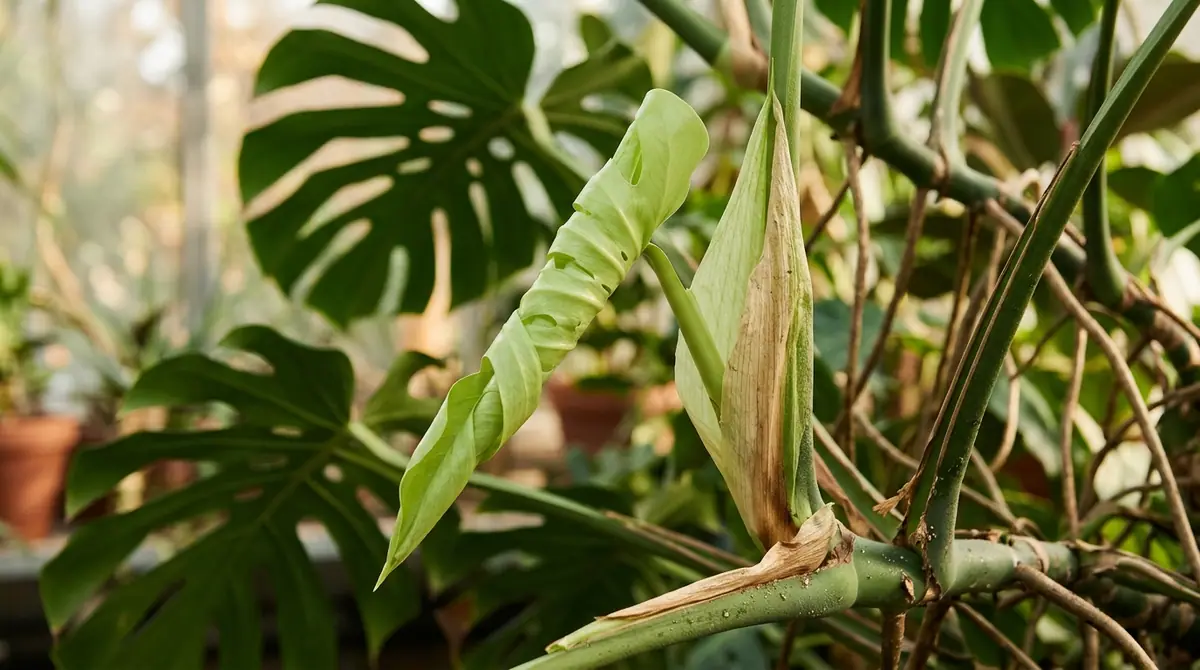
A brown, papery scrap often clings to the base of a Monstera deliciosa stem. While some panic and are convinced the prized plant is rotting from a mysterious disease, that strange structure is a normal feature, and leaving it alone is the secret to the plant's structural integrity.

1. Botanical Overview & Natural Habitat
In their native understory habitats of Central and South American rainforests, species like Monstera deliciosa and Monstera adansonii rely on a specialized leaf structure to survive. The monstera sheath—technically known as the vaginate petiole base—is the expanded, channelled lower portion of the leaf stem that wraps around the main vine.
As a new leaf develops, it unfurls from within this protective wrapper. Botanically, the sheath acts as a structural brace and a water-guiding conduit. In the wild, where rainfall is torrential, the sheath funnels vital moisture and organic debris directly toward the aerial root nodes embedded along the stem. It also shields the tender meristematic tissue from mechanical damage and insect predation while the juvenile leaf pushes upward toward filtered sunlight.
Morphologically, the sheath is an extension of the leaf petiole. As the leaf matures and hardens off, the sheath loses its turgor pressure, dries out, and turns brown. This transition often alarms growers who mistake natural senescence for disease. Understanding that this tissue is meant to desiccate is your first step toward mastering tropical plant care.
2. Essential Environmental & Care Requirements
To produce robust leaves with healthy, vigorous sheaths, your indoor environment must mimic the warm, humid conditions of a tropical canopy. Here are the precise environmental benchmarks required for optimal sheath development and leaf emergence.
| Parameter | Optimal Condition | Common Mistake | Why It Matters |
|---|---|---|---|
| Temperature | 70°F to 85°F (21°C to 29°C) | Allowing drops below 60°F (15°C) | Cold stress halts cellular division, causing leaves to trap and tear inside the sheath. |
| Humidity | 60% to 80% relative humidity | Ambient home air at 30% to 40% | Low humidity dries the sheath prematurely, choking the emerging leaf and causing distortion. |
| Light | 10,000 to 20,000 lux (bright, indirect) | Direct midday sun or deep shade | Insufficient light weakens petiole structure, preventing the sheath from supporting heavy foliage. |
| Soil Moisture | Top 2 inches (5 cm) dry between waterings | Keeping soil soggy or bone dry | Errant moisture levels cause root shock, directly interrupting the hydration needed for leaf unfurling. |
💡 Pro-Tip: If you notice your new monstera leaves consistently getting stuck inside the sheath, do not immediately reach for a mister. Instead, run a small humidifier directly adjacent to the plant to maintain a constant 70% relative humidity zone. Ambient humidity is far more effective for softening dry sheath tissue than sporadic misting, which can invite fungal leaf spot pathogens like Pseudomonas.
To deepen your understanding of tropical plant morphology and systemic care guidelines, consult the Royal Horticultural Society plant care guides.
3. Step-by-Step Cultivation, Feeding & Propagation
When cultivating monsteras for optimal growth and clean, unhindered leaf emergence, you need a disciplined approach to maintenance. Here is your protocol for managing the plant's structural development.
- Assess the Light and Micro-Climate: Position your monstera within 3 feet (1 meter) of an east- or north-facing window, ensuring ambient temperatures remain consistently between 75°F (24°C) and 80°F (27°C).
- Apply Balanced Nutrition: Feed your plant every 14 days during the active growing season (spring through summer) using a balanced, water-soluble liquid fertilizer diluted to half-strength (e.g., NPK 10-10-10). This provides the macronutrients necessary for strong petiole and sheath cell wall formation.
- Inspect Emerging Growth Weekly: Look closely at the nodes where new leaves form. If you see a swelling petiole, your plant is preparing to push a new leaf through the sheath.
- Manage Dead Sheath Tissue: Wait until the sheath tissue has completely dried, turned brown, and papery. Gently peel it away from the main stem using clean fingers or sterilized pruning shears. Never pull on a sheath that is still green or semi-green, as you risk tearing the active stem vascular bundles.
- Support Vertical Ascent: Tie the main stem to a moss pole or cedar plank using soft plant velcro, ensuring the node and sheath areas remain unobstructed and free from compression.
⚠️ Important Caution: Never force an emerging monstera leaf out of a tight sheath by ripping or tearing the wrapper with your fingers or tools. The delicate vascular tissue connecting the new leaf to the stem is easily ruptured, which will permanently deform or kill the new leaf before it even opens. If a leaf is severely stuck, apply a single drop of warm water to the binding site using a pipette and let natural humidity do the work.
For additional university-backed research on soil microbiology and plant nutrition, visit the University of Florida IFAS Extension.
4. Common Problems, Pests & Troubleshooting
Even with pristine care, issues can arise around the petiole and sheath zones. Here is how to diagnose and correct them.
- Trapped Leaves (Mechanical Binding): When a new leaf fails to emerge and stays crumpled inside the sheath for more than 14 days, low humidity is almost always the culprit. Remedy this by increasing ambient humidity immediately and wiping the sheath with a damp microfiber cloth to soften the fibers.
- Rotting Sheaths: If the base of the sheath turns black, mushy, and emits a foul odor, you are dealing with a bacterial or fungal infection, typically triggered by overwatering or poor air circulation. Sterilize a sharp blade, cut away the rotting tissue down to healthy green stem tissue, and dust the wound with cinnamon or sulfur powder as a natural antifungal.
- Pest Infestations (Thrips and Mealybugs): The tight crevices of a monstera sheath are prime real estate for thrips larvae and mealybugs. These pests hide inside the overlapping tissue layers, feeding on sap and leaving behind stippled, silvery leaves. Inspect these zones with a jeweler's loupe, and treat infestations by scrubbing the area with a cotton swab dipped in 70% isopropyl alcohol, followed by an application of cold-pressed neem oil.

5. Frequently Asked Questions
Should I cut off the brown sheath on my monstera?
You should only remove the sheath once it has turned completely brown, dry, and papery. At this stage, it is dead tissue and can be gently peeled away to improve air circulation around the stem and prevent pest hideouts. Leave green or partially living sheaths attached, as they are still functioning.
Why is my new monstera leaf stuck in the sheath?
A trapped leaf is almost always caused by insufficient relative humidity, which makes the sheath tissue dry, tough, and inflexible. When the air drops below 50% humidity, the sheath tightens its grip around the emerging leaf. Increase humidity to 70% and gently mist the area to help the tissue soften.
Do all aroids have a monstera sheath?
No. While many members of the Araceae family feature modified petioles, the prominent, wrapping sheath that completely encloses the developing leaf petiole is particularly characteristic of climbing genera like Monstera and Philodendron, whereas plants like Epipremnum aureum (pothos) have different attachment structures.
Is the monstera sheath where aerial roots grow?
Not directly, though they are closely associated. Aerial roots emerge from the dormant nodes located immediately below the leaf petiole and sheath junction. As the stem matures and the old sheath falls away, the node and its corresponding aerial root are exposed directly to the air.
Related Guides
📋 Table of Contents ▼ Click to expand
Tags:
Keep reading
🌿 Related Plants You Might Like






PlantSavvyWorld
Editorial team
PlantSavvyWorld is an independent botanical education project. Articles are drafted with AI assistance, then edited and checked against university extension services, botanical garden collections and other published horticultural sources.