

Magnificent Croton
Written with AI assistance, edited and checked against horticultural sources.
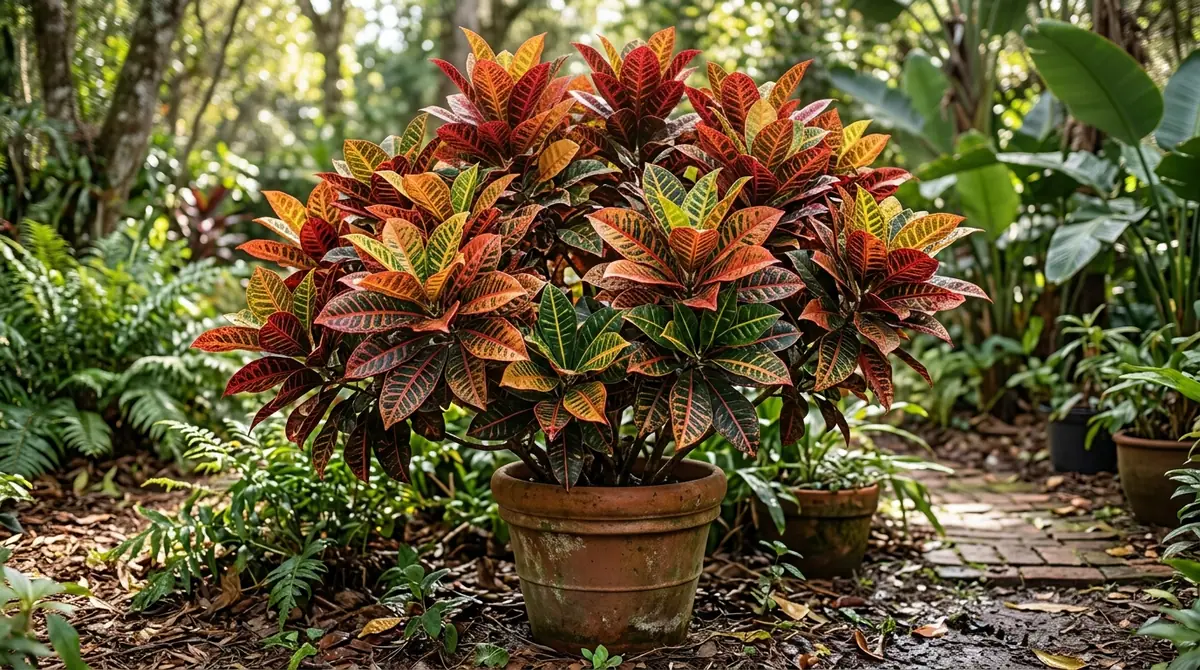
The morning sun cut through the glass of a greenhouse, striking a ten-inch container of Codiaeum variegatum 'Magnificent' just as it caught the daily misting cycle. The light didn't simply reflect off the foliage; it dissolved through a translucent tapestry of crimson, golden-yellow, deep olive, and vibrant orange, all mapped across broad, lobed leaves. Twenty years ago, when I first inherited a leggy, neglected specimen from a retiring horticulturist in Savannah, I nearly ruined it by moving it into a dim office corner within forty-eight hours. Within a week, it dropped half its leaves in protest. That hard lesson taught me that the Magnificent Croton is not a plant you tuck away quietly in the shadows—it is an absolute diva of color that demands specific, uncompromising environmental conditions to truly thrive.

1. Botanical Overview & Natural Habitat
The Magnificent Croton belongs to the family Euphorbiaceae, a remarkably diverse group of plants that also includes poinsettias and rubber trees. Scientifically classified as Codiaeum variegatum 'Magnificent', this specific cultivar is celebrated for its broad, multi-colored leaves that often feature striking twists and variable lobes.
In its native habitats of Southeast Asia, Northern Australia, and the western Pacific islands, the Magnificent Croton grows as a dense, evergreen woody shrub that can eventually reach heights of 6 to 10 feet (1.8 to 3 meters) with a spread of 3 to 6 feet (0.9 to 1.8 meters). In indoor container cultivation, however, you can realistically expect it to top out between 3 and 5 feet (0.9 to 1.5 meters).
What makes the foliage of Codiaeum variegatum so botanically fascinating is its pigment architecture. While juvenile leaves emerge in understated shades of chartreuse or soft green with yellow veins, they undergo an astonishing color metamorphosis as they mature. This transformation is driven by varying concentrations of chlorophyll (green), carotenoids (yellow and orange), and anthocyanins (red and purple), all synthesized in direct response to light intensity.
For comprehensive botanical classification data and historical cultivation records of the Euphorbiaceae family, you can consult the Royal Botanic Gardens, Kew.
2. Essential Environmental & Care Requirements
If you want the vibrant, multi-hued display that earned this cultivar its name, you must replicate its native tropical understory or rainforest-edge habitat. Compromising on light or humidity is the fastest way to turn a magnificent plant into a dull, dropping stick.
Light
Magnificent Crotons require a minimum of 6 to 8 hours of bright, indirect to direct sunlight daily. An unobstructed east-facing or a bright west-facing window is ideal. If grown in medium or low light, the plant will produce solid green leaves, losing its signature variegation entirely.
Temperature
This tropical native despises sudden thermal shocks and drafts. Maintain indoor ambient temperatures between 65°F and 85°F (18°C to 29°C). Never expose the plant to temperatures dropping below 60°F (15°C), as chilling injury causes rapid, irreversible defoliation.
Humidity
Relative humidity must be kept high, ideally between 50% and 70%. Below 40% humidity, leaf margins will brown and crisp, and the plant becomes a prime target for spider mites.
| Parameter | Optimal Condition | Common Mistake | Why It Matters |
|---|---|---|---|
| Light | 6–8 hours of bright, direct/indirect light | Placing in a dark room or north-facing corner | Insufficient light halts pigment synthesis, causing leaves to revert to solid green and drop. |
| Watering | Water thoroughly when top 1 inch (2.5 cm) is dry | Keeping soil soggy or letting it dry out completely | Crotons drop leaves from drought stress or root rot from waterlogged media. |
| Temperature | 65°F to 85°F (18°C to 29°C) | Placing near AC vents, heaters, or drafty doors | Sudden thermal drops shock the vascular system, triggering mass leaf drop. |
| Humidity | 50% to 70% relative humidity | Relying on dry indoor winter air without a humidifier | Low moisture causes crispy leaf tips and attracts microscopic sap-sucking pests. |
💡 Pro-Tip: When you bring a new Magnificent Croton home from the nursery, do not move it more than once. Select its permanent, brightly lit spot immediately. Crotons possess an intensely sensitive photosensory system and will drop their leaves in a dramatic "tantrum" if forced to re-acclimate to a new light gradient.
3. Step-by-Step Cultivation, Feeding & Propagation
Successful long-term cultivation of Codiaeum variegatum 'Magnificent' relies on precise root-zone management and structured nutritional support. Because these plants are vigorous growers during the warm season, following a reliable protocol ensures balanced development.
Step-by-Step Potting and Soil Preparation
- Select the container: Choose a pot with adequate drainage holes that is only 1 to 2 inches (2.5 to 5 cm) larger in diameter than the current root ball. Crotons prefer to be slightly root-bound.
- Mix the soil: Combine 2 parts high-quality peat-based potting soil, 1 part perlite or coarse horticultural sand, and 1 part orchid bark to create a fast-draining, highly aerated medium with a target pH between 5.5 and 6.5.
- Layer the base: Add a 1-inch (2.5 cm) layer of the soil mix to the bottom of the container.
- Position the plant: Unpot the croton, gently tease apart any tightly bound outer roots to encourage radial expansion, and set it in the center so the soil line matches its previous depth.
- Backfill and settle: Fill in the gaps with the remaining soil mix, tapping the pot gently to eliminate large air pockets, and water thoroughly until it runs freely from the drainage holes.
Feeding and Fertilization
During the active growing season (spring through summer), feed your Magnificent Croton every 4 weeks with a balanced, water-soluble houseplant fertilizer diluted to half-strength. Look for formulations containing essential micronutrients like iron and magnesium, which support intense leaf coloration. Cease fertilization entirely from late autumn through winter when plant metabolism slows down.
Propagation Protocol
Propagating your croton via stem cuttings is entirely achievable if you maintain warm, sterile conditions.
- Select a healthy, disease-free stem tip in late spring measuring 4 to 6 inches (10 to 15 cm) in length.
- Using sterilized pruning shears, make a clean cut just below a leaf node.
- Dip the cut end in rooting hormone powder to accelerate root initiation and deter fungal pathogens.
- Insert the cutting 2 inches (5 cm) deep into a pre-moistened mixture of half perlite and half peat moss.
- Tent the cutting with a clear plastic bag or place it inside a propagation dome to trap humidity, ensuring bottom heat is maintained at 75°F to 80°F (24°C to 27°C).
- Roots typically develop within 30 to 45 days. Once roots reach 1 inch (2.5 cm) in length, transplant the cutting into a standard 4-inch (10 cm) container.
⚠️ Important Caution: The milky sap of the Magnificent Croton contains diterpene esters that are toxic when ingested and can cause severe contact dermatitis or allergic reactions on human skin and mucous membranes. Always wear gloves when pruning, propagating, or handling broken stems, and wash your hands immediately afterward.
4. Common Problems, Pests & Troubleshooting
Even experienced growers occasionally run into issues with this dramatic cultivar. Here is how to diagnose and correct the most frequent problems.
Sudden Leaf Drop
If your croton is dropping leaves rapidly, examine your watering and placement history. Did it experience a sudden draft? Has the soil completely dried out, or conversely, stayed wet for over a week? Correct the environmental stressor immediately; while mature stems will recover, dropped leaves will not grow back, leaving lower stems bare.
Pest Infestations
Dry indoor air is an open invitation for spider mites and mealybugs. Spider mites manifest as fine webbing on the undersides of leaves accompanied by stippled, yellowing foliage. Mealybugs appear as small, cottony white masses in leaf axils.
- Treatment: Wipe all leaves down with a damp microfiber cloth to physically remove pests. Thoroughly spray the plant with insecticidal soap or horticultural neem oil, ensuring coverage of leaf undersides and stems. Repeat the treatment every 7 days for a 3-week cycle to break the pest reproductive lifecycle.
Fungal Leaf Spot
Overwatering combined with poor air circulation can lead to fungal leaf spots characterized by dark, water-soaked circles on the foliage. Remove severely affected leaves, improve room ventilation with a small oscillating fan, and let the top 2 inches (5 cm) of soil dry out completely between waterings.

5. Frequently Asked Questions
Why is my Magnificent Croton losing its bright colors and turning green?
This is almost always caused by insufficient light intensity. When a croton does not receive enough photons, it stops producing protective colorful pigments and ramps up chlorophyll production to capture more light. Move the plant closer to a bright, sun-drenched window, but transition it gradually over 7 to 10 days to prevent sunburn.
How often should I water my indoor Magnificent Croton?
Water your croton thoroughly only when the top 1 inch (2.5 cm) of soil feels completely dry to the touch. Depending on your indoor humidity and temperature, this typically translates to every 7 to 10 days in the summer and every 14 to 21 days in the winter. Always discard excess water collected in the saucer to prevent root rot.
Can I put my Magnificent Croton outdoors for the summer?
Yes, absolutely. Moving your croton outdoors to a shaded patio or a spot with dappled morning sunlight during the warm summer months can dramatically boost its vigor and color vibrancy. However, you must bring it indoors well before night temperatures drop consistently below 60°F (15°C).
Is the Magnificent Croton toxic to cats and dogs?
Yes. The sap of the Magnificent Croton is toxic to cats, dogs, and horses. Ingestion can cause intense oral irritation, excessive drooling, vomiting, and diarrhea. Keep the plant safely elevated on plant stands or display shelves far out of reach of curious household pets.
Related Guides
📋 Table of Contents ▼ Click to expand
Tags:
🌿 Related Plants You Might Like



PlantSavvyWorld
Editorial team
PlantSavvyWorld is an independent botanical education project. Articles are drafted with AI assistance, then edited and checked against university extension services, botanical garden collections and other published horticultural sources.