

How to Design a Drought Tolerant Mediterranean Garden
Written with AI assistance, edited and checked against horticultural sources.
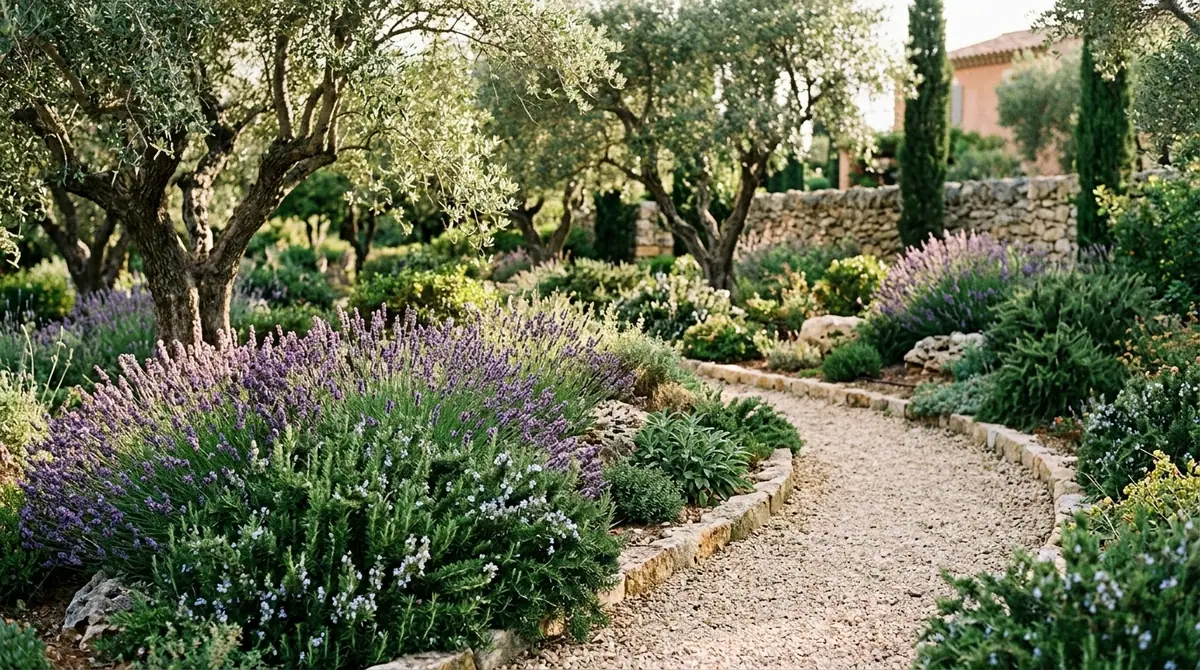
Last July, standing on a gardener's baking clay slope in Sonoma County while the thermometer hit 104°F (40°C), I watched a pristine turf lawn turn to crisp, yellow-brown dust in real time. We ripped out 2,500 square feet of that thirsty grass the following week. In its place, we built a layered Mediterranean refuge featuring silver-leafed foliage, deep-taprooted shrubs, and aromatic herbs that actually smelled better the harder the sun beat down on them.

Here is my definitive guide on how to design a drought tolerant mediterranean garden that performs brilliantly across USDA zones 8 through 11.
1. Botanical Overview & Natural Habitat
Mediterranean gardens mimic the harsh, beautiful conditions found in the five global regions sharing a Mediterranean climate: the Mediterranean Basin itself, coastal California, central Chile, the Cape Province of South Africa, and southwestern and southern Australia. These regions share a distinct climatic rhythm: cool, wet winters and hot, bone-dry summers, compounded by poor, rocky soils and blazing solar exposure.
Plants evolved here to outsmart drought, not by abandoning water, but by mastering water conservation. We categorize these resilient species into three structural layers:
- The Canopy & Structural Layer: Sculptural trees and upright shrubs like Olea europaea (Olive), Arbutus unedo (Strawberry Tree), and Cupressus sempervirens (Italian Cypress) provide vertical contrast and cooling shade.
- The Shrub & Mounding Layer: Aromatic, woody perennials such as Lavandula (Lavender), Rosmarinus officinalis (Rosemary—now taxonomically Salvia rosmarinus), and Cistus (Rockrose) form dense, weed-suppressing mounds that anchor the design.
- The Groundcover & Perennial Layer: Low-growing, creeping spillers like Creeping thyme (Thymus serpyllum), Teucrium chamaedrys (Germander), and bulbous accents such as Agapanthus or Tulbaghia violacea (Society Garlic) knit the composition together at ground level.
Adaptations across these plants are marvels of botanical engineering. Many employ sclerophylly—thick, leathery, or needle-like leaves that minimize transpiration. Others use indumentum, a dense covering of fine hairs that traps a boundary layer of humid air against the leaf surface, scattering harsh UV rays and reflecting light (which accounts for that signature silvery-grey aesthetic).
| Parameter | Optimal Condition | Common Mistake | Why It Matters |
|---|---|---|---|
| Soil Drainage | Rapidly draining, coarse mineral soil (percolation rate >2 inches/hr) | Planting in heavy, compacted clay | Stagnant water around roots triggers Phytophthora root rot, the #1 killer of Mediterranean flora. |
| Solar Exposure | Full sun (minimum 6 to 8 hours of direct, unobstructed sunlight daily) | Placing shade-loving plants nearby or under dense tree canopies | Low light causes leggy, weak stems, loss of essential oils, and poor flowering. |
| Root Zone Oxygen | High air-filled porosity in upper 12 inches (30 cm) of soil | Over-amending planting holes with rich, organic compost | Organic matter holds excess moisture; native roots rot when coddled with rich loam. |
| Establishment Watering | Deep soaking every 7 to 10 days for the first root-growth season | Frequent, shallow sprinkles that wet only the top 1 inch (2.5 cm) | Shallow watering trains roots to stay near the surface, making them vulnerable to drought stress. |
2. Essential Environmental & Care Requirements
Designing a Mediterranean garden requires shifting your perspective from constant intervention to intentional neglect once established. These plants are adapted to survive lean conditions, and trying to love them to death with fertilizer and water is the fastest way to ruin them.
Sunlight and Exposure: You must site your garden in full sun. Most Mediterranean natives originate from chaparral, maquis, or garrigue biomes where shade is a rare luxury. Partial shade will cause sun-loving herbs like lavender to split open in the middle, lose their woody density, and invite fungal pathogens due to poor air circulation.
Soil Composition and pH: The native soils of the Mediterranean basin are typically calcareous, alkaline (pH 7.0 to 8.5), and heavily mineral-based, consisting of weathered limestone, shale, and fractured rock. While many species tolerate neutral soils, they universally demand exceptional drainage. If your native soil is heavy clay, do not merely amend individual planting holes—which creates a literal bathtub effect holding water around the root ball. Instead, amend the entire planting bed with coarse horticultural grit, decomposed granite, and sharp sand to a depth of at least 12 inches (30 cm), or build raised beds.
Irrigation Management: During the establishment phase—typically the first 12 to 18 months—plants require consistent moisture to develop deep root systems. Water young plants deeply once every 7 to 10 days if there is no natural rainfall. Once established, scale back drastically. Mature Mediterranean plants generally thrive on deep, infrequent soakings once every 3 to 4 weeks during peak summer, or rely solely on natural rainfall if your region receives 15 to 25 inches (380 to 635 mm) of annual precipitation.
💡 Pro-Tip: When you do water established Mediterranean shrubs, run your drip irrigation or soaker hoses for 3 to 4 hours straight rather than 20 minutes daily. This forces water down to a depth of 18 to 24 inches (45 to 60 cm), encouraging roots to dive deep into the cooler, moister subsoil where they are protected from surface heat.
3. Step-by-Step Cultivation, Feeding & Propagation
Building a Mediterranean landscape from scratch demands precision. Follow this exact workflow to ensure high survival rates and long-term garden resilience.
- Site Assessment & Drainage Testing: Dig a hole 12 inches (30 cm) deep and fill it with water. Allow it to drain completely, then fill it a second time. Measure how many inches it drops per hour. If the rate is less than 1.5 inches (3.8 cm) per hour, you must install subsurface drainage tiles or build raised berms before proceeding.
- Rough Grading and Contouring: Shape your landscape to create natural slopes and swales. This not only adds visual topography reminiscent of the Tuscan hills or Greek islands, but it also directs any excess winter rainwater away from crown-sensitive plants and toward deeper root reservoirs.
- Soil Preparation & Mineral Amendment: Spread a 2-inch (5 cm) layer of mineral aggregate—such as 3/8-inch crushed lava rock or decomposed granite—across the bed. Till or fork this thoroughly into the top 8 inches (20 cm) of native soil to break up compaction and maximize air-filled porosity.
- Planting Layout and Spacing: Arrange plants in their container pots on the soil surface before digging a single hole. Space larger shrubs (Arbutus, Laurus nobilis) 6 to 8 feet (1.8 to 2.4 m) apart, and smaller perennials (Santolina, Salvia) 2 to 3 feet (0.6 to 0.9 m) apart. Remember that crowded plants trap humidity, which is fatal in summer.
- Installation Technique: Dig planting holes twice as wide as the nursery container, but no deeper than the root ball. Gently score the outer roots if root-bound. Set the plant so that the root flare sits 0.5 inches (1.3 cm) above the surrounding grade. Backfill with the native-grit mixture—do not add fertilizer or rich compost to the hole.
- Mineral Mulching: Apply a 2-inch (5 cm) layer of 0.5-inch to 1-inch (1.3 to 2.5 cm) gravel, crushed slate, or river rock over the entire bed. Keep the rock 2 inches (5 cm) away from direct contact with woody stems to prevent crown rot.
⚠️ Important Caution: Never use wood chips, shredded bark, or organic mulches around established Mediterranean plants. Organic mulches retain summer humidity right against the soil surface, breaking down into rich organic matter that invites fungal collar rot and encourages surface rooting.
4. Common Problems, Pests & Troubleshooting
Even the toughest landscape plants face challenges when pulled from their native habitats and placed into urban or suburban yards. Here is how to diagnose and correct the most common issues in a drought-tolerant design.
Root Rot (Phytophthora and Pythium):
- Symptoms: Sudden wilting, greyish-green foliage turning brittle and brown, and black, mushy roots that slide off their inner cores when pulled.
- Cause: Poor drainage combined with over-irrigation or unseasonal summer rainfall.
- Correction: Cease watering immediately. If caught early, improve surrounding drainage trenches. If the plant is severely affected, remove it, sterilize the surrounding soil with solarization or biofungicides, and replace it only with a highly resistant species like Rosmarinus or Oleander.
Leggy, Sprawling Growth:
- Symptoms: Woody perennials like lavender, germander, and rosemary open up in the center, exposing bare, woody stems with green growth only at the tips.
- Cause: Too much nitrogen in the soil, excessive irrigation, or insufficient sunlight.
- Correction: Prune back hard in early spring or immediately after flowering. Never prune into dead, leafless old wood on species like lavender, as they rarely produce epicormic shoots from bare timber. Always leave a few green leaf nodes on every cut stem.
Powdery Mildew (Erysiphe species):
- Symptoms: A powdery white or grey dusting on the upper surfaces of leaves, causing leaf distortion and premature drop.
- Cause: High relative humidity combined with stagnant air movement and crowded planting density.
- Correction: Thin out surrounding vegetation to maximize airflow. Prune crossing branches to open the plant's interior. Apply a potassium bicarbonate or copper-based fungicide at the first sign of infection during dry, calm weather.

5. Frequently Asked Questions
Can I install a Mediterranean garden if I live in heavy clay soil?
Yes, but you must change your installation strategy. Do not dig deep holes in clay, as they act as water-collecting bowls. Instead, plant on raised berms or slopes built from a mixture of native soil and 50% coarse mineral aggregate like decomposed granite or horticultural grit. Alternatively, select clay-tolerant Mediterranean species such as Nerium oleander, Laurus nobilis, or Myrtus communis, and install French drains to pull winter water away from the root zones.
How do I transition an existing lawn into a drought-tolerant Mediterranean landscape?
The most efficient method is sheet mulching (lasagna gardening). First, kill the existing turf by mowing it very short, laying down overlapping layers of heavy-duty cardboard or 4 layers of unprinted newspaper directly over the grass, and soaking it thoroughly. Cover the cardboard with 4 to 6 inches (10 to 15 cm) of coarse mineral aggregate or gravel. Cut small "X" slits in the cardboard to plant your Mediterranean shrubs directly through it into the soil below. The grass decomposes underneath, adding trace nutrients while suffocating completely.
Do Mediterranean plants need any fertilizer at all?
As a general rule, no. Native Mediterranean soils are notoriously low in nitrogen and phosphorus. Feeding these plants with high-nitrogen fertilizers forces rapid, succulent soft growth that is highly susceptible to frost damage, wind breakage, and sucking insect pests like aphids. If your soil is exceptionally depleted, apply a low-nitrogen, slow-release organic fertilizer or a light top-dressing of agricultural lime once every two years in early spring.
How do I prevent weeds in a gravel mulch garden?
Weeds will inevitably find a way into mineral mulches via wind-blown seeds, but you can manage them easily with proper prevention. Always lay down a woven, permeable landscape fabric beneath your gravel layer—though ensure the fabric is porous enough to let air exchange freely. Hand-pull or flame-weed any opportunistic seedlings in early spring while they are still small and before their taproots anchor deep into the gravel bed. For advanced design inspiration and regional plant lists, explore the University of California Agriculture and Natural Resources (ANR) publications on water-wise landscaping.
Related Guides
📋 Table of Contents ▼ Click to expand
Tags:
Keep reading
🌿 Related Plants You Might Like


PlantSavvyWorld
Editorial team
PlantSavvyWorld is an independent botanical education project. Articles are drafted with AI assistance, then edited and checked against university extension services, botanical garden collections and other published horticultural sources.