

Horn Worm Poop
Written with AI assistance, edited and checked against horticultural sources.
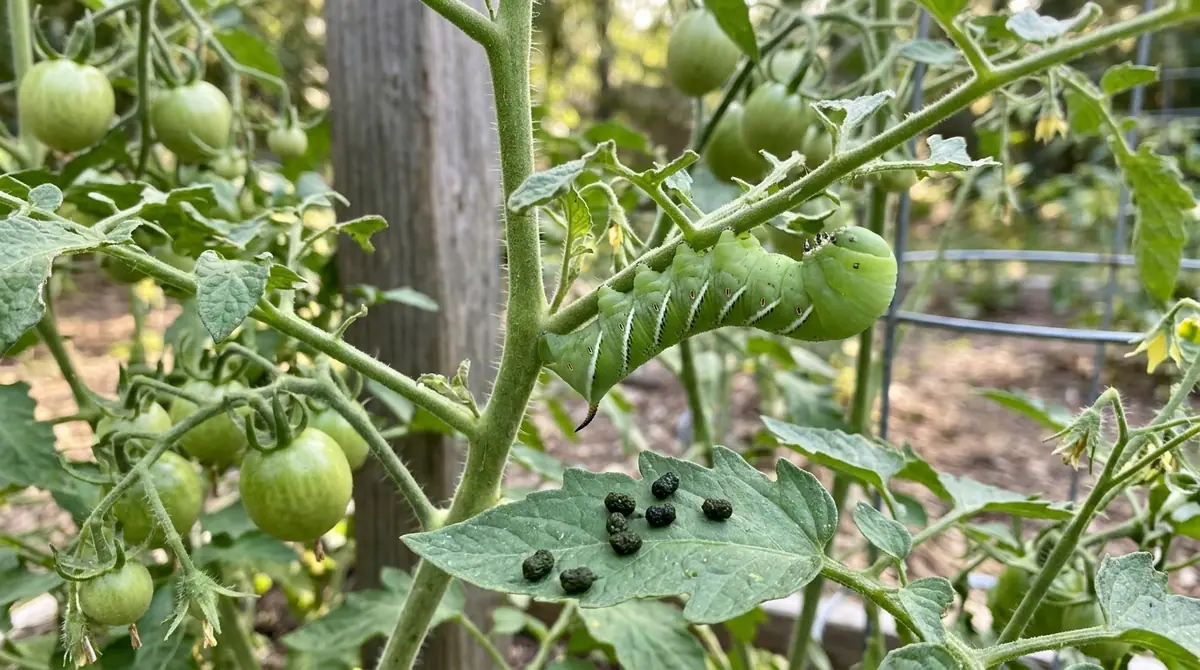
I stepped out onto the damp cedar planks of my southern Virginia deck at 5:45 AM, coffee mug warming my palms, and immediately spotted the devastation on my prized 'Cherokee Purple' tomato plants. A football-sized patch of foliage had been stripped down to the bare, weeping vascular veins, and sitting squarely on the wooden rail below was a cluster of hard, perfectly symmetrical, olive-green pellets marked with faint ribbed scoring. It was horn worm poop—frass, as we botanists call it—and it served as my unmistakable calling card for one of the most voracious defoliators in the home garden.
1. Botanical Overview & Natural Habitat

The larval lifecycle transitions through five distinct instars over roughly 21 to 28 days. During the final, fifth instar, a single caterpillar can grow up to 4 inches (10.16 cm) in length and consume more plant material in 48 hours than it did in its entire previous life combined. This massive consumption requires an equally high-volume digestive throughput. The frass they drop is the direct metabolic byproduct of this hyper-efficient processing of solanine-rich foliage.
Morphologically, hornworm frass is instantly recognizable to the trained eye. Unlike the soft, amorphous frass of cabbage loopers or the fine, powdery dust of beetle larvae, hornworm poop consists of distinct, spherical to barrel-shaped pellets measuring approximately 0.12 to 0.25 inches (3 to 6 mm) in diameter. They feature segmented, accordion-like ridges and a coloration that shifts from vibrant green to dark brown depending on whether the caterpillar has been feeding on tender leaf tips or tougher stems.
Natural habitats for these moths span across North, Central, and South America, thriving wherever nightshades—including tomatoes, peppers, eggplants, potatoes, and wild horsenettle—grow. Their co-evolution with these plants means they possess physiological adaptations to detoxify the plant's natural chemical defenses. When managing your garden ecosystem, recognizing the presence of frass is often your earliest diagnostic tool, appearing days before you actually spot the master-camouflaged green caterpillar resting along the underside of a main stem.
2. Essential Environmental & Care Requirements
Managing the conditions that encourage or discourage hornworm activity—and by extension, the accumulation of their frass—requires an understanding of the pest's environmental tolerances. While you cannot "care" for a pest, you must carefully manage your garden's microclimate to keep populations below economic injury levels.
| Parameter | Optimal Condition | Common Mistake | Why It Matters |
|---|---|---|---|
| Soil Temperature | 65°F–85°F (18°C–29°C) | Allowing soil to remain bone-dry | Pupae overwintering 2 to 4 inches (5 to 10 cm) deep require adequate moisture to successfully emerge as adult moths. |
| Ambient Humidity | 40%–60% relative humidity | Over-head evening watering | Excess foliage moisture encourages fungal pathogens like Beauveria bassiana, which naturally attacks hornworms. |
| Canopy Density | Moderate airflow, pruned lower leaves | Over-fertilizing with high-nitrogen formulas | Dense, succulent leaf growth accelerates hornworm fifth-instar feeding rates and doubles frass production. |
| Soil Tillage Depth | 4 to 6 inches (10 to 15 cm) post-harvest | Zero autumn soil disturbance | Fall tilling destroys overwintering pupal chambers, reducing next season's moth population by up to 80%. |
Temperature plays a vital role in their metabolic rate. When daytime temperatures consistently hover between 80°F and 90°F (26°C and 32°C), hornworm digestion speeds up dramatically. During these hot spells, a single caterpillar will double its daily output of frass, turning your clean mulch beds into a textured minefield of green pellets overnight.
Furthermore, soil composition directly impacts the pupation cycle. Once the caterpillar stops feeding after about 3 to 4 weeks, it drops from the plant to burrow into the soil at a depth of 3 to 4 inches (7.6 to 10.1 cm). Soils that are excessively compacted prevent this burrowing behavior, while loose, well-amended garden beds—perhaps enriched through sustainable practices like Worm Farming and Composting in a 5 Gallon Bucket Its Easy—provide ideal pupation sites if not managed properly at the end of the season.
3. Step-by-Step Cultivation, Feeding & Propagation
When you discover hornworm poop on your soil surface or lower leaves, you are dealing with an active infestation that requires an immediate, methodical intervention protocol. Follow these steps to locate, eliminate, and prevent further damage:
- Scan the Leaf Canopy (The Frass Line Rule): Locate the highest concentration of fresh green frass pellets on the ground or leaves. Trace a vertical line straight upward from this debris field into the plant canopy. The caterpillar will almost always be resting within 6 to 12 inches (15 to 30 cm) directly above the center of the frass drop.
- Deploy Ultraviolet Detection: If daytime searches fail—hornworms possess cryptographic green camouflage that matches plant stems perfectly—wait until dusk. Take a 365nm UV flashlight out to the garden and sweep it across your solanaceous crops. Hornworms fluoresce a brilliant, glowing neon cyan under UV light, making them instantly visible against the dark foliage.
- Hand-Picking and Physical Removal: Put on gardening gloves and gently pluck the caterpillar from the stem. If you notice white, rice-grain-like cocoons attached to its back, leave it alone; these are the pupae of the beneficial braconid wasp, a natural parasitic controller that will soon hatch and decimate the local hornworm population.
- Apply Biological Controls: For heavy infestations spanning multiple garden beds, spray the foliage with Bacillus thuringiensis subspecies kurstaki (Bt). This naturally occurring soil bacterium paralyzes the hornworm's gut when ingested, causing it to stop feeding within 24 to 48 hours and die shortly thereafter.
- Sanitation and Soil Tillage: At the end of the growing season, clear out all residual crop debris. Turn the top 4 to 6 inches (10 to 15 cm) of soil using a garden fork to expose overwintering pupae to freezing winter temperatures and predatory birds.
💡 Pro-Tip: Never wash hornworm frass away with water and ignore it. If you see frass on your mulch, the caterpillar is actively feeding in the canopy above. Use the frass as your primary diagnostic indicator; if the pellets are dry and crumbling, the pest has likely already moved, pupated, or died, but glossy, moist pellets mean an active, hungry fifth-instar caterpillar is currently stripping your harvest.
4. Common Problems, Pests & Troubleshooting
Identifying hornworm frass is only the first step in diagnosing broader garden ecosystem imbalances. Gardeners frequently misinterpret pest signs or apply incorrect remediation strategies.
One common issue is confusing hornworm frass with tomato fruitworm or armyworm droppings. Fruitworm frass tends to be smaller, gummy, and is usually found clustered directly inside hollowed-out green tomatoes or entry holes. Hornworm frass, by contrast, is distinctly faceted, larger, and found free-falling onto lower leaves and soil regardless of whether fruit is present.
Another frequent misstep is over-relying on broad-spectrum synthetic insecticides. Spraying pyrethrins or carbaryl indiscriminately kills off beneficial predatory insects such as lady beetles, green lacewings, and paper wasps, which are your primary line of defense against hornworm eggs. When beneficial insect populations crash, hornworm rebounds are typically explosive because the natural regulatory feedback loop has been broken.
⚠️ Important Caution: Do not compost hornworm-infested plant debris or soil heavily contaminated with frass if your compost pile does not reach and maintain thermophilic temperatures of 135°F to 160°F (57°C to 71°C) for at least 14 days. Pathogens and overwintering pest life stages can survive mild composting conditions and be reintroduced to your garden beds the following spring.

5. Frequently Asked Questions
What does hornworm poop look like?
Hornworm poop, or frass, appears as barrel-shaped or spherical pellets measuring roughly 0.12 to 0.25 inches (3 to 6 mm) across. It features distinctive ribbed, segmented ridges and ranges in color from bright green to dark brown, depending on the specific plant tissue the caterpillar has been consuming.
Can hornworm poop damage my tomato plants?
The poop itself does not damage the plant; it is simply metabolic waste. However, the presence of frass is an absolute indicator that a large hornworm is actively feeding in the plant canopy above, and the defoliation caused by the caterpillar can severely reduce fruit yields and sun-scald developing tomatoes.
How do I find a hornworm if I only see the poop?
Look straight up from the cluster of frass pellets. Hornworms rest along the stems and undersides of leaves, and their green coloration provides exceptional camouflage. If searching during the day fails, use a 365nm UV blacklight after dark; hornworms glow with a bright blue-green fluorescence against the dark garden foliage.
Should I leave hornworms with white cocoons on my plants?
No, do not kill them if they have white, rice-like projections on their backs. Those are the cocoons of the beneficial braconid wasp (Cotesia congregata). The wasp larvae feed inside the hornworm and emerge to pupate; leaving them in the garden ensures a new generation of parasitic wasps will control future hornworm generations naturally.
Related Guides
📋 Table of Contents ▼ Click to expand
Tags:
🌿 Related Plants You Might Like






PlantSavvyWorld
Editorial team
PlantSavvyWorld is an independent botanical education project. Articles are drafted with AI assistance, then edited and checked against university extension services, botanical garden collections and other published horticultural sources.