

Gathering your Own Red Clover
Written with AI assistance, edited and checked against horticultural sources.
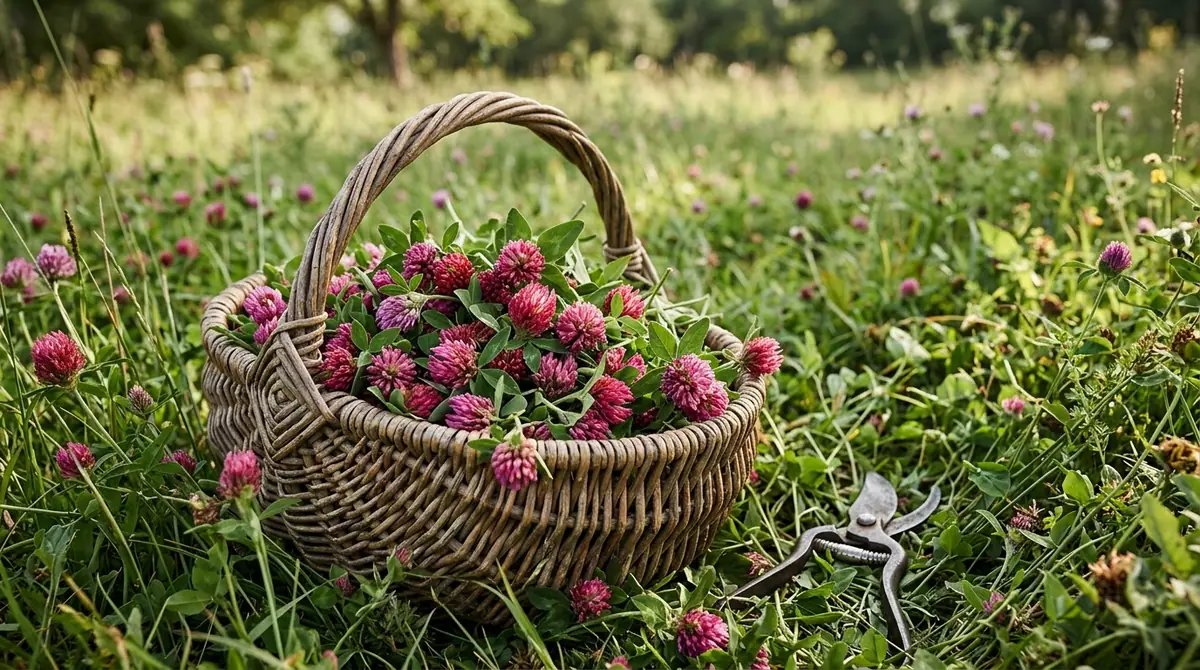
The midday sun was baking the clayey edges of my lower terrace when I first knelt to harvest a handful of Trifolium pratense, its deep magenta globes buzzing with heavy-legged bumblebees. My fingers slipped slightly on the fine, notched hairs of the stem before the familiar, clean snap released the blossom into my collecting basket. That tactile resistance—the slight tenacity of a plant that has spent centuries evolving to survive both grazing jaws and drought—is what makes gathering your own red clover such a deeply grounding ritual for any gardener or herbalist.

1. Botanical Overview & Natural Habitat
Red clover (Trifolium pratense) is a classic short-lived perennial herb belonging to the Fabaceae (legume or bean) family. Botanically, it is easily distinguished by its trifoliate leaves—each carrying three oval leaflets marked by a distinct, pale, V-shaped watermark—and its dense, sessile heads of deep pinkish-purple flowers sitting atop finely pubescent (hairy) stems that typically reach heights of 12 to 31 inches (30 to 80 cm).
In its natural habitat, Trifolium pratense thrives in meadows, along woodland edges, and across disturbed soils throughout temperate zones of Europe, Asia, and North America. It is exceptionally well-adapted to varied terrain, acting as a pioneer species that repairs exhausted earth. Its root system features a robust taproot that can plunge down to 24 to 35 inches (60 to 90 cm) into the soil profile. This deep reach allows the plant to mine subsoil minerals while breaking up compacted earth layers.
Like most legumes, red clover forms a symbiotic relationship with soil-dwelling bacteria known as Rhizobium trifolii. These microscopic partners colonize the plant's roots, forming small nodules that pull inert nitrogen gas from the atmosphere and convert it into bioavailable ammonium. This biological alchemy makes red clover not only a visual anchor in a landscape design scheme, but also an organic fertilizer when turned under as a green manure. For detailed botanical taxonomy and regional distribution data, you can consult the USDA Plants Database.
2. Essential Environmental & Care Requirements
To successfully establish and gather red clover from your own landscape, you must match its physiological preferences. While notoriously adaptable, Trifolium pratense performs with peak vigor when its fundamental environmental tolerances are met.
| Parameter | Optimal Condition | Common Mistake | Why It Matters |
|---|---|---|---|
| Soil pH | 6.2 to 7.0 | Planting in strongly acidic soils (pH < 5.5) | Low pH restricts nutrient uptake and starves the symbiotic Rhizobium bacteria. |
| Sunlight | Full sun (6 to 8 hours daily) | Siting in dense shade | Low light reduces flower density, diminishes essential oils, and makes stems leggy. |
| Moisture | 30 to 45 inches (76 to 114 cm) of annual rainfall | Waterlogging or continuous standing water | Heavy, saturated clay suffocates roots and invites fungal pathogens like Sclerotinia. |
| Temperature | 60°F to 75°F (15°C to 24°C) | Exposing to blistering, unshaded heat waves | Extreme summer heat triggers early dormancy and halts new blossom production. |
Soil texture should ideally be a well-draining loam or clay-loam. While red clover tolerates clay much better than many other cover crops due to its taproot, it utterly despises waterlogged conditions. If your garden features heavy, compacted clay, amending the top 4 inches (10 cm) with coarse sand or well-rotted compost during bed preparation will dramatically improve root penetration and survival rates through freeze-thaw cycles.
3. Step-by-Step Cultivation, Feeding & Propagation
Growing red clover from seed is remarkably straightforward, making it an ideal project for both novice gardeners and seasoned landscape designers looking to fill bare spots with productive, pollinator-friendly ground cover. Follow this precise protocol for optimal establishment:
- Site Preparation: Clear the chosen bed of all perennial weeds and debris. Rake the soil surface until you have a fine, crumbly tilth free of large clods.
- Inoculation (Optional but Recommended): If you have never grown legumes in this patch of earth, dust your red clover seeds with a commercial Rhizobium legume inoculant right before sowing. This ensures immediate nodulation and robust nitrogen fixation.
- Sowing Depth: Broadcast the seeds across the bed at a rate of roughly 1 to 2 ounces per 1,000 square feet. Rake them in lightly to a shallow depth of 0.25 to 0.5 inches (0.6 to 1.3 cm). Do not bury them deeply; red clover seed requires light to germinate successfully.
- Moisture Management: Gently water the bed using a fine mist attachment to avoid washing the seeds away. Keep the soil evenly moist—not soggy—for the first 14 days.
- Germination Window: Watch for seedlings to emerge within 7 to 10 days when soil temperatures sit consistently around 65°F (18°C).
- Thinning and Care: Once seedlings reach 3 inches (7.5 cm) tall, thin dense patches if necessary to prevent overcrowding, though red clover naturally forms a tight, cohesive mat. Because the plant manufactures its own nitrogen, avoid high-nitrogen synthetic fertilizers, which will burn the foliage and suppress root nodule formation. Apply a light top-dressing of phosphorus and potassium-rich wood ash or bone meal only if soil tests indicate a deficiency.
- Harvest Timing: For medicinal or culinary use, gather your red clover blossoms mid-morning on a dry, sunny day after the dew has completely evaporated. Select flower heads that are fully open, vibrant magenta, and free of brown spots or fungal blemishes.
💡 Pro-Tip: Never harvest every single flower head from a patch of red clover. Leave at least 30% of the blossoms untouched on each plant. This ensures that bumblebees and native pollinators can continue to forage, and allows the plants to set seed, naturally renewing your patch for the following season without requiring you to replant.
4. Common Problems, Pests & Troubleshooting
Even a tough, resilient species like Trifolium pratense encounters environmental stressors and opportunistic pests. Recognizing the early warning signs saves your harvest.
- Clover Rot (Sclerotinia trifoliorum): This is the most destructive fungal disease affecting red clover. It manifests as a white, cottony mold at the base of the stems during cool, wet autumn or spring weather, eventually causing the plants to wilt and collapse. Prevent it by practicing a 3-to-4-year crop rotation and ensuring your planting beds have excellent drainage. For authoritative management strategies on legume pathogens, consult the Royal Horticultural Society (RHS).
- Powdery Mildew (Erysiphe trifolii): Appearing as a chalky, white-gray dusting on the upper leaf surfaces during humid mid-summer stretches, powdery mildew rarely kills established red clover, but it can weaken the plant and ruin foliage quality. Space your plants properly to maximize air circulation, and cut back severely affected patches to encourage clean, disease-free regrowth.
- Clover Root Curculio (Sitona hispidulus): These small, grayish-brown weevils feed on clover leaves, leaving distinctive crescent-shaped notches along the margins. More destructively, their larvae burrow underground to feed on the nitrogen-fixing root nodules. Healthy plants in fertile soil can usually outgrow minor weevil damage, but severe infestations require treading the bed and resting the soil from legumes for a full season.
⚠️ Important Caution: Never harvest red clover from roadsides, industrial zones, or chemically treated lawns. Trifolium pratense acts as a dynamic bioaccumulator, readily pulling heavy metals, synthetic herbicides, and automotive toxins out of the soil and storing them in its tissues. Always source your gathered material from a clean, organically managed garden or a pristine, wild meadow far from urban pollution.

5. Frequently Asked Questions
Can I eat red clover raw right out of the garden?
Yes, the fresh flower heads and young leaves are edible and can be tossed into salads or used as a colorful garnish. They have a mild, sweet taste due to their nectar content. However, consume them in moderation when raw, as eating large quantities of fresh clover can occasionally cause mild digestive upset in sensitive individuals.
How do I properly dry red clover flowers for long-term storage?
Harvest fresh, fully open flower heads on a dry, sunny morning. Spread them out in a single layer on clean screens or paper towels in a warm, dark, well-ventilated room where temperatures remain around 70°F to 85°F (21°C to 29°C). The drying process typically takes 5 to 7 days. You will know they are finished when the petals feel crisp and dry to the touch. Store the dried heads immediately in airtight glass jars away from direct light.
Is red clover an annual or a perennial plant?
Red clover is technically a short-lived perennial, though in many agricultural and home garden settings, it behaves more like a biennial or triennial. Its productivity peaks during its second full year of growth, after which the crowns begin to thin out naturally. Many gardeners allow a few plants to drop seed each autumn to maintain a perpetual, self-sustaining patch.
Will red clover take over my entire yard and become a weed?
Unlike creeping white clover (Trifolium repens), which spreads aggressively via underground stolons and forms a low lawn mat, red clover grows in upright, distinct clumps from a central taproot. It does not aggressively invade turfgrass or choke out established garden beds. If an individual plant wanders where it is not wanted, it is easily pulled out by hand, thanks to that singular taproot.
Related Guides
- How to Get Rid of Raspberry Bushes
- How to Condition a Straw Bale for Gardening Straw Bale Gardening Guide
- When to Start Planting Seeds Outdoors
📋 Table of Contents ▼ Click to expand
Tags:
🌿 Related Plants You Might Like

PlantSavvyWorld
Editorial team
PlantSavvyWorld is an independent botanical education project. Articles are drafted with AI assistance, then edited and checked against university extension services, botanical garden collections and other published horticultural sources.